


Why Hillary Lost Part XVI


“The late Colonel Harry Summers liked to tell a tale familiar to many who served in Vietnam. In April 1975, after the war was over, the colonel was in a delegation dispatched to Hanoi. In the airport, he got into a conversation with a North Vietnamese colonel named Tu who spoke some English and, as soldiers do, they began to talk shop. After a while, Colonel Summers said: “You know, you never defeated us on the battlefield.” Colonel Tu thought about that for a minute, then replied: “That may be so. But it is also irrelevant.”
Forty one years later, the losing generals are debating the 2016 Presidential election. Hillary won the popular vote by a wide margin. What people fail to mention was that the election was for the electoral vote. If the election had been for the popular vote, there would have been a different group of voters. The candidates would have employed different strategies to reach these voters. There is a chance that Donald Trump would have won the popular vote.
How Clinton lost Michigan — and blew the election. This article goes into detail about the clueless campaign that HRC fronted. There were many details they did not mention. Somebody actually thought it was a good idea for BHO to say ““We have achieved historic turnout in 2008 and 2012, especially in the African-American community. I will consider it a personal insult and an insult to my legacy if this community lets down its guard and fails to activate itself in this election. You want to give me a good send-off? Go vote.”
In other words, white voters don’t count. The President of the United States is telling a specific group of voters to vote, for a certain candidate, based on the color of their skin. If a white person objects to this, they are told it is none of their business. You are just worried because you think you are losing your privilege. I’m not talking to you.
The Politico article had an interesting quote. “Guided by polls that showed the Midwestern states safer, the campaign spent, according to one internal estimate, about 3 percent as much in Michigan and Wisconsin as it spent in Florida, Ohio and North Carolina. Most voters in Michigan didn’t see a television ad until the final week.”
The margin of defeat was greater in Florida (1.3%), Ohio (7.6%), and North Carolina (3.8%), than it was in Michigan (0.3%) and Wisconsin (1.0%).Perhaps the Democratic campaign had the effect of persuading citizens to vote for DJT. If the entire country had been subjected to the “I’m With Her” campaign, then DJT might have won the popular vote.
Pictures today are from The Library of Congress.


What Are You Trying To Proooove With Your Long Hair?


Once a week, bloggingheads.tv has a feature called Science Saturday. Some of the best feature John Horgan and George Johnson. They are pals, and say “oh really” a lot. This past week they discussed the business of scientific research, how big money can corrupt the findings. It makes cents sense … when you get government grants to fund your research, it is in your best interests to get the results the government wants. Or, if your employer stands to make billions of dollars from selling a new drug, you want to “prove” that the drug works.
Perhaps it is a semantic issue. People often say prove, when what they should say is indicate. Prove is a murky legalistic concept, full of smoke and mirrors. Indicate is what the numbers on the screen say.
John got mixed up in a controversy about this recently. While discussing this, he quoted an scientific journal to about Why Most Published Research Findings Are False . This caught PG’s ear, and made him put down his photo editing, and make a comment. (Those pictures from the War between the States have waited 145 years. A few more minutes is not going to hurt.) This comment resulted.
chamblee54 wrote on 12/18/2010 at 02:10 PM Re: Science Saturday: Discovery and Invention (John Horgan & George Johnson) John makes a bold statement .
It seems as if an author, writing behind a paywall , wrote about corruption of the scientific method. At the end, he wrote “Just because an idea is true doesn’t mean it can be proved. And just because an idea can be proved doesn’t mean it’s true. When the experiments are done, we still have to choose what to believe.” ( John says it here. )
In a touch of irony, George begins the discussion by recalling a visit to California, and a report on the medical marijuana scene. Marijuana is a good example of the government deciding the results, and then commissioning a study to “prove” what had already been decided. If your lab depends on Uncle Sugar for funding, then your study is going to show that Reefer makes you turn purple.
When PG was in tenth grade, he had a geometry teacher. She had participated in LSD experiments (and said a shot of whiskey would do more for you.) Basic geometry is dependent on proofs, or a series of statements that show a theorem to be true. (There is a difference between a theory and a hypothesis.) A foundation concept of geometry is the Pythagorean theorem. This teacher said it was possible to disprove the Pythagorean theorem.
A couple of years later, PG grew shoulder length hair, and went to visit his uncle. The relative was known for being to the right of Herbert Hoover, and was not amused by PG’s fashion statement. The uncle got into the firewater, and would say, over and over, “What are you trying to proooove with your long hair?” Spell check suggestions for proooove: ovenproof, groove.
This is a repost. Bloggingheads TV is having money problems, and is converting into a non profit enterprise. The future of Science Saturdays is in doubt. In another surprising development, research shows that tabloids do not always tell the truth.


I’m A Strong Dog


Display of a link in this facility does not indicate approval of content ~ The Night the Lights Went Out in Georgia ~ Georgia’s Dangerous Rush to Execution ~ In FTM testosterone therapy, testosterone (often called “T” for short) can be administered into the body in a number of ways. ~ A Study of Effect of Deodorant and Axillary Hair on Testosterone Absorption in Healthy Participants We’d welcome your feedback! Thank you for visiting our website. You have been selected to participate in a brief customer satisfaction survey to let us know how we can improve your experience.The survey is designed to measure your entire experience, please look for it at the conclusion of your visit. ~ Speak Up: Responding to Everyday Bigotry ~ We need an old-school approach to Richard Spencer ~ Don’t trust no n***a no. ~ Religious cats arguing ~ story idea godwins law part two how calling any idiot you don’t like a nazi is a joke how any discussion goes to hell when kkk and white supremacy is mentioned ~ Shootout mannequin challenge leads to gun, marijuana arrests ~ Gun-wielding Alabama Mannequin Challenge leads to 2 arrests; weapons and drugs seized ~ canton dental ~ Dorothea Lange’s Censored Photographs of FDR’s Japanese Concentration Camps ~ Dorothea Lange and the Japanese-American Internment ~ Censored Photos From Inside U.S. Japanese Concentration Camps ~ How telling the truth became racebaiting. ~ The Blind Spots of Liberalism ~ Colonel Harry G. Summers, Jr. ~ Gillian Welch returns to “Revival”: “We felt like Martians” ~ another facebook shitfest about race ~ Fake Buddha Quotes ~ 25 Mostly Fake Buddha Quotes That May or May Not Change Your Life ~ 15 Easy Things You Can Do That Will Help When You Feel Like Shit ~ Alyssa Wright and Elijah Ramoutar ~ Nicholas Smarr and Jody Smith ~ Dorothea Lange – An American Odyssey ~ Eudora Welty job application ~ Are You a U.S. History Expert? ~ Dontavis Montgomery ~ How Trump Could Finally Win the War on Terror ~ i’m a strong dog but sometimes i want someone to take my paw and say everything will be all right ~ @WernerTwertzog “It is better to ask for forgiveness than to ask for permission.” –An unknown person who was fired for not asking for permission. @chamblee54 The original saying was “easier to ask for permission” confusing easier for better is an issue for another thinking ~ Comments are reviewed and, in some cases, edited before posting. Not all comments are posted. Chances of a comment being posted are increased if the comment is polite, accurate, grammatical, and substantive or newsworthy. The Sun does not accept comments referring to individuals by only their first names or by nicknames and in the case of most public officials requires, on first reference, a title, such as President Obama or Secretary Clinton. Second references to individuals and public officials require in most cases an honorific, such as Mr. Obama or Mrs. Clinton. Comments adhering to these style points stand a better chance of being posted. ~ Next time, I will check the address before I leave. They are no longer just off N. Highland. ~ The next time someone tries to drag you into a facebook mudbath, say “I see your comment. I prefer not to reply” ~ A lady on the Dick Cavett show talked about the concept of actors putting on masks to play a part. To her, people in everyday life wear masks all the time. The theater was where an actor took off the mask, to give a performance of reality. ~ I used to leave the North Avenue marta station at 7am, and walk north on West Peachtree Street. Sun Trust Plaza was behind me, and the IBM building was in front of me. ~ One of the ways @ChrisCrocker dealt with unwanted (?) fame was making porno movies. Lets hope that DJT does not do this. BTW, @ChrisCrocker lives in Tennessee. Does anyone know him? ~ I learned something today. I read a story, about a combination of deodorant and testosterone called Pitronex. I googled the ingredients, and learned that the medical term for armpit hair is axillary. The spell check suggestion for axillary is Hillary. You can’t make this stuff up. ~ @postcrunk getting enraged by something, growing passionate about it, becoming apathetic toward it, and forgetting it all in a single 24hour news cycle ~ My dentist is so so, but her office is five minutes away. You win some you lose some. ~ Strategic Communication The late Colonel Harry Summers liked to tell a tale familiar to many who served in Vietnam. In April 1975, after the war was over, the colonel was in a delegation dispatched to Hanoi. In the airport, he got into a conversation with a North Vietnamese colonel named Tu who spoke some English and, as soldiers do, they began to talk shop. After a while, Colonel Summers said: “You know, you never defeated us on the battlefield.” Colonel Tu thought about that for a minute, then replied: “That may be so. But it is also irrelevant.” ~ It took fifty four years, but the heat shield finally killed #johnglenn ~ The dentist I use now is *ok*. The good news is the five minute drive. ~ Just do it before January 20. Obamacare covers butt hurt. ~ “However many holy words you read, however many you speak, what good will they do you if you do not act on upon them?” ~ @existentialcoms Philosophy is important because without it we could never know whether or not it was possible to know if you really know anything. ~ The page you requested cannot be displayed right now. It may be temporarily unavailable, the link you clicked on may be broken or expired, or you may not have permission to view this page. ~ Thank you for the notice. TTTT, I was debating whether, or not, to make the OTP drive. ~ The Washington Post does not need to be talking about critical thinking. ~ why was d lange censored while ansel adams was not? ~ The ego and the super ego walked into a bar. The bartender asked to see their id. ~ @dailyzen Labeling the world to make yourself comfortable is the most popular form of ignorance among ‘intelligent people’. ~ Think of how much fun First Lady Melania Trump is going to be. Just say no is officially obsolete ~ 1-“The KKK” has dozens of chapters. Many are secret societies, which would not publicly endorse a politician. To say that this one newspaper represents the KKK is a lie. 2- What I heard before the election is “the KKK endorses Donald Trump” This is not the same thing as saying a KKK newspaper endorses DJT. 3- It is fascinating how the population accepted, without question, the notion that the KKK endorsed DJT. Nothing negative you said about DJT was too far fetched. This hurt the Democrats credibility. People do not like to be lied to. ~ Additionally, Ancona believes Murray’s fundraising effort is a scam, because technically, members of the Klan cannot speak with the media, let alone solicit their help with raising donations. All members sign an agreement that forbids conversations with the press. Only highly vetted officials interact with reporters, and even then, interviews are rare.” ~ @jswilliams1962 When you see #DickVanDyke trending you figure he either died or Trump nominated him for Secretary of State ~ pictures today are from The Library of Congress. ~ selah


Flannery O’Connor
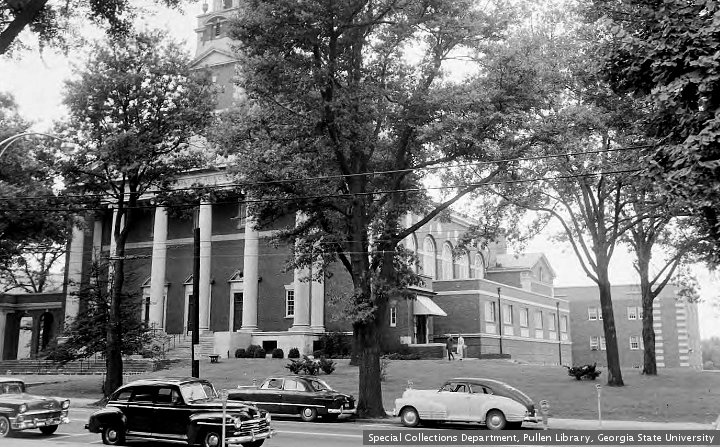



With one day before it was due, PG finished reading Flannery: A Life of Flannery O’Connor , by Brad Gooch. The author is a professor of English at William Patterson University in New Jersey. He spares no citations, to show where he gets his information. This is a repost.
Chamblee54 has written before about Miss O’Connor , and repeated the post a year later. There is a radio broadcast of a Flannery O’Connor lecture. (The Georgia accent of Miss O’Connor is much commented on in the book. To PG, it is just another lady speaking.)
Mary Flannery O’Connor was born March 25, 1925 in Savannah GA. The local legend is that she was conceived in the shadow of St. John the Baptist Cathedral, a massive facility on Lafayette Square. Her family did leave nearby, and her first school was just a few steps away. This is also a metaphor for the role of the Catholic Church in her life. Mary Flannery was intensely Catholic, and immersed in the scholarship of the church. This learning was a large part of her life. How she got from daily mass, to writing stories about Southern Grotesque, is one mystery at the heart of Flannery O’Connor.
Ed O’Connor doted on his daughter, but had to take a job in Atlanta to earn a living. His wife Regina and daughter Mary Flannery moved with him, to a house behind Christ The King Cathedral. Mr. O’Connor’s health was already fading, and Mother and Daughter moved in with family in Milledgeville. Ed O’Connor died, of Lupus Erythematosus, on February 1, 1941.
Mary Flannery went to college in Milledgeville, and on to the Iowa Writer’s Workshop. She dealt with cold weather, went to Mass every day, and wrote. She was invited to live at an artists colony called Yaddo, in upstate New York. She lived for a while with Robert and Sally Fitzgerald in Connecticut, all while working on her first novel, “Wise Blood”. In 1950, she was going home to Milledgeville for Christmas, and had been feeling poorly. She went to the hometown doctor, who thought at first that the problem was rheumatoid arthritis. The illness of Flannery O’Connor was Lupus Erythematosus.
Miss O’Connor spent much of that winter in hospitals, until drugs were found that could help. She moved, with her mother, to a family farm outside Milledgeville, which she renamed Andalusia. She entered a phase of her life, with the Lupus in relative remission, and the drugs firing her creative fires, where she wrote the short stories that made her famous.
Another thing happened when she was recuperating. Flannery was reading the Florida “Market Bulletin”, and saw an ad for “peafowl”, at sixty five dollars a pair. She ordered a pair, and they soon arrived via Railway Express. This was the start of the peacocks at Andalusia, a part of the legend.
During this period of farm life and writing, Flannery had several friends and correspondents. There was the “Bible Salesmen”, Erik Langkjaer, who was probably the closest thing Flannery had to a boyfriend. Another was Betty Hester, who exchanged hundreds of letters with Miss O’Connor. This took place under the stern eye of Regina O’Connor, the no nonsense mother-caregiver of Flannery. (Mr. Gooch says that Betty Hester committed suicide in 1998. That would be consistent with PG stumbling onto an estate sale of Miss Hester in that time frame.)
The book of short stories came out, and Flannery O’Connor became famous. She was also dependent on crutches, and living with a stern mother. There were lectures out of town, and a few diverse personalities who became her friends. She went to Mass every day, and collected books by Catholic scholars. Flannery was excited by the changes in the church started by Pope John XXIII, and in some ways could be considered a liberal. (She supported Civil Rights, in severe contrast to her mother.)
In 1958, Flannery O’Connor went to Europe, including a trip to the Springs at Lourdes. Her cousin Katie Semmes (the daughter of Captain John Flannery, CSA) pushed Flannery hard to go to the springs, to see if it would help the Lupus. Flannery was reluctant…” I am one of those people who could die for his religion sooner than take a bath for it“. When the day for the visit came, Flannery took a token dip in the waters. Her condition did improve, briefly. (It is worth speculating here about the nature of Flannery’s belief, which was apparently more intellectual than emotional. Could it be that, if she was more persuaded by the mystical, emotional side of the church, and taken the healing waters more seriously, that she might have been cured?)
At some point in this story, her second novel came out, and the illness blossomed. Much of 1964 was spent in hospitals, and she got worse and worse. On August 3, 1964, Mary Flannery O’Connor died,

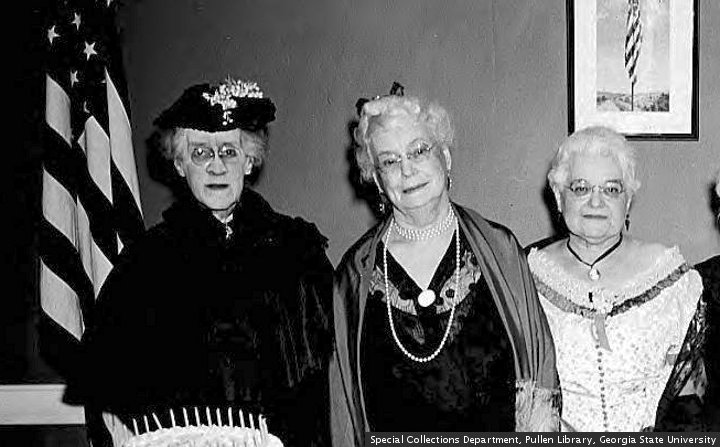


PG remembers the first time the name Flannery O’Connor sank in. He was visiting some friends, in a little house across from the federal prison.
Rick(?) was the buddy of a character known as Harry Bowers. PG was never sure what Harry’s real name was. One night, Rick was talking about Southern Gothic writers, and he said that Flannery O’Connor was just plain weird. ”Who else would have a bible salesman show up at a farm, take the girl up into a hayloft, unscrew her wooden leg and leave her there? Weird.”
Flannery O’Connor was recently the subject of a biography written by Brad Gooch. The book is getting a bit of publicity. Apparently, the Milledgeville resident was a piece of work.
PG read some reviews of this biography, and found a collection of short stories at the library. The book included ” Good Country People”, the tale about the bible salesman. Apparently, this story was inspired by a real life incident. (Miss O’Connor had lupus the last fifteen years of her life. She used crutches.) And yes, it is weird. Not like hollywood , but in the way of rural Georgia.
Some of the reviews try to deal with her attitudes about Black people. On a certain level, she is a racist. She uses the n word freely, and her black characters are not inspiring people. The thing is, the white characters are hardly any better, and in some cases much worse.
The stories are well crafted, with vivid descriptions of people and places. The reader floats along with the flow of the story, until he realizes that Grandma has made a mistake on a road trip. The house she got her son to look for is in Tennessee, not Georgia. She makes him drive the family car into a ditch. Some drifting killers come by. Grandma asks one if he prays, while his partner is shooting her grandchildren. Weird.
In another story, a drifter happens upon a pair of women in the country. The daughter is thirty years old, is deaf, and has never spoken a word. The drifter teaches her to say bird and sugarpie. The mother gives him fifteen dollars for a honeymoon, if he will marry her. He takes the fifteen dollars and leaves her asleep in a roadside diner.
There was a yard sale one Saturday afternoon. It was in a house off Lavista Road, between Briarcliff and Cheshire Bridge. The house had apparently not been painted in the last forty years. Thousands and thousands of paperback books were on the shelves. The lady taking the money said that the lady who lived there was the friend, and correspondent of, the “Milledgeville writer” Flannery O’Connor. This is apparently Betty Hester, who is mentioned in many of the biography reviews.
PG told the estate sale lady that she should be careful how she said that. There used to be a large mental hospital in Milledgeville, and the name is synonymous in Georgia with mental illness. The estate sale lady had never heard that.
This is a repost. Pictures are from “The Special Collections and Archives, Georgia State University Library”. It was written like James Joyce. An earlier edition of this post had comments.
Fr. J. December 10, 2009 at 3:00 pm I am glad you take an interest in Flannery, but to say baldly that she is a racist is to very much misunderstand her. For another view on Flannery and race, you might want to read her short story, “Everything that Rises Must Converge.”
chamblee54 December 10, 2009 at 3:17 pm “On a certain level, she is a racist.” That is not the same as “baldly” labeling her a racist. (And I have a full head of hair, thank you). As a native Georgian, I am aware of the many layers of nuance in race relations. I feel that the paragraph on race in the above feature is accurate.



Ansel Adams And Dorothea Lange
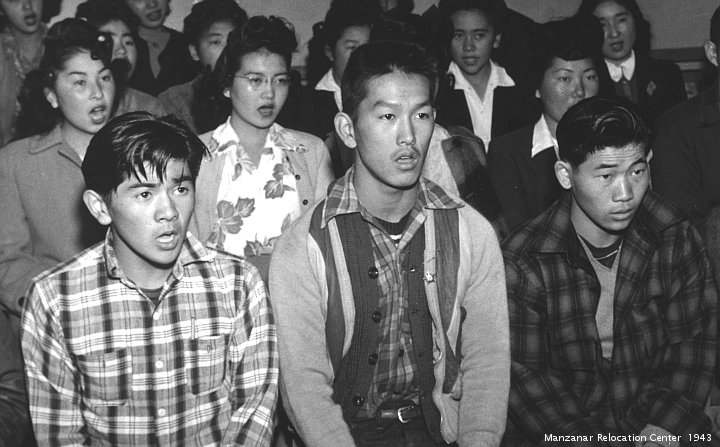


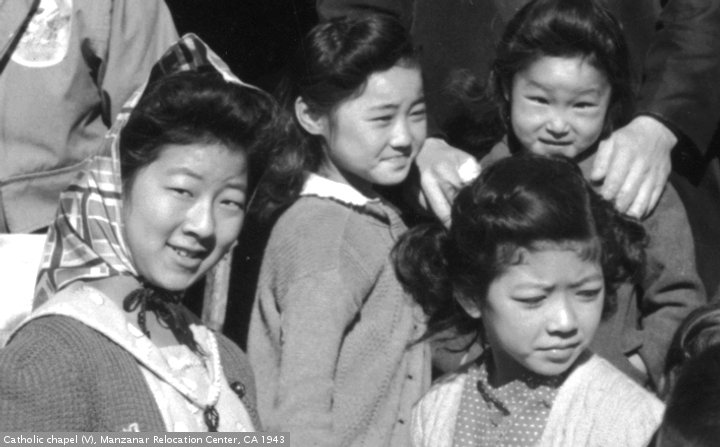
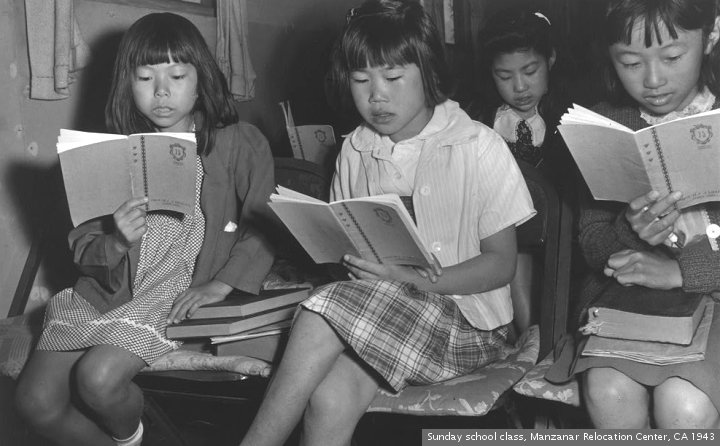

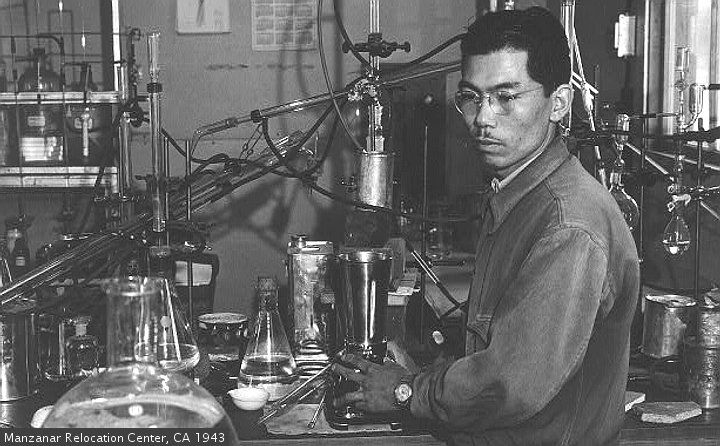

The facebook feed has recently had links to a story, Dorothea Lange’s Censored Photographs of FDR’s Japanese Concentration Camps. Miss Lange was the photographer of the iconic Migrant Mother. After Pearl Harbor, Miss Lange took a job with the War Relocation Authority, documenting the “relocation” of Japanese-Americans to interment camps. The photographs did not please the authorities. They were censored, and only appeared recently.
Ansel Adams also took photographs at the Manzanar, California, camp. In the current stories, he is literally a footnote: quotes were used from a book about his photography. Why is Dorothea Lange receiving attention, while Ansel Adams is ignored?
One answer is that Miss Lange was hired early on, and shows the harsh reality of relocation. “On July 30, 1942, the WRA laid her off “without prejudice,” adding that the cause was “completion of work…. the WRA impounded the majority of her photographs of Manzanar and the forced detentions, and later deposited 800 image from the series in the National Archives without announcement.”
“After Lange’s departure, Manzanar’s director Ralph Merritt visited renowned environmentalist and landscape photographer Ansel Adams and suggested he document the camp — Merritt and Adams were friends from the Sierra Club. Lange, also friends with Adams, encouraged him to take the job. (Coincidentally Adams printed “Migrant Mother” for her ) …Ansel Adams made several trips to Manzanar between October 1943 and July 1944 for this new personal project, and, as Alinder writes, he was primed to try the kind of documentary photography regularly practiced by Dorothea Lange and the Farm Security Administration that he had earlier shunned. Unlike Lange, a white woman who had been viewed with suspicion by her subjects, Adams was welcomed by the incarcerees, even greeted as a celebrity in a cultural community that had a deep appreciation of nature — many incarcerees at Manzanar literally opened their doors to him dressed in their finest clothes. … By 1943, Manzanar’s incarcarees had had time to settle in and enjoy the fruits of their collective work. In less than ideal surroundings, they had collectively built their own post office, town hall, library, auditorium, co-op store system, police station, jail, cemetery with memorial, published their own newspaper (the ironically named the Manzanar Free Press, which was regularly censored by the military), and even their own YMCA.”
“As for Lange, looking at the historical record, it appears that she was treated differently from the other WRA photographers. She was discouraged from talking to the incarcerees, was constantly followed by a censor, and faced harassment. She was refused access to areas after being given clearance, and she was often hounded over phone charges and receipts. … After being discharged, Lange expressed in letters her dismay that her work was ineffective in helping the people she documented. Her assistant Christina Clausen later noted the ferocity of this body of work also marked the beginning of the photographer’s bleeding gastric ulcers. Lange was unable to work for a number of years after her harrowing experience at Manzanar. She died from esophageal cancer in 1965.”
“In 1944, Adams’s photographs were published as a book, “Born Free and Equal: The Story of Loyal Japanese Americans,” and shown at New York’s Museum of Modern Art. Nativists took offense. They saw Adams’s work as a slur on the war effort. He was a “Jap lover.” This quote is from a 2016 article, Let’s be honest, Ansel Adams’s images of a WWII internment camp are propaganda
“Adams visited Manzanar to take photos in 1943 at the request of camp director Ralph Merritt, who was a personal friend. “They don’t look quite as dusty and quite as forbidding as Dorothea Lange’s photos … Indeed, the place that looks barren and depressing in Lange’s pictures manages to look beautiful in Adams’. You get little sense that it was even a detention center, in part because Adams, like other photographers, was not allowed to shoot the guard towers or barbed wire…
There are scenes from a baseball game, kids walking to school, a gathering outside a chapel. Lots of smiles, too, and portraits of camp residents cropped so close, you can see every blemish and stray hair. In Adams’ vision, Manzanar comes off as a place where Japanese-Americans, dignified, resilient and optimistic in spite of their circumstances, built a temporary community in the desert.
(Skirball Cultural Center director Robert) Kirschner said that if Adams’ photos appear to sugarcoat the indignities of life in an internment camp, it is because he did not see himself as a social activist the way Lange did. Still, Kirscher says, Adams was challenging internment in his own way, by depicting its victims as patriotic, law-abiding Americans. Unlike Lange, Adams was given permission to publish his photos. Before the war ended, he did so in a book called “Born Free and Equal: The Story of Loyal Japanese Americans,” in which he warned about the dangers of letting wartime hysteria justify depriving U.S. citizens of their freedom.”
The NPR article mentions a third Manzanar photographer. “Before World War II, Toyo Miyatake had a photo studio in Los Angeles’ Little Tokyo. When he learned he would be interned at Manzanar, he asked a carpenter to build him a wooden box with a hole carved out at one end to accommodate a lens. He turned this box into a makeshift camera that he snuck around the camp, as his grandson Alan Miyatake explains in the video below, which is featured in the exhibit.
Fearful of being discovered, Miyatake at first only took pictures at dusk or dawn, usually without people in them. Camp director Merritt eventually caught Miyatake, but instead of punishing him, allowed him to take pictures openly. Miyatake later became the camp’s official photographer.”
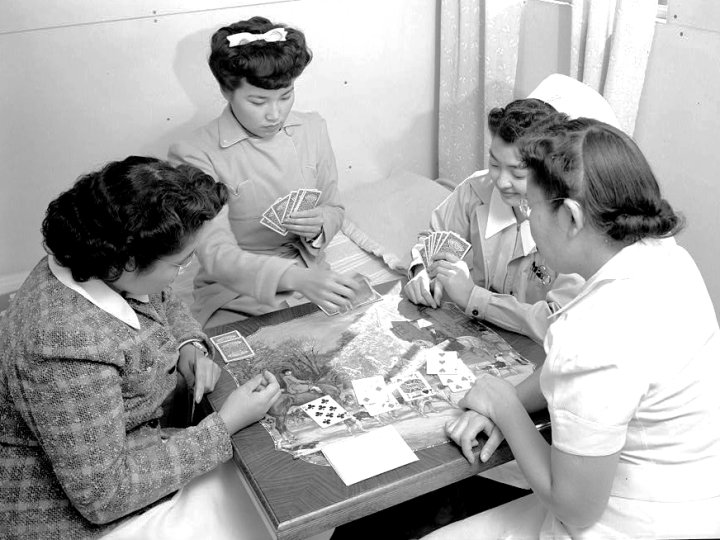
Pictures for today’s feature are from The Library of Congress. These are pictures that Ansel Adams took at Manzanar. They have been posted at chamblee54 before. The ladies in the bridge game are Aiko Hamaguchi, Chiye Yamanaki, Catherine Yamaguchi, and Kazoko Nagahama.







Judy Roasting On An Open Fire


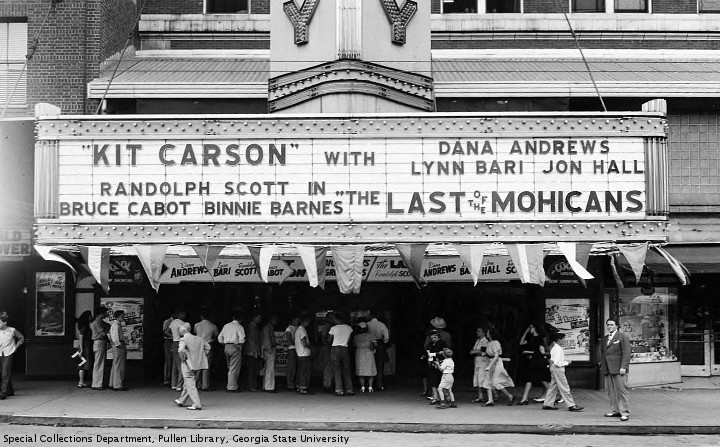
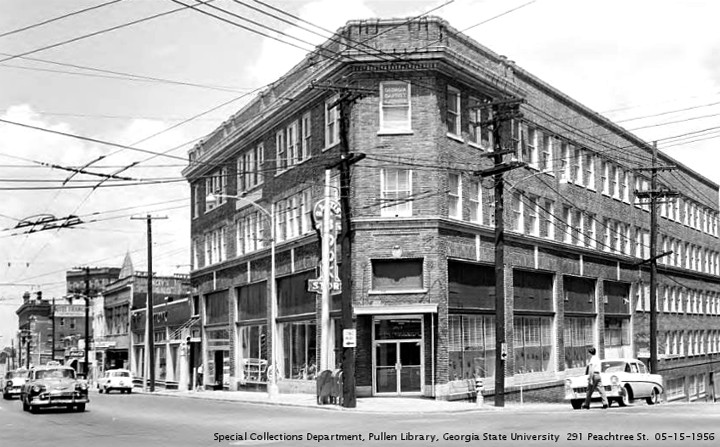
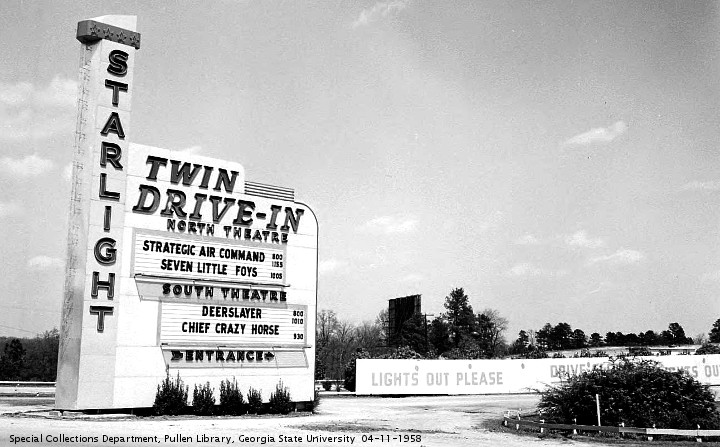
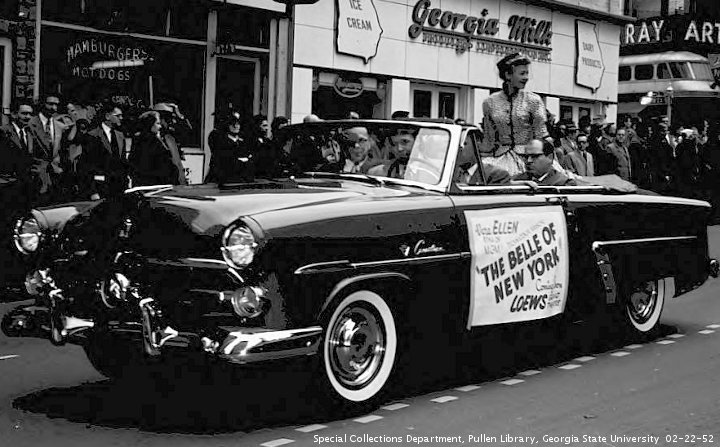
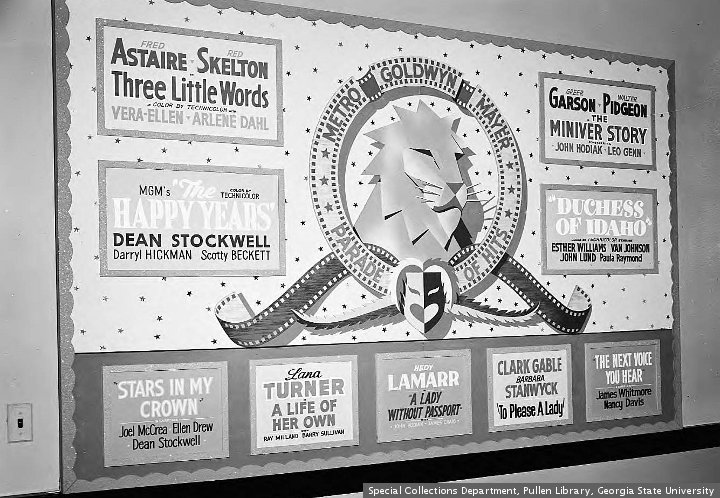
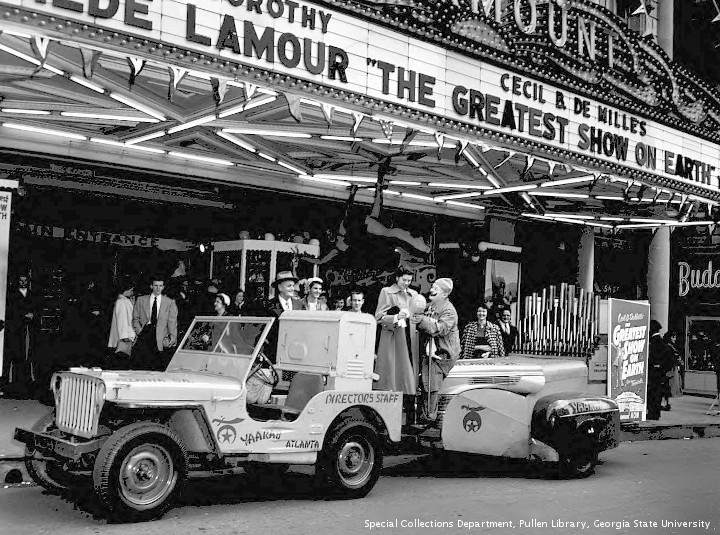
SFFILK (Not his real name) passes along a story about Mel Tormé. It seems like Mr.Tormé was eating a leisurely breakfast at a food court in Los Angeles, and a quartet appeared singing Christmas songs. They wound up performing “The Christmas Song” for co- author Tormé … and the singers had no idea who he was. It is a good story, better told in the link. (The link no longer works.) This is a repost, with pictures from “The Special Collections and Archives, Georgia State University Library”.
According to the inerrant Wikipedia, Mr. Tormé collaborated with Robert Wells, until they had a falling out. One afternoon, on the hottest day of July in 1945, Mr.Tormé went to visit Mr.Wells, and saw the first four lines of “The Christmas Song” (including “Chestnuts roasting on an open fire, Jack Frost nipping at your nose”). The lines were on a note pad, and the two agreed to beat the heat of summer by completing the song. Supposedly, Mr. Tormé did not like the song very much. After three divorces, he probably didn’t see many of the royalties.
Mel Tormé was the music director of the ill fated “Judy Garland Show” in the early sixties. He wrote a book about it… The Other Side of the Rainbow: With Judy Garland on the Dawn Patrol . The story is that Miss Garland would get blasted, call Mr.Tormé in the middle of the night, and pour out her troubles. (This review is much less sympathetic towards Mr. Tormé.) While the show did not last longer, there are some great youtube clips left over.


1 comment