The Limits Of Fantasy



This content was published September 17, 2009. … These thoughts are for you to use. They were articulated by a man named Don Miguel Ruiz. They are called The Four Agreements. I do not claim to live up to these ideals. Number two is especially tough. The main thing is to try, and to always do your best. This is not about what you believe or think, it is about what you do. These are agreements, not beliefs. · 1 – “Be impeccable with your word – Speak with integrity. Say only what you mean. Avoid using the word to speak against yourself or to gossip about others. Use the power of your word in the direction of truth and love.”
2 – “Don’t take anything personally – Nothing others do is because of you. What others say and do is a projection of their own reality, their own dream. When you are immune to the opinions and actions of others, you won’t be the victim of needless suffering.” · 3 – “Don’t make assumptions – Find the courage to ask questions and to express what you really want. Communicate with others as clearly as you can to avoid misunderstandings, sadness and drama. With just this one agreement, you can completely transform your life.” · 4 – “Always do your best – Your best is going to change from moment to moment; it will be different when you are healthy as opposed to sick. Under any circumstance, simply do your best, and you will avoid self-judgment, self-abuse and regret.”
This content was published September 5, 2009. … I was reading about Afghanistan while waiting for the time to go downtown. Dragon Con is in town, and the parade is at ten am. I decided to go downtown and see the costumes this year, so next year I can sleep late. Meanwhile, what is being said about Afghanistan is just as much a fantasy as DragonCon. The article is a two prong discussion… Should we be fighting in Afghanistan, and are we doing it right?
Uzi just called to say he is on his way to the train station, so this needs to be wrapped up asap. There is a man named William Kristol. He writes think pieces for various newspapers. Mr. Kristol … he had a deferment and never served in the Vietnam era military … was known as the brains behind Dan Quayle. … Mr. Kristol discusses counterinsurgency in a recent oped. The classic counterinsurgency theory is that you have you have one soldier per fifty civilians in your theater of war. Afghanistan has an *estimated* population of 28 million. Do the math.
Mr. Kristol observes: “But as the military historian Fred Kagan explains, counter-insurgency theory and experience suggest that if the Afghan National Army is expanded, as Gen. McChrystal proposes to do, and if there is a surge of several brigades of American forces “to bridge the gap between current Afghan capacity and their future capacity, while simultaneously reducing the insurgency’s capabilities,” then we would have roughly the number of forces necessary to carry out the strategy.” … The fantasy downtown will have more colorful costumes.
This content was published September 5, 2009. … I made a mistake. The preacher in front of the GP plaza held a picture board, which was poorly rendered. I made the mistake of assuming it was abortion pictures. It turns out to be an image of Jesus on the cross. … The Georgia Pacific building is on the site of the Lowes Grand Theater. On December 15, 1939, Gone With The Wind had its world premiere there. In a church choir was the ten year old Martin Luther King Jr. GWTW was about as real about the ante bellum south as the starship troopers were about intergalactic warfare. … The GP plaza is where Forsyth Street comes into Peachtree. For some reason, the wind on Forsyth Street is very strong, and this volume of air beats against the GP plaza. On DragonCon parade Saturday, the wind coming back from the plaza was a measure of revenge.
A theme of the post yesterday (see comments) was the importance of knowing fantasy from reality. The preacher was living a fantasy. Few are impressed by his rhetoric. He creates ill will for Jesus. The grossout pictures of the crucifixion do the same. I posted last week about the damage that selfish preachers do to Jesus. It should be noted that photography did not exist when Jesus lived. Nor did people speak English. That does not prevent people from calling an Aramaic to Greek to English double translation the inerrant word of God. If you believe the Bible is the inerrant word of God, then it is not much of a leap to believe those pictures were real.
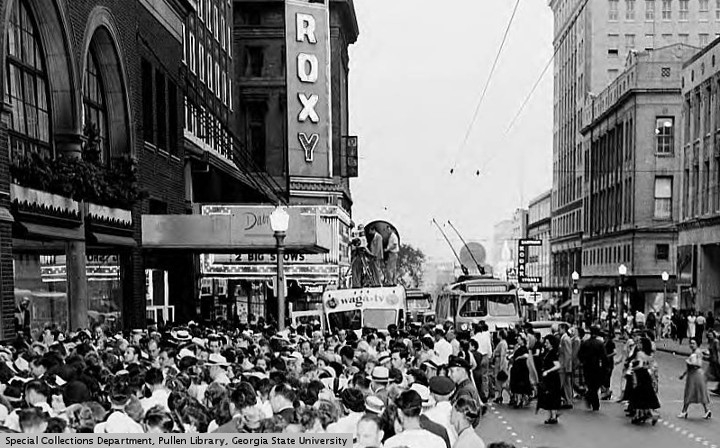
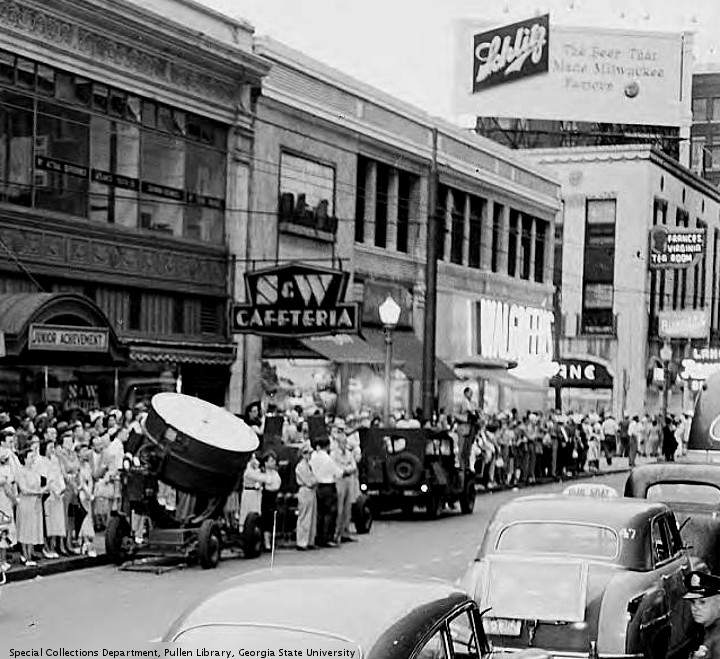
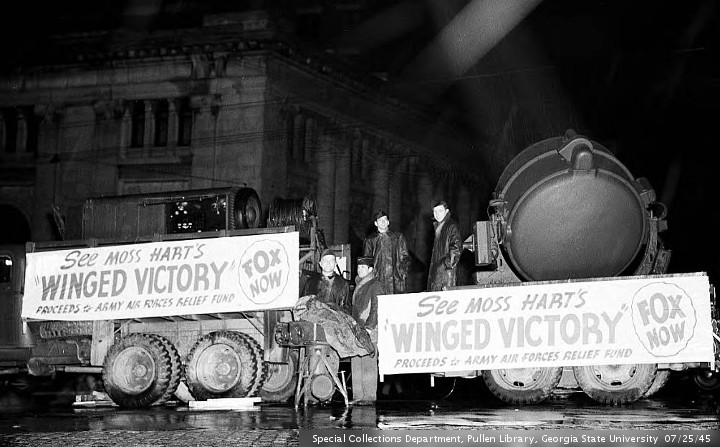
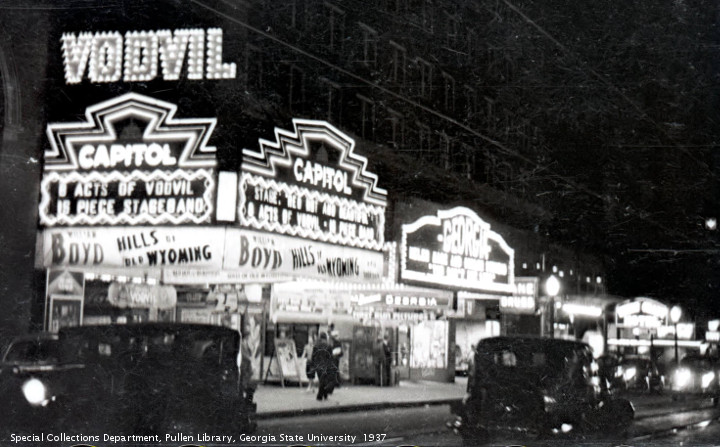
Another problem is the placement of the spikes. The spike that held feet to a cross was driven into a spot between the Achilles heel and the bone. No bones were broken, and the feet were secured to the cross. The spikes that held the arms were driven through a space in the wrist. Here again, no bones were broken, and the arms were not going to be pulled away from the cross. In the picture, there was a rope tying Jesus to the cross at this spot, and the spike was going to go in a couple of inches up the arm. When you believe your fantasy, details are not important. … Pictures today are from Special Collections and Archives, Georgia State University Library The social media picture was taken August 15, 1949. “Davison-Paxon’s grand opening of a new part of its downtown Atlanta, Georgia, store, August 15, 1949. This photo shows the speaker’s stand outside the store, the Roxy Theatre is in the background.” ©Luther Mckinnon 2025 · selah





The Soho Press Book Of 80s Short Fiction



This content was published September 16, 2022. … The Soho Press Book of 80s Short Fiction turned up in the Dekalb Library system, and has provided some cheap thrills. One negative review catalogs a few of the charms. “Beware. Raw, graphic sexual content. I had intended this as a reading group choice. It was a pre-order so I had no forewarning or list of titles (“Sodomy” would have given me pause). Cover listed Raymond Carver, Mary Gaitskill, Amy Hempel, Jamaica Kincaid.”
Weird Fucks Lynne Tillman is the first story. A young lady has an eventful summer. She takes up with a married man, whose wife dries her hair in the oven. Is this what happened to Sylvia Plath?
So Much Water So Close To Home Raymond Carver was a delight. I had listened to several of Mr. Carver’s stories read on youtube, but never read the text. SMWCTH is a tasteful story. Just-plain-folks go camping, and see too much.
Sodomy Gary Indiana jerks us off back into a New York state of mind. A man is talking about two of his late seventies boyfriends. One is a terrific fuck, but not much else. The other is a confused, off-and-on emotional connection. Mr. Indiana talks about 1978 as being “before the war.”
The Angel Patrick McGrath is the story of Harry Talboys, an eccentric old man who estivated in lower Manhattan. The old man lived his days in a gin fueled haze, while telling tales of his former glory. Eventually, the young man who wrote the story couldn’t take anymore of the old geezer.
River Of Names Dorothy Allison is tough to read. It’s about a lifestyle that I am blessedly unfamiliar with. A hyper productive South Carolina family gets through life, sometimes. RON opens up with one of the sisters taking a pail of soiled rags out to the fire. This scene involves the sense of smell.
Secretary Mary Gaitskill “A young woman, recently released from a mental hospital, gets a job as a secretary to a demanding lawyer, where their employer-employee relationship turns into a sexual, sadomasochistic one.” This is where the tales get funky. There is a connection to a movie and the description of the movie sounds different from the story … there’s no mental hospital discharge in the story. The young lady seems to be just a helpless young lady, who lives with her helpful parents. She gets a job in a law firm. The lawyer turns out to be a terrible person, who likes to beat her. She has a curious relationship with the whole thing … it’s a disturbing tale.
Wrong Dennis Cooper If Secretary wasn’t fucked up enough, the next story is by Dennis Cooper. Some guy lives in lower Manhattan during the seventies, and goes around killing people. Until he gets killed himself, and then goes on a deceased person monolog.
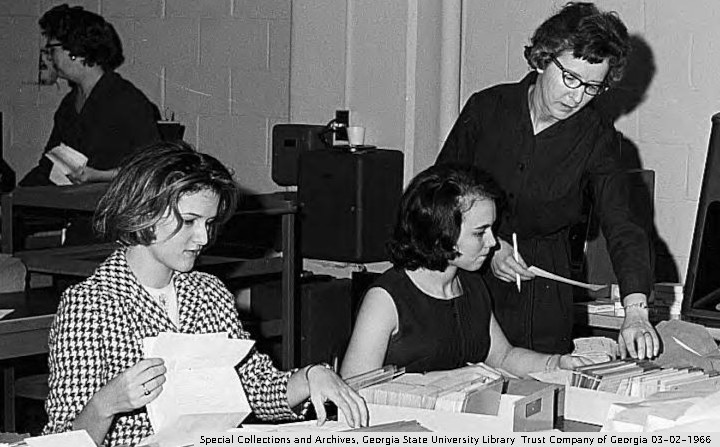
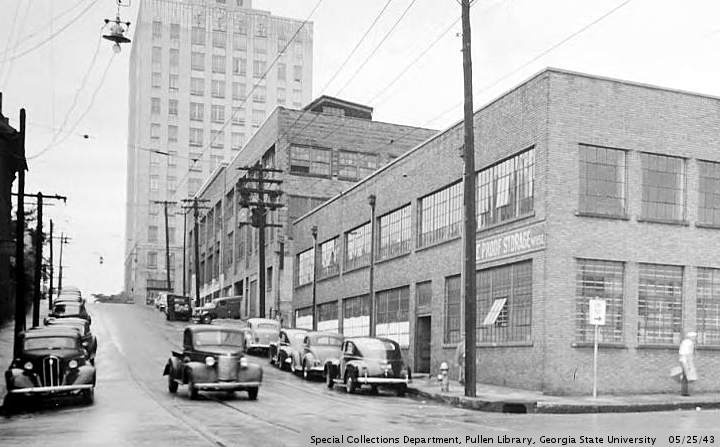
Debbie’s Barium Swallow Laurie Weeks makes william burroughs look like dick, jane, and sally. “There’s a guy named Benny lymphoma tracking … God or whatever Satan daddy lifts my skirt like he does at the slightest whim … what words can Debbie use for this secret procedure … she crawls and shakes with fever in the toxic dirt crawling one knee before the other … bitching from 34th Street to 35th a node shaped lip traveling from … your job in the … Hospital’s authoritative smoothing fekade.” Pictures today are from Special Collections and Archives, Georgia State University Library “Trust Company of Georgia processing facility” ©Luther Mckinnon 2026 · selah




A Sad Event
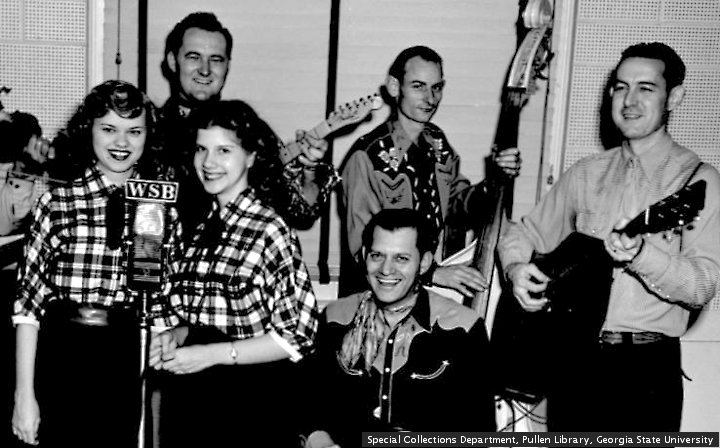
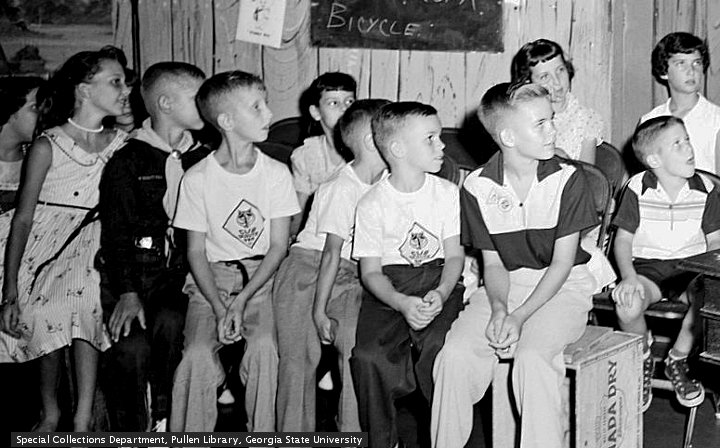
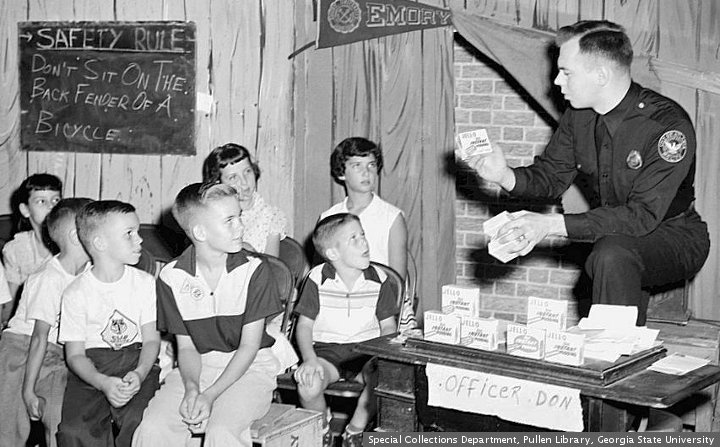
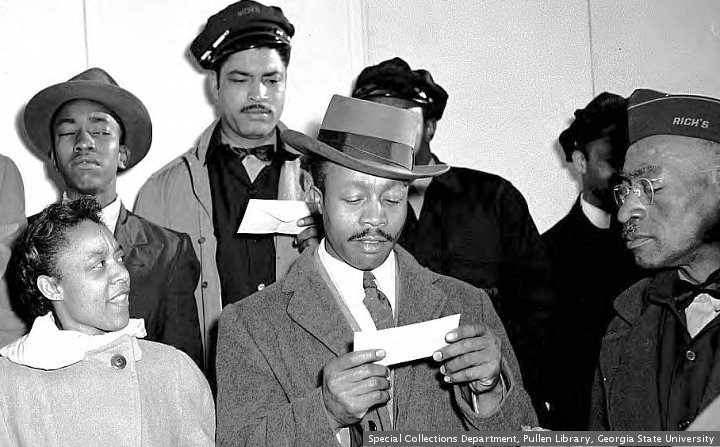
This content was published August 8, 2023. … It is with the saddest heart that I must pass on the following news. Please join me in remembering a great icon of the entertainment community. The Pillsbury Doughboy died yesterday of a yeast infection, and trauma complications from repeated pokes in the belly. He was 71. Doughboy was buried in a lightly greased coffin. The funeral was held at 3:50 for about 20 minutes.
Dozens of celebrities turned out to pay their respects, including Mrs.Butterworth, Hungry Jack, the California Raisins, Betty Crocker, the Hostess Twinkies, and Captain Crunch. The grave site was piled high with flours. Aunt Jemima delivered the eulogy and lovingly described Doughboy as a man who never knew how much he was kneaded.
Doughboy rose quickly in show business, but his later life was filled with turnovers. He was not considered a very smart cookie, wasting much of his dough on half-baked schemes. Despite being a little flaky at times, he was still a crusty old man and was considered a roll model for millions.
Doughboy is survived by his wife, Play Dough, two children, John Dough and Jane Dough, plus they had one in the oven. He is also survived by his elderly dad, Pop Tart.
I am not clever enough to compose the above piece. Credit is hereby given to whoever wrote it. Pictures today are from Special Collections and Archives, Georgia State University Library
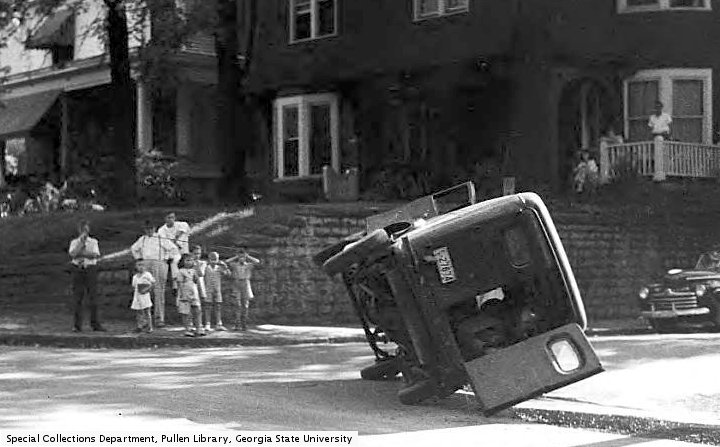
The social media picture was taken in 1946. “Automobile accident, Piedmont Avenue”
©Luther Mckinnon 2026 · selah
She Always Carries Jonquils
This content was published August 18, 2011. … I found Archival Atlanta: Electric Street Dummies, the Great Stonehenge Explosion, Nerve Tonics, and Bovine Laws : Forgotten Facts and Well-Kept Secrets from Our City’s Past at the Chamblee library. There are always more stories to be heard.
In the 1840s, the Western and Atlantic railroad wanted to hook up with the Central of Georgia railroad. The spot for the meeting was called Terminus. One idea was to name the town for William Lumpkin, a former Georgia Governor and a railroad executive. Lumpkinville sounded bad in the mouth, and the new town was named “Marthasville,” after the daughter of the Governor. (Martha is buried in Oakland Cemetery.) Few people liked this name, and someone decided that the feminine form of Atlantic was Atlanta. Unlike the state flag, this is unlikely to change.
The new town prospered, and recovered from the unpleasantness of 1864. In 1875, there was a problem with stray cows. The answer was the “1875 Cow Ordinance.” The law required that cows be kept in a pen at night. A fine of two dollars was assessed for every stray cow that was caught.
About this time, there were a few very busy railroad tracks going through downtown. People were getting tired of waiting for the trains to go through. One by one, viaducts were built over the tracks, creating a forgotten ground floor. This was built up into Underground Atlanta in the sixties, which was red hot for a while, then cooled off, and is now so so.
In 1897, J.W. Alexander was the first person in town to own a “horseless carriage.” One day, he decided to take a ride to East Point. A mule objected, and kicked man and machine into a ditch.
It is a rule that all history books about Atlanta have to discuss Coca Cola and Gone With The Wind. There are only so many stories to go around. This book tells of an Alpharetta farmer who bought the Tara set from MGM. He stored it in a barn, the location of which was a secret. Betty Talmadge wanted to buy it, and the price went from $375k to $5k. After a while, the sale was finalized. There was only one problem … the farmer died, and never told anyone where the barn was. Mrs. Talmadge got the money from her husband’s overcoat, went to Alpharetta, and found the barn. The set was moved into another secret location, where it was in 1996, when Archival Atlanta was published.
Sam and William Venable owned Stone Mountain, and had a quarry there. Sam built a large granite house at 1140 Ponce De Leon Avenue, and stocked it with ammunition. He thought a race war was on the way, and wanted to be prepared. One night, a chimney overheated. The roof caught on fire. The explosives in the attic exploded, and took the roof off. The house was repaired, Mr. Venable died, and the house became part of a Lutheran church.
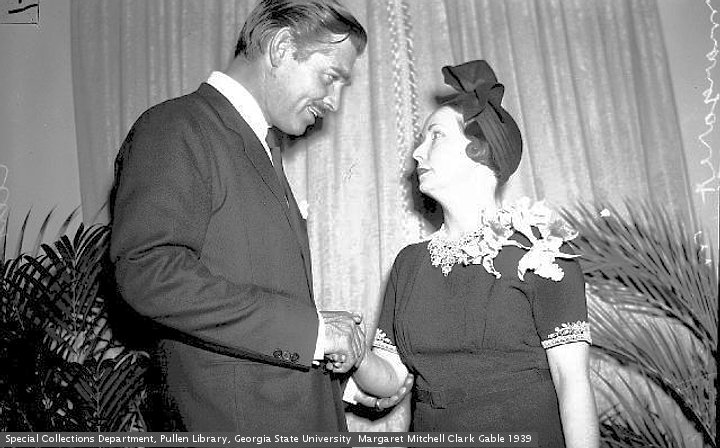
One of the few ante bellum houses in Atlanta is near Grant Park. It was once owned by Lemuel Grant, who donated the land for the park. He stays in a large marble house in Oakland Cemetery now. The Grant Park house was purchased by Mr. and Mrs. John Marsh, in partnership with Boyd Eugene Taylor. After the death of Mrs. Marsh (also known as Margaret Mitchell,) she was known to visit the house. “Margaret just wanders through the house, looking things over. She never talks, and she always carries jonquils. The first night she came I was very shocked. I went out to her grave at Oakland Cemetery the next day. I’d never been to the house before. But I was almost certain of what I’d find. The plot is covered by a bed of jonquils.”
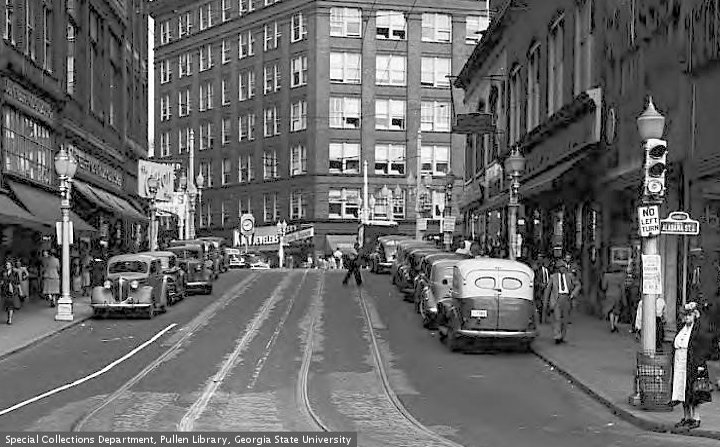
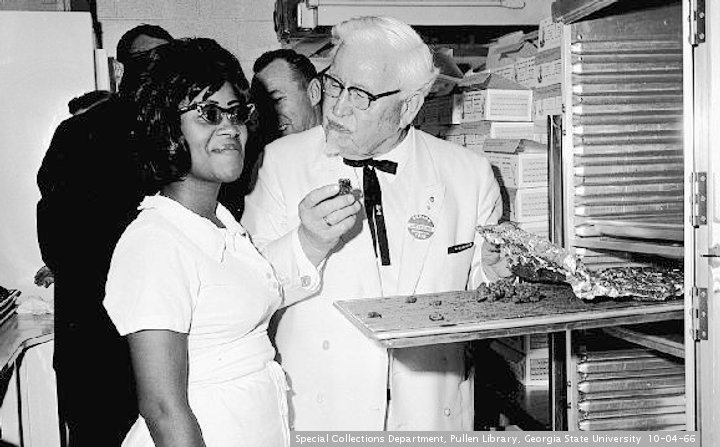
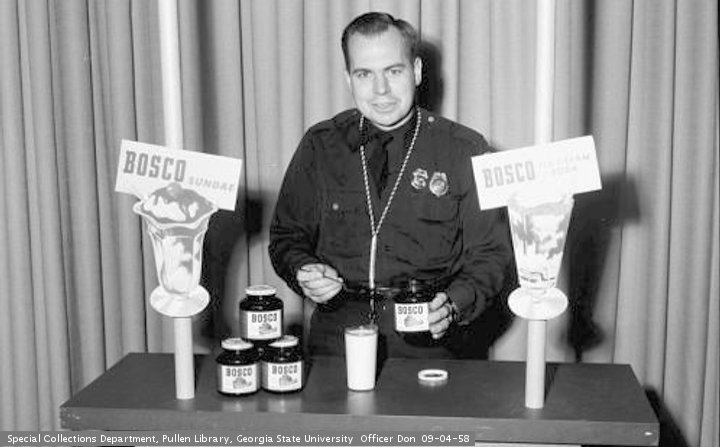
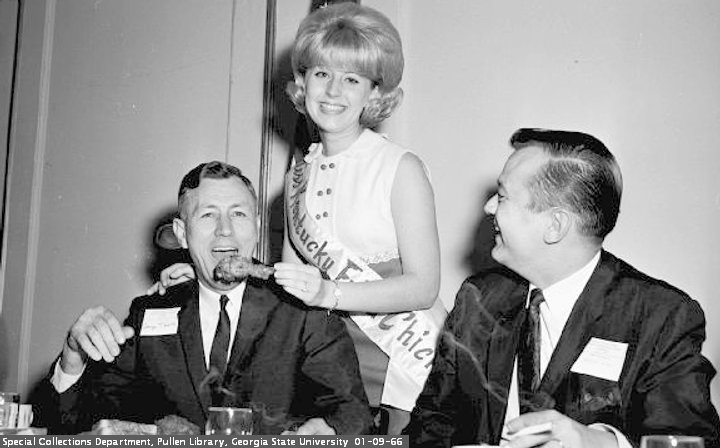
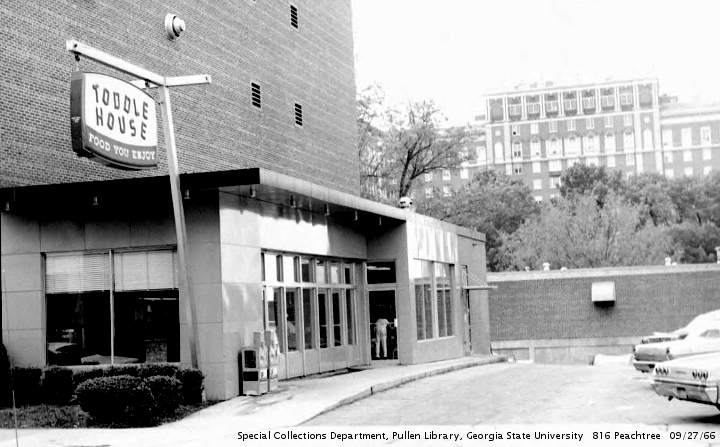
Pictures today are from Special Collections and Archives, Georgia State University Library The social media picture was taken October 4, 1966. “Davis House Kentucky Fried Chicken Colonel Harlan Sanders shown with worker. Davis House Cafeterias; Palmer Building; 39 Marietta Street, NW”
©Luther Mckinnon 2026 · selah

The God Of Word

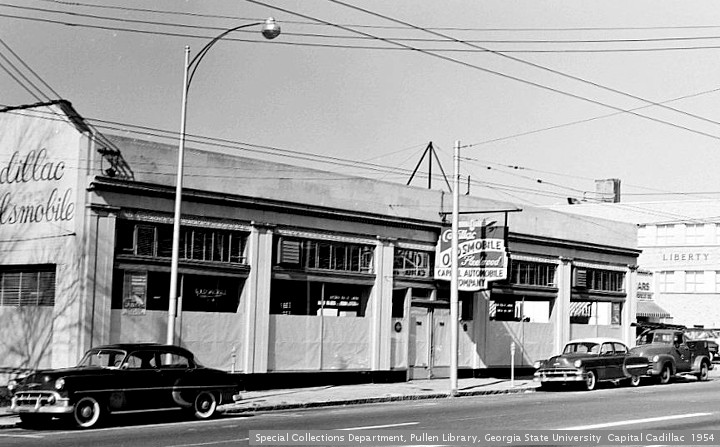
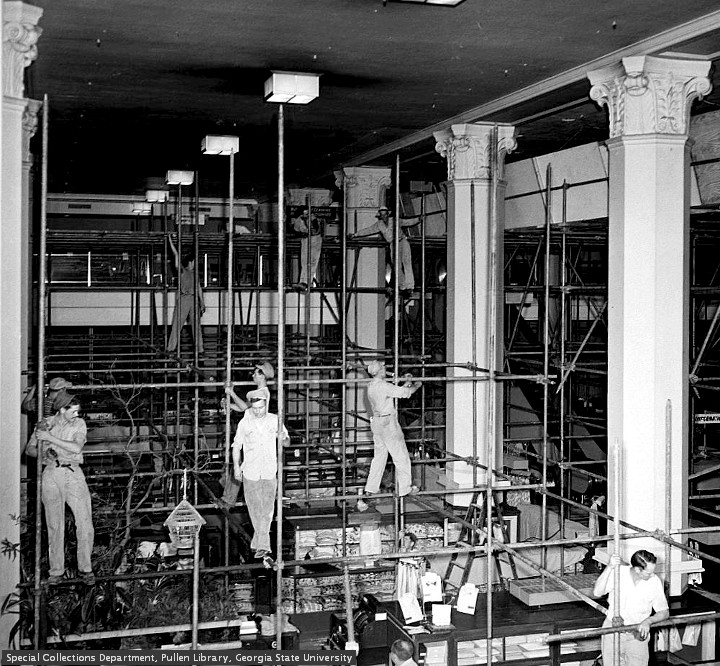
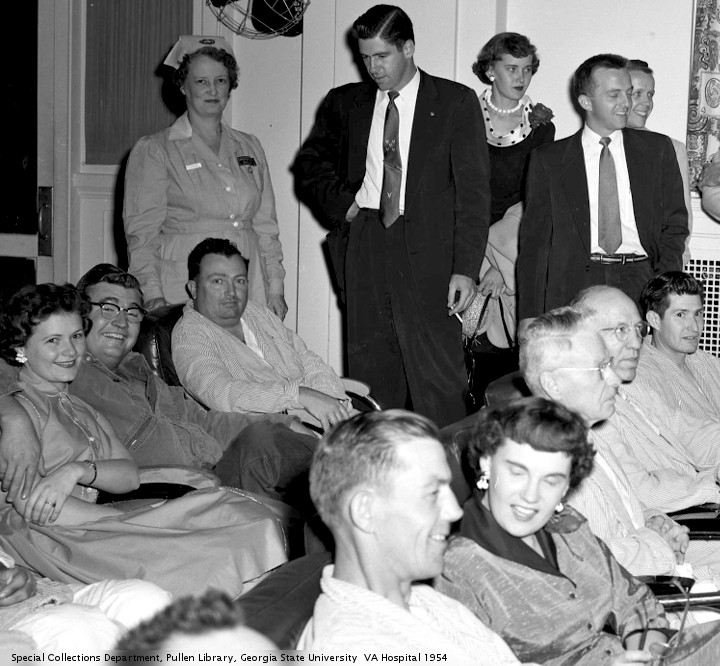
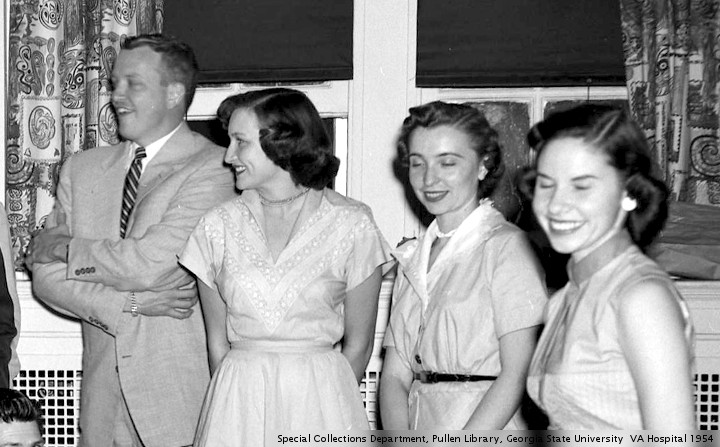
This content was posted July 18, 2017. … The facebook comment started with “Christ had so little regard for … ” I gave into the temptation to comment. “Are you talking about Jesus? Not everyone agrees that he was the Christ.” The internet showed mercy, and only one stranger replied. “I think the bigger picture is being overlooked for semantics here… ” Talking, in or out of vain, is a big deal here.
People like to express opinions about the teaching of Jesus. The source of 99% of these thoughts is the bible. It is a fundamental belief that “the bible is the word of God.” I have disagreed with this notion for a long time. This is not the same as not believing in the existence of God.
I started to type a facebook reply, and then thought better of it. Sunday afternoons are a gift, even if they are uncomfortably hot. It is too fine a day to argue religion on the internet. Before I stopped, one thought did occur to me. If the bible is the word of God, then maybe Yahweh is the God of word. If you saw a mushroom cloud rising over Brookhaven …
Christianism is a religion of beliefs, rather than practices. The idea of getting people to agree with your beliefs is key to the Jesus experience. Many of these beliefs are noted in the bible. It is as if people make a God out of a book. When these high powered thoughts are expressed, then the semantics can get overwhelming.
As for the teaching of Jesus, all we know is what the Council of Nicea chose to tell us. We don’t have very much. What we do have is conveniently selected to fit the agenda of the speaker. What someone says about Jesus tells us more about that person than it does about Jesus.
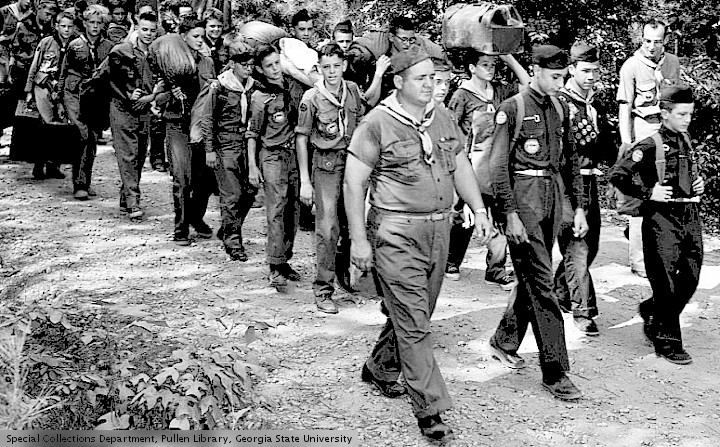
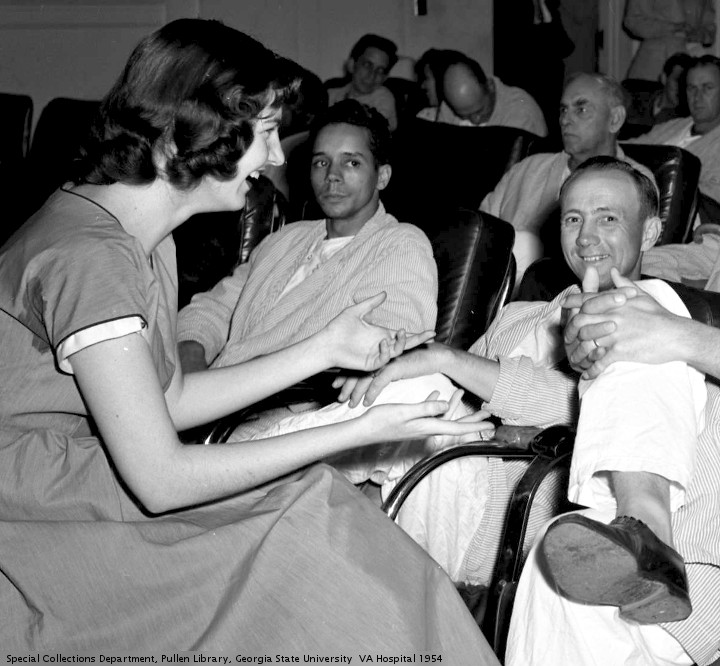
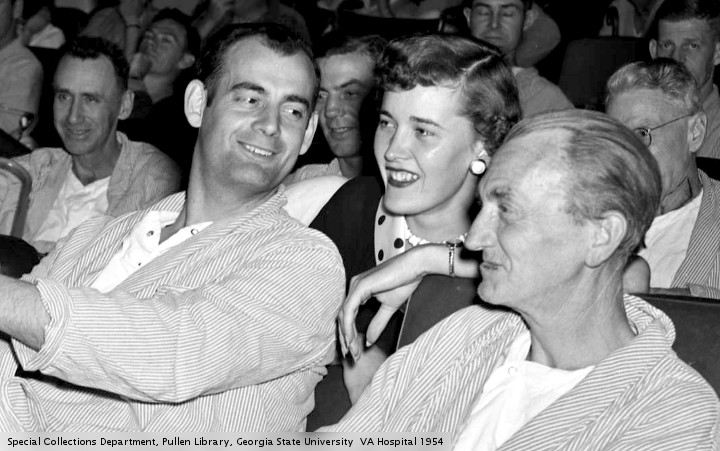
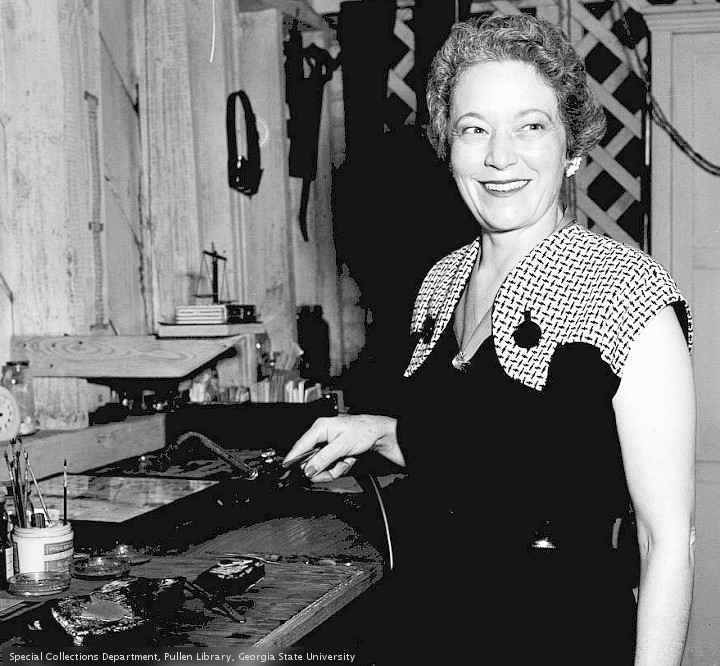
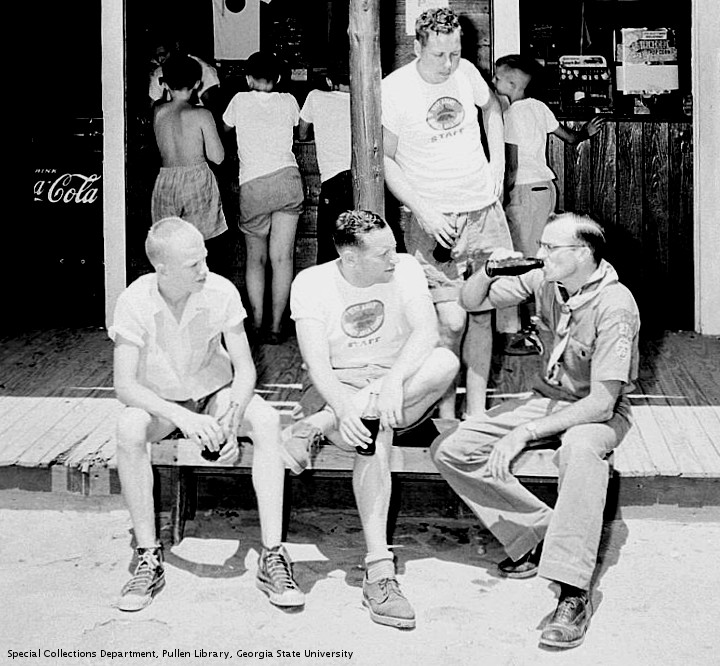
UPDATE This post starts with by quoting a facebook post. The link no longer works. The former facebook friend blocked me. After George HW Bush died, the ffbf was trashing the former President, using the phrase “I am not going to whitewash history.” I commented that it would be better for his karma to be a bit kinder towards the former President. The ffbf did not like that, and blocked me. Pictures today are from Special Collections and Archives, Georgia State University Library. The social media picture was taken July 7, 1954. “Boy Scout Camp” ©Luther Mckinnon 2026 · selah

The Lurid Digs Interview


This content was published July 20, 2010. … There is a site called Lurid Digs. (NSFW) It can be very, very funny. It is also filthy. 66 years ago, publishing pictures like this would get you sent to jail.
Chicken Fat Yellow Sofa in Ali McGraw’s Bathroom illustrates the LD feng shui. An aroused man is working on a hobby. LD ignores the talent, and comments on the “horrifying gay amateur interior” behind him. “The criminal offense, however, is that sofa — that goddamn chicken fat yellow, La-Z-Boy monstrosity. It looks like a big, sticky shammy mitten, and although some people I know would love to take a spin on the rough-tradin’, hooker-whoopin’ ShamWow Guy, that’s not where I want to relax on warm afternoons in Boca.”
I was *trolling* the internet one night, and landed at Lurid Digs. I saw a picture that might be fun to use, to illustrate a post about NASCAR. However, at the bottom of the LD page was some troubling language about copyrights. I decided to write LD and get permission, before he used any of their pictures. You can never be too careful.
The very next day, this arrived: “Hi Luther…Sure, you can use the credited pics. Also I’m available for ‘interview’ should you have any questions you like to ask…Cheers, David K Publisher Lurid Digs.” … An interview with the publisher of Lurid Digs! What a coup! I opened up a wordpad and started to think of questions. I edited them to a numerically proper twenty. The questions were sent to Lurid Digs. The reply arrived a few days later.
“Oy, too convoluted for me. But thanks anyway. (I was thinking of something much more simpler.) Cheers, David K.” As Scarlet might say, tomorrow is another day. The questions will make a fun post by themselves. … Sixteen years later, LD lives on at the wayback machine. @luriddigs.bsky.social last posted in 2023. This interior landmark may have run out of steam.


01- Are the models and decorators for Lurid Digs certified to be drug free?
02- What kind of strings do you use on your guitar?
03- Why do birds fly up in the sky, every time you walk by?
04- What can the argyle community do to fight racism?
05- If Jesus were to pose for you, would you put makeup over the holes in his hands?
06- Who asked Sarah Palin what she thought?
07- What impact does Lurid Digs have on global warming?
08- How much was the model’s bail?
09- Have residences been inspected by the fashion police?
10- Does Chenille ever go out of style?
11- Do the neighbors in the trailer park get suspicious when you do a photo shoot?
12- Why don’t we just go ahead and make murder legal?
13- Are humans as smart as dogs?
14- What do the youth of today want?
15- Why do people include the office disclaimer when sending out joke emails?
16- Is NASCAR rigged?
17- Who wrote the book of love?
18- If a model dies during a photo shoot, is he greeted in heaven by 72 virgins?
19- What do you put on pizza you order for photo shoots?
20- Do you ever play 20 questions? … Pictures today are from Special Collections and Archives, Georgia State University Library. The social media picture was taken November 11, 1954. “Automobile accident” ©Luther Mckinnon 2026 · selah


688 Spring Street
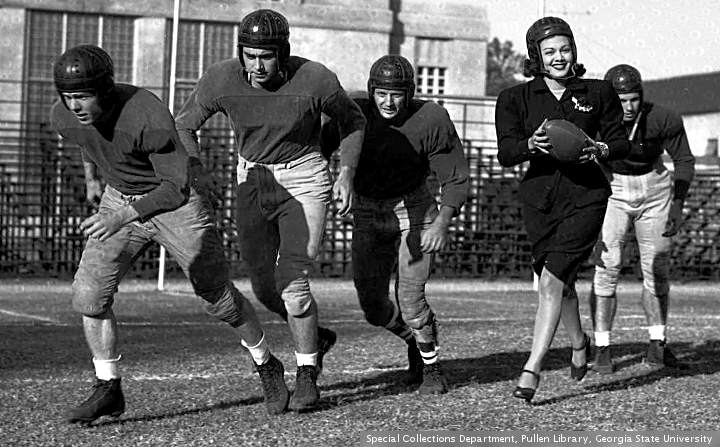
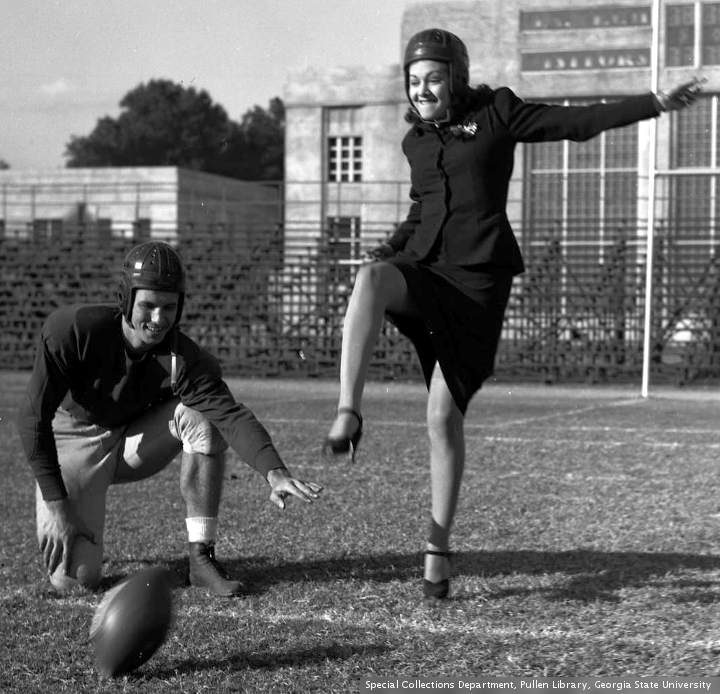

There was a comment at Chamblee54. “Steve Loehrer – So tell me what you know about Rose’s Cantina. I booked the music there from 1978-80 – Thorogood, Delbert, The Thunderbirds, The Fans, The Razor Boys and on and on. I was the one that did it. And I probably know you.” This blog has previously published features about the Great Southeast Music Hall, Richards, and the Georgian Terrace Ballroom. One more music venue post is not going to hurt anyone, and will be a good excuse to post some more pictures.
688 Spring Street is a nondescript building, located down the hill from the Varsity. At one time, a company called Southern Tailors made wine jackets there. It is currently a Concentra Urgent Care Center. In between, it was the site of two rock and roll nightclubs, Rose’s Cantina and 688.
House manager Rose Lynn Scott is quoted as saying “You know, we really aren’t sure exactly when it all started and ended … Honest to God, we weren’t paying that close attention.” I first knew about it around 1977, and really didn’t go very often. There is a running list for this post, and whenever a new band sinks into the mush, it is duly noted. Some band did “Love Gun,” which sounds remarkably similar to “Amphetamine Annie” by Canned Heat.
The punk rock revolution did not completely pass Atlanta by. A band called the Fans said they were making the pop music of the eighties. PG saw them twice at Rose’s, and they might be the only time he ever paid to get in. They were an impressive outfit, doing Velvet Underground songs. Later, they opened for Talking Heads at the Agora, and were pretty awful. In 1982, I shared an apartment with the drummer’s brother, his wife, a cable guy, seven snakes, a ferret, and a cat.
Back to the words of Rose Lynn, “It was a dive bar supreme and proud of it.” The stage was in the middle of the house, with a game room behind the stage. If you liked to shoot pool and listen to bands, this was the place. As for drinking, I might get a beer or two, but mostly got bombed at other spots.
In those days, I would go rambling from club to club, often accompanied by his friend Dinkson. One night, we stumbled in on a three piece band. They did a song called “Madison Blues,” with the guitar slinging riffs, and the bass playing the same notes over and over, never changing the look on his face. This was George Thorogood and the Destroyers.
One other night, I stumbled in on the last few minutes of a show by the Brains. They wrote a song called “Money Changes Everything,” that Cyndi Lauper did well with. The Brains were another great local band that never seemed to get a national audience. Another night, some old black man, possibly John Lee Hooker, was playing guitar.
Around about this time, I decided to either grow up, or take my childhood seriously. I wound up in Seattle WA. That wore off after a while. On the greyhound bus going home, I talked to a young lady, who said something about a punk rock club in the Rose’s Cantina space. This was 688.
A few weeks later, Iggy Pop did a week at 688. Here, through the miracle of copy paste, is the story. It isn’t plagiarism when you wrote it yourself.
At any rate, by the time I got back from Seattle, some brave investors decided to have a punk rock club at 688 Spring Street. Soon, Iggy Pop would be playing a week there. In the seventies, the bands would play for five days at the great southeast music hall or the electric ballroom, two shows a night, and if you were really cool you would go on a weeknight before it got too crowded. Soon after that, it was one night in town only, and you either saw it or you didn’t.
I had a friend at the Martinique apartments on Buford Hiway. There was someone living in the complex known as ZenDen, who sold acid. You would go to his place, wade through the living room full of grown men listening to Suzi Quatro, and purchase the commodity.
On to the 23 Oglethorpe bus, and downtown to 688 Spring Street. Before anyone knew it, the band was on the stage. Ivan Kral, a veteran of the Patti Smith Group, played bass. Mr. Kral sneezed, and a huge cocaine booger fell across his face. He was not playing when the show ended. … There was a white wall next to the stage, and someone wrote the song list on that wall. That list of songs stayed on the wall as long as 688 was open. “I want to be your dog” was on the list, as well as the number where Iggy pulled his pants off and performed in his underwear. Supposedly, in New York the drawers came off, but the TMI police were off duty that night.
The show was loud and long, and had the feel of an endurance event … either you go or the band does. Finally, the show was over, and I got on the 23 Oglethorpe bus. You got the northbound bus on West Peachtree Street. You could look down, from Fourth street, and see the Coca Cola sign downtown. Freeway expansion sent that section of West Peachtree to old road hell.
Twenty years after that, I worked in a building at that corner of Fourth and West Peachtree. If I had known about the future of working for Redo Blue, I might have jumped under the 23 Oglethorpe bus, instead of getting on it. The Coca Cola sign was long gone by then.
There was a band called Human Sexual Response. I caught their act at 688. They had three vocalists, wearing matching outfits, and sang a lot of lyric happy songs with cool harmonies. The problem was, I was not familiar with those oh so witty lyrics, and did not know what it was all about.
Kevin Dunn played guitar for the Fans. (He had an ad for guitar lessons on the bulletin board at Wax and Facts. It said that raising racing turtles was more profitable than playing guitar.) One night at 688, he performed with his band The regiment of women. They opened for someone, possibly the Plastics, who we will get to in a minute. So, this guy plays guitar and sings, and a woman plays a drum machine. No skin pounding drummer, but a lady who twisted the knobs on a machine.
The Plastics were from Japan, and did a killer version of “Last Train to Clarksville.” It was about this time that I got a job, and decided that I liked sleeping better than hanging out downtown.
One night, about 1983 or so, I made an exception. The band that night was Modern English. Before the show, I ate three z burgers from the Zestos on Ponce de Leon. During the show, the singer rubbed his stomach, and said to feel the music. About this time, the z burgers were making their presence known, and I could feel something, but it wasn’t the music.
The last show I saw at 688 was Hüsker Dü. The best guess is February 14, 1986. There was a totem pole, made of old TV sets, in the front part of the club. Here is the story.
Hüsker Dü means “do you remember” in Danish and Norwegian. I saw them sometime in the eighties. It might have been the metroplex, but it might have been the 688. There is a list of shows they played, and the metroplex is not on there.
I saw a show at the Metroplex the next night. The band is forgotten. The metroplex was a dark spooky building on Marietta street near the omni. The balcony was very dark, with everything painted black. I tripped over a bench. That was the high point of the evening.
688 was a different story. I saw a bunch of shows there, both as 688 and Rose’s Cantina. HD may have been the last show. I was well into the work/sleep lifestyle that preoccupied my life after a certain point, and just didn’t make it out much anymore. A friend won tickets to the show or he wouldn’t have made it. … I didn’t get into the show very much. HD was a trio, with the later-outed Bob Mould on guitar. For all of his musical skills, Mould is not much for onstage charisma. I felt that if I had been more familiar with their music, I would have enjoyed it more. Some bands you can see without hearing their records, where others need a bit of familiarity.
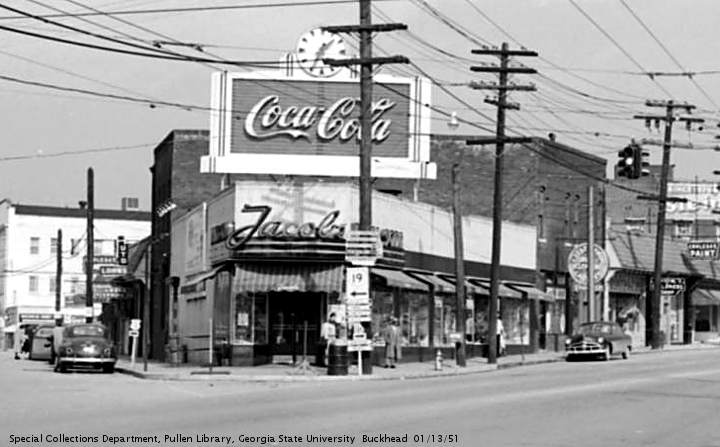
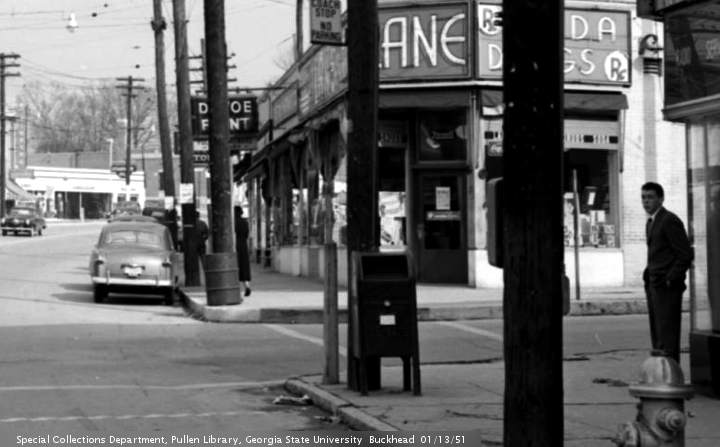
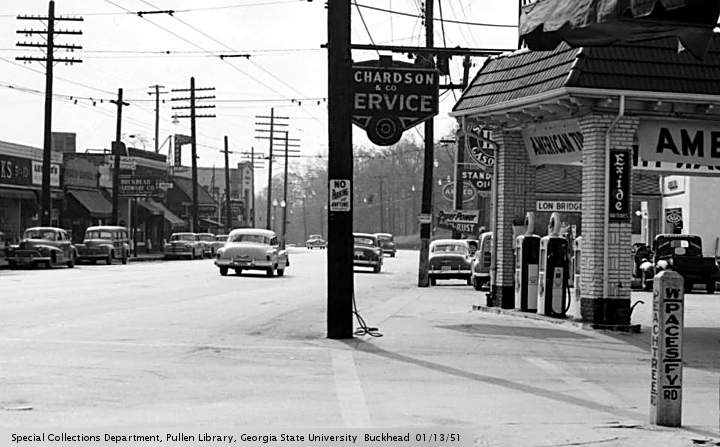
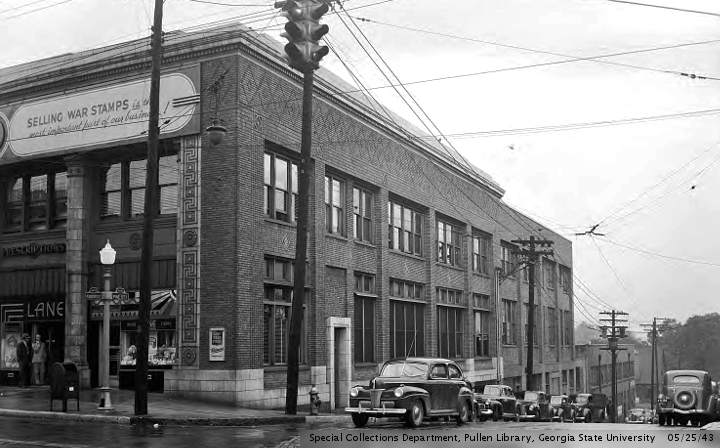
Pictures today are from Special Collections and Archives, Georgia State University Library The social media picture was taken January 14, 1951. “Intersection of West Paces Ferry Road, Roswell Road, and Peachtree Road, in Buckhead. … One photograph in a series commissioned by Mose S. Hayes of the law firm Barrett and Hayes. The Lane Brothers 1951 Assignment Book (page 15) indicates that the photographs were taken at “606 House Road,” (the photo of the victim) and the four photos of the accident scene were taken at the intersection of Peachtree Road and Paces Ferry Road. The negative envelope says that the scenes are in Buckhead and were taken on January 14, 1951. Total charge for the photographs was $21.00. This long view of the intersection shows a large Coca Cola billboard advertisement.” ©Luther Mckinnon 2026 · selah
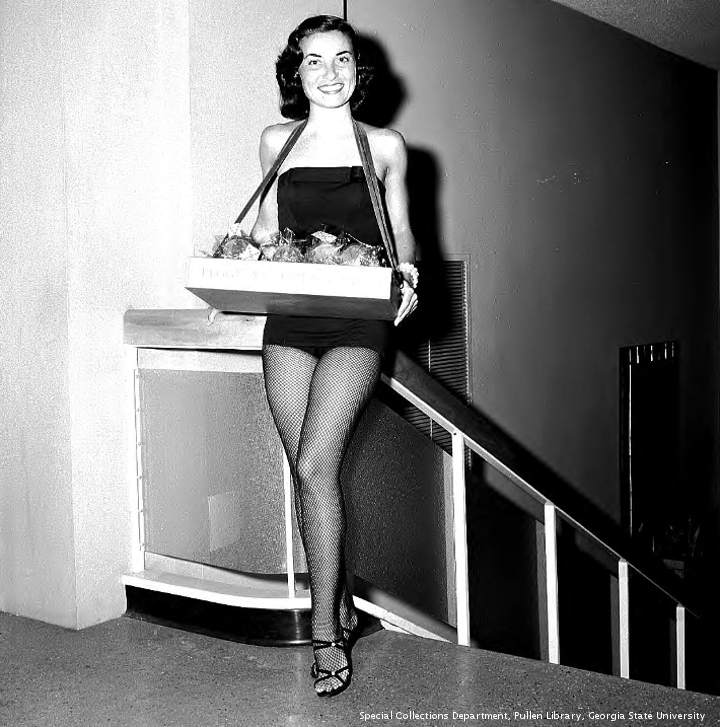
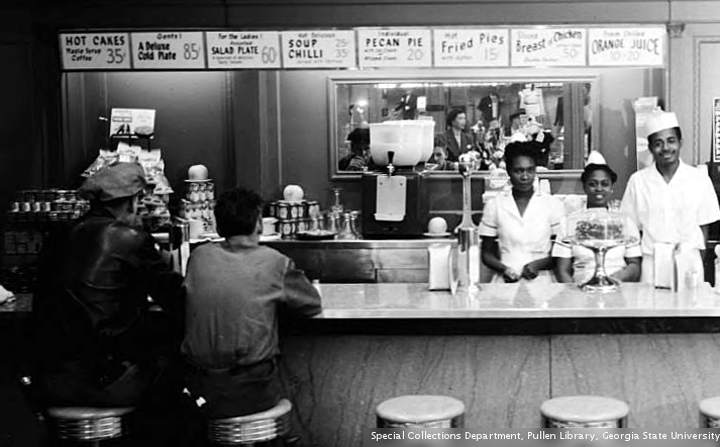
Slaughterhouse-Five Part Two
This product was posted July 29, 2015. … This is part two of an excavation of Slaughterhouse-Five, a story by Kurt Vonnegut. … The second chapter is the beginning of the story. The first eight words sum up the plot nicely. “LISTEN: Billy Pilgrim has come unstuck in time.” The first word is the most important, and the most likely to be ignored. People love to talk, but do not like to listen. If they do quit talking, and allow the other person to speak, then they are thinking of a clever comeback. If only people were as proud of the ability to listen, as they are of the clever things they say.
Billy Pilgrim, or BP, is the main character of this story. By trade, he was an optometrist in Ilium, NY. BP led a reasonably pleasant life, in spite of, or perhaps because of, being shaped like a Coca Cola bottle. His father was a barber, also in the mythical town of Ilium, NY, until he died in a hunting accident. This incident motivates KV to write “So it goes.” This will be abbreviated as SIG006.
BP … which under no circumstances should be confused with British Petroleum … survives infantry duty in World War II, and a plane crash in 1968. This crash killed everyone except BP and the co-pilot. SIG007. The plane crash is an important moment in the movie version of SF. I saw the SF movie, while a UGA student, at the PJ auditorium. That is enough initials for one paragraph.
While recovering from the plane crash, BP’s wife dies of carbon monoxide poisoning. SIG008. (In the note taking that preceded this text, I missed SIG008. If this was a scholarly dissertation, this would be a big deal. To a slack blogger, it is not. While I will try to chronicle all 106 SIG in SF, I am not making any promises.) After the plane crash, BP comes out of the time travel closet. BP tells earth people about the wonders of Tralfamadore. These folks are two feet tall, green, and shaped like plungers. Tralfamadorians feel sorry for earth people.
I have long suspected that I am a Zorlac, from the planet Thrunombulax. I am quiet about this, as prejudice against Zorlacs is acceptable by polite people. Many white people are trying so, so, hard not to appear prejudiced against anyone. When they see an approved target for their tribal rage, white people lose it. Just look at the way people with deviant attitudes about race relations are portrayed. With this in mind, I have learned to keep quiet about his Thrunombulaxian origin. The relationship of Thrunombulax to Tralfamadore is unknown.
A letter was written to the Ilium News Leader by BP. He tells about the lessons he learned on Tralfamadore. This was in 1967, on the eve of BP’s daughter’s wedding. Trallies see a person who is dead, and say that he/she is having a bad day. It is a Trally custom to say, about death, so it goes. SIG009. Number nine, number nine, number nine. Turn me on dead man. The Beatles white album was recorded at approximately the same time as BP going to Tralfamadore.
A wonderful tool is now available for the production of this SF commentary, and SIG inventory. The text of SF … not to be confused with science fiction or San Francisco … is available electronically in the sf_pdf. Alas, it is an imperfect tool. You can download a copy to your machine. On this copy you can highlight certain words in yellow magic marker, but you cannot copy text. You can copy text from the online version, but it comes out funny and you have to do so much editing that it might be easier to just manually copy the text.
While working on the letter about Trallies, BP is visited by his daughter, Barbara. At a young age, she had to manage her mother’s funeral, and take care of her senile father. KV, who has a way with words, describes the young lady as a “a bitchy flibbertigibbet … legs like an Edwardian grand piano.” Barbara … we might know her married name later … asks her dad why he waited until 1968 to talk about time travel. He did not think the time was ripe.
The tale segues into the first experiences with time travel. This was in World War II. BP was a chaplain’s assistant, which is not a well thought of position. One day on maneuvers, BP was playing A Mighty Fortress Is Our God on the organ. (KV made a mistake here. AMFIOG was written by Martin Luther, without any assistance from Johann Sebastian Bach.) A war game umpire showed up, and told everyone that they were dead. Before long, BP got word that his father had been killed while hunting deer. SIG010. The offending shot was fired by his human friend, and not by a deer.
When BP returns from the funeral, there are orders for him to go to Europe. A chaplain’s assistant has been killed in action. SIG011. Soon, BP participates in the Battle of the Bulge. BP has no weapon, helmet, or boots. BP looks alternately like a box of kitchen matches, and a filthy flamingo. BP meets foulmouthed Pittsburgh refugee Roland Weary, who saves BP numerous times before trying to kill him. Roland Weary was the only member of a gun crew to survive a 88mm German tank gun. SIG011.
The name Roland means many things to me. Rowland NC, with an ornamental w, is the hometown of my father. Roland Cofer is a former co-worker. Roland Cofer was the cheerful son of Willie Simpson, the store manager. The fact that Roland is black, and Willie is white, should not concern the reader. It did not concern Roland or Willie.
The father of Roland Weary was a plumber. He collected guns, knives, and torture devices. The noname dad gave his wife a model of an iron maiden, which was a torture device before it was a heavy metal band. The device was a small chamber, with doors on hinges. The doors were lined with spikes, which impale the guest when the doors are closed. There is a drain in the bottom, for elimination of blood. SIG012. No mention is made of who cleans the iron maiden, or if it was cleaned. Eventually the smell would make the spikes redundant.
Roland Weary was a bully. He saw BP as a good target for his tough talk. Once, he described a torture where someone was tied down, with his eyes facing the sky. The eyelids are cut off, so there is no stopping the sun. SIG013.
BP is showing signs of common sense. He lets the motor mouth ramble without protest or argument. It turns out that BP is no stranger to gore. (This is blood and guts, not slick Willie’s VPOTUS.) BP had an explicit crucifix in his bedroom. Though nominally nondenominational, the Pilgrim family made sure young Billy knew all about the terrible things that happened to Jesus. SIG014.
Roland Weary had a pornographic picture, which BP saw numerous times. The legend was that André Le Fèvre was an assistant to Louis J. M. Daguerre was busted for selling a print of this photograph. Mr. Le Fèvre died in prison. SIG015. A killjoy website, mental floss, says this never happened. Roland Weary later fantasizes being the only survivor of a German attack. SIG016.
It was about this time that BP starts to time travel. The first visit is to the YMCA, where his father is teaching him how to swim. The second adventure is to 1965, when BP is 41 years old. His mother is in an old peoples home. (I once used the phrase “old folks home” at an estate sale, and was quickly told that OFH was considered rude.) While BP was at the OFH, a former marathon runner crossed the mortal finish line, and was wheeled out on a gurney. SIG017.
While sitting in a chair at the OFH, BP noticed a lump in the cushion. It was a book, The Execution of Private Slovik. Eddie Slovik was an American soldier, who was executed for desertion in 1945. SIG018. An excerpt from the court opinion in the case is quoted. It seems as though Pvt. Slovik was executed as a morale building exercise. SIG019.
The next time travel episode was a party in 1958. BP gets drunk, and screws a woman he is not married to. This is putting the tryst back in optometrist. When BP comes back to real time 1945, Roland Weary is about to kick him in the lower back. This effort at self expression is interrupted by the Germans, who take BP prisoner. This is the end of chapter two.
The regurgitation of Slaughterhouse Five has seven parts. one two three four five six seven Pictures today are from Special Collections and Archives, Georgia State University Library. The social media picture was taken March 7, 1956. “Moreland, North Avenue and Fairview”
©Luther Mckinnon 2026 · selah
Jane Fonda


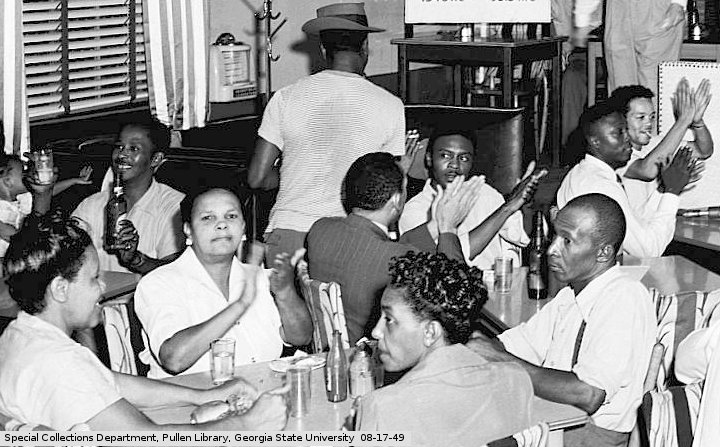


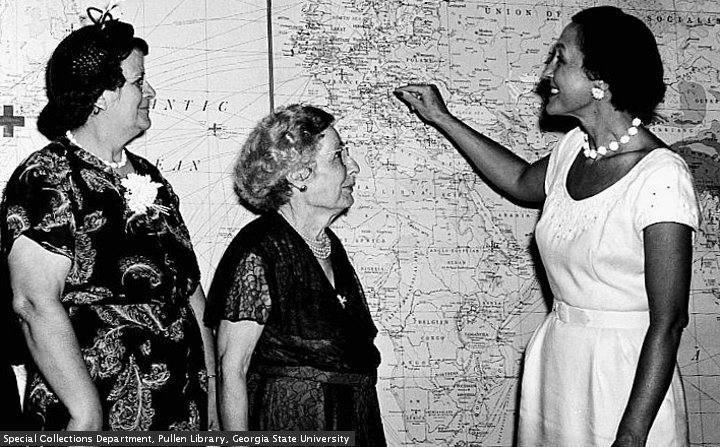
This content was originally publishedMay 28, 2007. This is a work of speculation, and has no basis in proven fact. The thesis cannot be proven nor disproven.
Listening to talk radio while you drive is a dangerous activity. You might start to think, and look at the man behind the screen. Neal Boortz was on a rant today about Jane Fonda. It is the same story you have heard many times … she gave aid and comfort to the enemy, she is a traitor, American troops died because of her, she should have been executed.
Sometimes when you hear something too many times, you begin to have doubts about what you heard. A light bulb went off in my head when I heard the Fonda Rant again … What if Jane Fonda was working for the US government when she went to Hanoi?
How would this benefit the government? This trip gave our government a discredited leader of the antiwar movement to denounce. When the government was trashing Jane Fonda, they did not have to defend the disastrous policies of that war.
Miss Fonda has been an icon of right wing hatred ever since, as well as of military training. One story has Miss Fonda giving the North Vietnamese information about activities by American forces. How would she get this information?
The infamous trip to Hanoi took place in the Summer of 1972. American troops were being withdrawn, and anti war protests lost most of their passion. (It was also soon after the death of F.B.I. Director J. Edgar Hoover, and the Watergate burglary) The war in Vietnam was essentially over for America. We were no longer trying to win, but to negotiate a face saving treaty. President Nixon called it “Peace with Honor.” Miss Fonda’s actions probably had little impact on these negotiations.
In 1967, Kurt Vonnegut published a book titled “Mother Night.” It tells the story of Howard W. Campbell Jr. Mr. Campbell made propaganda broadcasts for Germany in World War II, which were secretly used to pass coded messages to the Allies. He was condemned as a traitor after the war, but never prosecuted. He did not win an Academy Award.
Why would a woman known for her left wing activism do such a thing? Maybe, the FBI had some dirt on her, and blackmailed her. Perhaps Miss Fonda was sincere in her actions, but aided by the government. Miss Fonda was under surveillance in 1972. The government would have known about her plans to go to North Vietnam, and perhaps could have stopped her. But, because her going to Hanoi was to their advantage, the government allowed the trip to take place.
The above is speculation, and could be horribly wrong. The fact that Miss Fonda has expressed regrets over her trip neither proves nor disproves this. She got great movie roles, and won two Academy Awards, during the seventies. This may be a coincidence, or maybe it was a reward for her service.
Clearly, the trip she made to Hanoi had propaganda value to the US government. It has been a Godsend over the years. You should always consider who benefits from an action.
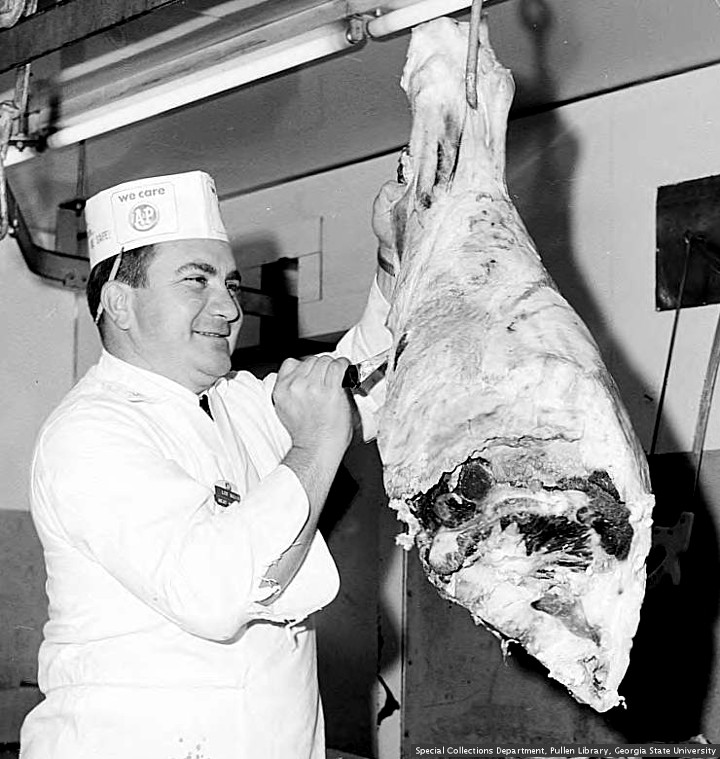
During his rant today, Mr. Boortz said that US troops died because of Miss Fonda. (He does not discuss the man who went to Nam in his place, after his draft deferment.) By saying this, he can ignore the tens of thousands of troops who died because Richard Nixon chose to wait until 1973 to sign a “peace treaty”. He could have made the same deal in 1969. Peace with honor indeed. … Pictures today are from Special Collections and Archives, Georgia State University Library The social media picture: A&P Food Store ©Luther Mckinnon 2026 · selah


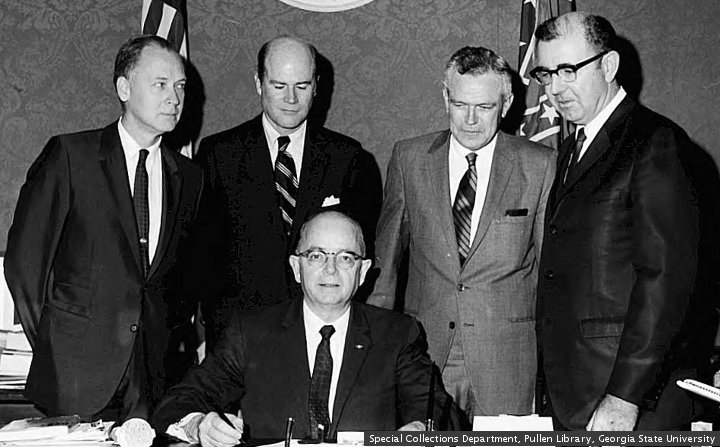
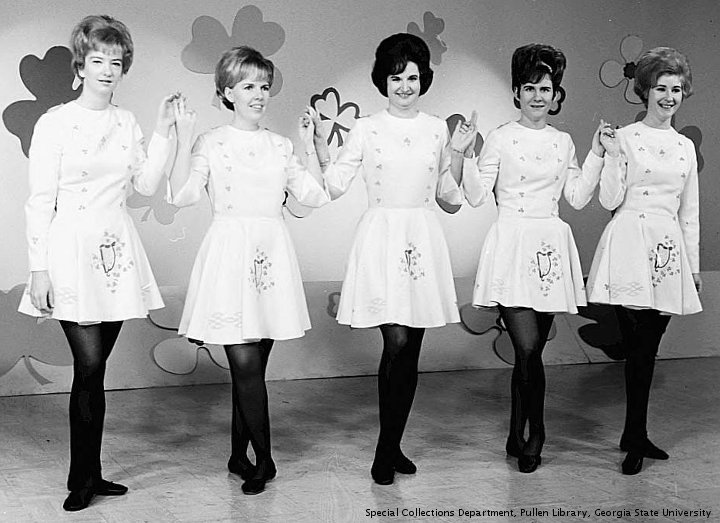


Jokes For The Fourth

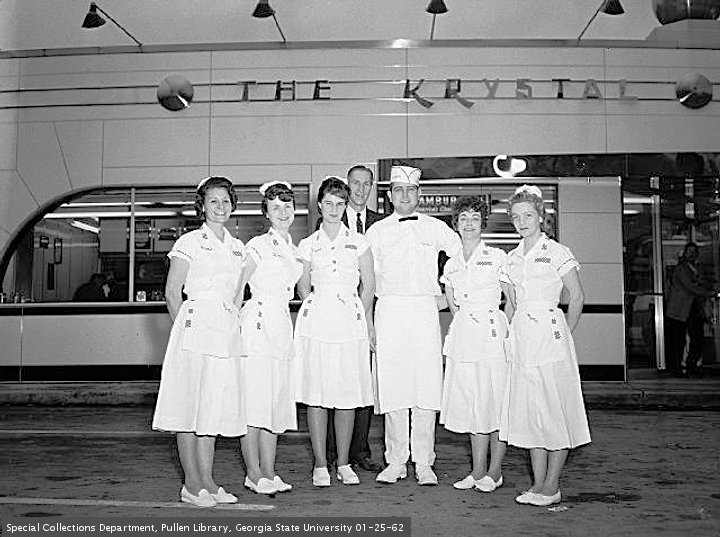
The credit/blame for these stories goes to JokesFunny.com.
What did one flag say to the other flag? Nothing. It just waved!
What’s red, white, black and blue? Uncle Sam falling down the steps!
What would you get if you crossed Washington’s home with nasty insects? Mt. Vermin!
What did a patriot put on his dry skin? Revo-lotion!
Which colonists told the most jokes? Punsylvanians!
What was General Washington’s favourite tree? The infantry!
Where did George Washington buy his hatchet? At the chopping mall!
What quacks, has webbed feet, and betrays his country? Beneduck Arnold!
Did you hear the one about the Liberty Bell? Yeah, it cracked me up!
What would you get if you crossed a patriot with a small curly-haired dog? Yankee Poodle!
What happened as a result of the Stamp Act? The Americans licked the British!
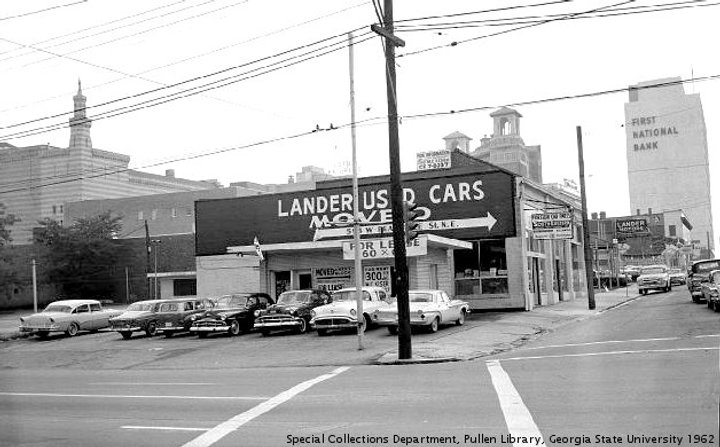
Pictures today are from Special Collections and Archives, Georgia State University Library. The social media picture was taken in June of 1962. “Landers Motors, West Peachtree Street and North Avenue looking east” ©Luther Mckinnon 2026 · selah
How Do White People Talk?

This content was published June 2, 2010. … I was reading another episode in the latest orgy of mid east punditry, when a couple of things made me think. The first was a breakdown of the Knesset. Towards the end of the tally, it came out that the two Arab parties had 7 seats, out of 120. This works out to 5.83%. According to wikipedia, 20% of Israel is Arab. So one fifth of the population is represented by 5 percent of the Knesset? This is not exactly one man one vote. If Israel is really a democracy, then something should be done about that.
“Israel’s policy-making no longer seems to me to be particularly related to concrete policy objectives at all. Neither the Lebanon war nor the Gaza war had actual military goals. Both were essentially wars for domestic consumption. Hezbollah and Hamas were firing rockets at Israel, and Israelis were understandably furious. “Something” had to be done about that, to let the Israeli public know that their leadership felt their fury. So the government did “something.””
Which is more or less why the United States is in Afghanistan. When 911 happened, the people required revenge. The plotters for 911 lived in Hamburg, Germany. 15 of the 19 attackers were from Saudi Arabia. For various reasons, revenge against those countries was not an option. That left Afghanistan, where Al Queda was based. … When we attacked Afghanistan, we did not have a goal. All we wanted was revenge for 911. We wanted to do something. Almost nine years later, we are stuck. … HT to Andrew Sullivan for the article quoted above.
This content was published June 7, 2010. … I was paying for dinner, when a cafeteria worker made a tacky comment to the cashier. When the worker left, the cashier and I exchanged looks that said, in effect, that guy is an idiot.
The cashier started to ramble, and she told a story of how she called someone hon. This is something that people in the south do, when they don’t say sweetie or sugar, they say hon, which is short for honey. The cashier said hon to someone, and the person was amazed. This person said that they had never heard a black person say that. They thought that was how white people talk. The cashier then asked, “how do white people talk?” I replied, “too much.”
This content was published June 13, 2010. … A woman in a hot air balloon realized she was lost. She lowered her altitude and spotted a man in a boat below. She shouted to him, “Excuse me, can you help me? I promised a friend I would meet him an hour ago, but I don’t know where I am.” … The man consulted his portable GPS and replied, “You’re in a hot air balloon, approximately 30 feet above ground elevation of 2,346 feet above sea level. You are at 31 degrees, 14.97 minutes north latitude and 100 degrees, 49.09 minutes west longitude.
“She rolled her eyes and said, “You must be an Obama Democrat.” “I am” “How did you know?” “Well,” answered the balloonist, “everything you told me is technically correct. But I have no idea what to do with your information, and I’m still lost. Frankly, you’ve not been much help to me.”
The man smiled and responded, “You must be a Republican.” “I am,” replied the balloonist. “How did you know?” “Well,” said the man, “you don’t know where you are or where you are going. You’ve risen to where you are due to a large quantity of hot air. You made a promise you have no idea how to keep, and you expect me to solve your problem. You’re in exactly the same position you were in before we met, but somehow, now it’s my fault.”
“The real question you might be asking yourself right now is why was the man in a boat? You understand, as a map savvy person, that 31 degrees 14.97 minutes North and 100 degrees 49.09 minutes West puts the balloon about 20 miles southwest of San Angelo, Texas, probably still in the city limits of Mertzon, Texas, just off U.S. Highway 67. He’s a few miles west of any significant boat-supporting body of water.”
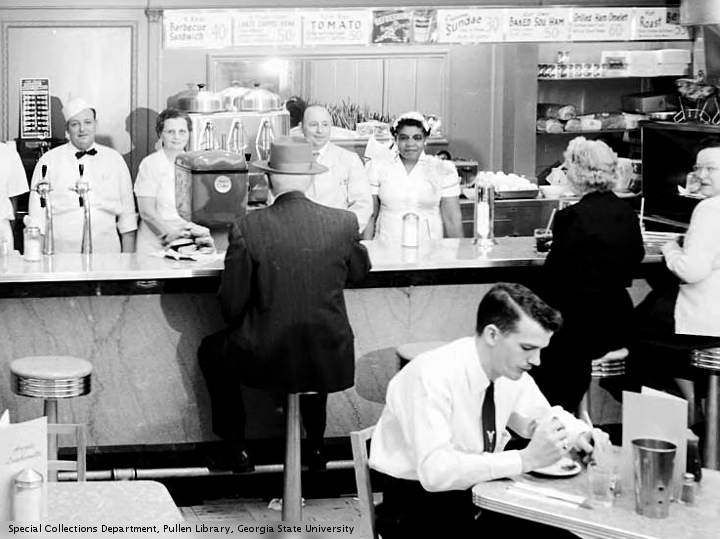
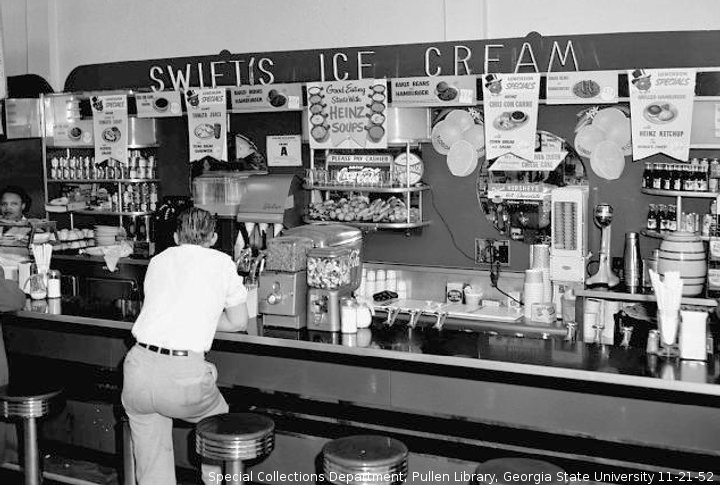
Today’s entertainment was borrowed from Millard Fillmore’s Bathtub, from a comment at Crooks and Liars. MFB added the commentary about 31°14.97′ N and 100°49.09′ W. … Pictures today are from Special Collections and Archives, Georgia State University Library. The social media picture was taken November 21, 1952. Wheeler’s Pharmacy soda fountain. ©Luther Mckinnon 2026 · selah

Midtown
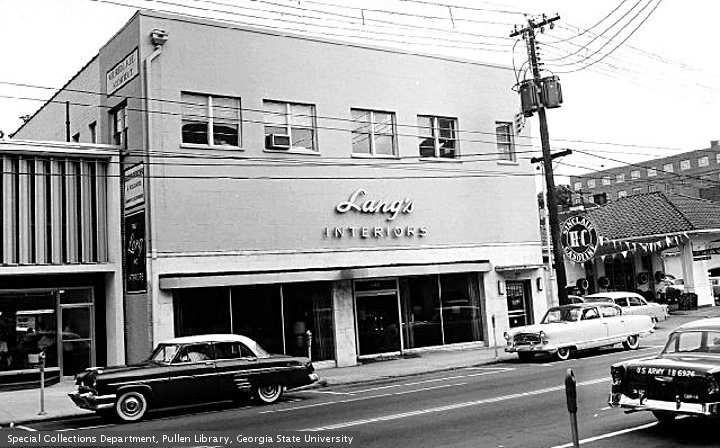
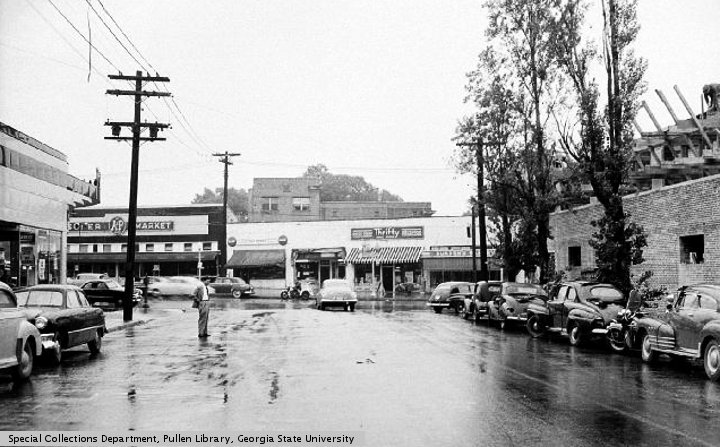
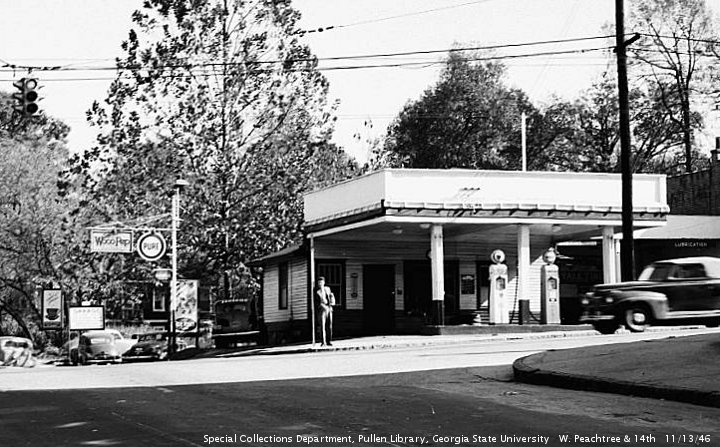
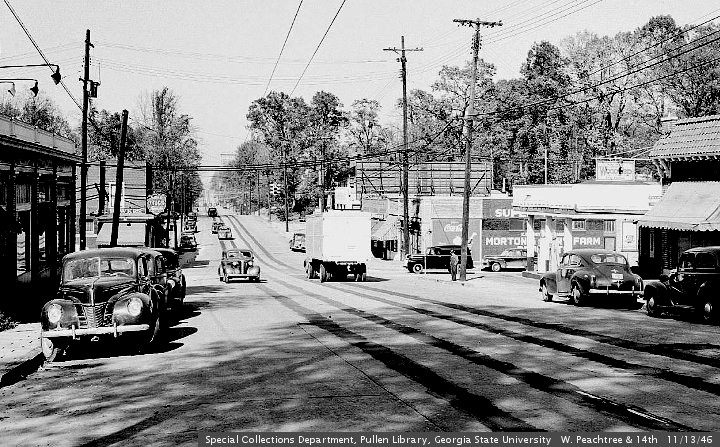
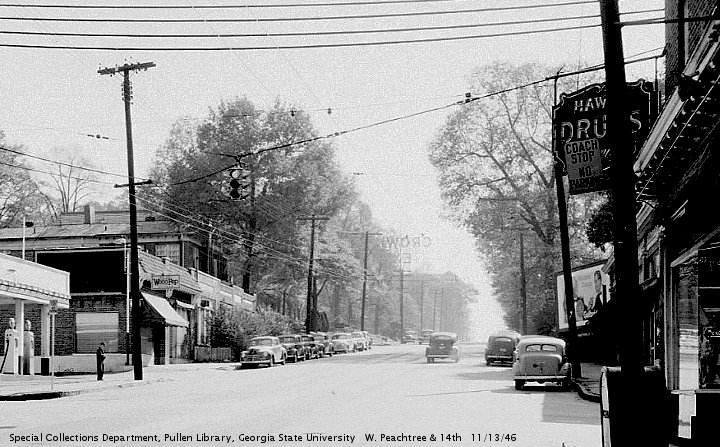
This content was posted June 4, 2013. … The neighborhood along Peachtree Road has always been a great place to be a freak. For a long time it didn’t have a name. It is north of downtown, between Piedmont Park and Georgia Tech. Sometime in the early eighties, people started to call it Midtown, and the name stuck.
In the time after the War Between the States, this area was a shantytown called “Tight Squeeze.” It evolved into a pleasant middle class area. In the sixties, hippies took over. The area was known as the strip, or tight squeeze. Many stories could be told.
After the flower children moved on, the area went into decline. Gays started to move in, with the battle cry “Give us our rights or we will remodel your house.” Developers, worshiping the triune G-d of location, location, location, began to smell money. The neighborhood became trendy, then expensive, then more expensive. The freaks with money remain.
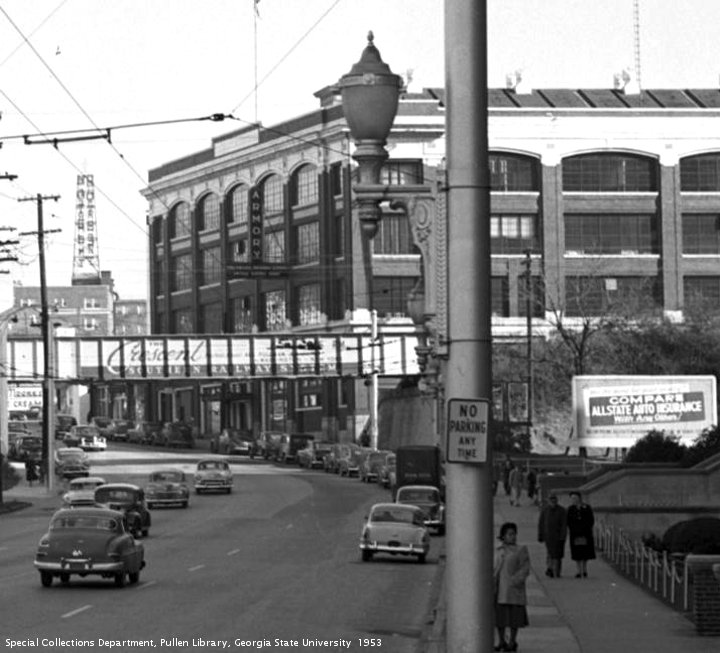
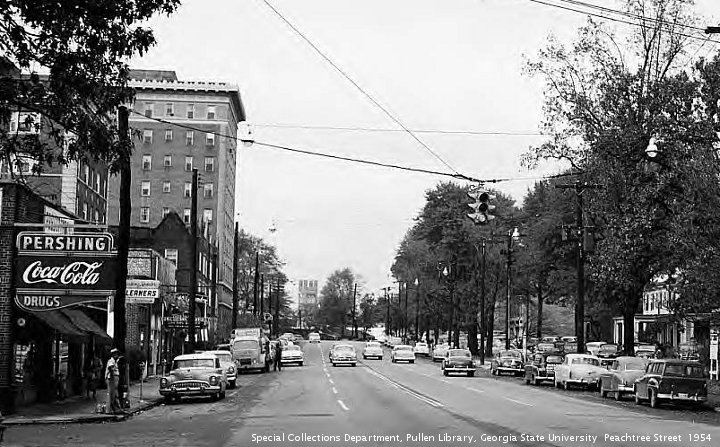
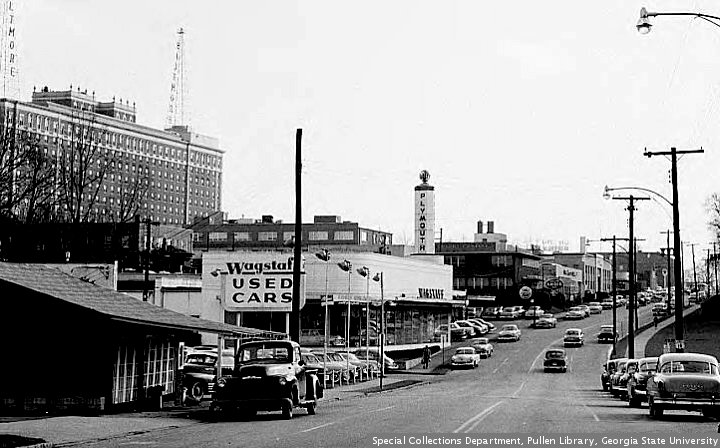
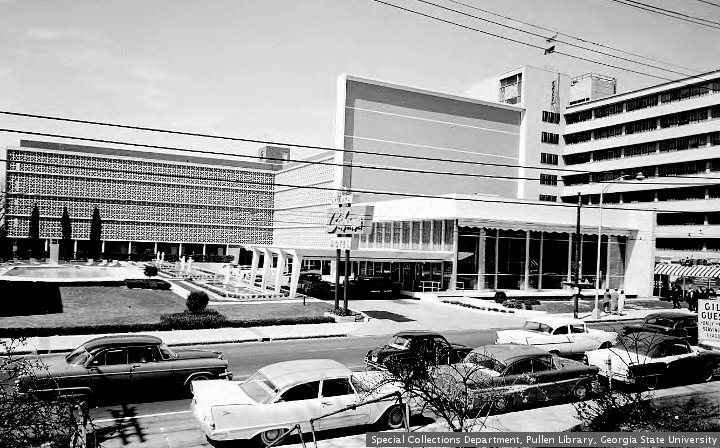
This content was posted August 4, 2009. … There is a nifty webcam up now. It shows the progress of 1010 Midtown, a high rise going up at 12th and Peachtree in midtown. The location of the camera itself is not certain. The most likely location is 999 Peachtree, on Tenth Street.
A glance at the image reveals a curve in the road, between the two glass boxes under construction. Atlanta does not have wide, straight boulevards extending to the horizon. It is said that Atlanta did not build roads, but paved the cow paths.
People of a certain age will remember this area as the the strip. The tenth street district was a neighborhood shopping area, up until the mid sixties. At some point, the old businesses started to move out and the hippies moved in. For a while, it was a festive party. Soon reality returned, and the area went into a crime filled decline.
The 999 complex is the neighborhood story in a nutshell. Before 1985, it was a block of small businesses. There was a hardware store, with the peace symbol set in tiles on the sidewalk. On Juniper Street stood the Langdon Court Apartments. They were named for my great uncle Langdon Quin.
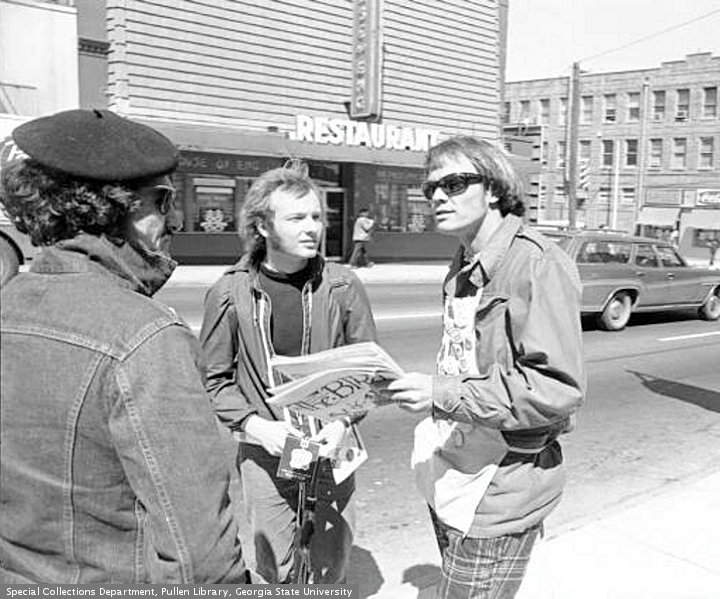
Across the street was a Chinese restaurant, the House of Eng. A staircase on the side led to the Suzy Wong Lounge. Behind the building was an apartment building. It was one of the residences of Margaret Mitchell, while she wrote “Gone With The Wind.” She called it “the dump,”which was fairly accurate. The museum on that site would have amazed her.
I went to the House of Eng for lunch one day in 1985. I noticed that I was the only customer in the house, at 12:30 pm on a weekday. After finishing lunch, I knew why.
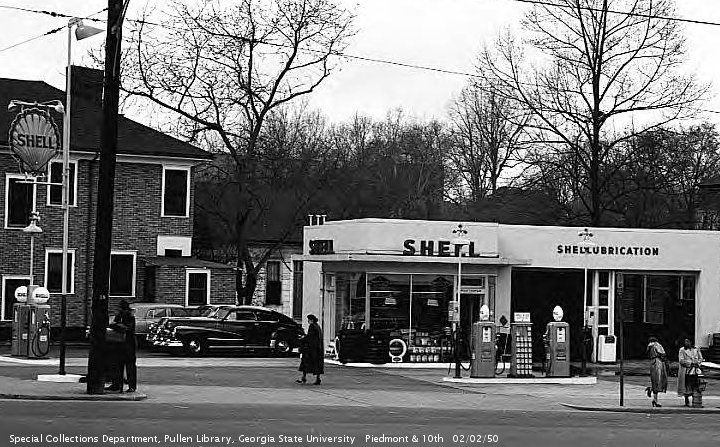
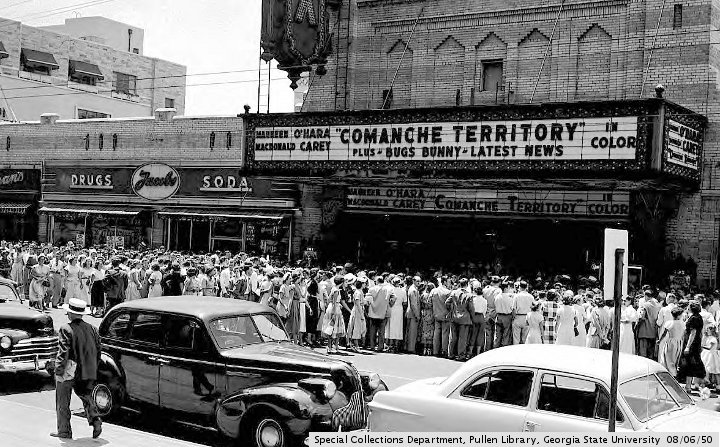
At some point, it was decided to build a high rise there. Heery was one of the equity partners, along with a law firm and an ad agency. The building was designed by Heery (duh).The ad agency folded before the building opened, followed within a couple of years by the law firm. Heery was sold to a British company. 999 Peachtree is now owned by Piedmont Office Realty Trust. … Pictures today are from Special Collections and Archives, Georgia State University Library “Dub” took the social media photograph February 2, 1950. “Shell service station Piedmont and 10th streets.”
©Luther Mckinnon 2026 · selah


leave a comment