Hiroshima 71 Years Later




At 8:15 am, August 6, 1945, Hiroshima got nuked. It was the start of a new era. Since Japan is 13 hours ahead of Georgia, and standard time was used, the literal anniversary is 8:15 pm, August 5.
Tsutomu Yamaguchi was working in Hiroshima when the bomb hit. He survived, and found a train to take hime to his home town, Nagasaki.
The device dropped on Hiroshima, the Little Boy, had an estimated force of 13 kilotons of Trinitrotoluene, or TNT. A kiloton of TNT is roughly a cube whose sides are ten meters. This device is fairly tiny compared to many of the warheads developed since. Many of the modern appliances are measured in megatons, or millions of tons of TNT. The Soviet Union had a bomb with a capacity of 50 megatons, or 4,000 times the size of the Little Boy.
The largest weapon tested by The United States is the Castle Bravo. This device destroyed Bikini Atoll in the Pacific. The two piece swimsuit was named for this island. The Castle Bravo device had a yield of 15 megatons of TNT. This is roughly 1,000 times the power of the Little Boy.
The decision to drop the bomb has long been controversial. There are a lot of factors and gray areas, and the issue does not lend itself to sound bite solutions. The conventional wisdom is that Japan surrendered because of the nuclear attack. This meant the war was shortened by at least a year, there was no invasion of Japan, and many lives were saved. PG is scared by the moral calculus involved in a decision like this….do 100,000 civilian deaths prevent the deaths of 500,000 soldiers? PG suspects that even G-d herself would lose sleep over that one.
There is also evidence that the bomb was not needed. Japan was whipped in August 1945. The air raids were conducted in daylight with little resistance. A debate was going on in the Japanese government on whether to continue the fight.
An event happened the day between Hiroshima, and Nagasaki, which influenced the Japanese decision to surrender. The Soviet Union had agreed to help the United States with the war against Japan. On August 8, The Soviet Union invaded Japanese occupied Manchuria. There are indications that Japan knew the fight was hopeless at this point, and would rather surrender to The United States than The Soviet Union. This is one of the gray areas that never seems to be mentioned.
The United States wanted the war to end quickly for obvious reasons, and a few subtle ones. America did not want to share the spoils of Japanese war with The Soviet Union. There were already tensions between the two allies, and the cold war was not far off. Many felt The United States used the Little Boy as a warning to The Soviet Union.
When you get your moral software out, you might want to figure in the effect of opening the nuclear Pandora’s box. Would the nuclear bomb have been developed by other countries if America had not led the way? The science is not that complicated…after all, America hit paydirt with the Manhattan Project fairly quickly. Nonetheless, there is karma involved in using a terrible new device on a civilian population. The United States started the wind of the arms race, and has yet to feel the whirlwind.
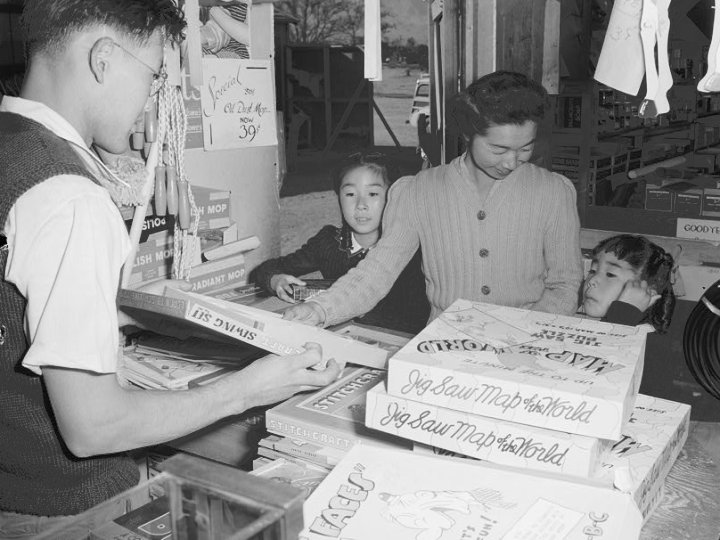
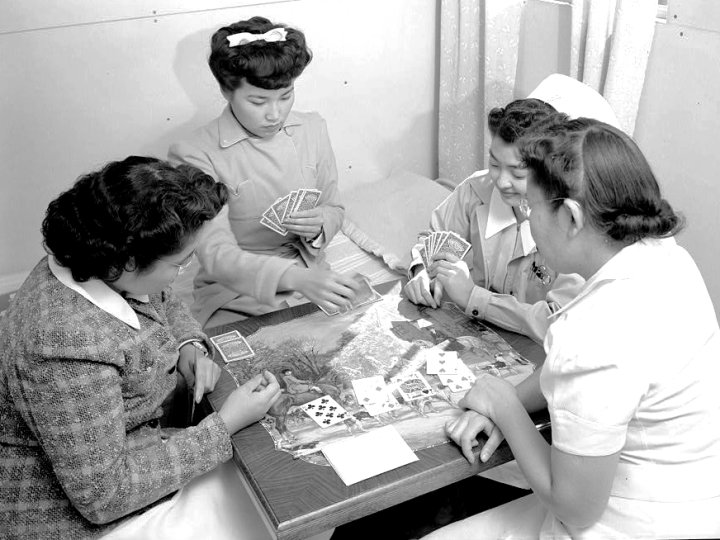
This is a repost. The pictures are from The Library of Congress. Ansel Adams took pictures of Japanese Americans, in a World War Two internment camp. The ladies in the bridge game are Aiko Hamaguchi, Chiye Yamanaki, Catherine Yamaguchi, and Kazoko Nagahama.


Rumors Of War

Matt Taibbi (pronounced like Tybee Island) spent some quality time with his computer the other day. The post was about the Tea Party, but took a couple of detours en route.
The preamble was about the execution of John Wayne Gacy . For those with short memories, Mr. Gacy was not a nice man. He entertained children wearing a clown costume, before he molested and murdered children. The crawl space to his Illinois home was used for storage. After a while, Mr. Gacy was caught, and sentenced to die.
This is where the story kicks in. A friend of Mr. Taibbi covered the scene outside the prison, on the night that Mr. Gacy was poisoned by the state. A festive crowd had gathered to celebrate. As the party was breaking up, the reporter started to interview a young man. The chat went like this: “You’re not against capital punishment, are you?” “I’m not against capital punishment,I’m against enjoying capital punishment.”
A few years ago, PG was working with someone who told stories. A celebrity murderer was going to be executed, this time using the electric chair. An Atlanta radio station had a parking lot party to celebrate the frying. (PG cannot remember the name of the murderer, nor the state of the execution). The wife of the co worker baked a cake to celebrate the occasion. It was decorated with a bright yellow icing, to resemble a fried egg.
The arguments for and against capital punishment are many. For the foreseeable future, it is a fact of life in Georgia. PG (who has written several posts on the subject ) feels that, while there are some despicable people, the justice system is too flawed to administer capital punishment properly. At the very least, the execution of a criminal is not a time for celebration.
Capital punishment is compared to war, abortion, and euthanasia. All are times where a conscious decision is made to end a human life. Is it proper to enjoy any of these activities?
The easy one is euthanasia. Does anyone enjoy euthanasia, or spend much time campaigning against it? The case of Terri Schiavo is the most prominent, and some did try to make political hay out of it. That really didn’t catch on, as many people saw the shades of gray involved, and were mostly glad they were not the one to make the decision.
Do people enjoy abortion? The procedure itself is not celebrated, and is cloaked in quiet shame. On the other hand, PG suspects that the opponents of abortion are having a bit too much fun with their activities. The morality of using abortion as a vehicle for power is another subject for debate.
Do people enjoy war? HELL YEA. Firing up people on the home front is an essential part of a successful war. When the conflict drags on, and victory or truce begins to seem impossible, the war may lose some of it’s luster. The glamorization of war makes the conflict much more likely. Maybe if the attitude about war was similar to the attitude about euthanasia, we would have less of them.



Tom Dispatch has an audio feature about Afghanistan, and the many unanswered questions about our war there. It is apparent to PG that we invaded Afghanistan to get revenge for 911, and looked for a reason later.
Tom begins the monologue by discussing the prospects for Gen. Petraeus (spell check suggestions:Petroleum, Perpetrates,) and how a success there may actually be worse than failure. If we “conquer” Afghanistan, we will hold “the fifth poorest country on earth, the second most corrupt country, the world’s premier narco state.”
At the 3:06 mark on the tape, when Tom makes the comment about narco (spell check suggestions: Narcissus) state, PG had a flash of understanding, and a possibility for the reason behind this war. This may even have been powerful enough for the powers that be to ignore the reports about a terror strike in September 2001, and passively let 911 happen.
The rumors of CIA involvement in drug trafficking are wide spread and long term. When planes went to Central America in the eighties to bring arms to the contras, they came back to the United States loaded with cocaine. There are stories of collusion with the government in Cuba. There are many, many more stories about connections between the US government and the drug trade.
When the Taliban took over Afghanistan, they cracked down on the poppy farmers. Much of the raw opium for heroin/morphine/opium is grown in Afghanistan. This was not a pleasing for the CIA.
Could it be that the real reason for our involvement in Afghanistan is to ensure the flow of narcotics into the hungry world? This would be a big cash cow for the CIA, although not enough to justify the amounts of money being spent on the conflict.
This is a double repost. Pictures are from The Library of Congress.




The Worst Vice Presidents Of The United States


PG wrote a post yesterday. One of the topics was the “Siamese Twins”, James Buchanan and William Rufus King. While researching the feature, PG googled his way to a Time magazine article about the Worst Vice Presidents in American History. PG is well known for his negative attitude, and writing about the worst things in life always appeals to him. (To see the feature, you have to click through a popup ad for Amway. Good times.) This is a repost, with pictures from The Library of Congress
The first name on the list is Aaron Burr. He had a problem with Alexander Hamilton, and shot him dead in a duel. Elbridge Gerry (the namesake of Gerrymandering) served under James Madison for twenty months, and died. John C. Calhoun served under John Quincy Adams and Andrew Jackson, and managed to get Mr. Jackson so upset that Mr. Calhoun was fired.
Richard M. Johnson served under Martin Van Buren, and was bad at PR. “Johnson scandalized his colleagues by taking one of his slaves as his common-law wife; as a result, he barely garnered enough support to serve in Martin van Buren’s administration. While in office, he proposed an expedition to the North Pole so Americans could drill to the center of the Earth, believing the planet was hollow (his resolution was defeated). Evidently van Buren’s experience with Johnson soured him on vice presidents altogether — when he ran for re-election he dropped Johnson from his ticket and didn’t bother replacing him. Instead, he ran alone.”
William Rufus King was VP under Franklin Pierce a mere six weeks before he died. There is no word on the status of his relationship with James Buchanan at the time. The Time magazine article has a picture of Fernando Wood , which was mistakenly thought to be of Mr. King. (Wikipedia uses the same picture to illustrate an article about Mr. King.)
The VP under James Buchanan (there is no word on who was top or bottom in the Buchanan-King household) was John Breckinridge. During the War Between the States, he left the Union to fight for the Confederacy. Mr. Breckinridge was charged with treason after the war. “The town of Breckenridge, Colorado is named in his honor — although it altered the spelling of its name after the Civil War, so as not to be associated with a traitor.”
Andrew Johnson did not make the list, but maybe should have. He was drunk at his inauguration, and made a fool of himself. Mr. Lincoln had nothing to do with him, until a meeting on April 14. This was Good Friday. Mr. Lincoln went to the theater that night.
Johnson had been marked for death by the conspiracy, but Wilkes Booth had little confidence in the man assigned to kill Mr. Johnson. The afternoon of the assassination, Mr. Booth was at the Kirkwood House, where Mr. Johnson stayed. Mr. Booth left a note for Mr. Johnson at the desk of the hotel… “Don’t wish to disturb you. Are you at home. J. Wilkes Booth”. The idea was for the police to find the note, and implicate Mr. Johnson in the killing of Mr. Lincoln. This mini plot was spoiled by the secretary for the Vice President, who collected the mail that afternoon. He took the card with him. The secretary had met Mr. Booth a few years earlier, and thought the note was for him.
The other three Vice Presidents who took office after the boss was murdered… Chester Arthur, Theodore Roosevelt, and Lyndon Johnson… were not mentioned in the Time article. All three are mentioned in conspiracy theories about the killings that promoted them into office.
When Theodore Roosevelt was elected to a full term as President, his VP was Charles Fairbanks. “Teddy once ordered a noisy and distracting crystal chandelier removed from his office because it disturbed him. He ordered it to be installed in the office of the Vice President to keep him awake.”
Getting back to Time’s honor roll, Hannibal Hamlin was Lincoln’s first VP. Thomas A. Hendricks survived nine months under Grover Cleveland, before passing away. Thomas Marshall served two terms with Woodrow Wilson, and refused to take over the office when Mr. Wilson had a stroke. Calvin Coolidge did little while waiting for Warren Harding to die. Henry Wallace was, and will be, the only third term VP in our history. He acquired a few enemies, and was replaced by Harry Truman.
Richard Nixon was ok once he got elected, but almost managed to blow that. There were charges of financial shenanigans, and some thought he should be kicked off the ticket. After the Checkers Speech he was on his way to stardom. (After Mr. Nixon died, PG saw a large flag flying at half staff. The flag belonged to a hamburger chain called Checkers.) When Mr. Nixon became President, his VP was Spiro Agnew. Once again, there were charges of financial shenanigans, and much, much more. While the nation wallowed in Watergate, Mr. Nixon needed a diversion. It was suddenly discovered that Mr. Agnew had taken bribes. He was pressured into resigning.
Dan Quayle was VP for George H.W. Bush. He was widely regarded as an idiot, although his damage as VP was minimal. The last VPOTUS on the list is Dick Chaney. For some reason, he was regarded as having more power than the President, George W. Bush. Mr. Chaney was said to be one of the major promoters of the wars which have damaged America so much during the last ten years.


The Origin Of Barbie

PG found a copy of Snuff at a yard sale. The story was written by Chuck Palahniuk, pronounced paula nick. This book report may have spoilers.
The 197 pages recount an attempt to break a world record. Aging porn star Cassie Wright is trying to take on 600 men in one session. The plan is to die, in a blaze of gooey glory. The story is told by four characters: Mr. 72, Mr. 137, Mr. 600, and Sheila. Each of the four feels a connection to Miss Wright. It is a case of four wrongs making one Wright.
The story gets weirder and weirder. Mr. 72 is convinced that he is the son of Cassie Wright. Mr. 137 became an Okla-homo after being diddled by daddy. Mr. 600 is said to be Miss Wright’s baby daddy. Sheila, original name Zelda Zonk, was another possible Wright baby. After a while, the reader just plows ahead. When PG pays a dollar for a book, he wants his money shot money’s worth.
Snuff has a couple of gimmicks that are repeated to the point of no return. The talent is known by a variety of names, like pud puller, wiener wrangler, page paster, fist flogger, white washer, and sherbet shooter. The movies made by Cassie Wright all had satirical titles, like World Whore One, and The Asshole Jungle. It was funny the first twenty times.
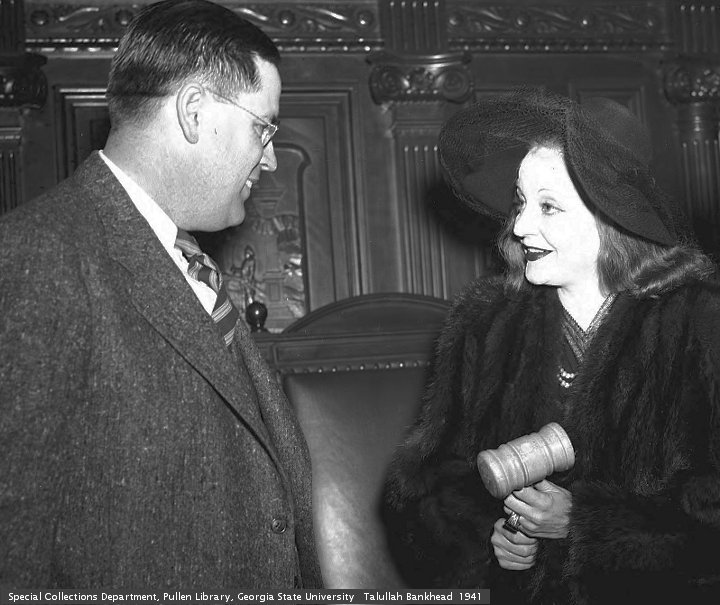
Another gimmick Mr. Nick works us with is the “true fact.” Someone will throw out a chestnut, and say “true fact.” Many of them are Hollywood beauty secrets, like Lauren Becall, and Tallulah Bankhead, drinking eggshell tea. Here is an example.
“… Hitler … was disgusted by seeing his fellow soldiers visit French brothels. To keep the Aryan bloodlines pure,and prevent the spread of venereal disease, he commissioned an inflatable doll that Nazi troops could take into battle. Hitler himself designed the dolls to have blond hair and large breasts. The Allied firebombing of Dresden destroyed the factory … “
Mr. Google has more. “But in 1942 the project was halted when German soldiers refused to carry the dolls because of the potential embarrassment if they were captured by the enemy. Author Graeme Donald uncovered Hitler’s secretive “Borghild Project” while researching the history of Barbie, which was based on a postwar German sex doll.”
“I was actually researching the history of the Barbie doll that was based on a German sex doll of the 1950s. Ruth and Elliot Handler from America visited Germany in 1956 and saw the Lilli dolls that were sold in barbers’ shops and nightclubs – and were not for children Ruth didn’t realise this and bought one and realised later they were not toys. But Ruth and her husband used the doll as a foundation for what became Barbie.”
Pictures are from “The Special Collections and Archives, Georgia State University Library”.


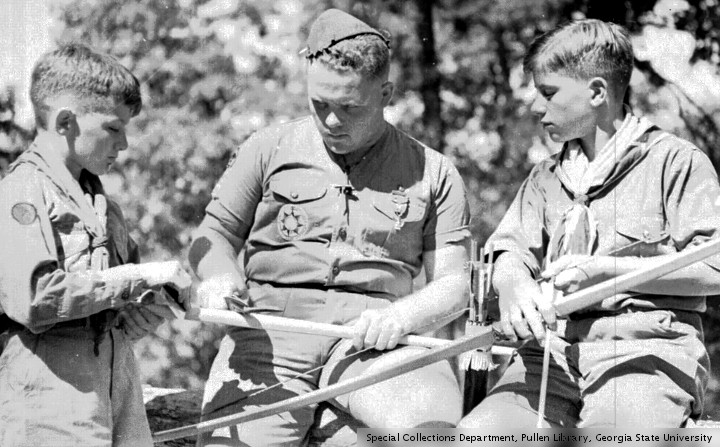


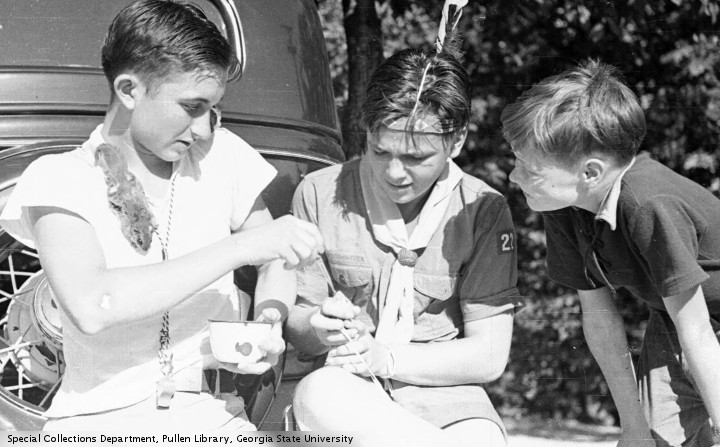
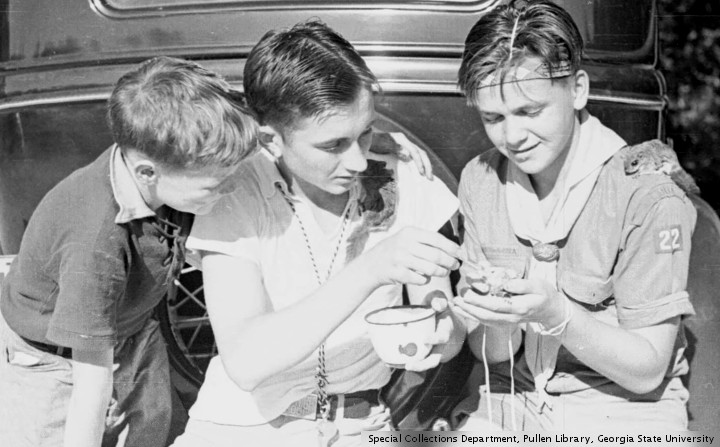
Luther C. Mckinnon
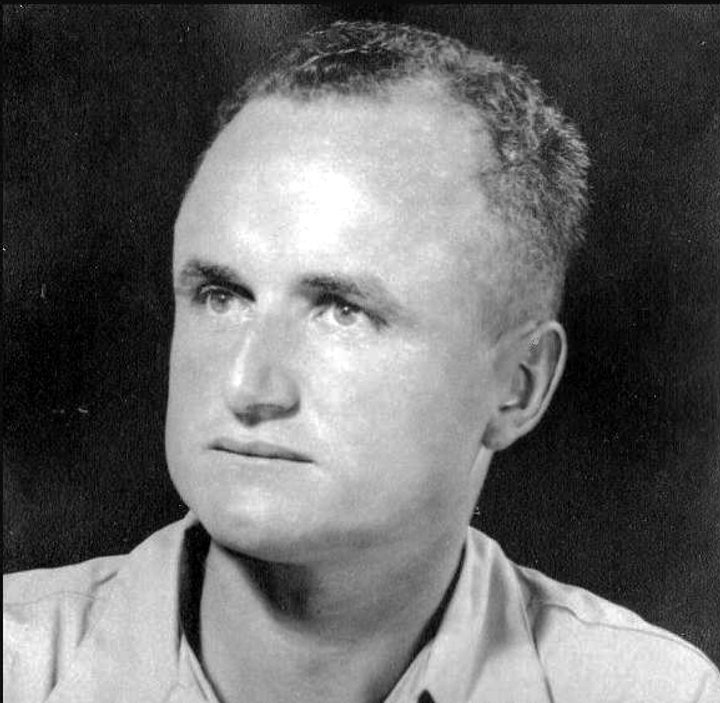

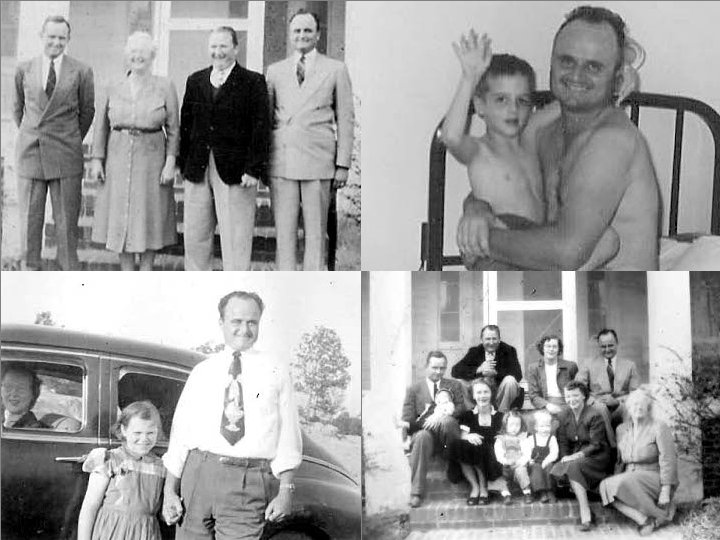
Luther Campbell McKinnon Sr. was born February 22, 1916, on a farm in Rowland, North Carolina. Europe was stuck in a war that would change the world, and not until The United States got involved. This didn’t happen for another year.
Luke was the youngest of four children. After life as a farm boy, he went to Wake Forest University, and then came back when his Daddy died. He ran a family dairy for a few years, and went to live in New Jersey. He lived near a prison, and saw the lights dim when the electric chair was used.
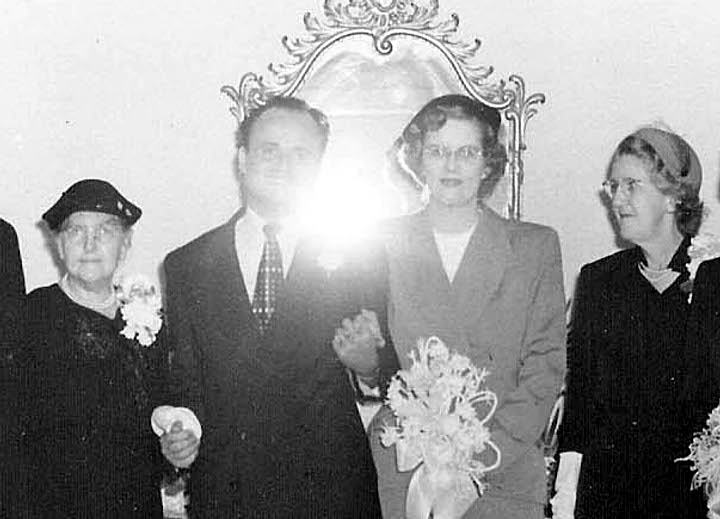
In the early fifties, he came to Atlanta to live. This was where his sister Sarah stayed, with her husband and two daughters. One day he went into the C&S bank on 10th street, and took notice of one of the tellers. On October 6, 1951, he married Jean Dunaway. She was with him the rest of his life.
At some point in this era he started selling shoes. He would go to warehouses, gas stations, and wherever barefoot men needed shoes. He was “The Shoe Man” .
Before long there were two boys, and he bought a house, then another. The second house is the current residence of my brother and myself, and is probably worth 15 times what he paid for it. He had the good fortune to not buy in an area that was “blockbusted,’ as many neighborhoods were.
And this was his life. He tended a garden, went to the gym, and was in the Lions Club for many years. When he met Mom, she let him know that going to church with her was part of the deal. They found a church that was good for their needs, and made many friends there. The Pastor at Briarcliff Baptist, Glen Waldrop, was his friend.
When I think of the character of this man, there is one night, which stands out. My brother was away at the time. The day before, Mom had discovered she had a detached retina, and was in the hospital awaiting surgery. Her job had arranged a “leaf tour” by train in North Georgia, and she got one of her friends at work to take me. There was some mechanical trouble on the train, and it did not get back into town until 3am Monday morning. And yet, Daddy stayed at home, did not panic, and had faith that all of us would be back soon, which we were.
Through all the struggles of his life, Dad was cheerful, laughed a lot, and was good company. He left me with a rich repertoire of country sayings, and had many stories to tell. He was surprising mellow about black people, if a bit old fashioned. (In the south when I grew up, this was highly unusual).
Dad was always in good, vigorous health, and I thought he would be with us for a long time. Well, that is not how things work. A cancer developed in his liver, and spread to his lungs (he did not smoke). After a mercifully brief illness, we lost him on February 7, 1992. This is a repost.


The Night Muhammad Ali Fought In Atlanta

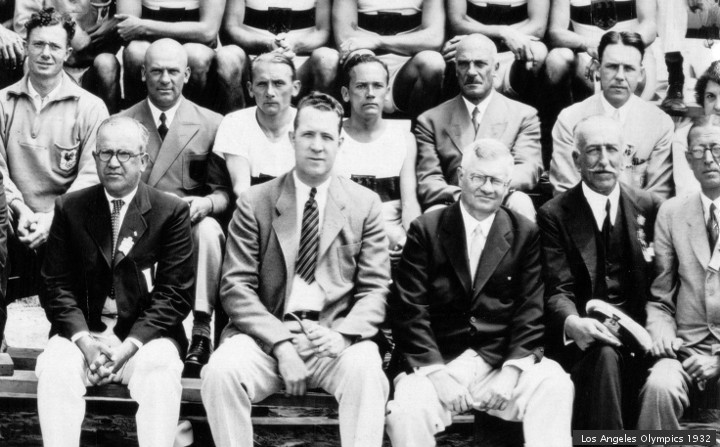


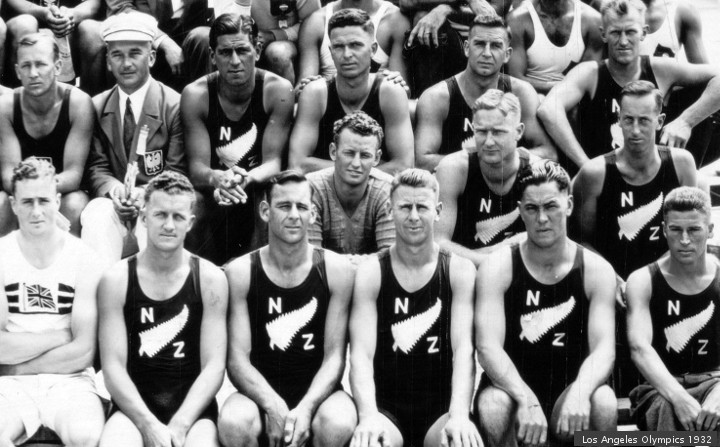
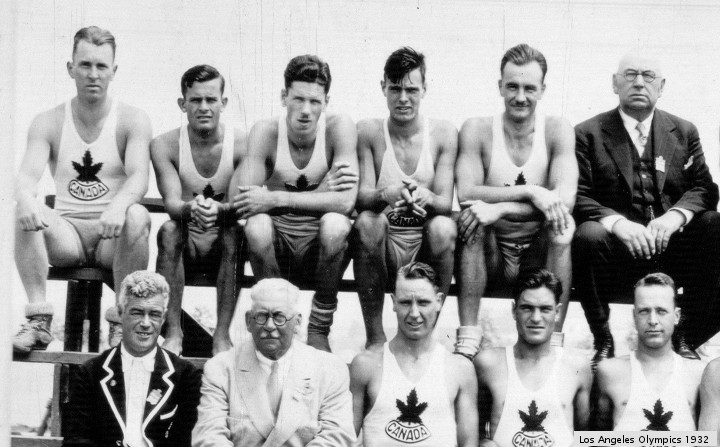
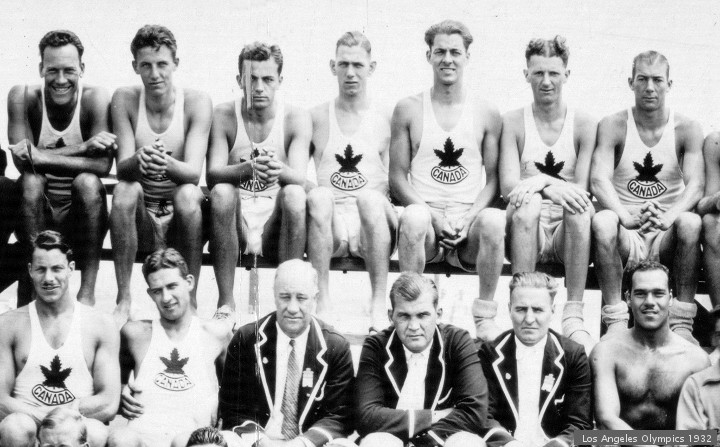


Many have noted that Muhammad Ali lit the Olympic torch in 1996. Few seem to remember another Atlanta appearance from the former Cassius Clay. It happened October 26, 1970, at the Municipal Auditorium. To get to this point, lets borrow a few lines from a Courier-Journal Ali Timeline.
1960 – “Clay defeats Zbigniew Pietrzykowski of Poland on Sept. 5 to win the light-heavyweight boxing gold medal at the Olympics in Rome…”
1962 – “Clay hears Elijah Muhammad speak for the first time. He meets another Nation of Islam leader, Malcolm X, who becomes a friend and adviser. – On March 9, the military draft board classifies Clay 1-A, meaning he is fit and available to be called into the Army…”
1964 -” Because of a low score on the Army intelligence test, Clay is reclassified 1-Y, not qualified for military service, in January. “I said I was The Greatest,” he explains. “I never said I was the smartest.” – Clay scores a stunning seventh-round technical knockout over 7-1 favorite Sonny Liston on Feb. 25 at the Miami Convention Center, winning the world heavyweight championship at age 22. – In response to a reporter’s question the day after the fight, Clay confirms he is a member of the Nation of Islam, saying: “I believe in Allah and in peace. … I’m not a Christian anymore. … Followers of Allah are the sweetest people in the world. They don’t tote weapons. They pray five times a day.” – A rift grows between Elijah Muhammad and Malcolm X. Ali sides with Elijah, causing grief for Malcolm. – Casting off his “slave name,” Clay adopts the temporary name Cassius X. Later he announces that Elijah has bestowed on him the name Muhammad Ali. The name means “Praiseworthy One.”…”
1965 – “Ali knocks out Liston in the first round of their rematch, before only 4,280 fans in Lewiston, Maine, on May 25. Liston falls under a “phantom” punch that apparently few people see, giving rise to suspicions that he threw the fight. Former champion Joe Louis eventually declares Ali “unfit” to hold the title. – In October, former champion Floyd Patterson says: “Cassius Clay is disgracing himself and the Negro race.” On Nov. 22, Ali delivers a punishing defeat to Patterson, in part, he says, because Patterson refuses to call him Ali….”
1966 – “With the Vietnam War heating up, the Army lowers test-score standards, reclassifying Ali 1-A — fit for service. – “Man, I ain’t got no quarrel with them Viet Cong,” he says to reporters who call him at home in Miami. He later explains that “no Viet Cong ever called me nigger.” – Ali asks to be reclassified a conscientious objector to military service. A hearing officer sides with him, but the draft board keeps him 1-A, armed with a U.S. Justice Department opinion that Ali’s objections to military service are political not religious….”
1967 – “On April 28, Ali refuses induction into the Army in Houston.” “It is the light of my consciousness as a Muslim minister and my own personal convictions that I take my stand in rejecting the call to be inducted in the armed services,” Ali stated after refusing induction on April 28, 1967. “I have searched my conscience and I find I cannot be true to my belief in my religion by accepting such a call.” He was convicted of draft evasion on June 20, 1967. Ali was sentenced to five years in prison and fined $10,000, the maximum penalty for the offense. He remained free on a $5,000 bond while he appealed his conviction. Ali was also stripped of the World Heavyweight Championship by the New York State Athletic Commission and the World Boxing Association, systematically denied a boxing license in every state and stripped of his passport. “
For three and a half years, Mr. Ali was unable to fight in the ring. The WBA had a tournament, and installed their own champion. People tried to set up a fight for Mr. Ali, but were blocked by politicians, and state boxing authorities. California Governor Ronald Reagan said “That draft dodger will never fight in my state, period.” Then someone had the idea to have the fight in Atlanta.
Atlanta has never been a boxing town. There was no boxing commission. The Municipal Auditorium, the only venue that could host, was a dump. As Ring magazine tells the story: “So it was the height of irony that it was Atlanta, a city that occupied the heart of the Deep South, that provided the breakthrough. State Senator Leroy Johnson and Governor Lester Maddox helped pave the way for a most improbable return by persuading the City of Atlanta Athletic Commission to grant Ali a boxing license on Aug. 12, 1970. Shortly thereafter, it was announced Ali would fight Jerry Quarry on Oct. 26 at the City Auditorium in Atlanta. The bout was scheduled for 15 rounds, probably in recognition of Ali’s status as lineal heavyweight champion.” (Other sources say that Governor Maddox was opposed to hosting the fight, but was powerless to stop it.)
The opponent was Jerry Quarry, whose white skin was apparent that night. His obituary notes: :His most famous night was in Atlanta, Georgia, in October 1970, when he was the “fall-guy” for Ali’s comeback from his three- year exile. Quarry was stopped because of a badly cut eye in the third round. It brought him his biggest payday, $338,000. … By 1995 he was in the care of his brother James, and was suffering from severe pugilistic dementia.” Jerry Quarry died January 3, 1999.
The fight was not much of a contest. It lasted three rounds, before the referee stopped the match. Mr. Ali fought for ten more years, and regained the Heavyweight Championship twice. “On June 28, 1971, the Supreme Court unanimously overturns Ali’s 4-year-old draft conviction, saying that his claims as a conscientious objector were based on religion and were sincere.”
The fight was the occasion for a display of black pride, and black money. The New Yorker essayist George Plimpton remembered that invasion of the Harlem peacocks in their enormous purple Cadillacs: “I’d never seen crowds as fancy, especially the men – felt hatbands and feathered capes, and the stilted shoes, the heels like polished ebony, and many smoking stuff in odd meerschaum pipes.”
“The times reported that the bout was like “a page out of the roaring twenties. … The ladies had beads down to the hem of their maxi-skirts. One man wore an ankle length mink coat, with a high hat of mink to match. … Diana Ross sat in the forth row, ringside, with a bouffant, Afro-American hair-do that stretched out 10 inches on each side.” Many of those in attendance were invited to a party.
“Engraved invitations to one party in particular had been passed around to the hustlers in New York a week earlier and in Atlanta in the days leading up to the fight. The invitations announced that “Fireball” was throwing a party at 2819 Handy Drive, in Collier Heights.
The Handy Drive house happened to be one of several properties that “Chicken Man” Williams owned. He’d given a friend, an Atlantan-turned-New-Yorker known as “Fireball,” permission to use the house. He’d even helped build a craps table the week before so all the big-time gamblers who were sure to show up could “roll the bones.”
Williams’ girlfriend, Barbara Smith, skipped the fight to help prepare for the party. She and two girlfriends were busy in the kitchen when they heard the front door open. The fight was still going on, so Smith went to the front, expecting to meet an early bird. She was greeted by three men in ski masks standing in the hallway. All were armed; one was pointing a shotgun at her face. …
An estimated 80 to 200 people had arrived at the house expecting to party, only to be fleeced by masked men with shotguns. According to news accounts, the victims were led to the basement, then ordered to strip to their underwear, throw all their valuables in a pile and lay on the floor…
As more victims arrived, floor space in the basement became scarce, so the gunmen ordered the victims to lie on top of each other. Cash and jewelry was swept into pillowcases. That went on for hours as more and more people kept showing up. By 3 a.m., the half-naked victims were stacked like cordwood on top of each other.
Not one shot was fired. But as they left, the gunmen took Smith and one of her friends hostage and told everyone else to stay put. Three hours later, they dropped the women off on the other side of town and gave them $10 each for cab fare. By that time, the investigation was underway.
Creative Loafing has a terrific story about the party at Chicken Man’s house. If you have a few minutes, it is worth your time. Ditto for this newspaper story, in the sucky google books format.
A key person in the story is J.D. Hudson. One of the first eight black Atlanta policemen, Lt. Hudson was Mr. Ali’s bodyguard the night of the fight. Lt. Hudson wound up conducting the investigation of the party at Chicken Man’s house. Lt. Hudson met Gordon “Chicken Man” Williams, under rather unpleasant circumstances, in 1949.
Lt. Hudson never suspected Chicken Man of being part of the robbery. “From the time he took over the case, Hudson says, he knew Williams wasn’t responsible — even though other investigators already had pinned the crime on him. For one thing, Hudson could place Williams at the fight at the time the gunmen were at the house setting up the crime.
For another, Hudson says, “I knew [Williams] wasn’t dumb enough to pull a stunt like that. This was a man who ran [a] million-dollar operation from a pay phone on a street corner. He was smart. He could’ve run IBM or Coke. There’s no way he would’ve risked all that to pay somebody off. This was pulled off by a bunch of young thugs who were trying to knock over a party, and when they got there and saw how big it was, they improvised.”
Chicken Man went to prison in the seventies, and became a minister. He served as the Pastor of the Salem Baptist Church. Gordon Williams died December 6, 2014. J.D.Hudson died June 4, 2009. The men who robbed the party goers were killed a few months after the fight.
Pictures today are from The Library of Congress.
Jane Fonda And J. Edgar Hoover



This repost is a work of speculation, and has no basis in proven fact.The thesis cannot be proved nor disproved. Pictures are from “The Special Collections and Archives, Georgia State University Library”.
Listening to talk radio while you drive is a dangerous activity. You might start to think, and look at the man behind the screen. Neal Boortz was on a rant today about Jane Fonda. It it the same story you have heard many times…she gave aid and comfort to the enemy, she is a traitor, American troops died because of her,she should have been executed.
Sometimes when you hear something too many times, you begin to have doubts about what you heard. A light bulb went off in PG’s head when he heard the Fonda Rant again.. .What if Jane Fonda was working for the US government when she went to Hanoi?
What was in it for the government? This trip gave our government a discredited leader of the antiwar movement to denounce. When the government was trashing Jane Fonda, they did not have to defend the disastrous policies of that war.
Miss Fonda has been an icon of right wing hatred ever since, as well as of military training. One story has Miss Fonda giving the North Vietnamese information about activities by American forces. How would she get this information?
The infamous trip to Hanoi took place in the Summer of 1972. American troops were being withdrawn, and anti war protests lost most of their passion. (It was also soon after the death of F.B.I. Director J. Edgar Hoover, and the Watergate burglary) The war in Vietnam was essentially over for America. We were no longer trying to win, but to negotiate a face saving treaty. President Nixon called it “Peace with Honor”. Miss Fonda’s actions had little impact on these negotiations.
Miss Fonda made some radio broadcasts from Hanoi. Is it possible that coded messages to our troops were included in these broadcasts? Is it also possible that she gave the North Vietnamese misinformation on purpose?
Why would a women known for her left wing activism do such a thing? Maybe, the FBI had some dirt on her, and blackmailed her.
In 1967, Kurt Vonnegut published a book titled “Mother Night”. It tells the story of Howard W. Campbell Jr. Mr. Campbell made propaganda broadcasts for Germany in World War II, which were secretly used to pass coded messages to the Allies. He was condemned as a traitor after the war, but never prosecuted. He did not win an Academy Award.
The role of the government in this affair could have taken another role. Perhaps Miss Fonda was sincere in her actions, but aided by the government. Miss Fonda was under surveillance in 1972. The government would have known about her plans to go to North Vietnam, and perhaps could have stopped her. But, because her going to Hanoi was to their advantage, the government allowed the trip to take place.
The above is speculation, and could be horribly wrong. The fact that Miss Fonda has expressed regrets over her trip neither proves nor disproves this. She got great movie roles, and won two Academy Awards, during the seventies. This may be a coincidence, or maybe it was a reward for her service.
Clearly, the trip she made to Hanoi had propaganda value to the US government. It has been a Godsend over the years. You should always consider who benefits from an action.
During his rant today, Mr. Boortz said that US troops died because of Miss Fonda. (He does not discuss the man who went to Nam in his place, after his draft deferment.) By saying this, he can ignore the tens of thousands of troops who died because Richard Nixon chose to wait until 1973 to sign a “peace treaty”. He could have made the same deal in 1969. Peace with honor indeed.
A few days ago, the possibility that the government allowed Jane Fonda to go to Hanoi was discussed. Ms. Fonda’s trip to North Vietnam had numerous propaganda/p.r. advantages to the American government. Direct government sponsorship cannot be ruled out. Another scenario would have the government knowing about the trip, having the ability to stop the trip, but allowing it to happen. For the purposes of today’s discussion, we will call this the “Hoover Option”(HO). It is named for John Edgar Hoover, the publicity savvy director of the FBI until his death in 1972.
HO is a favorite of conspiracy theorists. It is difficult to prove or disprove, and explains a lot of things. Another conspiracy rich event is the shooting of John Kennedy on November 22, 1963. The various hypotheses on this event are well known. Numerous people wanted JFK to retire…gangsters, teamsters, Republicans, Lyndon Johnson, Vietnamese… to the point to where it is tough to sort out all the possible candidates. The thinking goes here, that J. Edgar Hoover knew of the plot to kill JFK, could have stopped it, but chose to allow it to happen. Even conspiracy skeptics think this is plausible.
The concept of Lee Harvey Oswald working alone does not eliminate the possibility of HO. Here was a sketchy character, known to have traveled to the Soviet Union, and favor “fair play for Cuba”. He worked in a building on the parade route. As much as the FBI knew…especially about those with Soviet connections…is it possible that Mr. Hoover knew what Mr. Oswald was going to do that Friday? And decided to allow it to happen. And why did Jackie choose that photogenic pink outfit?
A few years later, Dr. Martin Luther King Jr. was murdered in Memphis, TN. Mr. Hoover had a well known hatred of Dr. King. How did a sketchy character get a room, within gunshot range of the hotel Dr. King stayed in? How did he know when Dr. King would be stepping on the balcony? Did Mr. Hoover know all of this, and still allow the shooting to take place? Why was Jesse Jackson there?
J. Edgar Hoover died on May 2, 1972. This was 13 days before Arthur Bremer shot George Wallace, six weeks before the Watergate burglary, and eight weeks before Jane Fonda went to Hanoi. Mr. Hoover died at the height of the Nixon administrations “dirty tricks”, just a few weeks before they got caught. No doubt, Mr. Hoover knew what Tricky Dick was up to.
HO has probably been in existence throughout history. Most leaders have blood on their hands, and it is always better to get someone else to do the dirty work.
Pearl Harbor has long been the object of this speculation. There is little doubt that Mr. Roosevelt wanted the United States to join the war, but was having a tough time with an isolationist public. After the Japanese attacked Pearl Harbor, Mr. Roosevelt got what he wanted. It has long been speculated that he knew in advance about the attack, and let it go down. There were obvious advantages to him.
Which brings us to the Pearl Harbor of the modern era, 911. The attacks that day were a political jackpot for George W. Bush. He was able to ram many restrictions on civil liberties through congress, and begin a war in Iraq, that had clearly been planned for some time. Did our government know about plans for the 911 attacks, and quietly let them happen?

Happy Birthday Mr. Ginsberg

Allen Ginsberg would be 90 today, if nature had not made other plans in 1997. The son of Louis and Naomi Ginsberg arrived, in Newark NJ, June 3,1926.
Allen Ginsberg had a part in many new age dramas, with a few musicals and comedies thrown in for good measure. Hippie, beatnik, gay, artist, peace promoter, Buddhist convert…these are a few of the labels. He became famous for being famous, well known to people who never read a word of his poems. Two of the more famous were howl and kaddish.
Howl became scandalous in 1956 when it was busted for obscenity. It is mild by today’s standards, but almost landed Mr. Ginsberg in prison. PG heard about howl in the early nineties, and looked high and low for a copy. He could not find one. Today on the internet, not only is the text widely available, there are recordings of Mr. Ginsberg reading his work. (Here is an updated version, Howl 2011.)
The original plan was to listen to Mr. Ginsberg read while editing photos. PG was going to listen to the words, and think of something to say while listening to the bard. About the seventeenth time Mr. Ginsberg shouted “Moloch”, the plan began to fall apart.
The next poem was Kaddish. This is about Naomi Ginsberg, the mother of the poet, who evidently had some issues. This was tough for PG to listen to. The other night, PG had a disturbing dream about his own late mother. In this dream, a fearsome shouter came in wearing a black suit, which meant that he intended to do some scary shouting. PG went into another room, where his recently deceased mother was laying on a table.
1956 was the year of the obscenity trial for howl. This took place on the other side of america, from the Brookhaven where PG was two years old. This was the year when his brother was born, the year when the Georgia legislature voted in a new flag, for whatever reason. In 1955, President Eisenhower had a heart attack. Many wondered if it was a good idea to have Richard Nixon as the vice president.
Finally, PG could stand no more of that voice. The player was turned off, the files stored on an external hard drive, never to be heard again. PG just is not a poetry person. This is a repost, with pictures from “The Special Collections and Archives, Georgia State University Library”.


I Sing The Body Electric




1
I sing the body electric,
The armies of those I love engirth me and I engirth them,
They will not let me off till I go with them, respond to them,
And discorrupt them, and charge them full with the charge of the soul.
Was it doubted that those who corrupt their own bodies conceal themselves?
And if those who defile the living are as bad as they who defile the dead?
And if the body does not do fully as much as the soul?
And if the body were not the soul, what is the soul?
2
The love of the body of man or woman balks account,
the body itself balks account,
That of the male is perfect, and that of the female is perfect.
The expression of the face balks account,
But the expression of a well-made man appears not only in his face,
It is in his limbs and joints also, it is curiously in the joints of his hips and wrists,
It is in his walk, the carriage of his neck, the flex of his waist and knees,
dress does not hide him,
The strong sweet quality he has strikes through the cotton and broadcloth,
To see him pass conveys as much as the best poem, perhaps more,
You linger to see his back, and the back of his neck and shoulder-side.
The sprawl and fulness of babes, the bosoms and heads of women,
the folds of their dress, their style as we pass in the street,
the contour of their shape downwards,
The swimmer naked in the swimming-bath, seen as he swims through
the transparent green-shine, or lies with his face up and rolls
silently to and from the heave of the water,
The bending forward and backward of rowers in row-boats,
the horse-man in his saddle,
Girls, mothers, house-keepers, in all their performances,
The group of laborers seated at noon-time with their open dinner-kettles,
and their wives waiting,
The female soothing a child, the farmer’s daughter in the garden or cow-yard,
The young fellow hosing corn, the sleigh-driver driving his six horses
through the crowd,
The wrestle of wrestlers, two apprentice-boys, quite grown, lusty,
good-natured, native-born, out on the vacant lot at sundown after work,
The coats and caps thrown down, the embrace of love and resistance,
The upper-hold and under-hold, the hair rumpled over and blinding the eyes;
The march of firemen in their own costumes, the play of masculine muscle
through clean-setting trowsers and waist-straps,
The slow return from the fire, the pause when the bell strikes suddenly again,
and the listening on the alert,
The natural, perfect, varied attitudes, the bent head, the curv’d neck
and the counting;
Such-like I love—I loosen myself, pass freely, am at the mother’s breast
with the little child,
Swim with the swimmers, wrestle with wrestlers, march in line
with the firemen, and pause, listen, count.
3
I knew a man, a common farmer, the father of five sons,
And in them the fathers of sons, and in them the fathers of sons.
This man was a wonderful vigor, calmness, beauty of person,
The shape of his head, the pale yellow and white of his hair and beard,
the immeasurable meaning of his black eyes,
the richness and breadth of his manners,
These I used to go and visit him to see, he was wise also,
He was six feet tall, he was over eighty years old, his sons were massive,
clean, bearded, tan-faced, handsome,
They and his daughters loved him, all who saw him loved him,
They did not love him by allowance, they loved him with personal love,
He drank water only, the blood show’d like scarlet
through the clear-brown skin of his face,
He was a frequent gunner and fisher, he sail’d his boat himself,
he had a fine one presented to him by a ship-joiner,
he had fowling-pieces presented to him by men that loved him,
When he went with his five sons and many grand-sons to hunt or fish,
you would pick him out as the most beautiful and vigorous of the gang,
You would wish long and long to be with him, you would wish to sit by him
in the boat that you and he might touch each other.
4
I have perceiv’d that to be with those I like is enough,
To stop in company with the rest at evening is enough,
To be surrounded by beautiful, curious, breathing, laughing flesh is enough,
To pass among them or touch any one, or rest my arm ever so lightly
round his or her neck for a moment, what is this then?
I do not ask any more delight, I swim in it as in a sea.
There is something in staying close to men and women and looking on them,
and in the contact and odor of them, that pleases the soul well,
All things please the soul, but these please the soul well.
5
This is the female form,
A divine nimbus exhales from it from head to foot,
It attracts with fierce undeniable attraction,
I am drawn by its breath as if I were no more than a helpless vapor,
all falls aside but myself and it,
Books, art, religion, time, the visible and solid earth,
and what was expected of heaven or fear’d of hell, are now consumed,
Mad filaments, ungovernable shoots play out of it,
the response likewise ungovernable,
Hair, bosom, hips, bend of legs, negligent falling hands all diffused,
mine too diffused,
Ebb stung by the flow and flow stung by the ebb, love-flesh swelling
and deliciously aching,
Limitless limpid jets of love hot and enormous, quivering jelly of love,
white-blow and delirious juice,
Bridegroom night of love working surely and softly into the prostrate dawn,
Undulating into the willing and yielding day,
Lost in the cleave of the clasping and sweet-flesh’d day.
This the nucleus—after the child is born of woman, man is born of woman,
This the bath of birth, this the merge of small and large, and the outlet again.
Be not ashamed women, your privilege encloses the rest,
and is the exit of the rest,
You are the gates of the body, and you are the gates of the soul.
The female contains all qualities and tempers them,
She is in her place and moves with perfect balance,
She is all things duly veil’d, she is both passive and active,
She is to conceive daughters as well as sons, and sons as well as daughters.
As I see my soul reflected in Nature,
As I see through a mist, One with inexpressible completeness,
sanity, beauty,
See the bent head and arms folded over the breast, the Female I see.
6
The male is not less the soul nor more, he too is in his place,
He too is all qualities, he is action and power,
The flush of the known universe is in him,
Scorn becomes him well, and appetite and defiance become him well,
The wildest largest passions, bliss that is utmost, sorrow that is utmost
become him well, pride is for him,
The full-spread pride of man is calming and excellent to the soul,
Knowledge becomes him, he likes it always, he brings every thing
to the test of himself,
Whatever the survey, whatever the sea and the sail
he strikes soundings at last only here,
(Where else does he strike soundings except here?)
The man’s body is sacred and the woman’s body is sacred,
No matter who it is, it is sacred—is it the meanest one in the laborers’ gang?
Is it one of the dull-faced immigrants just landed on the wharf?
Each belongs here or anywhere just as much as the well-off, just as much as you,
Each has his or her place in the procession.
(All is a procession,
The universe is a procession with measured and perfect motion.)
Do you know so much yourself that you call the meanest ignorant?
Do you suppose you have a right to a good sight,
and he or she has no right to a sight?
Do you think matter has cohered together from its diffuse float,
and the soil is on the surface, and water runs and vegetation sprouts,
For you only, and not for him and her?
7
A man’s body at auction,
(For before the war I often go to the slave-mart and watch the sale,)
I help the auctioneer, the sloven does not half know his business.
Gentlemen look on this wonder,
Whatever the bids of the bidders they cannot be high enough for it,
For it the globe lay preparing quintillions of years without one animal or plant,
For it the revolving cycles truly and steadily roll’d.
In this head the all-baffling brain,
In it and below it the makings of heroes.
Examine these limbs, red, black, or white, they are cunning in tendon and nerve,
They shall be stript that you may see them.
Exquisite senses, life-lit eyes, pluck, volition,
Flakes of breast-muscle, pliant backbone and neck, flesh not flabby,
good-sized arms and legs,
And wonders within there yet.
Within there runs blood,
The same old blood! the same red-running blood!
There swells and jets a heart, there all passions, desires, reachings, aspirations,
(Do you think they are not there because they are not express’d
in parlors and lecture-rooms?)
This is not only one man, this the father of those who shall be fathers
in their turns,
In him the start of populous states and rich republics,
Of him countless immortal lives with countless embodiments and enjoyments.
How do you know who shall come from the offspring of his offspring
through the centuries?
(Who might you find you have come from yourself,
if you could trace back through the centuries?)
8
A woman’s body at auction,
She too is not only herself, she is the teeming mother of mothers,
She is the bearer of them that shall grow and be mates to the mothers.
Have you ever loved the body of a woman?
Have you ever loved the body of a man?
Do you not see that these are exactly the same to all in all nations
and times all over the earth?
If anything is sacred the human body is sacred,
And the glory and sweet of a man is the token of manhood untainted,
And in man or woman a clean, strong, firm-fibred body, is more beautiful
than the most beautiful face.
Have you seen the fool that corrupted his own live body?
or the fool that corrupted her own live body?
For they do not conceal themselves, and cannot conceal themselves.
9
O my body! I dare not desert the likes of you in other men and women,
nor the likes of the parts of you,
I believe the likes of you are to stand or fall with the likes of the soul,
(and that they are the soul,)
I believe the likes of you shall stand or fall with my poems,
and that they are my poems,
Man’s, woman’s, child, youth’s, wife’s, husband’s, mother’s, father’s,
young man’s, young woman’s poems,
Head, neck, hair, ears, drop and tympan of the ears,
Eyes, eye-fringes, iris of the eye, eyebrows, and the waking
or sleeping of the lids,
Mouth, tongue, lips, teeth, roof of the mouth, jaws, and the jaw-hinges,
Nose, nostrils of the nose, and the partition,
Cheeks, temples, forehead, chin, throat, back of the neck, neck-slue,
Strong shoulders, manly beard, scapula, hind-shoulders,
and the ample side-round of the chest,
Upper-arm, armpit, elbow-socket, lower-arm, arm-sinews, arm-bones,
Wrist and wrist-joints, hand, palm, knuckles, thumb, forefinger,
finger-joints, finger-nails,
Broad breast-front, curling hair of the breast, breast-bone, breast-side,
Ribs, belly, backbone, joints of the backbone,
Hips, hip-sockets, hip-strength, inward and outward round,
man-balls, man-root,
Strong set of thighs, well carrying the trunk above,
Leg-fibres, knee, knee-pan, upper-leg, under-leg,
Ankles, instep, foot-ball, toes, toe-joints, the heel;
All attitudes, all the shapeliness, all the belongings of my or your body
or of any one’s body, male or female,
The lung-sponges, the stomach-sac, the bowels sweet and clean,
The brain in its folds inside the skull-frame,
Sympathies, heart-valves, palate-valves, sexuality, maternity,
Womanhood, and all that is a woman, and the man that comes from woman,
The womb, the teats, nipples, breast-milk, tears, laughter, weeping,
love-looks, love-perturbations and risings,
The voice, articulation, language, whispering, shouting aloud,
Food, drink, pulse, digestion, sweat, sleep, walking, swimming,
Poise on the hips, leaping, reclining, embracing, arm-curving and tightening,
The continual changes of the flex of the mouth, and around the eyes,
The skin, the sunburnt shade, freckles, hair,
The curious sympathy one feels when feeling with the hand
the naked meat of the body,
The circling rivers the breath, and breathing it in and out,
The beauty of the waist, and thence of the hips,
and thence downward toward the knees,
The thin red jellies within you or within me, the bones and the marrow
in the bones,
The exquisite realization of health;
O I say these are not the parts and poems of the body only, but of the soul,
O I say now these are the soul!
Text for this adventure is from the Project Gutenberg.
The text was reformatted by Chamblee54.
“I sing the Body Electric” was written by Walt Whitman.
An audio version of this poem is available from Librivox.
Reposted May 31,2017, Walt Whitman’s 197th Birthday.
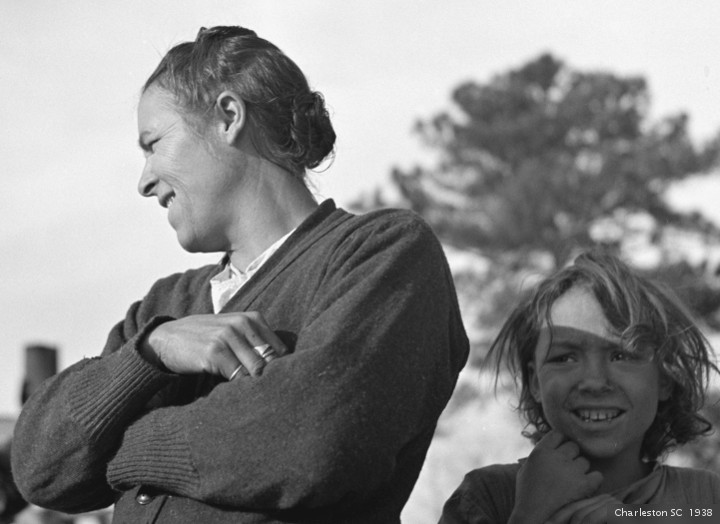
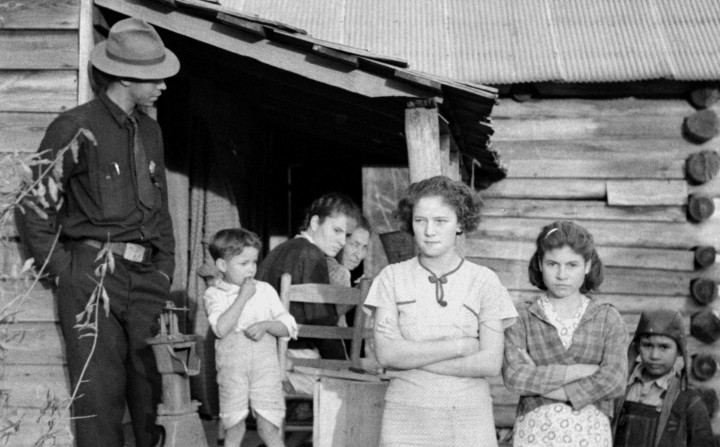
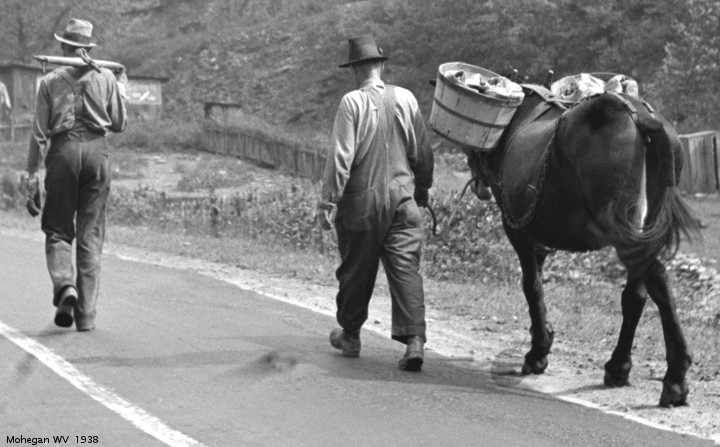
Pictures from The Library of Congress.



HBDBD
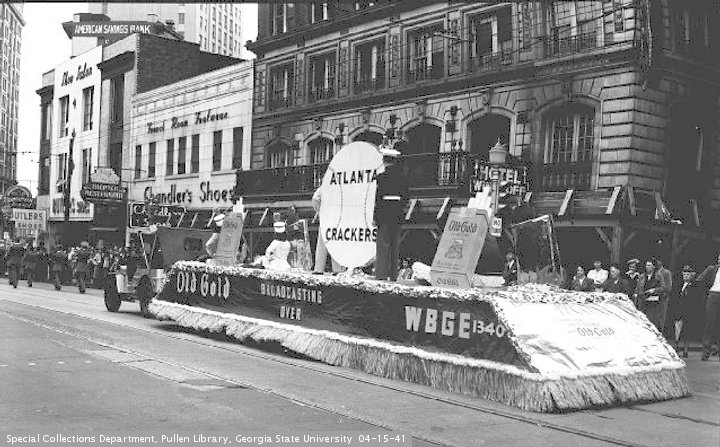



This is a repost. Pictures are from “The Special Collections and Archives, Georgia State University Library”. By the time this is posted, it will be Bob Dylan’s seventy fifth birthday. This chamblee 54 birthday tribute is composed primarily of three previously published pieces of work.
It was a late may morning in Atlanta GA, and a slack blogger was searching his archives. Yes, Issac Asinov never got writers block, and when he wasn’t going to the bathroom he was typing, but that is a lifestyle choice. Easy writing makes tough reading. So, anyway, in the may archive for 2011 there was a post about Bob Dylan’s seventieth birthday. People were taking bets on whether he would make it to thirty, and here he is at seventy five.
Hibbing MN is a cold place. At least it can claim to be the birthplace of Robert Allen Zimmerman. That’s Allen ,with an e, and double L, just like hell. The original initials were RAZ, which might be a good trivia question, or, with a silent W in front, radio station call letters. The problem is, he legally changed his name to Bob Dylan, with no known middle name. Those initial are BD.
On May 24, 1941, the curly haired wonder boi arrived. The world was a different place. Europe was in flames, and eyeing the young men of America as fresh cannon fodder. This was twelve years, eleven months, and eighteen days before PG graced the planet. A twelve year old in Hibbing MN would have no reason to think of a newborn baby in Atlanta GA.
These days, not everyone knows who Bob Dylan is. Auto tuned automated canned music is the next big thing. If auto tune had been around in 1963, we would never had known how badly Mr. Dylan sings. In an age where rappers pay ghost writers to compose their tweets, being able to write songs is not valued. There is just no telling. And so it goes.
A.J. Weberman has made a life out of going through Bob Dylan’s garbage. He wrote a book, “The Devil and Bob Dylan”. “THIS BOOK CHALLENGES ALL PREVIOUS CONVENTIONAL THINKING ABOUT BOB DYLAN. DYLAN IS JUST THE OPPOSITE OF WHAT YOU BELIEVE HIM TO BE. BUT WHAT PURPOSE DOES IT SERVE EXPOSING HIM AS A RACIST, HIV POSITIVE EX-JUNKIE AND HOLOCAUST DENIER? NONE EXCEPT THAT OF TRUTH, AND THE TRUTH WILL SET YOU FREE. $17 INCLUDING POSTAGE! THE BOOK IS 500 PAGES AND FULLY ILLUSTRATED.
There was a comment on the Bob Dylan webpage… Everybody knows by now that there’s a gazillion books on me either out or coming out in the near future. So I’m encouraging anybody who’s ever met me, heard me or even seen me, to get in on the action and scribble their own book. You never know, somebody might have a great book in them. PG doesn’t write books. He did grow up in America, and has a few opinions about Bob Dylan. It ought to be good for a few hundred words here. (HT to dangerous minds ) (Chamblee54 has posted about Mr. Dylan before.)
The first time PG heard of Bob Dylan was probably at the record rack of Zippy’s dime store in Cherokee Plaza. There was an album of his greatest hits, and it came with a poster. The poster had a drawing of the man, with psychedelic waves of hair cascading in multi colored glory to the edges. PG never did buy the LP.
The former Mr. Zimmerman was never big on top 40 am radio. Somebody somewhere was getting a headache over those lyrics, but Atlanta GA was not somewhere in those days. By this time, Mr. Dylan had crashed his motorcycle, and gone into hiding. As the counter culture exploded (if only someone had disinfected that counter) the curly haired poet was in hiding, the subject of much speculation. At one point, people were stealing his garbage, and claiming to find evidence of investment in munitions firms. The neoscience of Dylanology continues to this day.
As PG got older and stupider, he heard more and more Bob Dylan music. In the summer of 1972, there was a performance at the Concert for Bangladesh. A couple of albums released during this era sucked, and some people stopped caring about Bob Dylan.
At the start of 1974, a tour was announced. The Band was to be the backing group. The circus came to the Omni, and PG got some of the mail order tickets. He couldn’t find anyone to use the second ticket, and sold it to a stranger outside the arena.
The show was nothing special. Bob Dylan excels at writing, is ok in the studio, and blah on stage. Georgia Governor Jimmy Carter was at the show, and was said to look bored. Mr. Dylan was invited to the Governor’s mansion after the show, and talked to the Governor. A lot of people in Georgia were surprised that Jimmy would want to run for President.
As the Seventies went me me meing into sex and drugs oblivion, Bob Dylan regained both his writing touch, and love of the spotlight. The Rolling Thunder tour happened, he got back together with Joan Baez, divorced his wife, became born again, became more Jewish, counted money, and generally lived the life. PG did his own version of all that, without Joan Baez or being circumcised again.
In the winter of 1991, America was consumed by war fever. Saddam Hussein had been elevated to next Hitler status, and had to be taught a lesson. One night, Bob Dylan played on a music awards show, and performed “Masters of War”. He played a discordant version of that ditty, with the result that few understood what he had said. By this time, Mr. Dylan had assembled a band, and gone out on the “Never Ending Tour”. A Bob Dylan concert had gone from being a special event, to being another name on the festival roster. Overexposure will do that.
On the last night of the Olympics in 1996, Bob Dylan played the House of Blues downtown. PG won a pair of the $80 tickets in a radio station contest. It was his only trip downtown during the games, and had to wait in a security line to get into Centennial Olympic Park.
The only celebrity, other than Mr. Dylan, seen at the House of Blues that night was Bill Walton. The band was competent…they impressed PG as being like a bar band that did a lot of Dylan songs, with a strangely authentic lead vocalist. The sound in the room was not good, at least in the spot where PG stood. The only song he recognized was “All along the Watchtower”, the Jimi Hendrix classic. Mr. Dylan got a cheer when he put his harmonica appliance on.



The aptly named dangerousminds has a link to a story about the recording of Blonde on Blonde, by Bob Dylan. It only happened once.
Bob Dylan was 24 years old, newly married, and had “sold out” i.e. started to play electric guitar. A bunch of Canadians known as The Hawks (later The Band) was touring with him. Barely a month after the release of “Highway 61 Revisited”, sessions started at a New York studio.
The New York sessions did not work, so a decision was made to go to Nashville. Al Kooper played organ, and served as a music director. A crew of Nashville players was recruited. A bass player named Joseph Souter, Jr. would become famous a few years later using the name Joe South. Kris Kristofferson was the janitor at the studio.
Most studios have bafflers, or sound proof room dividers, splitting the studio into cubicles. For these sessions, the bafflers were taken down, and the band played together as a unit.
The second session in Nashville started at 6pm and lasted until 530 the next morning. Mr. Dylan was working on the lyrics to “Sad eyed lady of the lowlands”, and the recording could not start until he was ready. The musicians played ping pong and waited. At 4am, the song was ready, and the record was finished in two takes.
PG had marginal encounters with two of the players on this album. He met a lady once, who worked in an insurance office. One of the customers was Joe South. His driving record file was an inch thick.
Al Kooper had a prosperous career after his association with Bob Dylan. The former Alan Peter Kuperschmidt produced the first three Lynyrd Skynyrd albums, sold that contract for a nice piece of change, and lived happily ever after.
One night, Mr. Kooper was playing a show at the Great Southeast Music Hall, and PG sat in front of the stage. During a break between songs, PG asked his friend “what time is it?”. Mr. Kooper heard him on stage, and said it was 11:30.




If it ever quits raining, PG is going to walk to the Chamblee library and return a book, and a cd. The cd is by Bob Dylan, and is a work of genius. The book is about the former Mr. Zimmerman, and is a piece of garbage. (BTW, Dylan is not the only Zimmerman to hit the big time. Ethel Merman was born Ethel Agnes Zimmerman.The Zimmerman telegram got us into World War I. The less said about George Zimmerman, the better)
When returning cd’s to a library, you need to get a check in receipt. Once, PG returned a stack of cd’s to the Brookhaven library. When checking them in, one was missed by the scanner. A few days later, there was a note in the mail about an overdue cd.
The good news was, the cd was on the shelf when PG went back to investigate, and the matter was quickly settled. It did not help that the cd was a collection of disco music called “Shake your booty”.
“The freewheelin’ Bob Dylan” was released in the early sixties, when the man was barely old enough to buy a drink. There is not a bad song on it, and several are classic rock staples. At a time when mindless pop dominated pop music, here were thoughtful, moving lyrics.
In 1991, with America in a war frenzy, Mr. Dylan appeared on a music awards show. He performed “Masters of War”, at a time when the majority would be appalled if they could understand what he was singing. Mr. Dylan has been reinvented many times, and often the lyrics get gargled.
Five years later, PG won tickets to a Bob Dylan concert. It was the last night of the Olympics, and the man was appearing at the House of Blues. (Tickets were $80, so the radio contest is the only reason PG went). It was like hearing a good bar band, that did nothing but Dylan songs, with the man as the vocalist. Due to the mix of the sound, PG could not recognize many of the songs.
The book is Bob Dylan: Prophet, Mystic, Poet by Seth Rogovoy. It tells the Dylan tale as a story of Jewish prophecy. PG got to page 16, where the author claims that “Like a Rolling Stone” “almost single handedly revolutionized rock’n roll music”. Huh?
PG was eating dinner, and did not have anything else to read. He got to page 38. Nothing in the next 22 pages changed his mind away from ditching the book. How does nonsense like this get published?



American Distrust



In dog bites man news, there was a post about Bernie Sanders on facebook. A well meaning lady made a comment, with a link to When Racism Trumps Socialism. The feature was a collection of tweets. PG got through a few, until he saw “The GOP has no qualm w/hugging its proudly bigoted, predominately White base, but Democrats decide to have an identity crisis every 2 yrs. ~ We can’t seem to agree on whether we want to fight the bigots or the banks first. ” PG remembered that there was some paint he could watch dry.
A few hours later, the well meaning lady had posted another comment. Included in the comment was a quote. : “If you aren’t starting from the basic premise that deep seated American distrust of government is rooted in racism, you’re doing it wrong.” There was a deeply edited reply.
Luther Mckinnon “”If you aren’t starting from the basic premise that deep seated American distrust of government is rooted in racism, you’re doing it wrong.” The Vietnam war. The outsourcing of jobs. The petty corruption. There is a lot of times the government has abused the trust of the governed that are not related to race.
Well Meaning Lady Luther: Respectfully, I think it’s naive to think systemic racism didn’t/doesn’t play into each of your examples.
Luther Mckinnon I am in the middle of a lengthy reply. If I feel it is worth my peace of mind to complete, I will put it on my blog.
Here is the incomplete reply: “When someone starts a reply with the word “respectfully” I know I am not going to like what follows. I can talk at great length about the obsession with other people’s racial attitudes (OPRA) that our culture has today. Yes, so called systemic racism may play a part in those three items, which I pulled out more or less randomly. There are a lot of other areas where the government has abused the trust of the governed. But the current dialog on race is not really about systemic racism. It is about what foolish thing some celebrity said. Or something that your neighbor says that rubs you the wrong way. This is what people mean when they say racism.”
There was a saying during the era when communism was an ongoing operation. People would say there is a communist under every bed. Today, this is true about racism. Some people think there is a racist under every bed. To some, all of the problems in today’s society can be traced back to racism.
Rhetoric has a way of evolving in a discussion. First, the distrust of government is “rooted” in racism, whatever that means. When the well meaning lady is called out on this, it becomes “play into.” In both statements, a cause and effect relationship is alleged, without a whole lot of evidence.
Lets focus for a minute on Vietnam. From her profile picture, Well Meaning Lady appears to be thirty something. This means she is probably the daughter, or grand daughter, of people who were old enough to be aware of the tragedy that was Vietnam. She probably does not have first hand knowledge of the lies told by the American government throughout that hideous conflict. A generation of patriotic Americans were disillusioned by the wretched conduct of that war.
Was the hatred of that war “rooted in racism”? Not exactly. Some said that the slaughter of Asian women and children was racist, and to a certain degree that is true. However, the racist nature of that war… and of most of the wars since then … is not the primary reason why Americans turned against it. The war was hated because the young men of America … our fathers, uncles, sons, and brothers … were being conscripted into the army, and sent to die. The reason our men … black, white, yellow, brown and red … were fed into the meat grinder was the lies of our government. And to make money for the military industrial complex… the petty corruption mentioned above. That is the reason why many Americans turned on its government, not racism.
Pictures today are from The Library of Congress.


Winston Churchill Said What

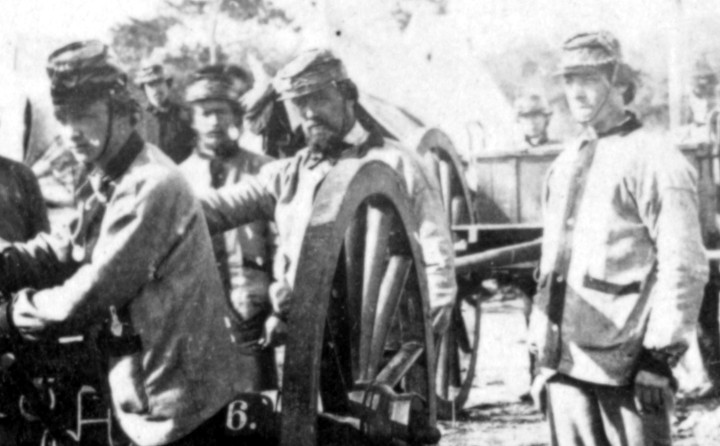
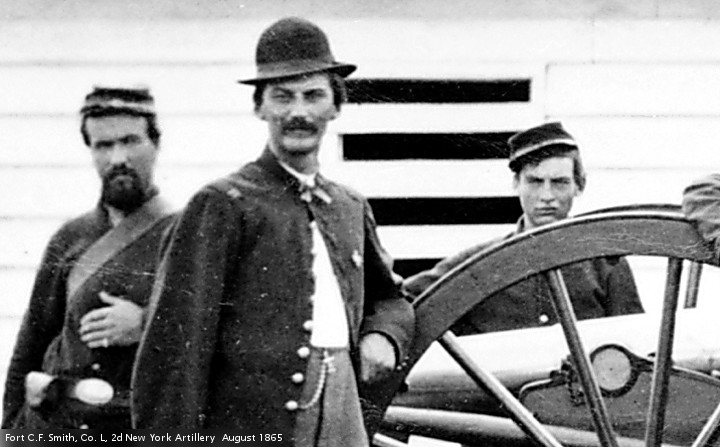

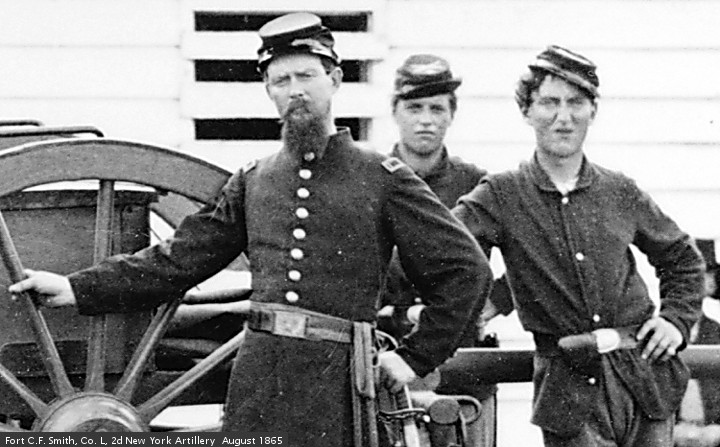
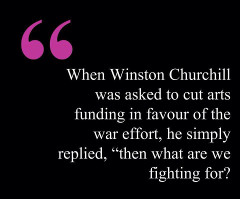
Another ghastly meme has surfaced on facebook. It has a large fuchsia quote mark for illustration. There is a quote from a famous man. The left side has a quote mark. The right side has a question mark, but no quote mark. The margins are much larger on the top, and left side, than on the right side, and the bottom. That this visual atrocity supports funding for the arts is a cruel irony.
Perhaps instead of the arts, the government funding should go for fact checking. The quote is generally considered to be bogus. For the record, here is the quote. “When Winston Churchill was asked to cut arts funding in favour of the war effort, he simply replied, “then what are we fighting for?” The quote is not in the Churchill archive, which is either fifteen million documents, or fifteen million words. The authorities use the figures interchangeably.
The Telegraph has an article debunking the meme. It has a splendid sentence: “But that anecdote does not so easily play into the screeching rhetoric of today’s 140-character political ding-dongs.” There are also some lovely quotes from Mr. Churchill.
 In 1937, Mr. Churchill spoke before the Peel Commission It was discussing “partitioning British mandated Palestine into Arab and Jewish states.” At the time, Mr. Churchill was a minor figure in British politics, disgraced by his blundering in the Great War. The quote: “I do not agree that the dog in a manger has the final right to the manger even though he may have lain there for a very long time. I do not admit that right. I do not admit for instance, that a great wrong has been done to the Red Indians of America or the black people of Australia. I do not admit that a wrong has been done to these people by the fact that a stronger race, a higher-grade race, a more worldly wise race to put it that way, has come in and taken their place.”
Winston Churchill is quite the quote magnet. This is somehow fitting for a man whose most famous speech was read, on the radio, by an actor. There is a page on the internet devoted to times when he was falsely accused of saying something inspiring.
One of these stories is notable. “The only traditions of the Royal Navy are rum, sodomy and the lash… Churchill’s assistant, Anthony Montague-Browne said that although Churchill had not uttered these words, he wished he had.” This is a repost, with pictures from The Library of Congress.





leave a comment