Tom Paine



There is a meme floating through the innertubes. “To argue with a person who has renounced the use of reason is like administering medicine to the dead.” Thomas Paine English-American political activist, writer and revolutionary. A drawing of Mr. Paine lurks to the left of the text.
The quote is from the first paragraph of a pamphlet written by Mr. Paine, The American Crisis: LANCASTER, March 21, 1778, TO GENERAL SIR WILLIAM HOWE. It was part five of a series, The American Crisis. The tract was intended to inspire the war effort against the British. The full sentence: “To argue with a man who has renounced the use and authority of reason, and whose philosophy consists in holding humanity in contempt, is like administering medicine to the dead, or endeavoring to convert an atheist by scripture.”
Four Principles of Quotation was written in 2002, before the rise of meme culture. The salient principle for today is number four, “Only quote from works that you have read.” The tract by Mr. Paine is 6956 words of revolutionary era purple prose. Today’s facebook expressionist does not want to go to that much trouble.
The American Crisis V has some interesting passages. It would be considered politically incorrect today. The British labelled is “the encourager of Indian cruelties,” and accused of “the unchangeable name of meanness.”… “The particular act of meanness which I allude to in this description, is forgery. You, sir, have abetted and patronized the forging and uttering counterfeit continental bills. … shows an inbred wretchedness of heart made up between the venomous malignity of a serpent and the spiteful imbecility of an inferior reptile.”
The text is directed at General William Howe. The war was not going well for the British… “They resemble the labors of a puppy pursuing his tail; the end is still at the same distance, and all the turnings round must be done over again.” General Howe resigned April 4, 1778, fifteen days after The American Crisis V was written. The purple prose might have been a factor.
“Your master’s speech at the opening of Parliament, is like a soliloquy on ill luck. It shows him to be coming a little to his reason, for sense of pain is the first symptom of recovery, in profound stupefaction…. who is daily decaying into the grave with constitutional rottenness. There is not in the compass of language a sufficiency of words to express the baseness of your king, his ministry and his army. They have refined upon villany till it wants a name. To the fiercer vices of former ages they have added the dregs and scummings of the most finished rascality, and are so completely sunk in serpentine deceit, that there is not left among them one generous enemy. … She is the only power who could practise the prodigal barbarity of tying men to mouths of loaded cannon and blowing them away. … If there is a sin superior to every other, it is that of wilful and offensive war. … We leave it to England and Indians to boast of these honors; …”
Mr. Paine has a good reputation today. This was not unversal during the revolution. “In 1777, Congress named Paine secretary to the Committee for Foreign Affairs. The following year, however, Paine accused a member of the Continental Congress of trying to profit personally from French aid given to the United States. In revealing the scandal, Paine quoted from secret documents that he had accessed through his position at Foreign Affairs. Also around this time, in his pamphlets, Paine alluded to secret negotiations with France that were not fit for public consumption. These missteps eventually led to Paine’s expulsion from the committee in 1779.”
After the war, Mr. Paine went back to England. He soon got involved in the French Revolution, and was imprisoned. He continued to write, and get in trouble. Mr. Paine was invited back to the United States by Thomas Jefferson. He “died in June 1809, and to drive home the point of his tarnished image, the New York Citizen printed the following line in Paine’s obituary: “He had lived long, did some good and much harm.” Pictures today are from The Library of Congress.




Oscar Wilde


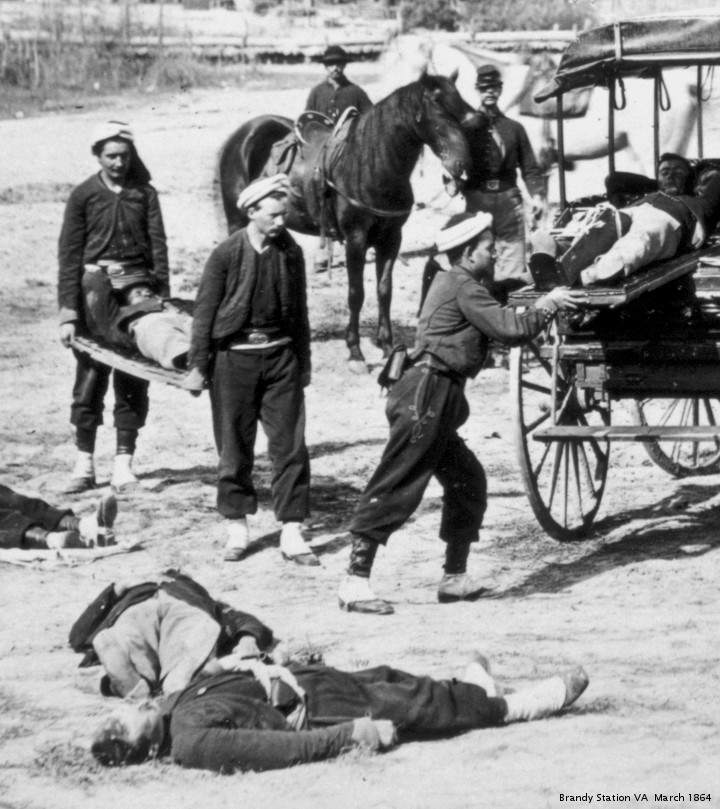
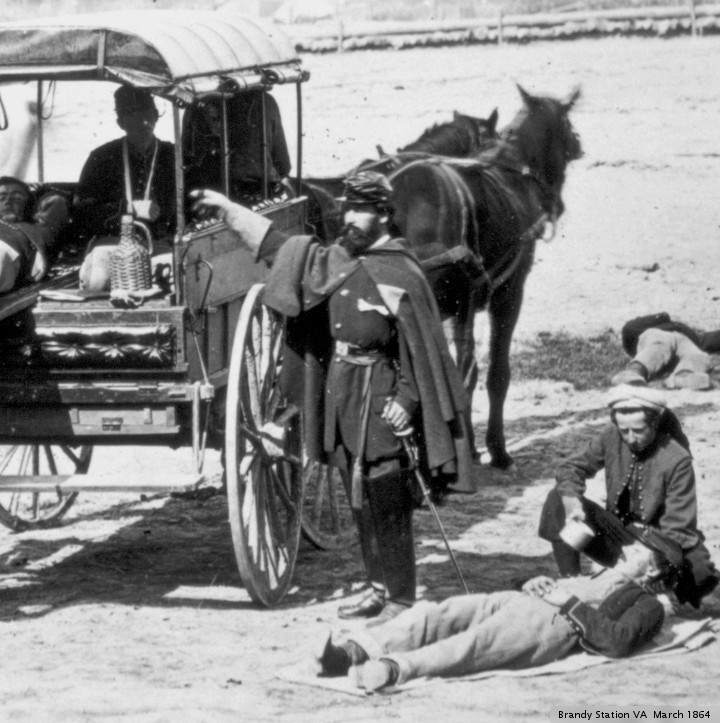
October 16 is Oscar Wilde’s birthday. On that day in 1854, he appeared in Dublin, Ireland. He is one of the most widely quoted people in the english language. Some of those quotes are real. Since he was a published author, it should be easy to verify what he really said. This belated birthday celebration is a repost, with pictures from The Library of Congress.
One night in 1974, PG was talking to someone, and did not know who Oscar Wilde was. The conversational partner was horrified. PG became educated, and learned about a misunderstanding with the Marquess of Queensberry. Soon the “Avenge Oscar Wilde” signs made sense.
Mr. Wilde once made a speaking tour in the United States. One afternoon, in Washington D.C., the playwright met Walt Whitman. Thee and thou reportedly did the “Wilde thing”.
The tour then went to Georgia. A young black man had been hired as a valet for Mr. Wilde on this tour. On the train ride from Atlanta to Augusta, some people told Mr. Wilde that he could not ride in the same car as the valet. This was very confusing.
After his various legal difficulties, Oscar Wilde moved to Paris. He took ill, while staying in a tacky hotel. He looked up, and said “either that wallpaper goes, or I do”. Soon, Oscar Wilde passed away.




Migrant Mother


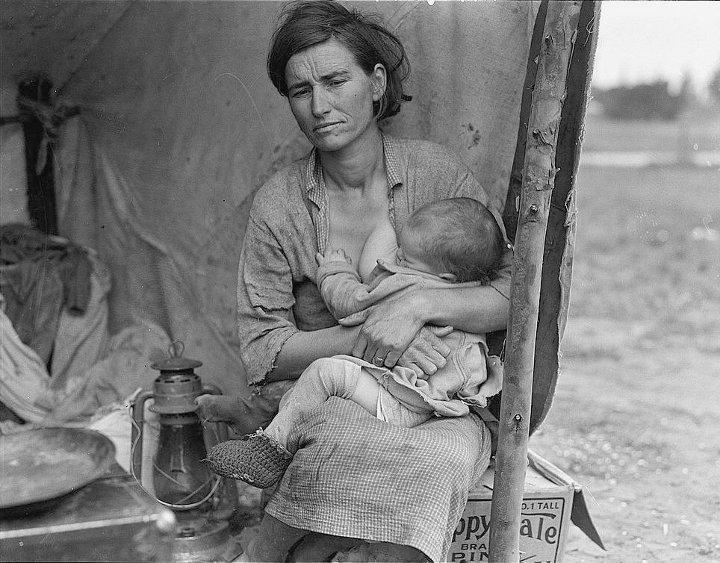


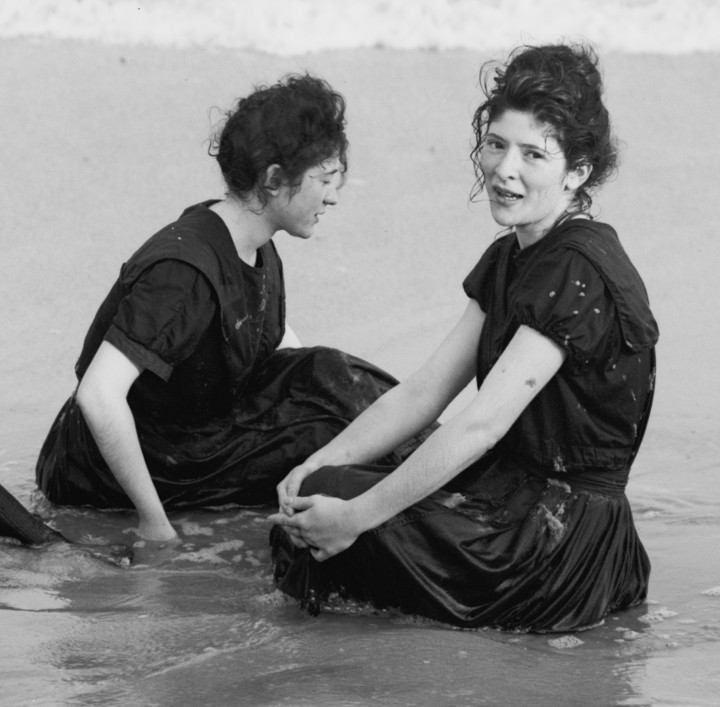
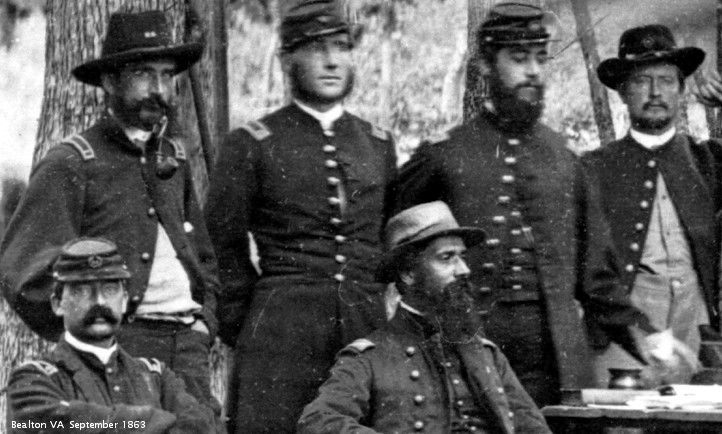
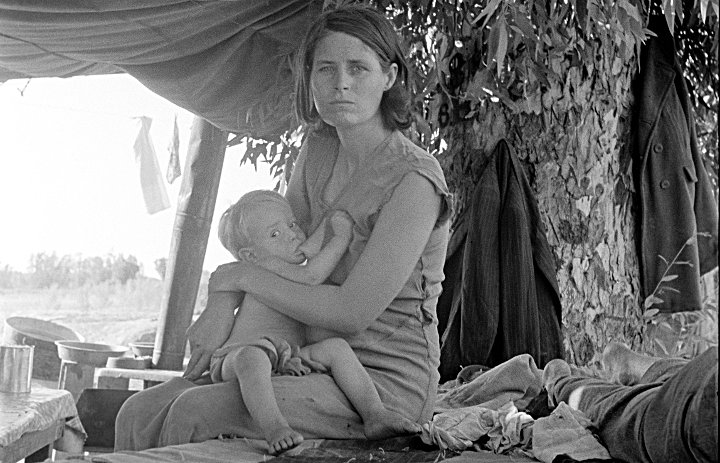
It is perhaps the most famous photograph from the depression. . The semi official title is Migrant Mother. The Library of Congress says “Destitute pea pickers in California. Mother of seven children. Age thirty-two. Nipomo, California.” The exact date is unknown, and was either February or March of 1936. The photographer was Dorothea Lange (pronounced dore-THEE-ah lang). The model was Florence Owens Thompson .
Ms. Lange was born Dorothea Margaretta Nutzhorn May 26, 1895 in Hoboken, N.J. When she was seven she had polio, and when she was twelve her father left. Both events affected her deeply. (Lange is her mother’s maiden name, chosen for use after the father left.) She became a photographer, and had a successful studio in San Francisco. By 1936 she was with her second husband, her sons were in boarding school, and she went to work for the Farm Security Administration.
The Farm Security Administration hired a number of photographers to document the lives of Americans between 1934 and 1944. (During part of this time, it was connected to the Office of War Information, and the Resettlement Administration.) Since they were working for the government, the photographers were not entitled to copyright protection. The majority of these pictures are in the public domain, including the famous pictures of Florence Thompson.
This feature started with a google search for the correct way to pronounce Dorothea Lange. (Readers of this blog have seen the fondness for Library of Congress historic pictures. Ms. Lange is one of their stars.) This search led to a teacher’s guide from Yale University. This guide is about Dorothea Lange and the Migrant Mother. It tells the story as well as PG could. Bless his pea picking heart.
The day that Dorothea Lange photographed what would become her most famous photograph, Migrant Mother, has been retold by Lange in numerous sources. She was on her way home from a trip documenting the living and working conditions of the migrants to California. She followed their schedules, getting up at sunup and working until sundown, which made for long, sixteen-hour days. She was tired, and she was ready to see her family.
With about seven hours of driving left ahead of her, she passed a homemade sign that said Pea Pickers’ Camp. She knew that a late frost had ruined the pea crop, and was concerned about the people who might be at the camp. It nagged at her to turn around, to go back and visit the camp, another opportunity to document. About 15 minutes (20 miles) later, Lange did turn around.
Right away she saw the woman who would be the subject of Migrant Mother. Some sources say she took 5 shots, but she really took 6; in any case each shot focuses in on the woman a little more, and the final shot is the one that would become the “timeless and universal symbol of suffering in the face of adversity “ (The Library of Congress only has five of the shots.)
Early the morning after she got home, instead of spending time with her family Lange rushed to develop the photographs and submit them to the FSA and The San Francisco News. She thought that these photographs could help bring attention to the plight of these American migrant farmers. She was right; the story was printed in newspapers around the country, and the federal government immediately sent 20,000 pounds of food…. (The Thompson family had left for Watsonville by the time the food arrived)
The Dust Bowl refugees were of European descent, and were migrating to California because they were displaced from their farmland by drought. Florence Owens Thompson, though from Oklahoma, was a full-blooded Native American, and her family had been displaced from tribal lands by the U.S. government. (By 1930, Native Americans had lost more than 80% of their lands this way).
The day Lange photographed Thompson, she and her family were driving towards Watsonville, hoping to pick lettuce in the Pajaro Valley. The timing chain on their car broke just outside Nipomo, and so they pulled into the pea -pickers camp to fix it. While fixing the chain, the radiator was punctured; Thompson’s two boys (and likely her male companion) (Wikipedia says it was husband Jim Hill) brought the radiator into town to be fixed. While they were gone, Lange arrived…
The choices Lange made in terms of shooting the scene are very telling in light of our discussion about documentary photography. Most strikingly, the woman’s teenaged daughter is purposefully excluded from the photograph. She appears in the first two photographs of the series, but Lange thought that including her would cause the viewer to speculate about how old the mother was when she began having children (Curtis p. 55). At the time, the ideal family contained no more than three children; this woman’s family of seven could have detracted from the matter at hand, and maybe caused people to feel less sympathetic towards her (Curtis p. 52).
In the third shot, all you see is the mother nursing her youngest child. Migrant Mother is often referred to as Migrant Madonna… Lange thought that her subject looked too anxious and uncomfortable with the camera, as Lange seemed to have triggered in her what she called “that self-protective thing” (Curtis p. 57). So, despite being uncomfortable with how unpredictable children were to photograph, to calm the mother she added one of the children back into the frame for the fourth shot. She had the child rest her chin on her mother’s shoulder, which, though somewhat unnatural, served the purpose of anchoring the child still. She was also asked to remove her hat, which would have obscured her facial features. This resulted in a good photograph. Lange “thought she could do better.”
The fifth shot was the same, but from a different angle, which illuminates an empty pie tin, heavily symbolic of the hunger the family was facing. It also highlighted a warm and loving relationship between mother and child, as the child is leaning lovingly on the mother’s shoulder, which is comforting to the child.
For the sixth and final shot, (the one which became famous) Lange brought another child in, but she had both children face away from the camera, so that her shot would not be jeopardized by their unpredictability, and they would serve as a loving frame for the mother. Lange asked the mother to bring her right hand up to her face, and that resulted in exactly what Lange wanted and knew was there (Curtis p. 65). It softened her anxiety about the camera into a mother’s concern for the welfare of her family. The mother was worried about letting her sleeping child slip, so in the original sixth shot you could see her thumb grasped around the pole for support. In her excitement Lange did not see it. She eventually altered the original photonegative because she “did not want a small detail to mar the accomplishment (of overcoming her subject’s defensiveness) (Curtis p. 67).”
In this feature, the second image from the session is missing. The pictures in this feature are as follows. 1- The famous picture, cropped. 2- The first shot from the session. 3- A detail from the first shot. 4- The Migrant Madonna. 5- Child on the shoulder. 6- Child on the shoulder #2. 7. The full length famous picture. 8- A portrait of Dorothea Lange. 9- Another photograph by Ms. Lange, taken on the California-Arizona border in the summer of 1936. 10- The information from the famous picture. 11- The famous picture with the thumb included.
2012 Repost Notes This was on a list of posts that could be repeated. Of course, there are usually improvements to be made. Youtube was searched, and some videos were found. One of them mispronounces Dorothea. A search for the correct pronunciation of that first name was how this post got started in 2010.
Looking at the pictures reveals a glitch in the famous picture. If you look in the part of her hair, you will see a gray stripe. This is a bit of damage to the negative, and is common to old photographs. Ordinarily, PG would paste over a spot like that, but this is a sacred photograph.
The files of the LOC were consulted, and a 115mg original was downloaded. The grey stripe was still in the part, which is where it will stay. The original has the thumb, which was taken out of the famous prints. It is included in this post, along with the information typed into the side.
A look at some of the other pictures taken that day show a grey spot in the part. Maybe it wasn’t a photo glitch. Raising seven children can give any woman a few gray hairs.
Another question is about Florence Thompson, the “Migrant Mother”. It was noted that she was a Native American. PG has decided that the expression “Native American” is the invention of European Import Americans, and is only marginally less offensive than Indian. There are hundreds of tribes in the Americas. A person is a member of a tribal nation. What tribe was Florence Thompson?
Mr. Google points us to this answer. “Thompson, a “full-blooded” Cherokee, was born Florence Leona Christie on September 1, 1903, on the Cherokee Nation in Oklahoma. Her father, Jackson Christie, was an ex-convict who had abandoned the family before her birth. Her mother,Mary Jane Cobb, married Charles Akman, a Choctaw, in 1905, with whom she raised Thompson near Tahlequah OK”
This is a repost. Pictures are from The Library of Congress.




Dick Nixon TV Critic


The text below is a conversation between Mr. Nixon, John D. Ehrlichman, and H. R. Haldeman. The tape was made May 13, 1971. This is a repost. Pictures are from The Library of Congress.
NIXON: … CBS … glorifying homosexuality.
EHRLICHMAN: A panel show?
H. R. HALDEMAN: No, it’s a regular show. It’s on every week. It’s usually just done in the guy’s home. It’s usually just that guy, who’s a hard hat.
NIXON: That’s right; he’s a hard hat.
EHRLICHMAN: He always looks like a slob.
NIXON: Looks like Jackie Gleason.
HALDEMAN: He has this hippie son-in-law, and usually the general trend is to downgrade him and upgrade the son-in-law–make the square hard hat out to be bad. But a few weeks ago, they had one in which the guy, the son-in-law, wrote a letter to you, President Nixon, to raise hell about something. And the guy said, “You will not write that letter from my home!” Then said, “I’m going to write President Nixon,” took off all those sloppy clothes, shaved, and went to his desk and got ready to write his letter to President Nixon. And apparently it was a good episode.
EHRLICHMAN: What’s it called?
NIXON: “Archie’s Guys.” Archie is sitting here with his hippie son-in-law, married to the screwball daughter. The son-in-law apparently goes both ways. This guy. He’s obviously queer–wears an ascot–but not offensively so. Very clever. Uses nice language. Shows pictures of his parents. And so Arch goes down to the bar. Sees his best friend, who used to play professional football. Virile, strong, this and that. Then the fairy comes into the bar. I don’t mind the homosexuality. I understand it. Nevertheless, goddamn, I don’t think you glorify it on public television, homosexuality, even more than you glorify whores. We all know we have weaknesses. But, goddammit, what do you think that does to kids? You know what happened to the Greeks! Homosexuality destroyed them. Sure, Aristotle was a homo. We all know that. So was Socrates.
EHRLICHMAN: But he never had the influence television had.
NIXON: You know what happened to the Romans? The last six Roman emperors were fags. Neither in a public way. You know what happened to the popes? They were layin’ the nuns; that’s been goin’ on for years, centuries. But the Catholic Church went to hell three or four centuries ago. It was homosexual, and it had to be cleaned out. That’s what’s happened to Britain. It happened earlier to France. Let’s look at the strong societies. The Russians. Goddamn, they root ’em out. They don’t let ’em around at all. I don’t know what they do with them. Look at this country. You think the Russians allow dope? Homosexuality, dope, immorality, are the enemies of strong societies. That’s why the Communists and left-wingers are clinging to one another. They’re trying to destroy us. I know Moynihan will disagree with this, and Mitchell will. But, goddamn, we have to stand up to this.
EHRLICHMAN: It’s fatal liberality.
NIXON: Huh?
EHRLICHMAN: It’s fatal liberality. And with its use on television, it has such leverage.
NIXON: You know what’s happened [in northern California]?
EHRLICHMAN: San Francisco has just gone clear over.
NIXON: But it’s not just the ratty part of town. The upper class in San Francisco is that way. The Bohemian Grove, which I attend from time to time–it is the most faggy goddamned thing you could ever imagine, with that San Francisco crowd. I can’t shake hands with anybody from San Francisco. … Decorators. They got to do something. But we don’t have to glorify it. You know one of the reasons fashions have made women look so terrible is because the designers hate women. Designers taking it out on the women. Now they’re trying to get some more sexy things coming on again.
EHRLICHMAN: Hot pants.
NIXON: Jesus Christ.



William McKinley


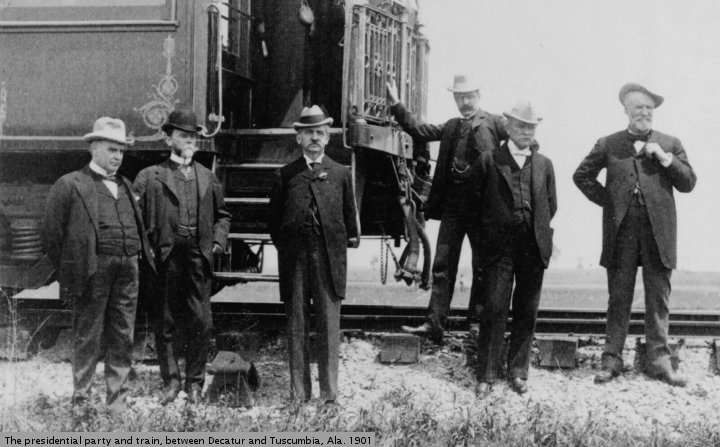
One hundred fifteen years ago, President William McKinley was near death. He had been shot September 6, 1901. Medicine at this time was primitive compared to today. During surgery after the shooting, the bullet was not removed. The University of Buffalo makes this comment: “Dr. Mann and the others were neither trained trauma surgeons nor did they bother with disinfection, not even wearing gloves. The first bullet had done little harm; the second entered McKinley’s abdomen. The physicians used improperly sanitized probes and when Mann could not find the bullet, he closed the incision without draining the wound. It was a fateful decision.”
After surgery, the President was taken to the home of John Milburn. He seemed to be recovering, but took a turn for the worse and died September 14, 2001.
President McKinley had been shaking hands at a reception. The meet and greet was at the Academy of Music, as part of the Pan American Expostion in Buffalo, New York. A letter to “The Nation” has this viewpoint. ” Whatever other results may flow from the assassination of President McKinley, let us hope that that object-lesson may be sufficient to put an end to our national habit of promiscuous handshaking in public. It is hard to conceive of a spectacle more fatuous and less edifying than that of a horde of country bumpkins, criminals, cranks, idlers, and curiosity-mongers standing in line waiting for a chance to grab and squeeze the hand of the unhappy Chief Executive of this country.”
 There were anarchists in 1901, who had murdered several European leaders. Several of McKinley’s advisors did not think the reception was a good idea, and forced him to have extra security. A writer in the Buffalo Courier observed on September 5 “The surrounding of President McKinley by a body-guard of detectives when he appears in public, is probably as distasteful to himself as it is to abstract American sentiment, but as long as the earth is infested by malevolent cranks and unreasoning Anarchists, the precaution is entirely proper.”
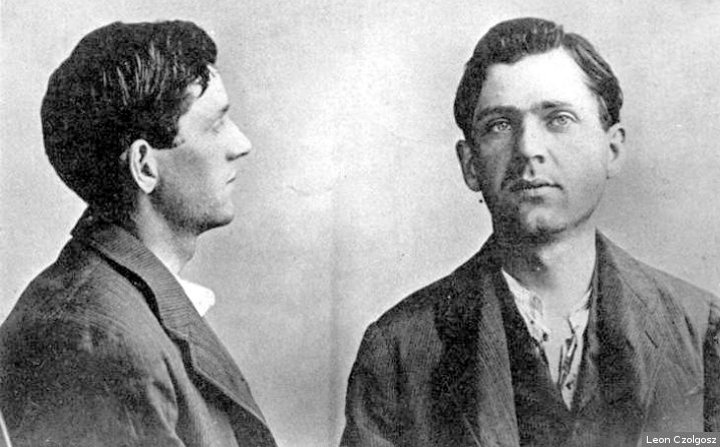
A young man named Leon Czolgosz (pronounced CHOL gosh) managed to wait in line with a concealed weapon. He was seen to shoot President McKinley. He was immediately captured, and executed October 29, 1901.
Lew Rockwell speaks of a rivalry between John Rockefeller and J.P. Morgan. Rockefeller man McKinley was replaced by Morgan supporter Roosevelt, who promptly began to break up the trusts. Another historian, connected to Lyndon LaRouche , speaks of British interests, and the rise of Confederate power. McKinley was a target of media superstar William Randolph Hearst. An editorial printed in the April 10, 1901 Journal asserted that “If bad institutions and bad men can be got rid of only by killing, then the killing must be done.”
Some say that a murder one hundred fifteen years ago does not affect us today. However, an argument could be made that the death of McKinley set in motion events that led to the establishment of the Federal Reserve System, and American participation in World War I. Both of those events have had effects lasting until today.
It is curious how President McKinley is mostly forgotten today. Some say he was most popular President since Lincoln . McKinley had been a wartime President, who won. His successor, Teddy Roosevelt, is on Mount Rushmore, and is a superstar President. Mr. Roosevelt also ran as a third party candidate in 1912, and helped to elect Woodrow Wilson. (Mr. Wilson was alleged to be a member of the “Omega Group,”rumored to be behind a McKinley conspiracy.) Mr. Roosevelt’s popularity is very different from the other three Vice Presidents who were promoted by the murder of the President. He was good at dealing with the press.
Pictures today are from The Library of Congress. This is a repost.




Nine Eleven Story
This is my 911 story. I repeat it every year at this time. If you saw it last year, it has not changed. Feel free to skip the text and look at the pictures, from The Library of Congress.
I was at work, and someone called out that someone had run a plane into the World Trade Center. I didn’t think much of it, until I heard that the second tower had been hit, then the Pentagon, then the towers collapsed, then a plane crashed in Pennsylvania.
I focused on my job most of the day. There was always drama at that facility, and concentrating on my production duties helped to keep me saner. This was roughly the halfway point of my seven year tenure at this place.
One of the other workers was a bully for Jesus. He was a hateful loudmouth. After the extent of the damage became known, he shouted “They are doing this for Allah,” and prayed at his desk. The spectacle of the BFJ praying made me want to puke.
I became alienated from Jesus during these years. Once, I had once been tolerant of Christians and Jesus, as one would be with an eccentric relative. I began to loath the entire affair. I hear of others who found comfort in religion during this difficult time. That option simply was not available for me.


Radio Free Europe



While researching a post about Molly Ivins, PG stumbled onto a lovely site called Booknotes. This site enables authors promoting their latest books. It seems to have gone out of business in December 2004, but the interviews are still available. PG likes to listen to “stuff” while he edits pictures, and Booknotes appears to be a treasure chest.
The multi tasking soundtrack last night was a chat with Hendrik Hertzberg, who is familiar to readers of The New Yorker. BTW, the majority of TNY readers live west of the Hudson River. Supposedly, the biggest number of readers is in California.
In 1965, Mr. Hertzberg was about to get drafted. At the time, this meant a one way ticket to Vietnam. Young men looked for alternatives to this, some of which were legal and moral. Mr. Hertzberg heard about an organization called the National Student Association. “And so I went to work after college for the National Student Association for a year. And it wasn`t just because the National Student Association was a wonderful cause that advanced liberal ideas and fought communism abroad and all of that sort of thing. Later, we learned that it was a CIA front, but I didn`t know that. What I did know was that if you worked for the National Student Association, you didn`t get drafted, that — it wasn`t exactly that you were deferred, but anyway, nobody got drafted while working for the National Student Association, so it was a way to have a year without worrying about getting drafted.”
The National Student Association has a facebook page, which one person likes. “The 1967 revelation of NSA’s ties to the Central Intelligence Agency sparked a national scandal, but did not measurably damage NSA.”
The CIA was involved in all sorts of things in those days. ( It still is today.) One of the fronts was Radio Free Europe. When PG was a kid, the cartoon shows had a commercial for Radio Free Europe. (It was different from the one embedded here.) These fund raising commercials were part of the scam. These commercials netted around $50k a year, towards a multi-million dollar budget. (source)
Soon after the war stories, the conversation turns to religion/tribal allegiance. LAMB: Explain this. “The Nuremberg laws would say I`m Jewish. The Law of Return would say I`m not.” HERTZBERG: Well, according to the Nuremberg laws, if you have a — if you had a Jewish father, the Nazi classification, you were a Jew. But the Law of Return, where — what entitles you to citizenship, automatic citizenship in Israel, you`ve got to have to have a Jewish mother. So I`m Jewish one way, I`m not Jewish the other way. I guess I feel sort of 51 percent Jewish because my name, Hertzberg, sounds Jewish, and therefore, people respond to me, often assume that I`m … 100 percent Jewish.”
This conversation was in 2004, when BHO was a little known Senator. Today, BHO, who had a white mother, is routinely considered black. If you go by the laws of the Nazis, BHO is black. If you go by the laws of Israel, BHO is white.
Mr. Hertzberg took a break from journalism to write speeches for President Jimmy Carter. Mr. Hertzberg is a member of the Judson Wellover Society. HERTZBERG: Judson Wellover was the very first White House speech writer. Not the first person to write speeches, ghost write speeches for a president — that would probably be Alexander Hamilton for George Washington — but the first person who was ever hired just to write speeches in the White House was Judson Wellover. He was hired by Warren G. Harding, and he — it was such a matter — it was such a shameful thing to have somebody writing — hired to write speeches that they hid his salary in the budget of the White House garage. And when we started, when Bill Safire and I started the Judson — the society of sort of a marching and chatter society or dinner — we have a dinner every couple of years of White House speech writers from all administrations, we named it after Judson Wellover.
Warren Harding is credited/blamed for coining the phrase “founding fathers”. Was Mr. Wellover involved? This is a repost, with pictures from The Library of Congress.



Tubby Boots






PG found Classic Television Showbiz while reserarching a recent feature about the late Sherwood Schwartz. The site is a treasure, with youtubes of classic tv shows, and interviews with “entertainers”. Somewhere in the sidebar was a link to a story about Tubby Boots.
Charles “Tubby” Boots was born around 1926 in Baltimore MD. He was a nightclub comedian. Mr. Boots weighed 375 pounds, had bleach blond hair, and often performed without a shirt. He wore pasties on his boobs, and would twirl them simultaneously in opposite directions.
The parts in blue are borrowed from Classic television showbiz. Tubby’s parents were a vaudevillian dance team called Boots and Barton. At the age of seven this youngster was clocking in at an astounding two hundred pounds, a constant target of ridicule in his Baltimore schoolyard….During his childhood, Tubby managed to witness a performance by comedy’s greatest cult icon, Lord Buckley … Tubby Boots recalled shortly before his death, “[Lord Buckley] was like a father figure to me. I met Buckley when I was seven years old when I was working at the Hippodrome in Baltimore, Maryland, and I was in awe of him. I saw his act every time he would come back to play the theater … I would sit in the theater all day and watch the shows. I’d stay out of school for the whole week – my mother would pack me a lunch – she knew what I was doing because I wanted to learn about show business. Buckley would do his hat-switching act. Every other show he would get me to do it with him. I’d hang out with him backstage, we’d go out for lunch or dinner, he’d sneak me back into the theater and I’d watch the whole stage show again. I started working nightclubs when I was eleven. I weighed 250 pounds and passed myself off as twenty-one. I got arrested in a strip joint and the police said: ‘We’re not going to throw you in jail but you’re not going to work in this town again – you’re too notorious.’ So they actually put me on a train and said ‘Where you wanna ticket to?’ I said, ‘New York.’ I didn’t run away – I was forced to leave. So when I got to New York I called Buckley and, pretending to sob, said, ‘My mama died in a car crash…my father was with her…’ Unbeknownst to me, he called my mother and told her, ‘He’s with me.’ So he got me a job at The Three Deuces, passing me off as twenty-one.” The Three Deuces was one of Manhattan’s major jazz holes in the thirties and forties, regularly featuring Dizzy Gillespie and Charlie Parker. Lord Buckley was connected to the jazz world for most of his career, performing in their clubs and utilizing a great deal of the Black hipster vernacular in his act.”
Mr. Boots got a job as the emcee for burlesque shows, frequently in traveling carnival shows. He was doing well, when Lord Buckley called him from Hollywood. Supposedly, there was a movie job waiting for Mr. Boots. When he got to California, he found out otherwise. “Tubby became affectionately known as Princess Lily. “He used to call me Princess Lily but Prince Charles of Booth was my title. Buckley used to say: ‘Lil! You had the misfortune to be born with the beautiful body of a woman in the ridiculous body of a man!””
In 1959, Mr. Boots was in a bizarre accident. He was taking a bath, and the controls for the hot and cold water were in another room. Lord Buckley was handling these controls, and poured scalding hot water into the tub. Mr. Boots was stuck in the tub, and was badly burned. He spent a week in the hospital, and was not friends with Lord Buckley later.
After he recovered, Mr. Boots moved to Miami Beach. He performed in motel lounges for many years, and developed a following. Comedy albums were becoming popular, and Mr. Boots contributed “Thin my be in but fats where its at”. The albums were sold at his shows. The legend is that no copies exist that were not autographed.
The various search engines are sketchy about Tubby Boots. The Lady Bunny tells about going to see Mr. Boots in a supper club on Long Island in the eighties. Reportedly Mr. Boots did well during the comedy club explosion of the eighties.
PG saw a show by Tubby Boots. It was December 1974, at a dingy Atlanta bar called The Cove. PG was hanging out with someone we will call McClain, who liked the drag shows at The Cove. The bar was a former electronics warehouse, with a sign for Ballantines Beer by the front entrance. Ballantines had not been sold in Georgia for a long time, but the sign stayed. This was on Monroe Drive, behind Piedmont Park. Tubby Boots was a friend of somebody, and did a show at The Cove one night.
If you can stand to look at the embedded video, you get an idea about his show. Forty years later, PG can remember a few of the jokes. There was a one liner about an *African American* who took a shit, and thought he was melting. There was a routine based on the role Katherine Hepburn played in “Suddenly Last Summer”. My boy is not queeyer, he’s carnivorous. After a while, the shirt came off, and he twirled pasties from his boobs in different directions.
After the show, PG talked to a black friend, who did not want to meet the comedian. Meanwhile, Tubby Boots and McClain were making out. Before long, McClain came over to PG, and said he wanted to go somewhere else. McClain died in July, 1992. Tubby Boots died in August, 1993. Pictures are from The Library of Congress. This is a repost.







Slavery And The Star Spangled Banner


There is a terrific Backstory episode about the War of 1812. This is a conflict that is not much thought about, even during its bicentennial. It was not a good war for people of color. Native tribes fought with the British in Michigan, and were soundly defeated. After this war, the attitude of the white man towards the natives got worse.
Perhaps the most famous product of the War of 1812 is The Star Spangled Banner, a.k.a. the national anthem. There are a few legends about writing this song that skeptical bloggers like to shoot down. At the 43 minute mark of the backstory episode, another aspect of TSSB is discussed.
It seems as though slaves were escaping their owners, and fighting with the British. Washington lawyer Francis Scott Key was a slave owner, and thought that the slaves would be better off with their owners. This is the sentiment behind the third verse of TSSB.
And where is that band who so vauntingly swore,
That the havoc of war and the battle’s confusion
A home and a country should leave us no more?
Their blood has wash’d out their foul footstep’s pollution.
No refuge could save the hireling and slave
From the terror of flight or the gloom of the grave,
And the Star-Spangled Banner in triumph doth wave
O’er the land of the free and the home of the brave.
The image of F.S. Key has been cleaned up over the years. This biography omits the third verse of TSSB, and does not mention his slaves. Wikipedia tells a different story.
In 1836, Key prosecuted New York doctor Reuben Crandall, brother of controversial Connecticut school teacher Prudence Crandall, for “seditious libel” for possessing a trunk full of anti-slavery publications in his Georgetown residence. In a trial that attracted nationwide attention, Key charged that Crandall’s actions had the effect of instigating enslaved people to rebel. Crandall’s attorneys acknowledged he opposed slavery but denied any intent or actions to encourage rebellion. In his final address to the jury, Key said “Are you willing gentleman to abandon your country, to permit it to be taken from you, and occupied by the abolitionist, according to whose taste it is to associate and amalgamate with the negro? Or gentleman, on the other hand, are there laws in this community to defend you from the immediate abolitionist, who would open upon you the floodgates of such extensive wickedness and mischief?” Crandall was acquitted.”
The Huffington Post has a story about F.S. Key, ‘Land of the Free?’ Francis Scott Key, Composer of National Anthem, Was Defender of Slavery.
Buying and selling humans remained a respectable business in Washington City. The slave holding elite of the south had a majority in the Congress and a partner in President Andrew Jackson…
To reassert the rule of law, Key set out to crack down on the anti-slavery men and their “incendiary publications.” Informants had reported to the grand jury about an abolitionist doctor from New York who was living in Georgetown. Key charged Rueben Crandall with bringing a trunk full of anti-slavery publications into the city.
In the spring of 1836, Key’s prosecution of Rueben Crandall was a national news story. In response, the American Antislavery Society circulated a broadsheet denouncing Washington as “The Slave Market of America.” The abolitionists needled Key for the hypocrisy of using his patriotic fame to defend tyranny in the capital: “Land of the Free… Home of the Oppressed.”
Key shrugged off his liberal critics. In front of courtroom crowded with Congressmen and correspondents Key waxed eloquent and indignant at the message of the abolitionists. “They declare that every law which sanctions slavery is null and void… ” Key told the jury. “That we have no more rights over our slaves than they have over us. Does not this bring the constitution and the laws under which we live into contempt? Is it not a plain invitation to resist them?”
Pictures today are from The Library of Congress. This is a repost.



Was Mae West A Real Girl?

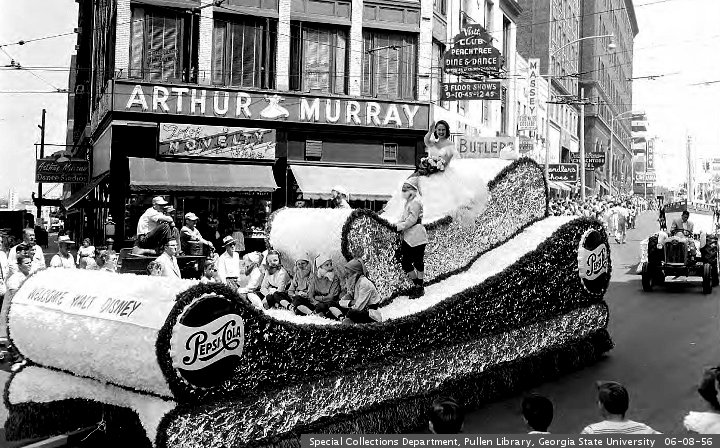




August 17 would have been birthday 123 for Mary Jane “Mae” West. Of course, she died in 1980, so the party is off. PG saw a note on facebook, and made the comment “She was rumored to be a man.” One right click google search later, this post started to take shape. This is a repost.
There is a blogspot site, maewest.blogspot.com. It is still published, with a birthday post today. Five years ago there was a post, Mae West: Penis Rumors. It seems as though Miss West liked to say, to the press, “When I die, you are going to be very surprised!”
A hollywood gossipmonger had a story, Was Mae West…A Man?! Much of her information comes from the tasteful findadeath site. The story here is that Mae West died in 1950, and the death was kept quiet. Her brother made appearances in her place, until the final death in 1980. This would have been quite a feat, considering that John Edwin West died in 1964. That doesn’t stop people from talking.
“…the real Mae West died somewhere around 1950, give or take a couple years, and rather than let the show stop, it was announced that not Mae, but her brother, died. Of course, the brother then became Mae West and carried on until November 1980. If you look carefully at photos from around 1950 on it definitely looks like a different person not to mention the big hands and masculine features, bone structure, etc. I may not have all the details 100% correct but I would almost put money on the fact that the ‘Mae West’ ‘who died in 1980 had a weenie!!”
The hands were mentioned by Raquel Welch. The two were in Myra Breckinridge, the first movie Miss West had made in 27 years. (Miss West appeared on Mr. Ed in 1964.) Miss Welch appeared at a film festival in 2012, and had stories to tell.
“When I went over to say hello to her (one day) I said, ‘Hi, it’s Raquel, remember?’ She sort of extended her hand to me and I went to kiss the ring and one false fingernail painted silver fell to the floor. I looked at the hand and I thought, ‘Oh, I’m getting a vibe.’ I really think she’s a man! At this point in her life all bets are off and you’re not going to be able to doll it up that much. I would say it’s pretty accurate that she resembled a dock worker in drag.” …
“I had this beautiful dress and it was black with a big white ruffle around the neck and a black velvet hat … Apparently Mae got wind of the fact that I was wearing this exquisite dress and I went to the studio that day for our scene together. I got coiffed, got my hair done and went to the closet to get the dress and it wasn’t there. I asked my dresser what happened to the dress and she said, ‘It’s been confiscated. Mae does not want you to wear that dress. You can wear the red dress that you wore in the last scene!’ … Welch was so outraged that she stormed off the set and refused to return until the dress was back in her closet. … “For the scene, we never appeared in a two-shot together. She left after she did her lines and I had someone off-camera reading her lines and I had to pretend she was there.”
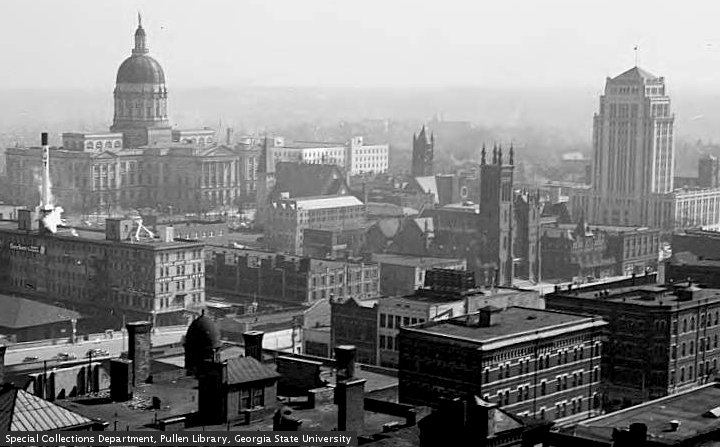
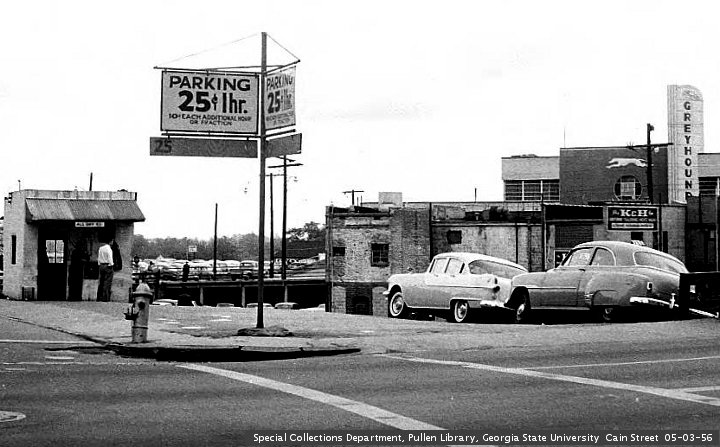
Pictures are from “The Special Collections and Archives, Georgia State University Library”.


The Funeral Of Elvis

PG was going to write about some depressing subject. People that are not kind to each other. People in Israel and people in Gaza just don’t seem to get along. Somebody driving a “faded red F-150 pickup truck” in Livonia MI was mean to a little girl. (HT to Neo Prodigy.) This is a repost. Pictures are from the Farm Security Administration collection of The Library of Congress.
There is a saying, “if a story seems too bad to be true, it probably isn’t”. PG tried to google that phrase, and got confused. Then he seemed to remember reading it in a column by Molly Ivins. Another google adventure, and there was this film. Miss Ivins, who met her maker January 31, 2007, was promoting a book. She sat down with a bald headed man to talk about it. PG could only listen to 24:30 of this video before being seized with the urge to write a story. There is a transcript, which makes “borrowing” so much easier. This film has 34 minutes to go, which just might yield another story or two.
Molly Ivins was a Texas woman. These days there is a lot of talk about Texas, with Governor Big Hair aiming to be the next POTUS under indictment. Mr. Perry claims that his record as Texas Governor qualifies him to have his finger on the nuclear trigger. Miss Ivins repeats something that PG has heard before… “in our state we have the weak governor system, so that really not a great deal is required of the governor, not necessarily to know much or do much. And we’ve had a lot of governors who did neither. “ It makes you wonder how much of that “economic miracle” is because of hair spray.
Texas politics makes about as much sense as Georgia politics. For a lady, with a way with words, it is a gold mine. “the need you have for descriptive terms for stupid when you write about Texas politics is practically infinite. Now I’m not claiming that our state Legislature is dumber than the average state Legislature, but it tends to be dumb in such an outstanding way. It’s, again, that Texas quality of exaggeration and being slightly larger than life. And there are a fair number of people in the Texas Legislature of whom it could fairly be said, `If dumb was dirt, they would cover about an acre.’ And I’m not necessarily opposed to that. I’m–agree with an old state senator who always said that, `If you took all the fools out of the Legislature, it would not be a representative body anymore.'”
We could go through this conversation for a long time, but you probably want to skip ahead and look at pictures. There is one story in this transcript that is too good not to borrow. For some reason, Molly Ivins went to work for The New York Times, aka the gray lady. In August of 1977, she was in the right place at the right time.



Mr. LAMB: And how long did you spend with The New York Times as a reporter?
Ms. IVINS: Six years with The New York Times. Some of it in New York as a political reporter at City Hall in Albany and then later as bureau chief out in the Rocky Mountains.
Mr. LAMB: Would you take a little time and tell us about reporting on the funeral of Elvis Presley?
Ms. IVINS: Oh, now there is something that when I’ve been standing in the checkout line at the grocery store and if I really need to impress people, I just let fall that I covered Elvis’ funeral. And, boy, people just practically draw back with awe. It may yet turn out to be my greatest claim to fame.
I was sitting in The New York City Times one day when I noticed a whole no–knot of editors up around the desk having a–a great scrum of concern, you could tell. It looked sort of like an anthill that had just been stepped on. And it turns out–The New York Times has a large obituary desk, and they prepare obituaries for anybody of prominence who might croak. But it turns out–you may recall that Elvis Presley died untimely and they were completely unprepared.
Now this is an enormous news organization. They have rock music critics and classical music critics and opera critics, but they didn’t have anybody who knew about Elvis Presley’s kind of music. So they’re lookin’ across a whole acre of reporters, and you could see them decide, `Ah-ha, Ivins. She talks funny. She’ll know about Mr. Presley.’
So I wound up writing Elvis’ obituary for The New York Times. I had to refer to him throughout as Mr. Presley. It was agonizing. That’s the style at The New York Times–Mr. Presley. Give me a break. And the next day they sold more newspapers than they did after John Kennedy was assassinated, so that even the editors of The New York Times, who had not quite, you know, been culturally aton–tuned to Elvis, decided that we should send someone to report on the funeral. And I drew that assignment. What a scene it was.
Mr. LAMB: You–you say in the book that you got in the cab and you said, `Take me to Graceland.’ The cabbie peels out of the airport doing 80 and then turns full around to the backseat and drawls, `Ain’t it a shame Elvis had to die while the Shriners are in town?’
Ms. IVINS: That’s exactly what he said. `Shame Elvis had to die while the Shriners are in town.’ And I kind of raised by eyebrows. And sure enough, I realized what he–what he meant after I had been there for awhile because, you know, Shriners in convention–I don’t know if you’ve ever seen a whole lot of Shriners in convention, but they were having a huge national convention that very week in Memphis. And they tend to wear their little red fezzes, and sometimes they drink too much and they march around the hotel hallways tooting on New Year’s Eve horns and riding those funny little tricycles and generally cutting up and having a good time. That’s your Shriners in convention, always something very edifying and enjoyable to watch. But they–every–every hotel room in Memphis was occupied with celebrating Shriners, and then Elvis dies and all these tens of thousands of grieving, hysterical Elvis Presley fans descend on the town.
So you got a whole bunch of sobbing, hysterical Elvis fans, you got a whole bunch of cavorting Shriners. And on top of that they were holding a cheerleading camp. And the cheerleading camp–I don’t know if your memory–with the ethos of the cheerleading camp, but the deal is that every school sends its team–team of cheerleaders to cheerleading camp.
And your effort there at the camp is to win the spirit stick, which looks, to the uninitiated eye, a whole lot like a broom handle painted red, white and blue. But it is the spirit stick. And should your team win it for three days running, you get to keep it. But that has never happened. And the way you earn the spirit stick is you show most spirit. You cheer for breakfast, lunch and dinner. You cheer when the pizza man brings the pizza. You do handsprings end over end down the hallway to the bathroom. I tell you, those young people will throw–show an amount of spirit that would just astonish you in an effort to win that stick.
So here I was for an entire week, dealing with these three groups of people: the young cheerleaders trying to win the spirit stick, the cavorting Shriners and the grieving, hysterical Elvis fans. And I want to assure you that The New York Times is not the kind of newspaper that will let you write about that kind of rich human comedy.
Mr. LAMB: Why?
Ms. IVINS: Because The New York Times, at least in my day, was a very stuffy, pompous newspaper.
Mr. LAMB: What about today?
Ms. IVINS: A little bit better, little bit better than it was.
Mr. LAMB: And…
Ms. IVINS: Has–has–it has a tendency, recidivist tendencies, though. You–you will notice if you read The Times, it–it collapses into pomposity and stuffiness with some regularity.
Mr. LAMB: Why did you leave it?
Ms. IVINS: Well, I–I actually got into trouble at The New York City Times for describing a community chu–chicken killing out West as a gang pluck. Abe Rosenthal was then the editor of the Times and he was not amused.
Mr. LAMB: Did–but did they let it go? Did they let it…
Ms. IVINS: Oh, no. It never made it in the paper. Good heavens, no. Such a thing would never get in The Times in my day.
POSTSCRIPT PG found some pictures, marked up the text, and was ready to post the story. He decided to listen to a bit more of the discussion between Molly Ivins and the bald headed man. When he got to this point, it became apparent that he could listen to Molly Ivins talk, or he could post his story, but he could not do both at the same time.
Ms. IVINS: Oh, well, of course, I’m gonna make fun of it. I mean, Berkeley, California, if you are from Texas, is just hilarious.
Mr. LAMB: Why?
Ms. IVINS: Well, of course, it is just the absolute center of liberalism and political correctness. And it is a veritable hotbed of people, of–bless their hearts, who all think alike, in a liberal way. And, of course, I’m sometimes called a liberal myself, and you would think I would have felt right at home there. But I just am so used to–I’m so used to Texas that I found the culture at Berkeley hysterical.


Don’t Tread On Me
Sometimes these stories write themselves. This one began with a tweet. @NotShaunKing “SJWs are now more offended by the Gadsen and Confederate flag, than the ISIS flag. Nice job, people!” The “Gadsen Flag” is the Revolutionary War banner. A coiled rattlesnake rests above the phrase “Don’t Tread on me.” It is a staple of American history.
Supposedly, someone is making a federal case out of wearing DTOM in the workplace. The google search shows stories by Fox News, and The Blaze. The slightly more reputable Washington Post has an article, Wearing ‘Don’t Tread on Me’ insignia could be punishable racial harassment.
“Here’s an excerpt from Shelton D. [pseudonym] v. Brennan, 2016 WL 3361228, decided by the EEOC two months ago: On January 8, 2014, Complainant filed a formal complaint in which he alleged that the Agency subjected him to discrimination on the basis of race (African American) and in reprisal for prior EEO activity when, starting in the fall of 2013, a coworker (C1) repeatedly wore a cap to work with an insignia of the Gadsden Flag, which depicts a coiled rattlesnake and the phrase “Don’t Tread on Me.” Complainant stated that he found the cap to be racially offensive to African Americans because the flag was designed by Christopher Gadsden, a “slave trader & owner of slaves.”
PG read that, and began to think. This is never a good omen. If Christopher Gadsen was a slave owner, then what about Betsy Ross?
Elizabeth Griscom Ross is, according to legend, the seamstress who created the stars and stripes. The story is disputed. For this sake of this blog post, lets assume that the legend is real. Betsy Ross created the American Flag, albeit with thirteen stars. Did she own slaves?
One internet forum raises the question, Did Betsy Ross have a slave? “no, Betsy ross did not have a slave. RE: Her husband had slaves though ” Could women own property in 18th century America? Who knows? Bear in mind, this is an undocumented internet forum. As is the next story.
“Have you ever heard Betsy Ross had children by her African slaves and was shunned by the Quakers because of it? Betsy Ross was widowed three times, and I have heard that since she knew how white men were having children by African women to increase their slave population, she decided to do the same. … Betsy Ross had children by her male slaves to increase her slave popuplation (and in essence, her property value).”
FWIW, Betsy, (January 1, 1752 – January 30, 1836,) was indeed married three times. The lucky men were John Ross (m. 1773–1776,) Joseph Ashburn (m. 1777–1782,) and John Claypoole (m. 1783–1817.) In both cases, she was remarried the next year. If she did take a slave baby daddy, she was very efficient. Maybe the husbands were understanding.
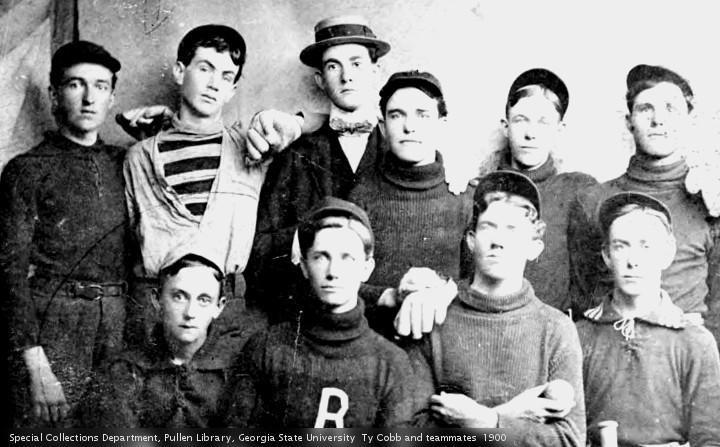
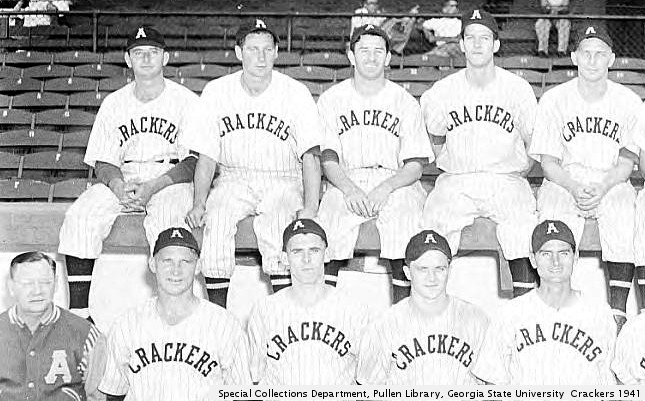
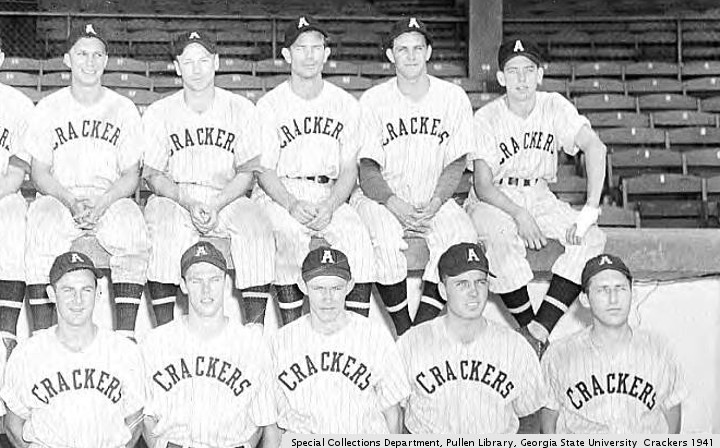
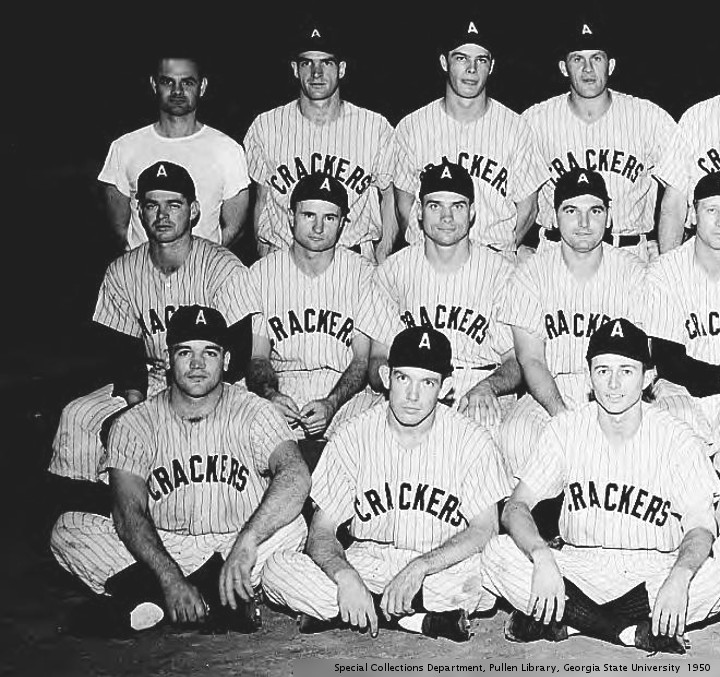
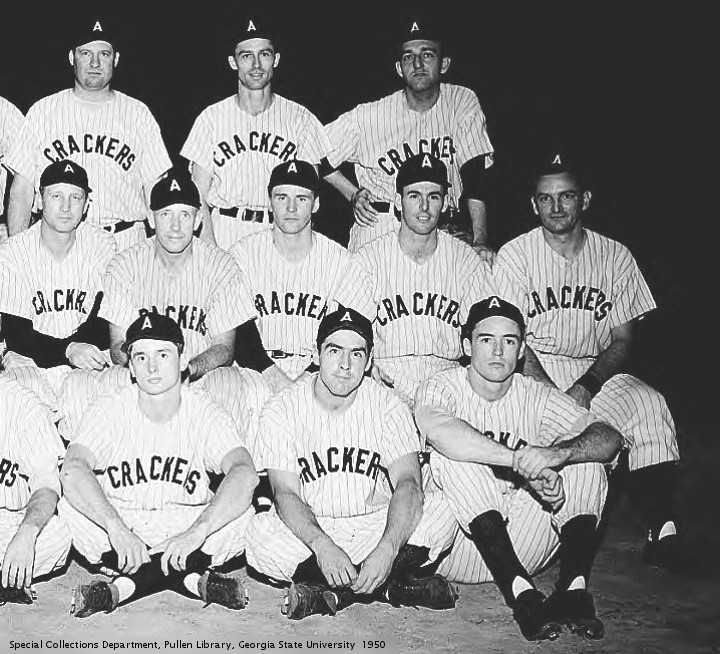
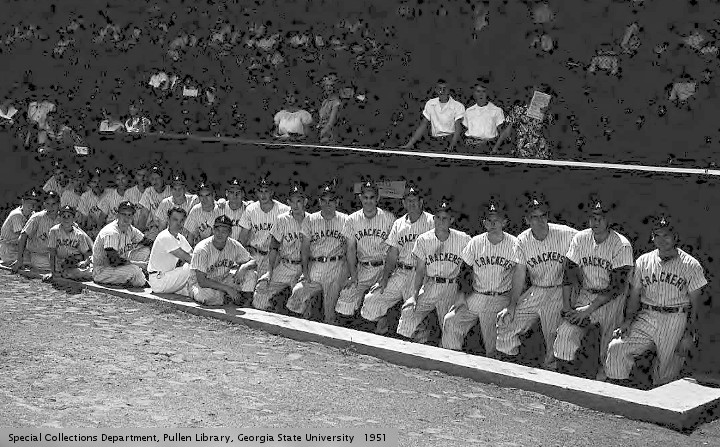
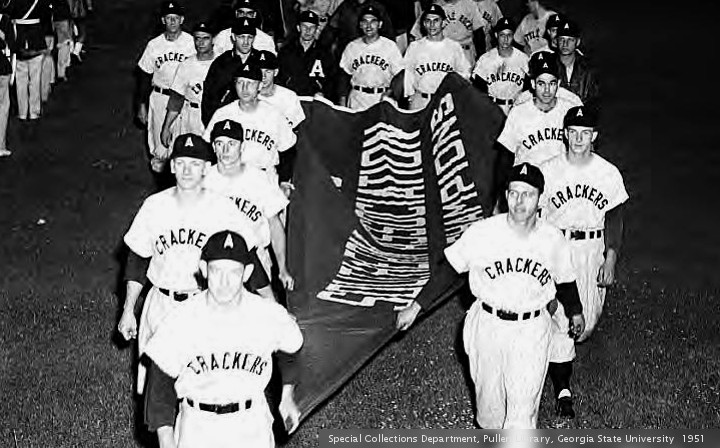
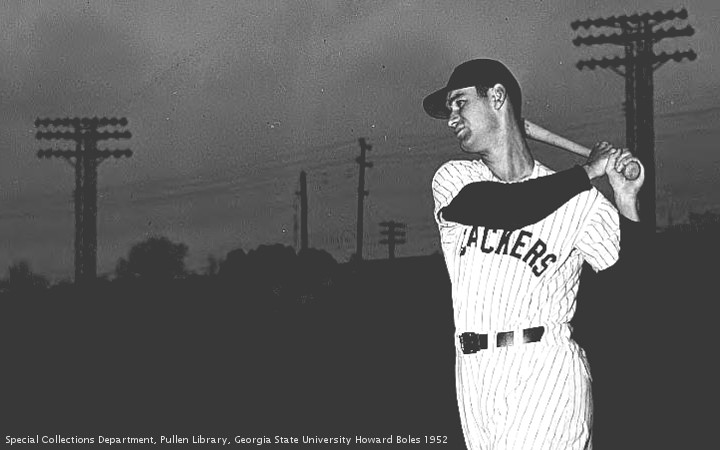
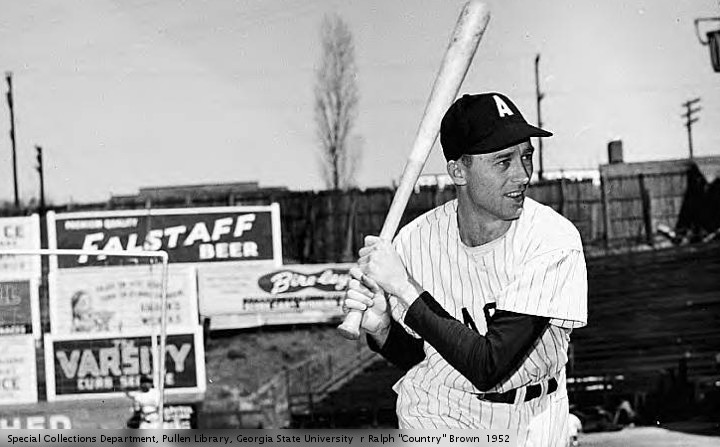
Pictures today are from “The Special Collections and Archives, Georgia State University Library”. The Atlanta Crackers played ball until 1965.


1 comment