Too Hot







It is too hot to do pride today. See you in October. ~ That which does not kill us makes us fatter ~ After line five, insert: A family I cannot leave ~ Doesn’t reason have an equally slutty brother named logic? ~ my heart on my sleeve a burning in my soul home i never leave mouth i cannot control ~ Not to mention the hysterical reaction when someone challenges a label like cis-. If you read my blog post, you will see that I acknowledge the need for this classification. But say that you don’t like the currently fashionable one, and see what happens. ~ One night I wandered into Roses Cantina, at 688 Spring Street. George Thorogood was playing. ~ @DailyRobbins I am writing about John Wayne Conner, who is awaiting execution Google search for JWC showed yacht by John Wayne in La Conner WA ~ WILL RAISE THE MINIMUM WAGE!!!!! ~ Preface to Leaves of Grass by Walt Whitman This is what you shall do: Love the earth and sun and the animals, despise riches, give alms to every one that asks, stand up for the stupid and crazy, devote your income and labor to others, hate tyrants, argue not concerning God, have patience and indulgence toward the people, take off your hat to nothing known or unknown or to any man or number of men, go freely with powerful uneducated persons and with the young and with the mothers of families, read these leaves in the open air every season of every year of your life, re-examine all you have been told at school or church or in any book, dismiss whatever insults your own soul; and your very flesh shall be a great poem and have the richest fluency not only in its words but in the silent lines of its lips and face and between the lashes of your eyes and in every motion and joint of your body. ~ Revealed: Jack Daniel was taught by minister’s slave how to distill signature whiskey ~ 8 Helpful Comebacks to Use When Someone Is Being Transphobic ~ 20 Powerful Quotes to Inspire Your Writing ~ Internet Argument Techniques ~ 9 reasons why “cis” isn’t working ~ The Reason Why This Is Correct ~ A Linguist Explains the Syntax of “Fuck” ~ Lisping – When /s/ and /z/ are hard to say ~ But When The Addicts Were Black, Nobody Cared ~ Why you think you’re right — even if you’re wrong ~ HeyJackass! Illustrating Chicago Values ~ the kid who asked too much, an interview with conner habib ~ THE DARK SIDE OF BUZZFEED ~ Not Everything Is a “Gospel” Issue – But Race Is! ~ Ten Signs of Intellectual Honesty ~ pictures today are from “The Special Collections and Archives, Georgia State University Library”. ~ selah






John Wayne Conner And James T. White






Georgia is fixin’ to poison 0000384035. Here is the what the Attorney General of Georgia has to say: “An execution date for John Wayne Conner has been set for July 14, 2016. Georgia Attorney General Sam Olens offers the following information in the case against John Wayne Conner for the 1982 murder of James T. White.
At the time of the murder, Conner lived with his girlfriend, Beverly Bates, in Milan. On the evening of January 9, 1982, they rode with friends, including the victim, J. T. White, to a party in Eastman. After spending the evening drinking and smoking marijuana, the group returned to Milan around midnight. J. T., described by one witness as “humble and satisfied” and by another as “mellow,” exited the vehicle with Conner and Ms. Bates at their house. Soon afterwards, Conner and J. T. left the house on foot, taking with them a nearly empty bottle of bourbon that Conner had purchased the night before. They walked to the home of Pete Dupree, woke him up, and asked him to take them to get more whiskey. He refused.
Then, according to Conner: “[M]e and J. T. left and went down the road. J. T. made the statement about he would like to go to bed with my girlfriend and so I got mad and we got into a fight and fought all the way over to the oak tree and I hit him with a quart bottle. He run over there to the fence trying to get through or across, I reckon, so I run over there and grabbed him and pulled him back and hit him again and he fell in the water and he grabbed my leg. I was down there at him right there in the ditch where he was at and he was swinging trying to get up or swinging at me to try to hit me one, and there was a stick right there at me, and I grabbed it and went to beating him with it.”
The next day, J. T.’s body was found in a drainage ditch near the Milan Elementary School. Injuries on his forehead bore the pattern of the sole of a tennis shoe. His nose was broken, both his cheekbones were fractured, his eyes were swollen, and his left ear was severely damaged. He had been hit so hard in the face with a blunt object that teeth, as well as portions of the bone to which they were attached, were broken away from his upper and lower jaws. Dr. Larry Howard, who conducted the autopsy, testified that the trauma to J. T.’s head and face caused brain damage and bleeding in and around the brain which extended into his lungs, causing him to drown in his own blood.
Beverly Bates had gone to bed when Conner and J. T. left. When Conner returned, he woke her up and told her that they had to leave; he had had a fight with J. T. and thought he was dead. Conner ripped off his shirt and threw it into the fire. He told Ms. Bates that he knew where a car was with its keys in it. The car was parked in front of the school. Before they left town, Conner told Ms. Bates that “he had to be sure,” and walked toward the ditch. She heard a thud. Conner returned, and said now he was sure, let’s go. They stopped to get gas in Eastman. Ms. Bates gave Conner $ 20 to buy gas with; in return, he gave her a bloody $ 5 bill. They were caught in Butts County.
The $ 5 bill, as well as a whiskey bottle and a tree limb found near the body, were subsequently analyzed and found to have blood on them that was consistent with that of the victim and inconsistent with that of Conner (understandable, since Conner suffered no injuries during the “fight”).”
The next part of this story is from Findlaw.
On January 26, 1982, while in the Telfair County Jail, Conner pounded a bullet into his chest until it exploded. As a result, he was admitted to Central State Hospital (“CSH”) in Milledgeville, Georgia. According to the records from that visit, Conner was “mute, uncooperative and appeared to be semicatatonic” upon admission. He showed “complete psychomotor retardation and [was] unable to answer any questions.” Conner was medicated and placed on “suicide precautions.” He later became cooperative and responsive.
By court order, Conner remained hospitalized at CSH until February 19, 1982, while the staff evaluated him for competency and insanity. ….. An IQ test administered while Conner was at CSH revealed a full-scale Weschler Adult Intelligence Score IQ score of 87, which placed Conner within the normal or average range of intelligence. On February 19, 1982, CSH issued a letter to the trial judge stating that Conner was competent to stand trial and could be held criminally responsible.
Conner’s father initially retained David Morgan to represent Conner in the underlying criminal case. About the same time, Dennis Mullis, a public defender, was appointed to represent Conner in an unrelated case. When it became clear that Conner’s father would not be able to pay Morgan’s fees through the pendency of the criminal case, Mullis was appointed to assist Morgan.
On April 30, 1982, Morgan filed a motion for funds to hire a defense expert to perform a mental examination because he was considering raising an insanity defense. This motion was heard on May 11, 1982. At that time, the court had the benefit of the February 19, 1982 CSH letter stating that Conner was competent to stand trial. Mullis stated that he could not determine if CSH had done anything wrong in its examination without an independent expert to assist him.
Nevertheless, the state trial court deferred ruling on the motion because the defense had not yet filed a motion to raise the insanity defense. At a later pre-trial hearing on June 21, 1982, Morgan withdrew from the case and Mullis became Conner’s sole counsel. At a hearing on June 30, 1982, Mullis announced that he would not be seeking to assert the insanity defense based upon his review of additional information private counsel had obtained from CSH. After that, Mullis did not file any other motion pertaining to Conner’s mental health nor did he request the appointment of an independent mental health examiner.
At his jury trial on July 12–14, 1982, Conner neither testified nor presented any evidence on his own behalf. During his guilt phase closing argument, the prosecutor said the following:
Ladies and gentleman, as prosecutor, as defense attorney, I have been involved in criminal law for seven years. As District Attorney of this circuit, I have prosecuted nine murder cases. I have never before sought the death penalty. I have seen several killings. I have been responsible for prosecuting several terrible killings. I have never before sought the death penalty. (This statement would later be considered improper conduct.)
Conner’s counsel objected. The trial court sustained the objection and gave the jury a curative instruction not to consider the penalty before deciding guilt or innocence.
After deliberating for fifty minutes, the jury found Conner guilty on all counts. Before the sentencing phase, the trial court granted defense counsel a brief recess for Mullis to confer with Conner. When the proceedings reconvened, the court asked Mullis if he planned to present any evidence in mitigation. Mullis responded:
Your Honor, I had planned on calling four witnesses—of course, the defendant, and his brother, and father, and his mother. After the verdict came in I talked to Mr. Conner in a room adjacent to the courtroom and he has informed me that he does not desire me to enter any evidence in mitigation. He does not desire to do that himself, he has told me. I have counsel[ed] him that my advice would be to do otherwise. My advice would be to put in some evidence to mitigate this. He has told me he does not desire to do that.
The following colloquy then took place between the court and Conner: THE COURT: Mr. Conner, do you understand your rights to present evidence? MR. CONNER: Yeah. THE COURT: And you have instructed your counsel and you are telling the Court now that you do not want to put anything in in evidence of mitigation? MR. CONNER: That’s right. THE COURT: All right, sir. That’s your privilege.
The prosecution and the defense then made their closing arguments without presenting any additional evidence. During his sentencing phase closing, the prosecutor once again expressed his personal belief, based upon his experience, that the death penalty was appropriate in Conner’s case… The jury returned a death sentence …
Conner filed his first writ of habeas corpus in state trial court on March 23, 1984. Evidentiary hearings were held on September 24, 1984, and February 11, 1985.
In the first evidentiary hearing, Mullis testified about his representation of Conner at trial. He explained that although raising an insanity defense crossed his mind, he found nothing to substantiate such a claim. When asked about the CSH records, Mullis admitted that he knew that Conner had some psychiatric problems and suffered from drug and alcohol abuse. He further admitted that in seeking the appointment of an independent mental health examiner, he did not reveal to the trial judge any of the information contained in the CSH records.
Mullis testified that while he was considering potential mitigation, he spoke with Conner’s parents and brother. They discussed Conner’s “upbringing” and “socioeconomic information.” Mullis stated that he learned that Conner had a deprived economic background and had not been raised “in the best of circumstances.” After Conner was convicted, Mullis spoke with Conner’s brother about testifying in mitigation. Also during this time, Mullis approached Conner’s girlfriend, Beverly Bates, who had testified against him at trial, about testifying in mitigation, but she refused. …
Mullis stated that his plan to present the testimony of Conner’s family members changed when Conner informed him after the entry of the guilty verdict that he did not want to present any mitigation evidence. Mullis explained that Conner said “something to the effect of letting [the jurors] do what they will.” Mullis testified that he explained the purpose of the evidence to Conner but that Conner did not seem to care about himself….
As for Conner’s relationship with his father, she explained that they were close but that Conner’s father beat him as a child and into his teens. Conner’s mother admitted that he had problems, describing him as a “very troubled young man” who drank alcohol and used drugs. She explained that Conner was always depressed and that he felt unloved. She also stated that Conner tried to commit suicide in 1981. … Conner’s father also described a second suicide attempt, in which Conner tried to kill himself by cutting ropes holding him in a tree while he was working with his father in a tree surgery business. Conner told his father that he was trying to have an accident so that he would fall and kill himself. …
Having determined that we must vacate the District Court’s judgment denying Conner’s petition and remand for further proceedings on the mental retardation claim, it is unnecessary for us to decide anything regarding the other two claims—the ineffective assistance of counsel at sentencing claim and the prosecutorial misconduct claim.
Murderpedia notes “The jury found the following statutory aggravating circumstance: “The offense of murder was outrageously and wantonly vile, horrible and inhuman in that it did involve depravity of mind and aggravated battery to the victim.” The evidence supports this finding. Appellant chased an unarmed, intoxicated victim (who failed to leave a mark on his assailant) from the road, across a drainage ditch and into a barbed wire fence; dragged him back to the drainage ditch; used a whiskey bottle, a heavy stick and his feet to beat and stomp the victim to death; and left him to die, lying in the water. The evidence shows that the defendant unnecessarily and wantonly inflicted serious physical abuse upon the victim prior to his death. The facts of this case distinguish it from those cases in which a finding of would not be appropriate.”
The fiswrapper sees the imposition of the death penalty differently. “Conner’s killing of White during the drunken brawl, while heinous, raises questions about whether the murder was proportionate when compared to others that landed men on death row. Some killed multiple victims. Some killed children. Some committed murder during an armed robbery or a sexual assault. The Atlanta Journal-Constitution, during a two-year-long investigation of Georgia’s death penalty, found that prosecutors rarely sought the ultimate punishment for murders similar to White’s.”
This quote is from a news report. “The tour was for Federal Communications Commission member Ajit Pai, who had come to the prison to meet Corrections Commissioner Homer Bryson and talk about what the federal government could do to help combat the scourge of contraband cellphones. After their meeting, warden Bruce Chatman led a small group on a tour of the Georgia Diagnostic and Classification Prison in Jackson. … Upon entering the row, Chatman acknowledged some cellphones have been found on death-row inmates. “But it’s been a while,” he said proudly.”
While on the tour, the group met John Wayne Conner. “With a broad grin that displayed several missing teeth, John Wayne Conner introduced himself by saying his name was the same as the “little Terminator.” That would be John Connor, the character in the “Terminator” movies who will lead a human revolt against the machines that have taken over the world.
Conner, 59, announced he has been on death row for 33 years. As for his appeals, they’ve almost run out, he said. “I’m hanging in there. I’m still kicking. In here, that’s a good thing.”
When asked how he bides his time, Conner, with a child-like enthusiasm, reached down, lifted the corner of his mattress and pulled out about a half-dozen watercolor paintings. He proudly laid them across his bed for all to see. Most were vibrant landscapes, including one with a majestic waterfall. Conner said it takes about an hour to finish a painting.”
Pictures are from “The Special Collections and Archives, Georgia State University Library”. UPDATE: John Wayne Conner died at 12:30 am, July 15, 2016.


The Origin Of Barbie





PG found a copy of Snuff at a yard sale. The story was written by Chuck Palahniuk, pronounced paula nick. This book report may have spoilers.
The 197 pages recount an attempt to break a world record. Aging porn star Cassie Wright is trying to take on 600 men in one session. The plan is to die, in a blaze of gooey glory. The story is told by four characters: Mr. 72, Mr. 137, Mr. 600, and Sheila. Each of the four feels a connection to Miss Wright. It is a case of four wrongs making one Wright.
The story gets weirder and weirder. Mr. 72 is convinced that he is the son of Cassie Wright. Mr. 137 became an Okla-homo after being diddled by daddy. Mr. 600 is said to be Miss Wright’s baby daddy. Sheila, original name Zelda Zonk, was another possible Wright baby. After a while, the reader just plows ahead. When PG pays a dollar for a book, he wants his money shot money’s worth.
Snuff has a couple of gimmicks that are repeated to the point of no return. The talent is known by a variety of names, like pud puller, wiener wrangler, page paster, fist flogger, white washer, and sherbet shooter. The movies made by Cassie Wright all had satirical titles, like World Whore One, and The Asshole Jungle. It was funny the first twenty times.
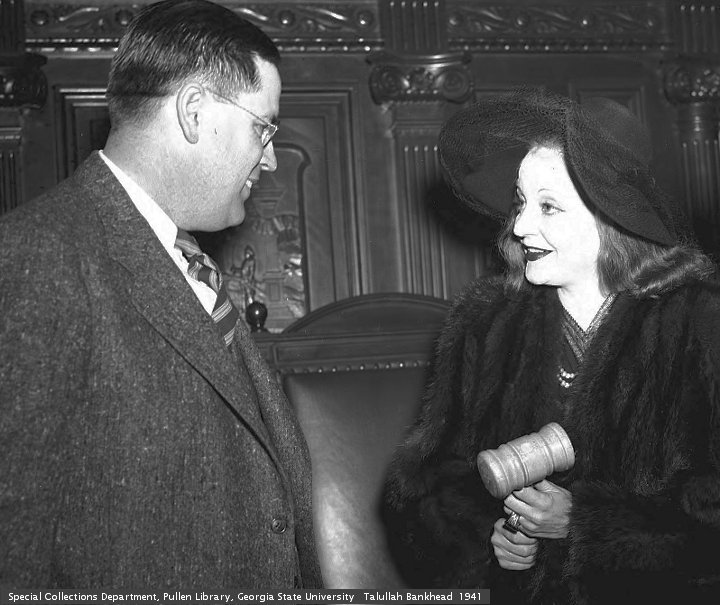
Another gimmick Mr. Nick works us with is the “true fact.” Someone will throw out a chestnut, and say “true fact.” Many of them are Hollywood beauty secrets, like Lauren Becall, and Tallulah Bankhead, drinking eggshell tea. Here is an example.
“… Hitler … was disgusted by seeing his fellow soldiers visit French brothels. To keep the Aryan bloodlines pure,and prevent the spread of venereal disease, he commissioned an inflatable doll that Nazi troops could take into battle. Hitler himself designed the dolls to have blond hair and large breasts. The Allied firebombing of Dresden destroyed the factory … “
Mr. Google has more. “But in 1942 the project was halted when German soldiers refused to carry the dolls because of the potential embarrassment if they were captured by the enemy. Author Graeme Donald uncovered Hitler’s secretive “Borghild Project” while researching the history of Barbie, which was based on a postwar German sex doll.”
“I was actually researching the history of the Barbie doll that was based on a German sex doll of the 1950s. Ruth and Elliot Handler from America visited Germany in 1956 and saw the Lilli dolls that were sold in barbers’ shops and nightclubs – and were not for children Ruth didn’t realise this and bought one and realised later they were not toys. But Ruth and her husband used the doll as a foundation for what became Barbie.”
Pictures are from “The Special Collections and Archives, Georgia State University Library”.






Insanity


@RuPaul Insanity: Doing the same thing over and over again, and expecting different results~Einstein @chamblee54 @RuPaul Everything I have seen on the internet is a lie, but maybe this one is the truth
It is a favorite of English speaking rhetoric mongers. The “definition of insanity” is usually blamed on Albert Einstein. There never seems to be a source, or context. Another possibility is the literature of Alcoholics Anonymous.
DOI is one of those sayings that sound good, until you think about it. Thinking is not a problem for the pontificating masses who trot the phrase out at every opportunity. The fact that Bill and Hillary Clinton quote DOI should tell you something. America is about to elect a Clinton President, and is expecting different results.
Perhaps the best place to look is the comments. alberto-a-stone: The definition of ignorance is quoting the same thing over and over even though it is not factual. Dollarhide: the definition of insanity is quoting Einstein over and over and expecting to be thought to be clever each time Pictures are from “The Special Collections and Archives, Georgia State University Library”.


35 Broad Street
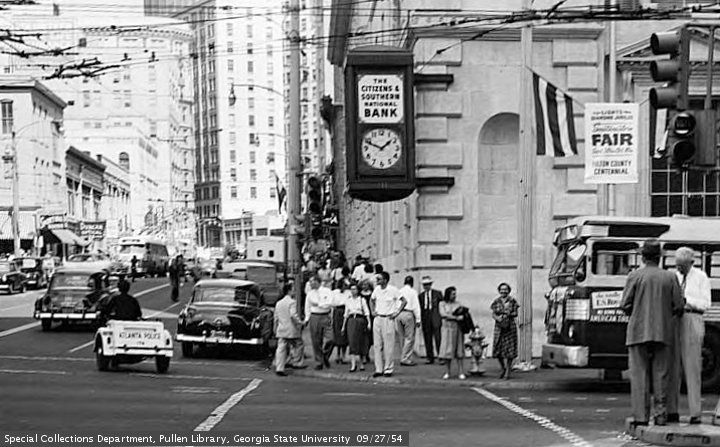

PG was having a delightfully slack afternoon, The one productive activity was editing pictures from “The Special Collections and Archives, Georgia State University Library”. In box seventy two of “corporate bodies”, in the Lane Brothers archive, there was a picture commissioned by King Road Marker Company. It displayed a brand new crosswalk, over Marietta Street at the intersection of Broad Street. The picture was taken at 1:51 p.m. September 27, 1954. This is a repost.
The time caught PG’s eye. 1:51 is one of the times used to display clocks and watches in advertising. Most ads use 10:09. This arrangement of the hour and minute hands makes a welcoming gesture. This allows the logo of the watch to be visible, and is thought to encourage the viewer to purchase the timepiece. The shadows on the buildings indicate that the picture was shot in early afternoon.
The clock with the magic time advertised the C&S national bank. The building behind the clock was the headquarters of that bank. In 1954, Citizens and Southern bank was a prime player in the Atlanta market. (PG’s dad said that C&S stood for choke’m and squeez’m.) At some point, C&S merged with NCNB to become Nationsbank, which was later absorbed by Bank Of America.
C&S kept it’s headquarters at 35 Broad Street for many years after competitors built trophy buildings. Their were constant rumors about where the C&S highrise was going to go. Finally, C&S Plaza was built at Peachtree and North Avenue, a mile north of five points. The building was to become the tallest building in America outside of New York and Chicago. During the construction of this building, C&S became part of Nationsbank.
The picture is featured in Atlanta Time Machine. The building is now owned by Georgia State University, with a BOA branch on the first floor. The banking hall is spectacular. It was designed by Philip Shutze, before the great depression. Here is more information.
Nations Bank Building (Citizens and Southern National Bank Building, Empire Building)
35 Broad Street, NW 1901: Bruce and Morgan, Architects, NR.
Remodeling of Lower Floors and Interiors 1929:
Hentz, Adler and Shutze, Architects; Philip Shutze, Designer
Fourteen stories high, the Nations Bank Building was the first steel-frame structure to be built in Atlanta. Its clear-cut silhouette, simple fenestration, and heavily decorated terra-cotta top bear the influence of the Chicago School. In 1929 the building became the headquarters of the Citizens and Southern National Bank, which asked Philip Shutze to redesign its three lower floors. Because the impression of load-bearing masonry was regarded as better suited for a banking establishment than large glass panes were, the original display windows were replaces by classical motifs apparently “carved out” of Indiana limestone.
Philip Shutze was inspired by Italian Mannerism, and especially by the city gates of Verona by Michele Sanmichelo (1484-1559) … Reached from Marietta and Walton streets through lofty arcaded entryways and a more intimate elevator lobby in the early Renaissance style on Broad Street, the banking hall is a long nave articulated by colossal Corinthian pilasters. While its walls and floors feature several kinds of Georgia, Tennessee, and European marbles in a warm gold-brown color scheme, the ceiling, from which hang gigantic chandeliers, is left bare. The Pantheon, which Shutze had measured during his internship at the American Academy in Rome, served as direct source for the pedimented niches, and for the floors with alternate square and circular patterns. Also, of Roman inspiration are the bronze desks and the eagle motif found throughout the design.




Two Hundred Yards Behind

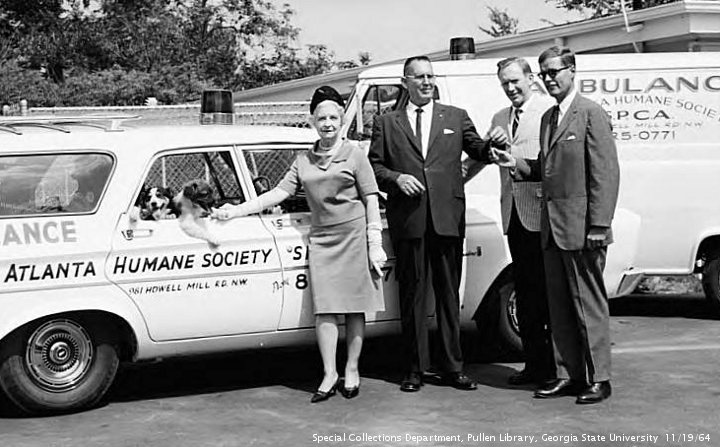
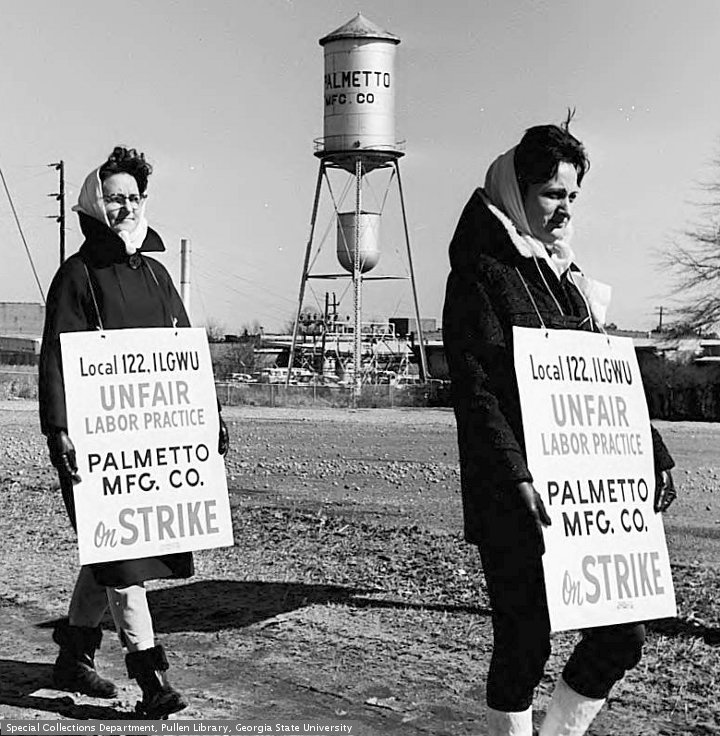


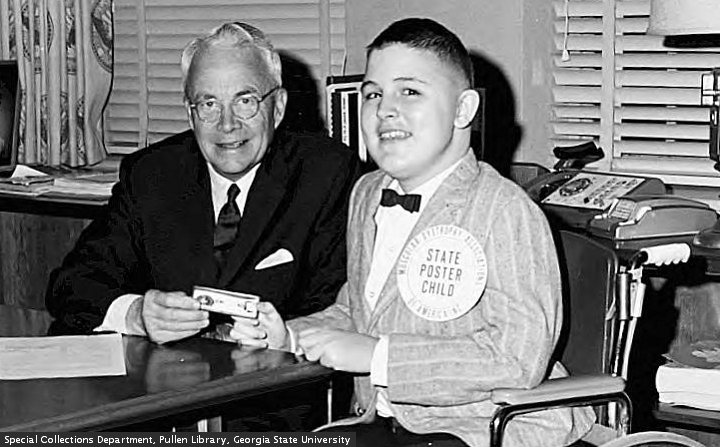
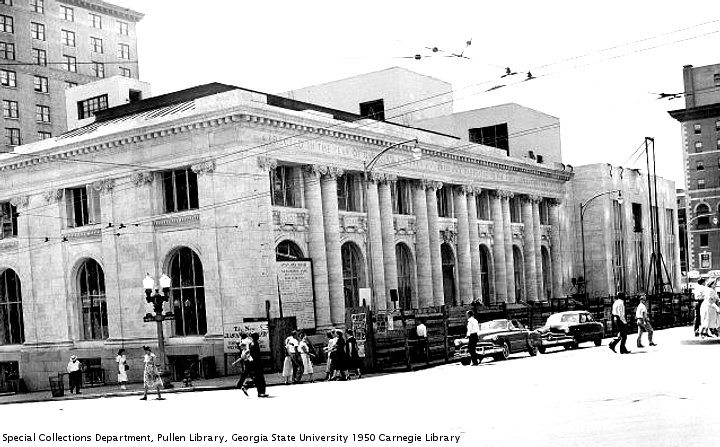
In 1985, PG went to work for Shaky Blueprints. The real name was a Japanese word that nobody knew how to spell. Two of the previous hires were an athletic young lady, and a fat man. Until better nicknames arrive, we will call them AYL and FM for this story.
AYL was trying to get FM to go jogging with her after work. This was an ongoing conversation, with FM always turning her down. One afternoon, PG wore an old pair of jogging shoes to work, and said that he would go running with AYL.
Shaky was just off highway 400, in what is now part of Sandy Springs. There was a road leading away from it. The road went over the highway, and went in a wooded semi circle for a couple of miles. The plan was to go on this loop, and take sidewalks on Roswell Road back to Shaky.
At one time, PG went running every day. He was out of the habit by this time, and always a slow runner. When the work day was over, PG tied his glasses on with a rubber band, did a few stretches, and was ready to take on the course.
AYL and PG left the parking lot, and started up the road. PG trudged along with his head down. When he got to the bridge over the highway, PG looked up. AYL had taken off like greased lightning, and was already two hundred yards ahead. PG hollered for her to slow down, and finished the course.
Pictures for this repost are from Special Collections and Archives, Georgia State University Library.


Midtown

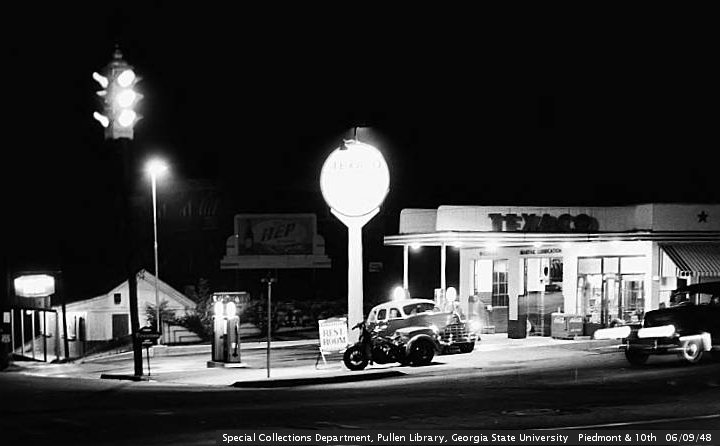


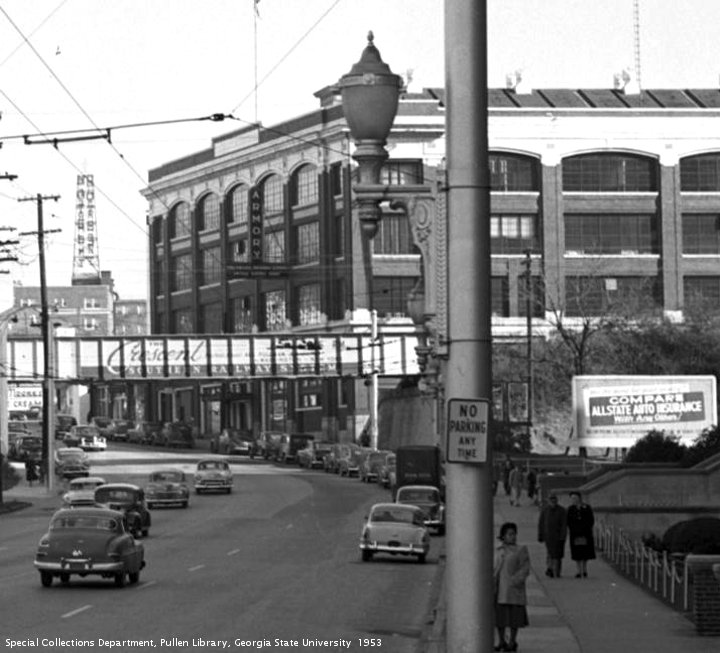
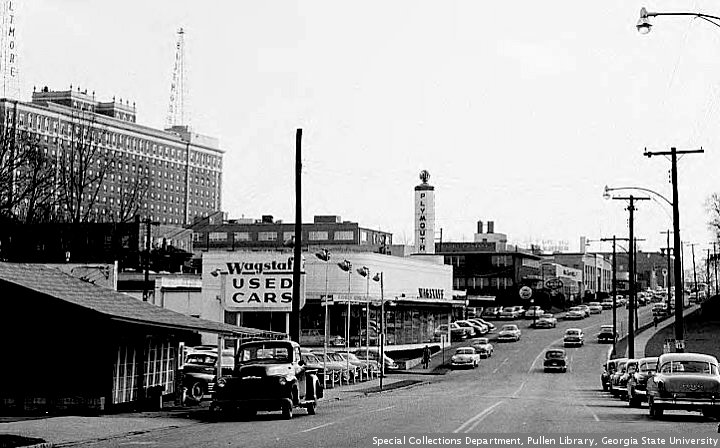
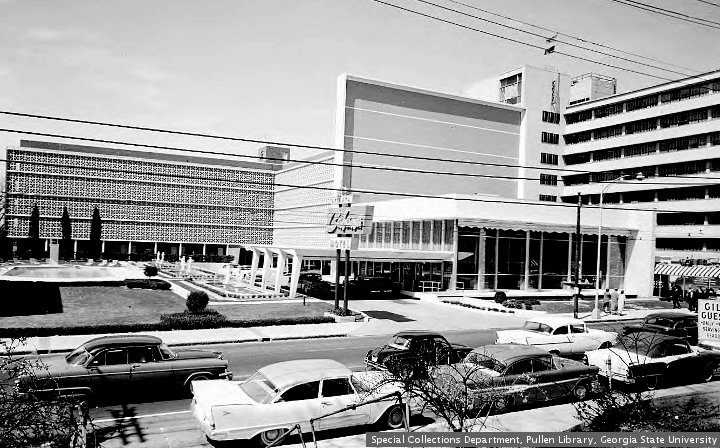
The neighborhood along Peachtree Road has always been a great place to be a freak. For a long time it didn’t have a name. It is north of downtown, between Piedmont Park and Georgia Tech. Sometime in the early eighties, people started to call it Midtown, and the name stuck.
In the time after the War Between the States, this area was a shantytown called “Tight Squeeze”. It evolved into a pleasant middle class area. In the sixties, hippies took over. The area was known as the strip, or tight squeeze. Many stories could be told.
After the flower children moved on, the area went into decline. Gays started to move in, with the battle cry “Give us our rights or we will remodel your house.” Developers, worshiping the triune G-d of location, location, location, began to smell money. The neighborhood became trendy, then expensive, then more expensive. The freaks with money remain. This is a repost. Pictures are from “The Special Collections and Archives, Georgia State University Library”.



Jane Fonda And J. Edgar Hoover




This repost is a work of speculation, and has no basis in proven fact.The thesis cannot be proved nor disproved. Pictures are from “The Special Collections and Archives, Georgia State University Library”.
Listening to talk radio while you drive is a dangerous activity. You might start to think, and look at the man behind the screen. Neal Boortz was on a rant today about Jane Fonda. It it the same story you have heard many times…she gave aid and comfort to the enemy, she is a traitor, American troops died because of her,she should have been executed.
Sometimes when you hear something too many times, you begin to have doubts about what you heard. A light bulb went off in PG’s head when he heard the Fonda Rant again.. .What if Jane Fonda was working for the US government when she went to Hanoi?
What was in it for the government? This trip gave our government a discredited leader of the antiwar movement to denounce. When the government was trashing Jane Fonda, they did not have to defend the disastrous policies of that war.
Miss Fonda has been an icon of right wing hatred ever since, as well as of military training. One story has Miss Fonda giving the North Vietnamese information about activities by American forces. How would she get this information?
The infamous trip to Hanoi took place in the Summer of 1972. American troops were being withdrawn, and anti war protests lost most of their passion. (It was also soon after the death of F.B.I. Director J. Edgar Hoover, and the Watergate burglary) The war in Vietnam was essentially over for America. We were no longer trying to win, but to negotiate a face saving treaty. President Nixon called it “Peace with Honor”. Miss Fonda’s actions had little impact on these negotiations.
Miss Fonda made some radio broadcasts from Hanoi. Is it possible that coded messages to our troops were included in these broadcasts? Is it also possible that she gave the North Vietnamese misinformation on purpose?
Why would a women known for her left wing activism do such a thing? Maybe, the FBI had some dirt on her, and blackmailed her.
In 1967, Kurt Vonnegut published a book titled “Mother Night”. It tells the story of Howard W. Campbell Jr. Mr. Campbell made propaganda broadcasts for Germany in World War II, which were secretly used to pass coded messages to the Allies. He was condemned as a traitor after the war, but never prosecuted. He did not win an Academy Award.
The role of the government in this affair could have taken another role. Perhaps Miss Fonda was sincere in her actions, but aided by the government. Miss Fonda was under surveillance in 1972. The government would have known about her plans to go to North Vietnam, and perhaps could have stopped her. But, because her going to Hanoi was to their advantage, the government allowed the trip to take place.
The above is speculation, and could be horribly wrong. The fact that Miss Fonda has expressed regrets over her trip neither proves nor disproves this. She got great movie roles, and won two Academy Awards, during the seventies. This may be a coincidence, or maybe it was a reward for her service.
Clearly, the trip she made to Hanoi had propaganda value to the US government. It has been a Godsend over the years. You should always consider who benefits from an action.
During his rant today, Mr. Boortz said that US troops died because of Miss Fonda. (He does not discuss the man who went to Nam in his place, after his draft deferment.) By saying this, he can ignore the tens of thousands of troops who died because Richard Nixon chose to wait until 1973 to sign a “peace treaty”. He could have made the same deal in 1969. Peace with honor indeed.
A few days ago, the possibility that the government allowed Jane Fonda to go to Hanoi was discussed. Ms. Fonda’s trip to North Vietnam had numerous propaganda/p.r. advantages to the American government. Direct government sponsorship cannot be ruled out. Another scenario would have the government knowing about the trip, having the ability to stop the trip, but allowing it to happen. For the purposes of today’s discussion, we will call this the “Hoover Option”(HO). It is named for John Edgar Hoover, the publicity savvy director of the FBI until his death in 1972.
HO is a favorite of conspiracy theorists. It is difficult to prove or disprove, and explains a lot of things. Another conspiracy rich event is the shooting of John Kennedy on November 22, 1963. The various hypotheses on this event are well known. Numerous people wanted JFK to retire…gangsters, teamsters, Republicans, Lyndon Johnson, Vietnamese… to the point to where it is tough to sort out all the possible candidates. The thinking goes here, that J. Edgar Hoover knew of the plot to kill JFK, could have stopped it, but chose to allow it to happen. Even conspiracy skeptics think this is plausible.
The concept of Lee Harvey Oswald working alone does not eliminate the possibility of HO. Here was a sketchy character, known to have traveled to the Soviet Union, and favor “fair play for Cuba”. He worked in a building on the parade route. As much as the FBI knew…especially about those with Soviet connections…is it possible that Mr. Hoover knew what Mr. Oswald was going to do that Friday? And decided to allow it to happen. And why did Jackie choose that photogenic pink outfit?
A few years later, Dr. Martin Luther King Jr. was murdered in Memphis, TN. Mr. Hoover had a well known hatred of Dr. King. How did a sketchy character get a room, within gunshot range of the hotel Dr. King stayed in? How did he know when Dr. King would be stepping on the balcony? Did Mr. Hoover know all of this, and still allow the shooting to take place? Why was Jesse Jackson there?
J. Edgar Hoover died on May 2, 1972. This was 13 days before Arthur Bremer shot George Wallace, six weeks before the Watergate burglary, and eight weeks before Jane Fonda went to Hanoi. Mr. Hoover died at the height of the Nixon administrations “dirty tricks”, just a few weeks before they got caught. No doubt, Mr. Hoover knew what Tricky Dick was up to.
HO has probably been in existence throughout history. Most leaders have blood on their hands, and it is always better to get someone else to do the dirty work.
Pearl Harbor has long been the object of this speculation. There is little doubt that Mr. Roosevelt wanted the United States to join the war, but was having a tough time with an isolationist public. After the Japanese attacked Pearl Harbor, Mr. Roosevelt got what he wanted. It has long been speculated that he knew in advance about the attack, and let it go down. There were obvious advantages to him.
Which brings us to the Pearl Harbor of the modern era, 911. The attacks that day were a political jackpot for George W. Bush. He was able to ram many restrictions on civil liberties through congress, and begin a war in Iraq, that had clearly been planned for some time. Did our government know about plans for the 911 attacks, and quietly let them happen?


Happy Birthday Mr. Ginsberg



Allen Ginsberg would be 90 today, if nature had not made other plans in 1997. The son of Louis and Naomi Ginsberg arrived, in Newark NJ, June 3,1926.
Allen Ginsberg had a part in many new age dramas, with a few musicals and comedies thrown in for good measure. Hippie, beatnik, gay, artist, peace promoter, Buddhist convert…these are a few of the labels. He became famous for being famous, well known to people who never read a word of his poems. Two of the more famous were howl and kaddish.
Howl became scandalous in 1956 when it was busted for obscenity. It is mild by today’s standards, but almost landed Mr. Ginsberg in prison. PG heard about howl in the early nineties, and looked high and low for a copy. He could not find one. Today on the internet, not only is the text widely available, there are recordings of Mr. Ginsberg reading his work. (Here is an updated version, Howl 2011.)
The original plan was to listen to Mr. Ginsberg read while editing photos. PG was going to listen to the words, and think of something to say while listening to the bard. About the seventeenth time Mr. Ginsberg shouted “Moloch”, the plan began to fall apart.
The next poem was Kaddish. This is about Naomi Ginsberg, the mother of the poet, who evidently had some issues. This was tough for PG to listen to. The other night, PG had a disturbing dream about his own late mother. In this dream, a fearsome shouter came in wearing a black suit, which meant that he intended to do some scary shouting. PG went into another room, where his recently deceased mother was laying on a table.
1956 was the year of the obscenity trial for howl. This took place on the other side of america, from the Brookhaven where PG was two years old. This was the year when his brother was born, the year when the Georgia legislature voted in a new flag, for whatever reason. In 1955, President Eisenhower had a heart attack. Many wondered if it was a good idea to have Richard Nixon as the vice president.
Finally, PG could stand no more of that voice. The player was turned off, the files stored on an external hard drive, never to be heard again. PG just is not a poetry person. This is a repost, with pictures from “The Special Collections and Archives, Georgia State University Library”.



Does G-d Exist?

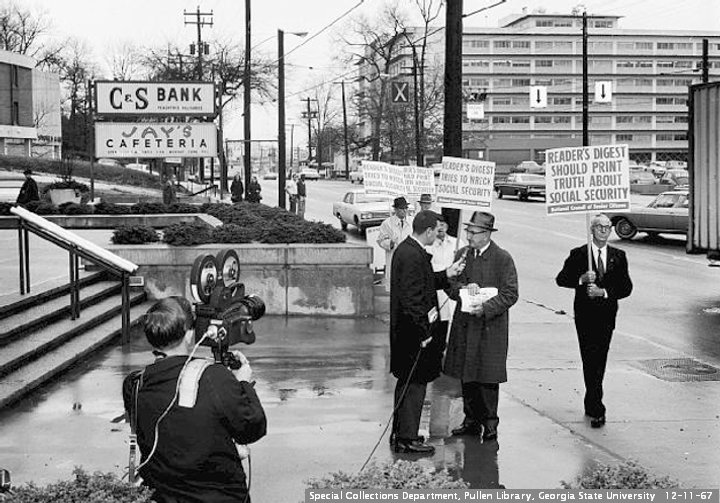
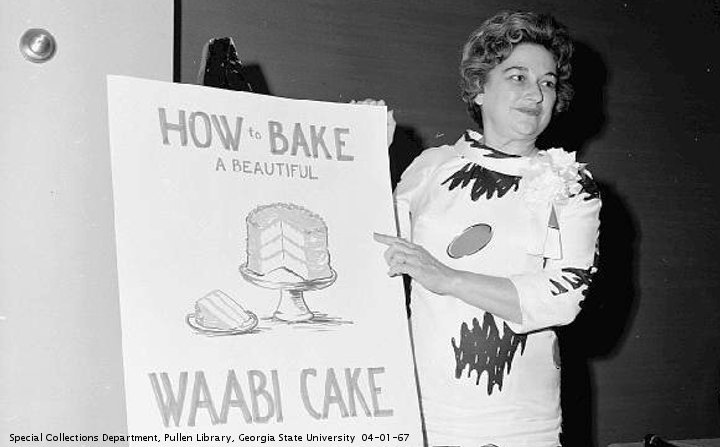



On Wednesday, July 21, 2010, there was a debate, with the topic being “Does G-d exist?”. The opponents were Christopher Hitchens vs. Dr. William Lane Craig. The host was Biola University, a Christian college in La Mirada, CA. Mr. Hichens died December 15, 2011. Dr. Craig is still with us.
Those who have endured religious debates will be intrigued by the lack of interruptions. With one exception, the two participants were allowed to finish their statements without interruption. The two did seem to have different ideas of what the topic of the debate was.
It is not known who won. There were numerous logical fallacies performed. Stray men were persecuted, and positions were misrepresented. The language was semanticized to the point of no return. This is to be expected, considering that it was beliefs that were being debated. There was self satisfaction at having “this most important of all discussions.”
PG has listened to the debate twice. The second time he followed the transcript, and took notes. His opinion did not change. PG suspects that G-d exists. The world might be a happier place if she did not exist, but we might be stuck with her. Where PG differs with conventional wisdom is on the matter of belief. Is belief the correct way to approach G-d? Is there a better way to “know” G-d?
One problem with Christianity is the emphasis on life after death. It is the only game in town. If you do not agree with the scheme for life after death, you have little reason to follow the Christian religion. The obsession with life after death is not discussed in this debate. In fact, Dr. Craig lists the resurrection of Jesus as being evidence of the existence of G-d.
In terms of tone, Mr. Hitchens is more pleasant to listen to. Dr. Craig speaks with the rhythms of a pulpit preacher. His message could be recycled as a sermon, including this part of his final statement: “And so, I want to invite Mr. Hitchens to think about becoming a Christian tonight.” Dr. Craig played the victim.”First, have we seen any good arguments tonight to think that God does not exist? No, I don’t think we have. We’ve heard attacks upon religion, Christianity impugned, God impugned, Mother Teresa impugned, but we haven’t heard any arguments that God does not exist.”
Mr. Hitchens, speaking before cancer and chemotherapy took it’s toll, was gracious, thanking his hosts repeatedly. His arguments were presented in the manner of a lecture, rather than a sermon. He piled facts on top of facts, and built his case in an entertaining style. What remains of his British tongue is employed to great effect. Whatever one thinks of Christopher Hitchens (and his appalling opinions about the war in Babylon), one cannot deny that he is a master user of the english language.
The debate began with both men giving twenty minute opening statements. Dr. Craig presented a five point argument. (the cosmological argument, the teleological argument, the moral argument, the resurrection of Jesus, the immediate experience of G-d) He likes to use big words. …
A foundation belief of Christianity is the idea that if you have the correct thoughts about Jesus you will live forever. The phrase “eternal life” is repeated, well, eternally. The thing about eternity that you never hear is, is something does not have an end, then it does not have a beginning. To hear about a human life, with a beginning and no end, this is only half of eternity. Getting back to Dr. Craig’s sermon, this does not add up. If life can be said to go on eternally in the future, should it not go on eternally in the past?
This is a repost, with pictures from “The Special Collections and Archives, Georgia State University Library”. The earlier version is much longer, and it had this disclaimer: It should be noted that this post is an attempt to condense a two hour discussion into a length that will not scare off readers. Many parts are being left out, some of which might be important. If the reader has the time, curiosity, and patience, here is the video and the transcript. Be sure to put fresh batteries in your BS detector. Use alcohol, drugs, or prayer at your own risk.
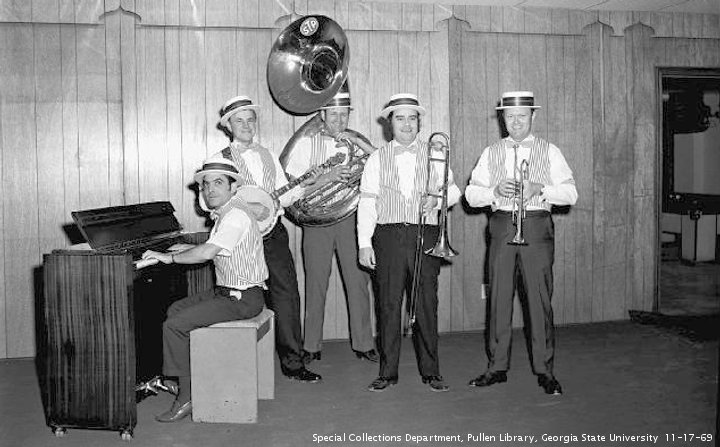
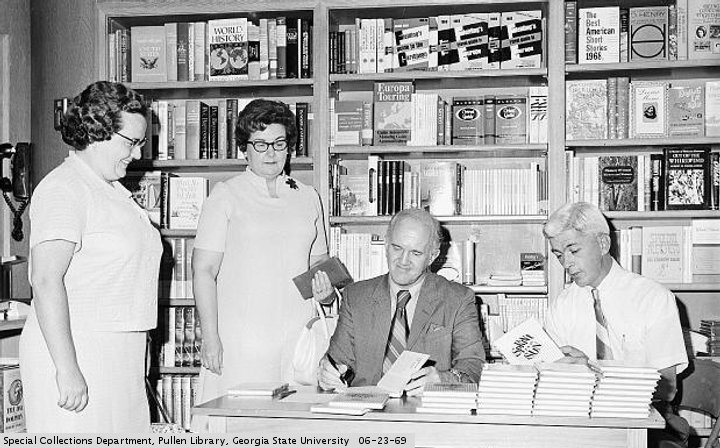


HBDBD



This is a repost. Pictures are from “The Special Collections and Archives, Georgia State University Library”. By the time this is posted, it will be Bob Dylan’s seventy fifth birthday. This chamblee 54 birthday tribute is composed primarily of three previously published pieces of work.
It was a late may morning in Atlanta GA, and a slack blogger was searching his archives. Yes, Issac Asinov never got writers block, and when he wasn’t going to the bathroom he was typing, but that is a lifestyle choice. Easy writing makes tough reading. So, anyway, in the may archive for 2011 there was a post about Bob Dylan’s seventieth birthday. People were taking bets on whether he would make it to thirty, and here he is at seventy five.
Hibbing MN is a cold place. At least it can claim to be the birthplace of Robert Allen Zimmerman. That’s Allen ,with an e, and double L, just like hell. The original initials were RAZ, which might be a good trivia question, or, with a silent W in front, radio station call letters. The problem is, he legally changed his name to Bob Dylan, with no known middle name. Those initial are BD.
On May 24, 1941, the curly haired wonder boi arrived. The world was a different place. Europe was in flames, and eyeing the young men of America as fresh cannon fodder. This was twelve years, eleven months, and eighteen days before PG graced the planet. A twelve year old in Hibbing MN would have no reason to think of a newborn baby in Atlanta GA.
These days, not everyone knows who Bob Dylan is. Auto tuned automated canned music is the next big thing. If auto tune had been around in 1963, we would never had known how badly Mr. Dylan sings. In an age where rappers pay ghost writers to compose their tweets, being able to write songs is not valued. There is just no telling. And so it goes.
A.J. Weberman has made a life out of going through Bob Dylan’s garbage. He wrote a book, “The Devil and Bob Dylan”. “THIS BOOK CHALLENGES ALL PREVIOUS CONVENTIONAL THINKING ABOUT BOB DYLAN. DYLAN IS JUST THE OPPOSITE OF WHAT YOU BELIEVE HIM TO BE. BUT WHAT PURPOSE DOES IT SERVE EXPOSING HIM AS A RACIST, HIV POSITIVE EX-JUNKIE AND HOLOCAUST DENIER? NONE EXCEPT THAT OF TRUTH, AND THE TRUTH WILL SET YOU FREE. $17 INCLUDING POSTAGE! THE BOOK IS 500 PAGES AND FULLY ILLUSTRATED.
There was a comment on the Bob Dylan webpage… Everybody knows by now that there’s a gazillion books on me either out or coming out in the near future. So I’m encouraging anybody who’s ever met me, heard me or even seen me, to get in on the action and scribble their own book. You never know, somebody might have a great book in them. PG doesn’t write books. He did grow up in America, and has a few opinions about Bob Dylan. It ought to be good for a few hundred words here. (HT to dangerous minds ) (Chamblee54 has posted about Mr. Dylan before.)
The first time PG heard of Bob Dylan was probably at the record rack of Zippy’s dime store in Cherokee Plaza. There was an album of his greatest hits, and it came with a poster. The poster had a drawing of the man, with psychedelic waves of hair cascading in multi colored glory to the edges. PG never did buy the LP.
The former Mr. Zimmerman was never big on top 40 am radio. Somebody somewhere was getting a headache over those lyrics, but Atlanta GA was not somewhere in those days. By this time, Mr. Dylan had crashed his motorcycle, and gone into hiding. As the counter culture exploded (if only someone had disinfected that counter) the curly haired poet was in hiding, the subject of much speculation. At one point, people were stealing his garbage, and claiming to find evidence of investment in munitions firms. The neoscience of Dylanology continues to this day.
As PG got older and stupider, he heard more and more Bob Dylan music. In the summer of 1972, there was a performance at the Concert for Bangladesh. A couple of albums released during this era sucked, and some people stopped caring about Bob Dylan.
At the start of 1974, a tour was announced. The Band was to be the backing group. The circus came to the Omni, and PG got some of the mail order tickets. He couldn’t find anyone to use the second ticket, and sold it to a stranger outside the arena.
The show was nothing special. Bob Dylan excels at writing, is ok in the studio, and blah on stage. Georgia Governor Jimmy Carter was at the show, and was said to look bored. Mr. Dylan was invited to the Governor’s mansion after the show, and talked to the Governor. A lot of people in Georgia were surprised that Jimmy would want to run for President.
As the Seventies went me me meing into sex and drugs oblivion, Bob Dylan regained both his writing touch, and love of the spotlight. The Rolling Thunder tour happened, he got back together with Joan Baez, divorced his wife, became born again, became more Jewish, counted money, and generally lived the life. PG did his own version of all that, without Joan Baez or being circumcised again.
In the winter of 1991, America was consumed by war fever. Saddam Hussein had been elevated to next Hitler status, and had to be taught a lesson. One night, Bob Dylan played on a music awards show, and performed “Masters of War”. He played a discordant version of that ditty, with the result that few understood what he had said. By this time, Mr. Dylan had assembled a band, and gone out on the “Never Ending Tour”. A Bob Dylan concert had gone from being a special event, to being another name on the festival roster. Overexposure will do that.
On the last night of the Olympics in 1996, Bob Dylan played the House of Blues downtown. PG won a pair of the $80 tickets in a radio station contest. It was his only trip downtown during the games, and had to wait in a security line to get into Centennial Olympic Park.
The only celebrity, other than Mr. Dylan, seen at the House of Blues that night was Bill Walton. The band was competent…they impressed PG as being like a bar band that did a lot of Dylan songs, with a strangely authentic lead vocalist. The sound in the room was not good, at least in the spot where PG stood. The only song he recognized was “All along the Watchtower”, the Jimi Hendrix classic. Mr. Dylan got a cheer when he put his harmonica appliance on.




The aptly named dangerousminds has a link to a story about the recording of Blonde on Blonde, by Bob Dylan. It only happened once.
Bob Dylan was 24 years old, newly married, and had “sold out” i.e. started to play electric guitar. A bunch of Canadians known as The Hawks (later The Band) was touring with him. Barely a month after the release of “Highway 61 Revisited”, sessions started at a New York studio.
The New York sessions did not work, so a decision was made to go to Nashville. Al Kooper played organ, and served as a music director. A crew of Nashville players was recruited. A bass player named Joseph Souter, Jr. would become famous a few years later using the name Joe South. Kris Kristofferson was the janitor at the studio.
Most studios have bafflers, or sound proof room dividers, splitting the studio into cubicles. For these sessions, the bafflers were taken down, and the band played together as a unit.
The second session in Nashville started at 6pm and lasted until 530 the next morning. Mr. Dylan was working on the lyrics to “Sad eyed lady of the lowlands”, and the recording could not start until he was ready. The musicians played ping pong and waited. At 4am, the song was ready, and the record was finished in two takes.
PG had marginal encounters with two of the players on this album. He met a lady once, who worked in an insurance office. One of the customers was Joe South. His driving record file was an inch thick.
Al Kooper had a prosperous career after his association with Bob Dylan. The former Alan Peter Kuperschmidt produced the first three Lynyrd Skynyrd albums, sold that contract for a nice piece of change, and lived happily ever after.
One night, Mr. Kooper was playing a show at the Great Southeast Music Hall, and PG sat in front of the stage. During a break between songs, PG asked his friend “what time is it?”. Mr. Kooper heard him on stage, and said it was 11:30.




If it ever quits raining, PG is going to walk to the Chamblee library and return a book, and a cd. The cd is by Bob Dylan, and is a work of genius. The book is about the former Mr. Zimmerman, and is a piece of garbage. (BTW, Dylan is not the only Zimmerman to hit the big time. Ethel Merman was born Ethel Agnes Zimmerman.The Zimmerman telegram got us into World War I. The less said about George Zimmerman, the better)
When returning cd’s to a library, you need to get a check in receipt. Once, PG returned a stack of cd’s to the Brookhaven library. When checking them in, one was missed by the scanner. A few days later, there was a note in the mail about an overdue cd.
The good news was, the cd was on the shelf when PG went back to investigate, and the matter was quickly settled. It did not help that the cd was a collection of disco music called “Shake your booty”.
“The freewheelin’ Bob Dylan” was released in the early sixties, when the man was barely old enough to buy a drink. There is not a bad song on it, and several are classic rock staples. At a time when mindless pop dominated pop music, here were thoughtful, moving lyrics.
In 1991, with America in a war frenzy, Mr. Dylan appeared on a music awards show. He performed “Masters of War”, at a time when the majority would be appalled if they could understand what he was singing. Mr. Dylan has been reinvented many times, and often the lyrics get gargled.
Five years later, PG won tickets to a Bob Dylan concert. It was the last night of the Olympics, and the man was appearing at the House of Blues. (Tickets were $80, so the radio contest is the only reason PG went). It was like hearing a good bar band, that did nothing but Dylan songs, with the man as the vocalist. Due to the mix of the sound, PG could not recognize many of the songs.
The book is Bob Dylan: Prophet, Mystic, Poet by Seth Rogovoy. It tells the Dylan tale as a story of Jewish prophecy. PG got to page 16, where the author claims that “Like a Rolling Stone” “almost single handedly revolutionized rock’n roll music”. Huh?
PG was eating dinner, and did not have anything else to read. He got to page 38. Nothing in the next 22 pages changed his mind away from ditching the book. How does nonsense like this get published?





Controversy

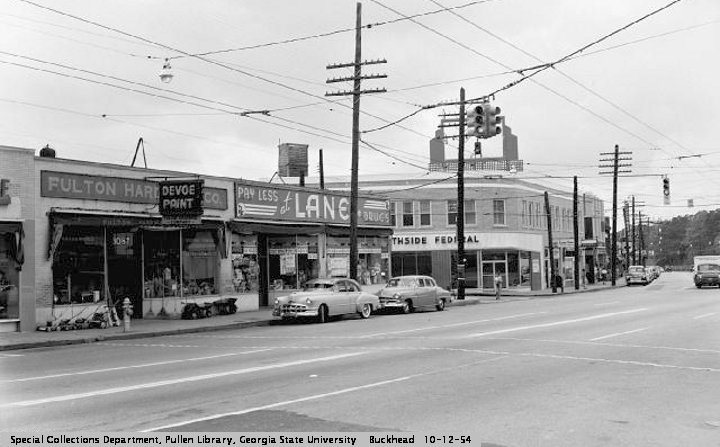
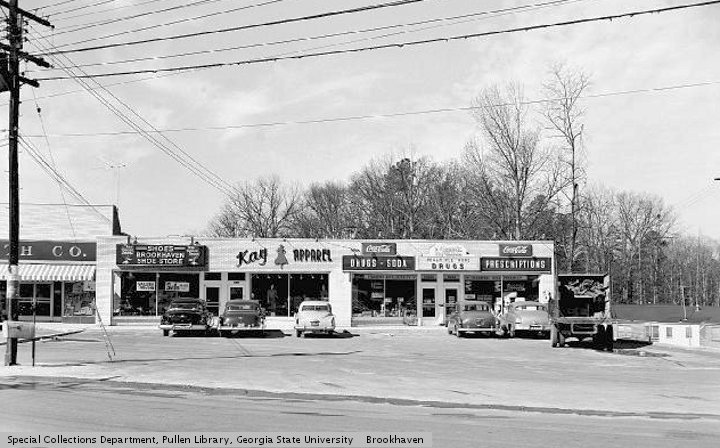
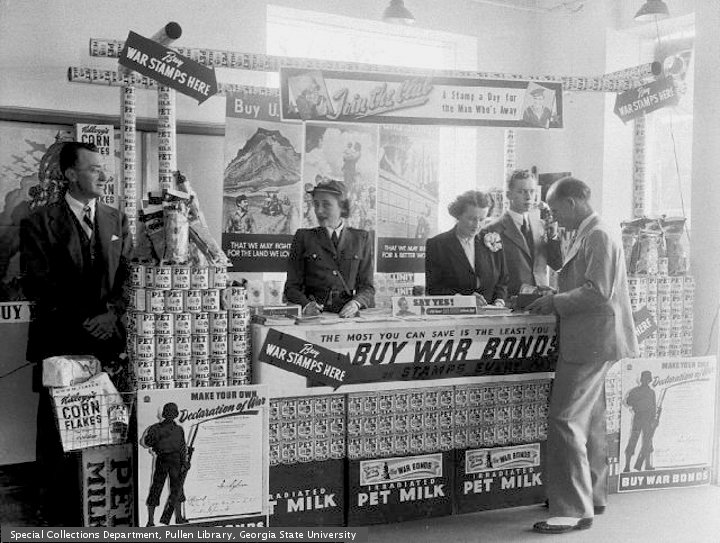
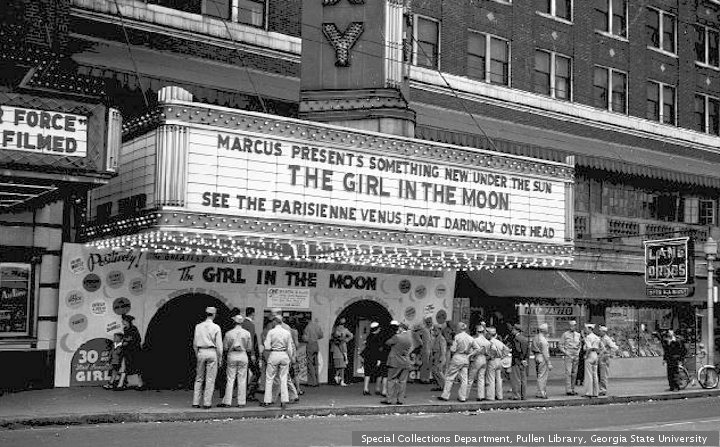
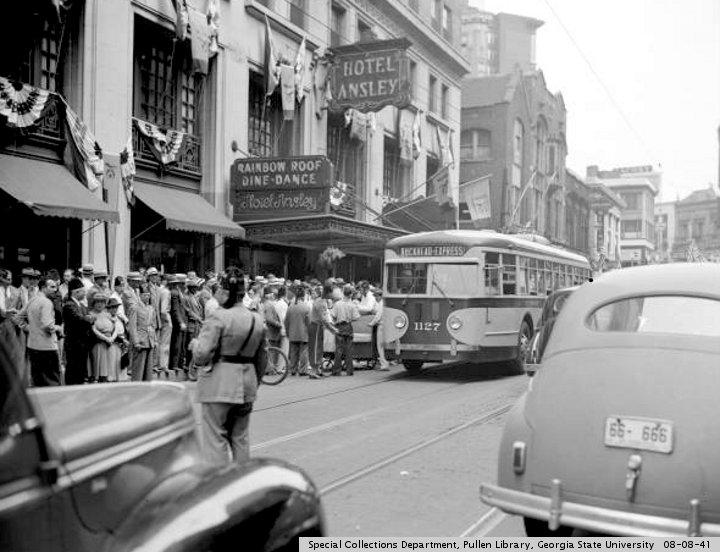
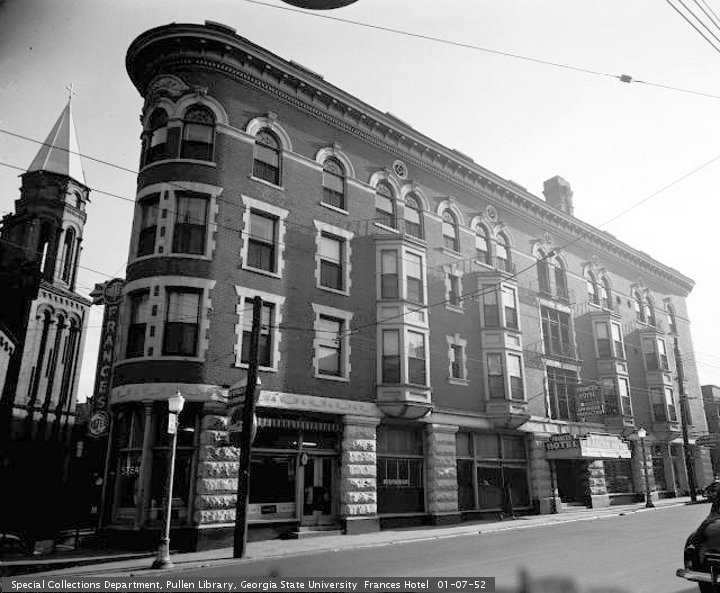
Number five on the yahoo home page news items is “David Bowie Controversy”. The old boi has some product for sale, and it must not be moving fast enough. The video has some religious imagery, including a scantily glad lady with a gushing stigmata. In the end, there is a tableau, with Ziggy ascending into the ceiling. The bathrobe he wears is more appropriate for a senior citizen than his thin white duke getup. This is a repost. Mr. Bowie has left the building.
When PG was in high school, he took Spanish. The teacher was a fundamentalist Catholic named Mrs. DiPaola. Religion and politics were more fun than verbs and nouns, and she was easy to distract. One day she was talking about an uncle of hers, a truly righteous man. When he died, these bloody spots appeared on his hands. It was the stigmata, the wounds of Jesus.
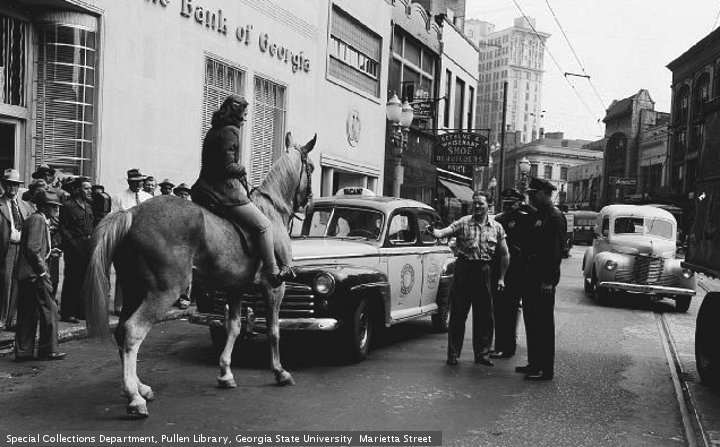
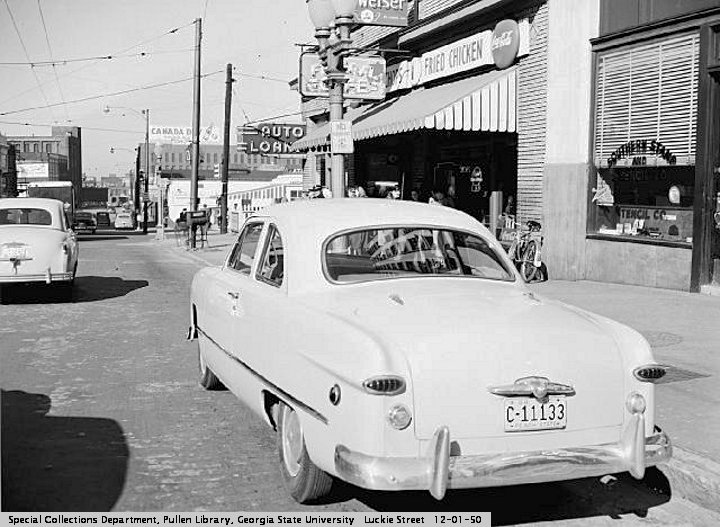
When the Romans put someone on a cross, the spike went through the wrists. There is a space between bones, and the giant nail went through without breaking one. If the nail was in the hand, the weight of the body would tear it off. The Romans were pros. Pictures are from “The Special Collections and Archives, Georgia State University Library”.





leave a comment