I Used to Be Charming Part Five

This is the fifth, and final, installment in the chamblee54 serial book report on I Used to Be Charming, by Eve Babitz. The pictures today are from “The Special Collections and Archives, Georgia State University Library.” The other four parts of this series are available: one two three four
It’s an old cliche about drug abuse … life becomes boring when you quit using. That might be true with Miss Eve. She got scared because of AIDS, and got cleaned up from her druggie ways. She started taking dance lessons, and got into ballroom dancing. When she tried to commit suicide by Tiparillo, the physical activity of dancing aided her recovery.
Hippie Heaven (Vogue October 1992) was the first story that made me want to take notes. “Especially the red rayon forties dress, cut on the bias, that I’d worn the nights I waited in the Troubadour bar in West Hollywood, looking for trouble like Jim Morrison.” Lord, whatever happened to Eve? Writing for Vogue about a dress “cut on the bias.” This is the Dowager Groupie, talking about clothes. Even Eve’s sister Mirandi … who started out as Miriam … made leather suits for Jimbo.
Eve says something about Leicester Square, in London. The Rolling Stones did a song, Cocksucker Blues. They owed a pesky record label one more song, so they decided to give them something they would never play on WQXI. So Mick says something about hanging out in Lester Square, but it turns out to be Leicester Square.
Scent of a Woman (Vogue March 1997) is where Eve finally gets her mojo back. Vogue published SOAW a few weeks before Eve’s catastrophic fire.
Some say that smell is the most animal of our senses. Aromas get directly from the nose to the brain, without the mental filters navigated by sound and sight. In SOAW, Eve discusses the various perfumes of her life. When she was young, the only perfume she felt comfortable with was Here’s My Heart, by Avon. True, it did not make her smell like old stationary, as Chanel N°5 did, but you don’t get more uncool than Avon.
“My great aunt sold Avon when I was a kid, and she and my conservative-about-fragrances mother (the one who flushed my Evening in Paris down the toilet) approved this for me. It was OK, girly, kind of little girly and nowhere near as exciting as Evening in Paris, but I liked it all right. It made me think I was missing something in fragrances, but it was enjoyable to wear.” Avon introduced Here’s My Heart in 1957. Nobody is sure when it was discontinued.
One afternoon in the sixties, Eve went swimming at the house of a Hollywood somebody. In the bathroom, there was a bottle of Le De by Givenchy “Le De came about when Hubert (Givenchy) chose decided to gift his friend (Audrey Hepburn) with a perfume; actually he commissioned two, the other being L’interdit (created in 1957 and commercialized in 1964) and they were hers alone for a whole year. In 1958 the idea of launching perfume under the aegis of his house saw Le De being introduced to the market while L’Interdit was immortalised in … Breakfast at Tiffany’s.”
“And then the unthinkable happened. They took Le De Givenchy off the market — or at least they cut back its distribution to the point where it became impossible to find. This is something Andy Warhol would have picketed Givenchy with me for. (Andy Warhol had an extremely funny section in his autobiography The Philosophy of Andy Warhol (From A to B and Back Again,) in which he says that whenever a product is “improved,” the manufacturer should leave the original, unimproved product on sale, too, because a lot of people don’t want what they already like pulled from the shelves.”
Amazon has a terrific one star review of the Warhol book. “I bought this due to a need for additional references. It’s written by warhols assistant and is filled by drivel, pompousism and things you may say on acid trips while your in a room wrapped in tin foil. Save your money and if you a want book about Andy warhol use one of the autobiographies written by an author after Andy died and has no connection to him or his factory friends.”
The last fun chapter is I Used To Be Charming. IUTBC is about the fire, on April 13, 1997. “I had just finished brunch with my mother; my aunt Tiby; my sister Mirandi; and my cousin Laurie. Mirandi would be driving my mother back to her place, where I was also living at the time, and I looked forward to smoking the Tiparillo I’ve been saving for the ride in peace and quiet. The cigar was one of those fashionable but hideous cherry-flavored ones I loved because smoking them made me feel like Clint Eastwood; everyone else hated them. I grabbed one of the wooden matches, struck it against the sandpaper side of the box, when all of a sudden the match fell from my hand. The gauzy skirt I’d put on to go out dancing later went up in flames; my panty hose melted to my legs. Thank God for sheepskin Uggs, which protected my lower legs from burns.”
When Eve struck that match, in a 68 VW bug, her life changed. There were a lot of rude comments about cigars. Tiparillos in particular have a curious market niche. One ad campaign had a picturesque young lady working the crowd, with her pitch “Cigars, cigarettes, Tiparillo’s?” “The modern smoke, found in all the right places, with all the right people.”
Another ad campaign asked the oh-so-modern question ”Should a gentleman offer a Tipparillo to a lady?” A later campaign produced a TV classic. “In 1970 the Federal Trade Commission banned cigarette commercials from American airwaves. However, cigars did not fall under the FTC ban, and so we have these two commercials from 1973 for Tiparillo cigars, which — if you believe the ads — must be offered to a lady, which will be appreciated more than “candlelight and small talk.”
Fiorucci, the book takes up the last 48 pages of IUTBC. Eve wrote text for a collection of graphics from the Fiorucci fashion emporium. Fiorucci closed its retail stores in the eighties, and is mostly known today because it rhymes with Gucci. “Zeigt und erklärt, wie und warum Fiorucci in den 70ern und 80ern bigger than life war. Das Buch ist Kunst, Marketinghandbuch und Poesiealbum in einem.”


May 6, 2024




May 6 is a day in spring, with 35% of the year gone by. It has it’s fair share of history, some of which did not turn out well. In 1861, the Confederate Congress declared war on the United States. In 1937, a German zeppelin named “Hindenburg” exploded while trying to land in New Jersey. In 1940, Bob Hope did his first show for the USO, somewhere in California.
Roger Bannister ran the first sub four minute mile, on May 6, 1954. The current record is 3:43.13 by Hicham El Guerrouj on July 7, 1999, with a party with Prince to celebrate. Since most track meets now use 1500 meters, the mile record is obsolete.
On this day, Georgia executed two notable prisoners. In 2003, Carl Isaacs was put to death. Mr. Isaacs was the ringleader in the 1973 Alday family killing, in Donalsonville GA. Five years later, in 2008, William Earl Lynd was poisoned by the state. This was the first condemned man to die after the U.S. Supreme Court ruled that execution by poisoning was constitutional.
Taurus is the sign for those whose blood starts to pump May 6. Included are:
Maximilien Robespierre (1758) Sigmund Freud (1856) Rudolph Valentino (1895)
Orson Welles (1915) Willie Mays (1931) Rubin Carter (1937)
Bob Seger (1945) Tony Blair (1953) Luther Mckinnon (1954) George Clooney (1961)
To make room for these folks, someone has to die. For May 6 this would mean:
Henry David Thoreau (1862) L. Frank Baum (1919) Marlene Dietrich (1992)
This repost, written like H.P. Lovecraft, has pictures from “The Special Collections and Archives, Georgia State University Library”.
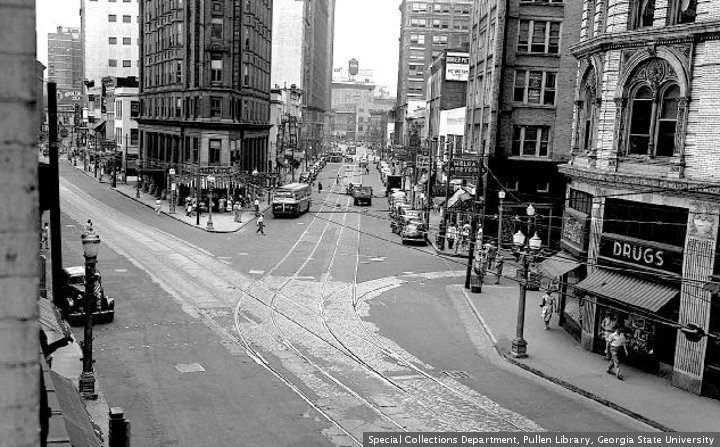


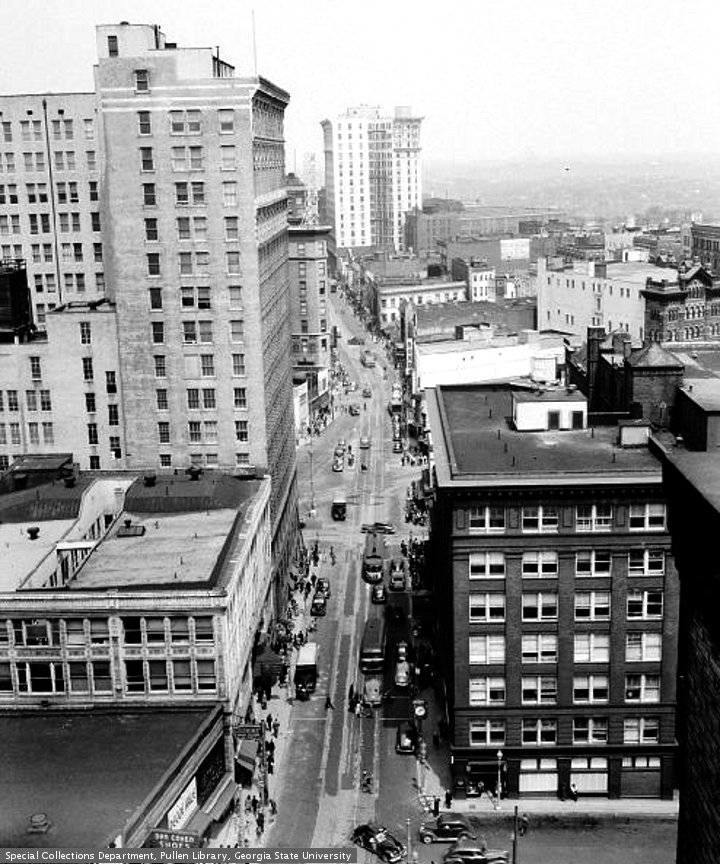
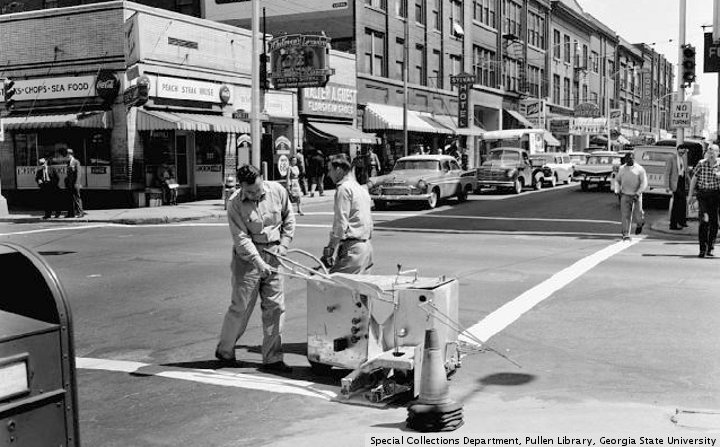

#NationalDayofPrayer
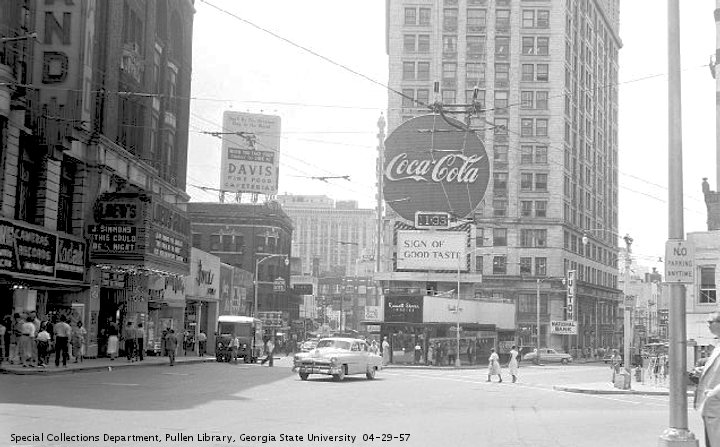
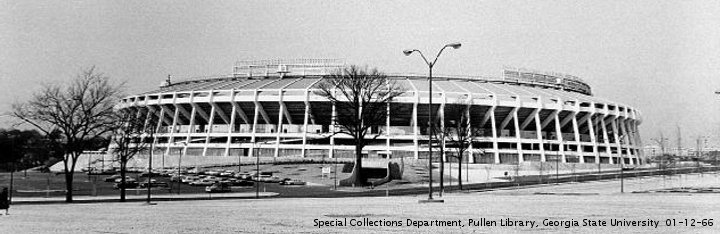


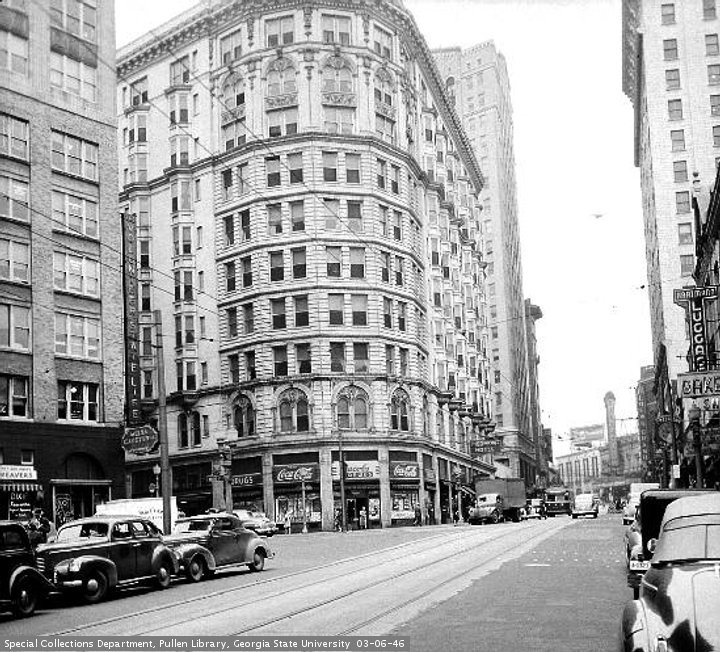
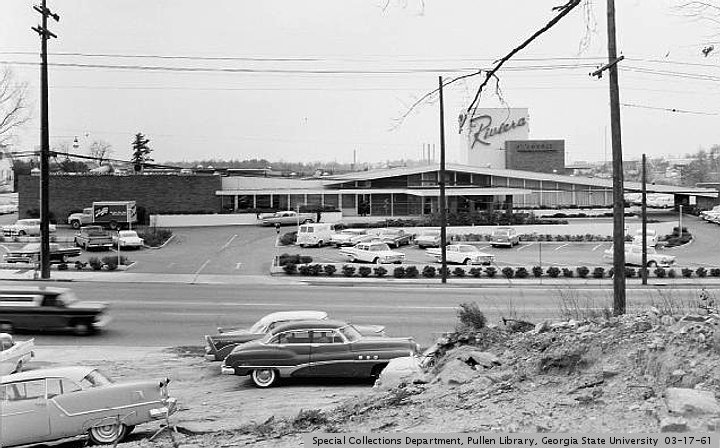
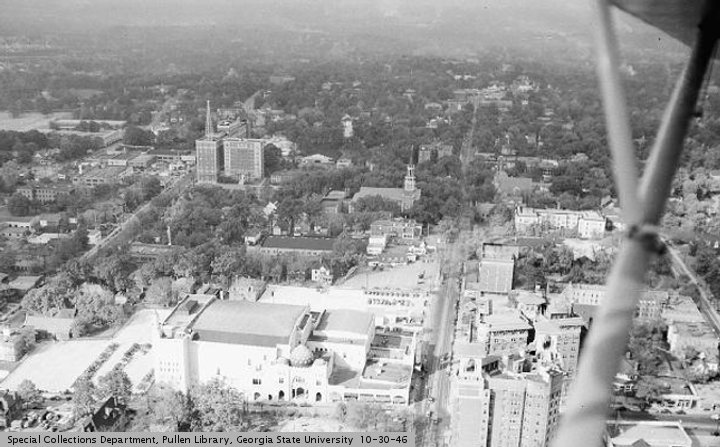
Good Morning God. Please give me the slack I need to make it through this life. I have a birthday soon, and am getting older. Please give me less pain, both above and below the neck. Thank you for letting me get this far. Thank you for the gift of sobriety, and the memory of inebrience. The gift of moderation would have been helpful. Help me to overcome body chemistry telling me to be unhappy. If this doesn’t work, help me hide it better.
Please tell Christians to make less noise, joyful or otherwise. Please help me forgive Christians for their good intentions. Please give Christians the gift of humility. Let us know that a real man keeps control of his temper. Please tell those praying today that it is better to listen than to talk.
Please find a happy medium for Atlanta water. Let us have neither drought nor flood. It would help if the developers would move to North Carolina, and the politicians would develop a conscience.
God, please try to get along better with Allah. Please help White people and Black people to show kindness and respect for one another. Please be good to the people who have already lived, and are now deceased. Please understand that I am not in a hurry to join them.
Please help Mr. Biden with the mess this country is in. Please help Israel get along with her neighbors, and live within her borders. Please help the world resolve the carbon dioxide problem.
Thank you for the birds that sing. Thank you for dogs, and dog owners who clean up. Thank you for earth, air, fire, and water. Thank you for people who enjoy this prayer. Please help those who are offended to get over it. Namaste, amen, all my relations, Good Bye.
Today is the #NationalDayofPrayer. This is a repost. Pictures are from “The Special Collections and Archives, Georgia State University Library”.





Why Did The Cow Cross The Road?



Why did the cow cross the road? The chicken was on vacation.
Knock knock. who’s there? boo. boo who?. Don’t cry it’s only a joke…
It’s six of one, half a dozen of the other.
A man walks up to a horse and says, “Why the long face?”
Two pretzels were walking down the street. one was a salted.
“He who laughs last thinks slowest.”
“Raise your hand if you’re here.”
Two nuns walk into a bar; the third one ducks.
Q: What did the radio say when it was dropped? A: “Ow. That hertz.”
What did the ranch say to the refrigerator door? “Close the door, I’m dressing”
Why don’t blind people skydive? It scares the heck out of their dogs…
What did the fish say when it ran into a wall? dam.
“I see.” said the blind man as he peed into the wind… “It’s all coming back to me now.”
What’s the last thing to go through a bug’s mind when it hits the windshield? Its butt.
You can tuna guitar, but you can’t tuna fish.
What do a duck and a bicycle have in common? They both have wheels… except the duck.
What’s brown and sounds like a bell? DUNGGGGG.
What’s brown and sticky? A stick
When people ask the mortician what he does for a living, he says he is a “boxer”.
What did the shy pebble say?… I wish I was a little boulder! .
What do you call an arrogant criminal falling out of a tower? Condescending.
Two guys walk into a bar… you would think the second guy woulda ducked.
A woman walks into a bar holding a duck. Bartender says, “What’s with the pig?”
Woman says, “It’s a duck.” Bartender says, “I was talking to the duck.”
Why do flamingos always lift one leg when they’re standing?
Cause if they lifted both, they’d fall over!
Q: How many Surrealists does it take to change a lightbulb? A: To get to the other side.
Did you get a haircut? Actually, I got them all cut.
One mushroom said to another mushroom, “Hey – you’re one Fungi!”
What do you call an arrogant criminal falling out of a tower? Condescending.
A dyslexic man walked into a bra …
Q: What do you call a midget, psychic, prison escapee? A: A small medium at-large.
A mule walks into a bar. The bartender says, “Hey, buddy, why the long face?”
“Because my dad is a jackass.”
I have one about the roof but its over your head.
Shall I tell you the one about the skunk? Never mind, it stinks!
There’s nothing like a good joke… and that was nothing like a good joke.
A rabbi, nun, lawyer, mime, and horse all walk into a bar.
The bartender says, “What is this, some kind of joke?”
When’s the best time to eat reindeer meat? …. When you’re hungry.
These stories are borrowed from 22 words. Pictures are from Special Collections and Archives, Georgia State University Library. This is a repost.


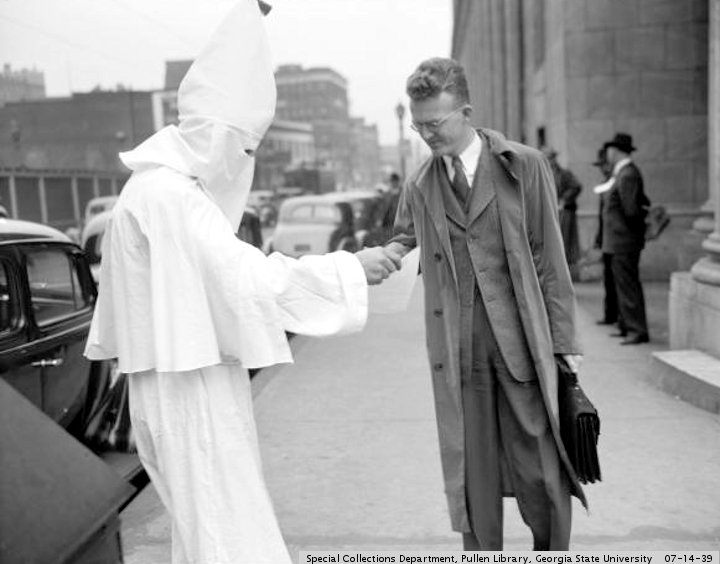
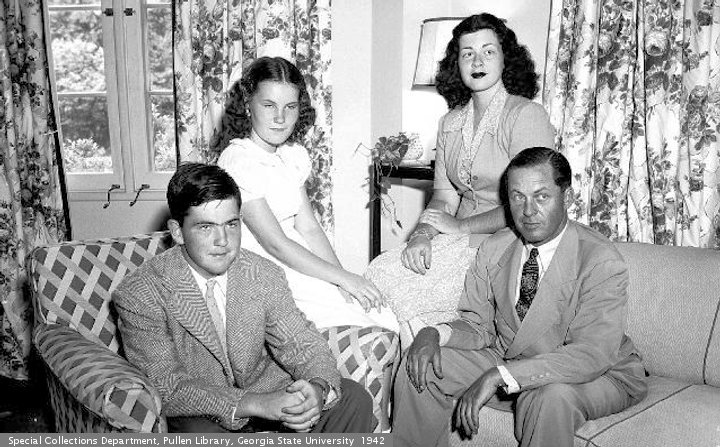
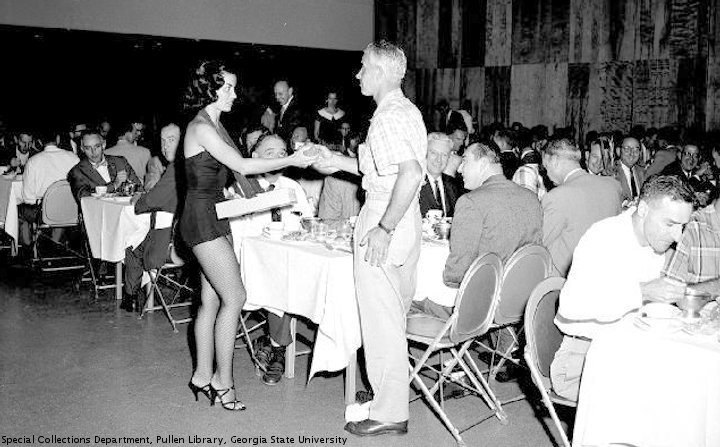
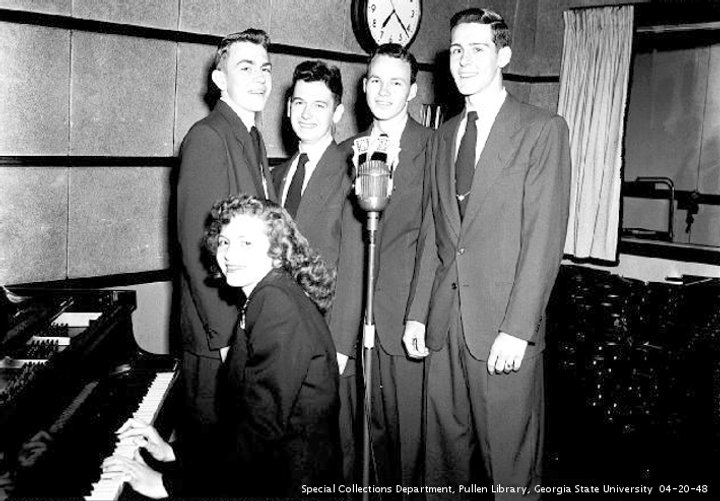
Loudon Wainwright III

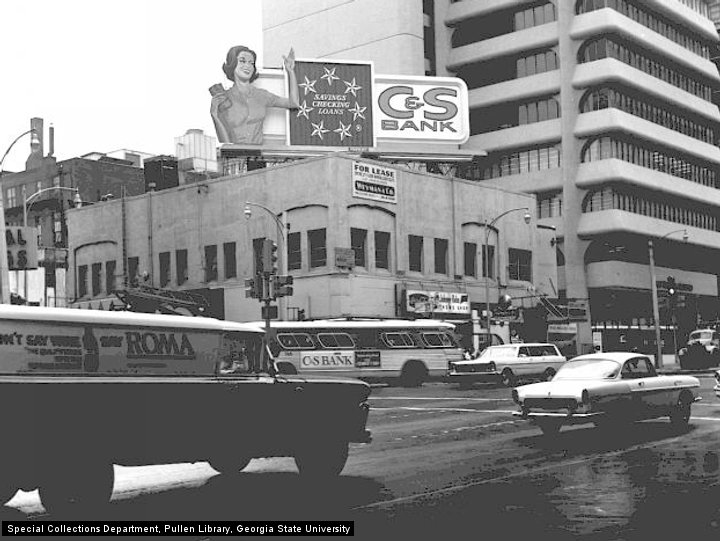


This is a repost from 2010. Mr. Wainwright has a show in London friday night. He recently made a short film about the Monsters he enjoyed as a young man. Pictures today are from Special Collections and Archives, Georgia State University Library. The facebook picture is a Colonial grocery store. After service as the Texas Tea Room, it is now a discount mattress store.
Loudon Wainwright III is the son of a man who wrote for Life magazine, who was known as Loudon Wainwright Jr. The son of III is named Rufus, which is Albanian for Fifth. Either he skipped a level, likes to drink, or this is a coincidence. Rufus Wainwright is a musician also, with lots of units sold, and a stay or two in rehab.
The official LWIII website has a biography page, so if you care about such things you can go there. He writes little acoustic songs, many of which are hilarious. Early in his career, Dead Skunk became a hit. It became the song he was known for, but it was far from the best thing he did.
I have seen Loudon Wainwright III perform twice. In December of 1973, LWIII played at the Great Southeast Music Hall. He had a backup band, for some reason, and I was not overwhelmed. After the show, I talked to a high school classmate, and we went riding on the dirt roads behind the music hall smoking reefer. Those dirt roads are now Highway 400.
In May of 1982, LWIII played a show by himself at a concert hall on North Decatur Road, which was formerly a Colonial grocery store, and the Texas Tea Room. “Maybe, the venue was called the Texas Tea Room—or the Texas something-or-another. I recall that I heard some male duo there. When I heard them, they were past their prime in terms of popularity, but perhaps they were making some sort of comeback. I keep trying to remember who I heard. I also remember going in there one time with short-shorts on. The shorts were totally inappropriate for the setting, but I had been somewhere else and just stopped by the hall (we’ll continue to call it the Texas Tea Room) on a whim. I vaguely remember some guy giving me grief about my attire. I don’t think I went home with him, and I’m sure that was an excellent decision.”
On that May evening 42 years ago, LWIII was spectacular. He had done a lot of shows in the previous 9 years, and had learned a few things about performing. The lines that got a good response were repeated, and played slow enough to understand the lyrics. This is a problem for many lyric based performers…if you don’t know their music, you will not enjoy the show. With Wainwright, he sang slow and loud, and you could hear all the words. You knew why the crowd was laughing.
It is now 2024, and LWIII has not gone away. His records never did sell very well, and he sells his own product over the internet now. His hair is turning gray and falling out. The skunk has dried up, his bones crushed into powder by eighteen wheelers. The motel was shut down by the health department. A luxury condo building was built on the site.


I Used To Be Charming Part Four

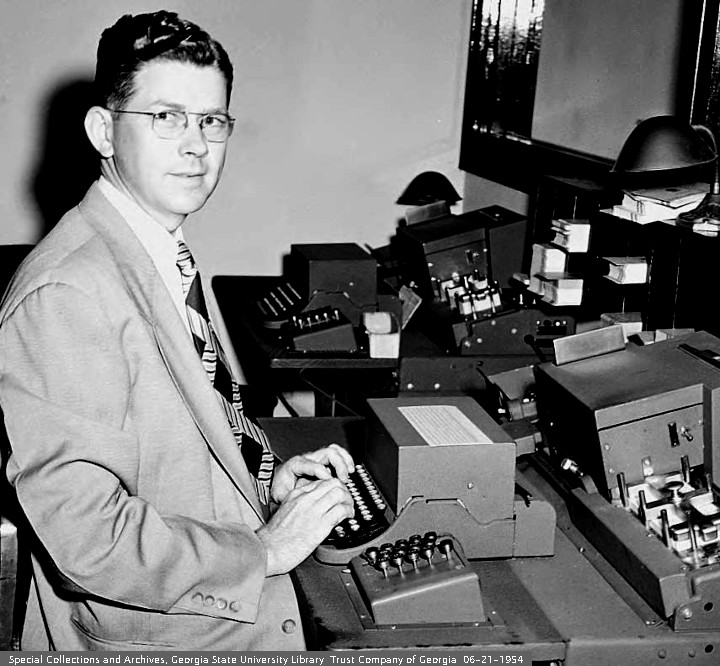

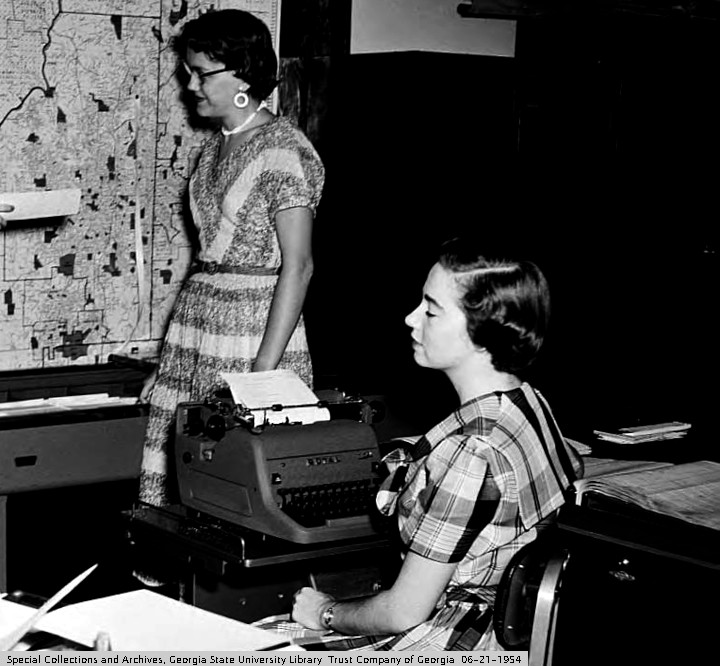

What follows is the fourth installment of the chamblee54 deconstruction of I Used to Be Charming, by Eve Babitz. IUTBC is a collection of magazine articles that Miss Babitz wrote. Pictures today are by “The Special Collections and Archives, Georgia State University Library.” Other features in this cycle are available. one two three five This is a repost.
Sober Virgins of the Eighties (Smart Fall 1988) was published in late 1988, at about the time I quit drinking. IUTBC is in chronological order. The pieces covered today are from Eve’s overboogie recovery days. Many are written for Esquire. “Every product was carefully curated by an Esquire editor. We may earn a commission from these links.” Eve may be counterculture, but by 1990 she was writing for the emperors tailor.
By 1988, aids was hitting like a ton of bricks. While some still partied, many started to clean up their act. SVOTE is about this. “Of course, now that it’s the eighties, most desirable members of the opposite sex give rise to dark wanderings like “If they’re so cute, why aren’t they dead?”—which for me really put a damper on sex and made me actually take up chastity for almost two years. … The great thing about the eighties is that if you’re still alive, there’s hope. That, anyway, has changed.”
SVOTE was in the first edition of Smart, in the “Love and Science” column. “One smart reader is worth a thousand boneheads” HL Mencken “Terry McDonell, the now legendary magazine editor, was starting his own magazine, Smart, in 1989. When he said he wanted to evoke The Smart Set, the stylish, literary monthly edited by H. L. Mencken and George Jean Nathan in the Roaring Twenties, I thought of Lucian Bernhard’s Bauer typeface from 1929, Lucian. That resulted in another early Font Bureau digitzation of a vintage foundry type, Belucian. At that point David Berlow was thinking of a adding a “Be-” to the names of all his revivals (cf. Belizio), but we talked him out of that later.”
Ronstadt For President (Smart May-June 1989) returns to Eve’s friendship with Linda Ronstadt. Eve is sometimes credited with designing the album ocver for “Heart Like a Wheel.” Other sources say that Eve was the photographer on the inner sleeve. Very little is said about Eve as a photographer. Mostly, artist Eve paints, and assembles collages.
RFP is about Linda’s struggles to make it as a singer. Her looks got in the way. “… men like Hugh Hefner would be propositioning her with “Let’s just shoot you with no clothes on, why don’t we?” and casting directors were trying to interest her in movies. “That’s not what I am, Eve,” she said, laughing and laughing. “Me with no clothes, imagine!” …
“I mean, Linda is just your normal good-time overeater type of person, whereas Jane Fonda, as she mentions in her book, was a bulimic—one of those sneaky people who eat and eat and then throw up. And bulimia is not what I want in a politician at all. I want things to stay down. And I want Linda to sing a slow, sexy double-entendre version of “You’re Just Too Marvelous” to Gorbachev.”
Rapture of the Shallows (Smart July-August 1989) was about Walter Hopps. He created an art gallery called Ferus, despite the NY notion that LA was a wasteland for art. Mr. Hopps was also Eve’s extramarital bf, and the motivation for the chess photograph with Marcel Duchamp.
“Ephemera mattered at Ferus. Founded by curator Walter Hopps and artist Ed Kienholz in March 1957, the “Ferus” honorific was designed to commemorate an unknown artist named James Farris who shot himself; the peculiar variant spelling of the gallery’s name got transposed, however, when Robert Alexander (a.k.a. “Baza”), the collage artist and poet who executed the gallery’s earliest typography, proposed “F-e-r-u-s” instead. Why? “Because it has more strength typographically,” Hopps remembers. Hopps’ response? “Let’s do it.” And thus, the gallery’s founding identity was composed with an ephemeral sensibility and by a typographic twist of fate.”
Eve: “I’m going to write a piece about John Goode and maybe Ed Ruscha and Laddie Dill and …” I told my friend Aaron, a New York collector who lives here but hates it. “Those phony-baloney bulshit artists … they all suck. They’re just for restaurant openings, tea at Trumps.”
In the Bret-Lili podcast, Trumps came up. It seems to have been quite the trendy place. In The Shards, Bret meets at Trumps with this semi-closeted producer, (and father of Bret’s gf.) He pretends to be interested in Bret’s script, but is really after Bret. If you like, you can buy a matchbook, and a small plate, from Trumps.
The Sexual Politics of Fashion (The Washington Post Book World July 30, 1989) is about books, (one two) that people wrote about fashion. Eve was not impressed with either. “But the Luscious photographs and illustrations are given a continuous cold shower by the prose: Every time you get a romance or fantasy going in your head … you are smacked into rectitude by phrases like “gender-specific” or just the very word “gender” itself which is enough to keep me from wanting to hear more, no matter how cute the people in the pictures are.” Eve had an eye, however badly focused, on the future. In 1989, gender meant boy and girl. Today, gender is the new civils rights movement, more third-railish than even race or football.
Gotta Dance (Playboy October 1989) was written for Playboy magazine. It’s mind blowing to think of Eve working in concert with Hugh Hefner. Apparently, when sex/drugs/rock/roll not longer did it, Eve started to dance.
“My only recommendation to a man who is even remotely thinking about ballroom dancing is to be careful. Unless you have a very large trust fund or a very strong character, don’t begin at Arthur Murray. Once they hook you, they have you for life. … “Me?” you say. “Hooked? On ballroom dancing? Come on!” … “I know. The only reason you’d take ballroom dancing at all would be as a joke. So that’s why I’m telling you: Don’t. Like a newborn duck, you’ll get imprinted on your teacher and your classmates, and then they’ll sign you up for lifetime lessons. Later, when you ask around, you’ll discover that you could get the same lessons for less from someone who used to teach at Arthur Murray and now gives lessons himself.”
I got a email before writing this. A young lady we knew, back in the day, passed away. For purposes of this story, we are going to call her Aspen. She drank the kool aid, and signed a mega-bucks contract with Fred Astaire dance studio. One time Aspen got me to go to a party, with “champagne ladies” trying to sell you dance lessons. I declined the kool aid.
The Soup Can as Big as the Ritz (Movieline November 1989) is about Andy Warhol. Walter Hopps brought the soup can paintings to California in 1962. Andy made it to the infamous Duchamp opening in 1963, which promted the photo of a naked Eve playing chess with Mr. Duchamp.
Walter Hopps: “… we may have also seen, in Warhol’s studio, work in progress that included one of his first Campbell’s Soup cans. … I said to Warhol, ‘Absolutely, I want to take some of this work for a show in Los Angeles.’ Warhol, who had never been to California, answered with some excitement, ‘Oh, that’s where Hollywood is!’ In the sea of magazines and fanzines scattered on the floor, so deep it was hard to walk around, were all those Photoplay and old-fashioned glamour magazines out of the Hollywood publicity mill. So a show in L.A. sounded great to Warhol. He agreed, and thus the multiple-image soup can show came to Ferus in 1962. Warhol missed that first exhibition of his Pop images, but he finally made it to California in September 1963 for the opening of the Marcel Duchamp retrospective at the Pasadena Art Museum and his own second Ferus show.”
Andy Warhol: “Marcel Duchamp was having a retrospective at the Pasadena Museum and we were invited to that opening … They served pink champagne at the party, which tasted so good that I made the mistake of drinking a lot of it, and on the way home we had to pull over to the side of the road so I could throw up on the flora and fauna. In California, in the cool night air, you even felt healthy when you puked – it was so different from New York.”
Eve gets talking about Edie Sedgwick here. “The next time I saw Edie she was sitting at the bar at Max’s Kansas City with Bob Neuwirth, the famous hippest coolest art type guy of his generation, and again she was crying this time into a gin and tonic. … Suddenly my ambition was to look gorgeous and miserable, but I’m always so thrilled to be anything and do anything in those days. … If you weren’t on speed you weren’t in New York City in the sixties. I was certainly on it. In fact, if you took the speed out of New York in the sixties, it would have been Des Moines. …”
“The world’s most fabulous people were dancing everywhere, and on stage was Nico, the girl lead singer of the Velvets looking down at the audience with eyes that’s all nothing but apolcalyptic collapse and the voice that did nothing but omit a bagpipe like drone.”
“On October 23, 1967, in New York, singer Nico sang with The Velvet Underground. … Nico’s delivery of her material was very flat, deadpan, and expressionless, and she played as though all of her songs were dirges. She seemed as though she was trying to resurrect the ennui and decadence of Weimar, pre-Hitler Germany. Her icy, Nordic image also added to the detachment of her delivery. … In between sets, Frank Zappa got up from his seat and walked up on the stage and sat behind the keyboard of Nico’s B-3 organ. He proceeded to place his hands indiscriminately on the keyboard in a total, atonal fashion and screamed at the top of his lungs, doing a caricature of Nico’s set, the one he had just seen. The words to his impromptu song were the names of vegetables like broccolli, cabbage, asparagus… This “song” kept going for about a minute or so and then suddenly stopped. He walked off the stage and the show moved on.”
Blame it on the VCRs (Smart June 1990) “In the meantime, the gay men and the feminists were in the background, girding their loins against the Farrah Fawcett spun-gold hair of the seventies, trying to ruin everything. And they succeeded. Yes, men were pigs, women were exploited—yet gay men were, well, out of the closet and staying out and up till three in the morning, having more fun than anyone else ever did in the history of mankind. They made straight people jealous.”
Jim Morrison is Dead and Living in Hollywood (Esquire March 1991) Part of the Eve Legend was that she was Jim Morrison’s girlfriend for a while. Nobody is sure how much of that is real. Eve doesn’t really seem to be too terribly impressed with Mr Morrison, who she calls the Bing Crosby from hell. Jimbo was basically a fat drunken asshole. Pamela, the heroin Juliet to Jimbo’s whiskey Romeo, does not seem to be a very nice person.
No matter how chummy Eve was to Jimbo, she did not design any of the Door’s album covers. Eve did do the cover for the Elektra reissue, The Best of Lord Buckley, who may have been the strangest neo-celebrity that ever lived.
I was a Naked Pawn for Art (Esquire September 1991) returns to the infamous picture of naked Eve playing chess with Henri-Robert-Marcel Duchamp. “The trouble was, I had been taking birth control pills for the first and only time in my life, and not only had I puffed up like a blimp but my breasts had swollen to look like two pink footballs. Plus they hurt. On the other hand it would be a great contrast — this large too-LA surfer girl with an extremely tiny old man in a French suit. Playing chess.”
On page 243, there is a typo. This is something that you see in hard copy. I treasure the moments when I catch a typo. and there he was it was just that they were changing suddenly the had eyes to see.
Life at Chateau Marmont (Esquire January 1992) Then she has a story about Chateau Marmont. of which many stories could be told and hopefully they spray Down the Walls of that hotel and they were doing a renovation of it. “In L.A., the impulse to tear down anything good but old and rebuild it crummy and different is so rampant that the only things anyone tries to restore are women’s faces.”
They Might be Giants Esquire May 1992 (Esquire May 1992) features a photo shoot of four hot, photogenic young actors. Thirty years later, none is a superstar. Being called the next James Dean is somewhat of a curse.
“James Dean was rock and roll before anyone knew it wasn’t a fad, and he was rock and roll before it was Disneyized and turned into role-model material. He was the role model for people who hated role models, and what we still want is more James Dean’s and no one will ever be James Dean enough.”
The trouble with James Byron Dean was that he lived the image, and it f****** killed him. When I was a kid, the one person that “they” held up as a bad example was Joe Namath. When you’re a kid growing up in Georgia, you need bad examples. Today, Broadway Joe is on cable tv, on commercials for medicare insurance. The kids he was a bad example to are buying medicare insurance.


Gerrymandering
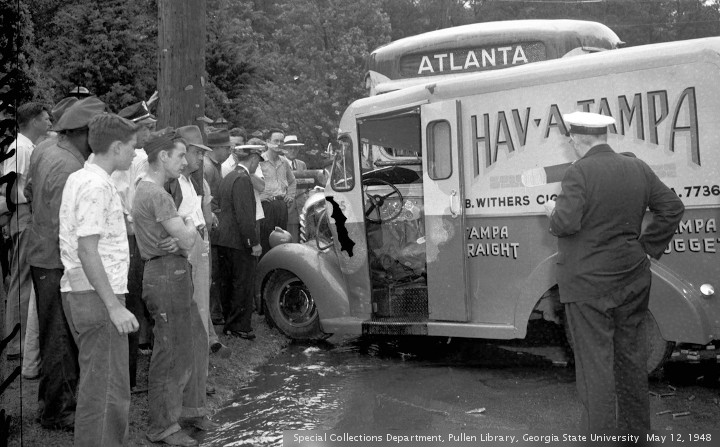


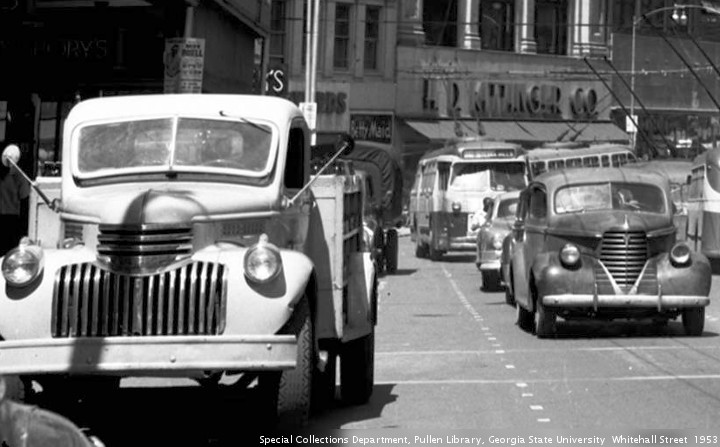

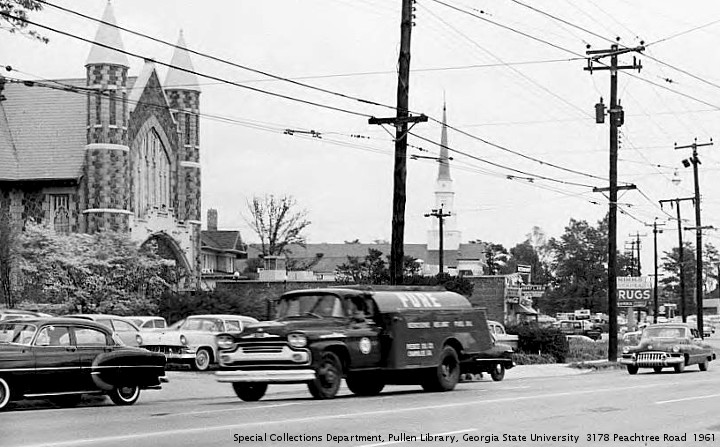

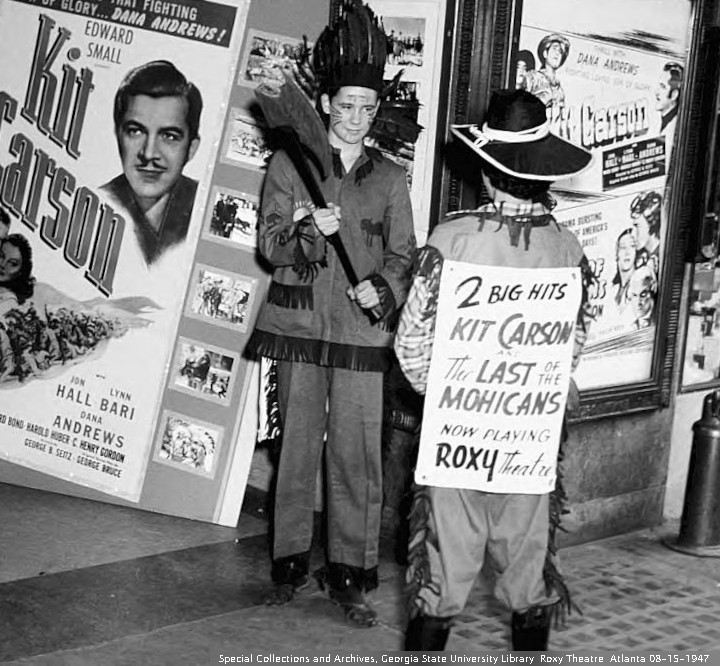
99% Invisible recently had an episode about gerrymandering. It was based on a series at FiveThirtyEight, The Gerrymandering Project Gerrymandering is like the weather: many people talk about it, but few know how it works. One former governor of California likes to say that we should terminate gerrymandering. The Austrian accent is a nice touch. This is a repost from 2018.
Gerrymandering is “the division of electoral districts for partisan political advantage.” The name dates back to Elbridge Gerry, one of the founding fathers. (…we should remember eight men who signed the Declaration of Independence, and later attended the Constitutional Convention … Elbridge Gerry (the namesake of gerrymandering) refused to sign the Constitution because it did not have a Bill of Rights.) When Mr. Gerry was Governor of Massachusetts, a bizarre district was drawn. It was said to look like a salamander, thus gerrymander.(Some purists say gary-mander.)
OK. How does it work? There are two terms used in the show, Cracking and Packing. “Cracking: Spreading like-minded voters apart across multiple districts to dilute their voting power in each. This denies the group representation in multiple districts. Packing: Concentrating like-minded voters together in one district to reduce their voting power in other districts. This gives the group representation in a single district while denying them representation across districts.” When you put these concepts into play, you start to cause brain damage.
The idea behind “The Voting Rights Act of 1965” was to safeguard the right of minorities to vote. The devil is in the details. “Section 2 of the Act, which closely followed the language of the 15th amendment, applied a nationwide prohibition against the denial or abridgment of the right to vote on the literacy tests on a nationwide basis. Among its other provisions, the Act contained special enforcement provisions targeted at those areas of the country where Congress believed the potential for discrimination to be the greatest. Under Section 5, jurisdictions covered by these special provisions could not implement any change affecting voting until the Attorney General or the United States District Court for the District of Columbia determined that the change did not have a discriminatory purpose and would not have a discriminatory effect.”
“In 1982, the North Carolina state legislature approved redistricting plans for the North Carolina State Senate and the North Carolina House of Representatives. The maps were challenged in United States District Court. The challengers alleged that the new maps “impaired black citizens’ ability to elect representatives of their choice in violation of Section 2 of the Voting Rights Act.” The district court ruled that six legislative districts violated the Voting Rights Act “by diluting the power of the black vote.” The decision was appealed to the Supreme Court of the United States.
On June 30, 1986, the high court ruled unanimously in Thornburg v. Gingles that five of the aforementioned six districts “discriminated against blacks by diluting the power of their collective vote.” … In Thornburg v. Gingles, the court also established three criteria that must be met in order “to prove claims of vote dilution under section 2 [of the Voting Rights Act]:” “The minority group must be able to demonstrate that it is sufficiently large and geographically compact to constitute a majority in a single-member district.” “The minority group must be able to show that it is politically cohesive.” “The minority must be able to demonstrate that the white majority votes sufficiently as a bloc to enable it usually to defeat the minority’s preferred candidate.”
In the post 1990 census redistricting, an effort was made to create “majority-minority” districts. This did enable some minorities, mostly African American, to elect people to congress. It also had the effect of creating highly republican districts. When you pack the (mostly democrat) black people in a district, the neighboring districts become more white, and more republican.
One of the states affected by this is Georgia. Congressional districts in the peach state have long resembled abstract expressionism. It got so bad in 1995 that the US courts had to draw the new districts. Court Draws Georgia Map Of Congressional Districts “The State Legislature, which is controlled by Democrats, ceded responsibility for drawing new Congressional lines to the courts in September when it failed to agree on a plan in a 20-day special session. That session was called after the United States Supreme Court ruled in June that Georgia’s 1992 Congressional map was unconstitutional because race played a dominant role in the configuration of the 11th District. Represented by Cynthia A. McKinney, who is black, the 11th snakes 260 miles through east Georgia, pulling pockets of black voters into a gerrymandered district that was intended to elect a minority candidate.” The bizarre district lines continue to this day.
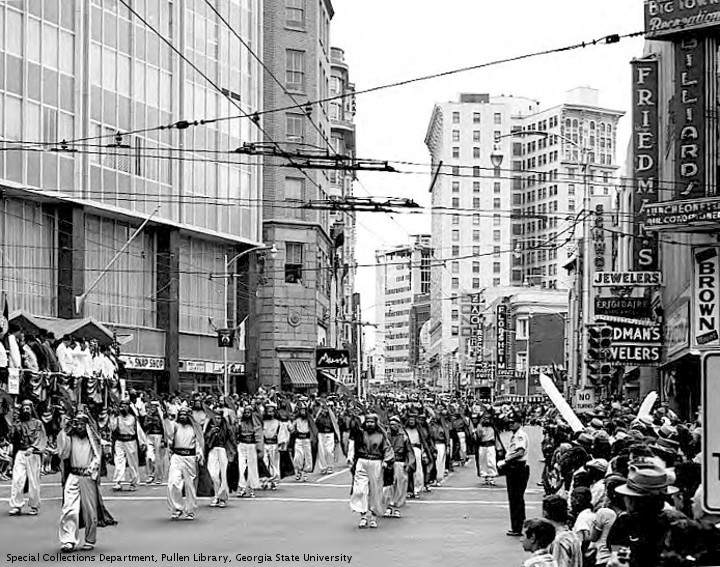
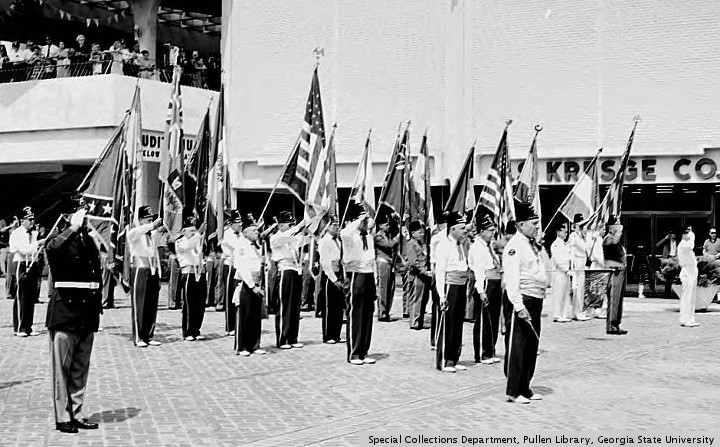
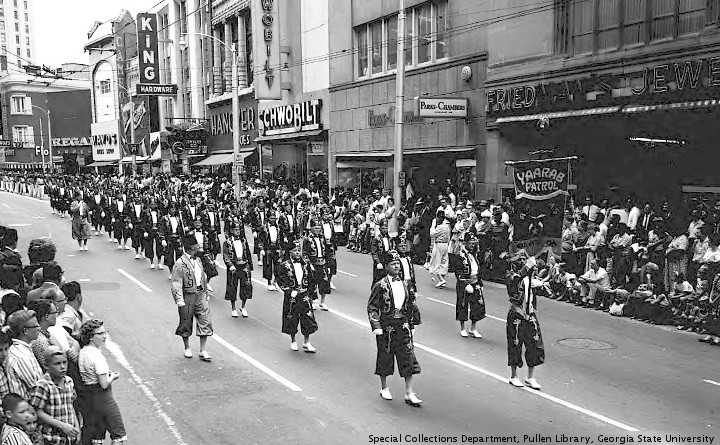
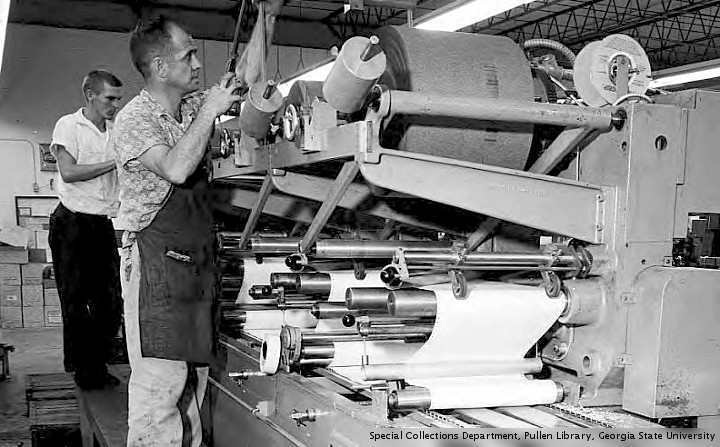
There are probably not any easy solutions. We you try to remedy one problem, like racial imbalance, you aggravate another one, like overly republican districts. Arizona tried using an independent commission. The meetings wound up on the Jerry Springer show. Do we want to choose our representatives, or do our representatives want to choose their voters? Pictures are from “The Special Collections and Archives, Georgia State University Library”.




Post Racial America



This is a repost from 2014. A current google search for Who said America is Post Racial? yielded Microaggressions and Traumatic Stress: Theory, Research, and Clinical Treatment. “Many media personalities made comments about the United States entering this alleged postracial era, including radio host Lou Dobbs, who in November 2009 said, “We are now in a 21st-century post-partisan, post-racial society” … MSNBC host Chris Matthews even claimed, “[President Obama] is post-racial by all appearances. You know, I forgot he was Black tonight for an hour.” Although Matthews’s comment was likely well-intentioned, it actually is reflective of his implicit bias and covert racism: Because the newly elected president did not fit Matthews’s schema of Black people, he was deemed to have no race—or, more likely, to seem White.”
It is a cliche among certain pundits that this is not “Post Racial America.” No one seems to know what PRA would look like. PRA might be less noisy, with fewer odors, than the current model. The opinion that we do not live in PRA seems unanimous. I heard the PRA denial, and began to wonder something. Who said America is Post Racial?
Mr. Google has 119 million answers to the question “who said america is post racial?” The short answer is nobody. The closest thing on the front Google page is an NPR commentary from January 2008. This was the early stages of the BHO run for the White House. The commenter said that the election of a dark skinned POTUS might usher in a post racial era in America.
This piece will not have any fresh opinions about race relations in America. That subject has been worn out elsewhere. If someone finds it to their advantage to denounce “racism”, there will be an audience. The truth is, very few people have ever said that America is Post Racial. Pictures are from Special Collections and Archives, Georgia State University Library



The Georgian Terrace Ballroom
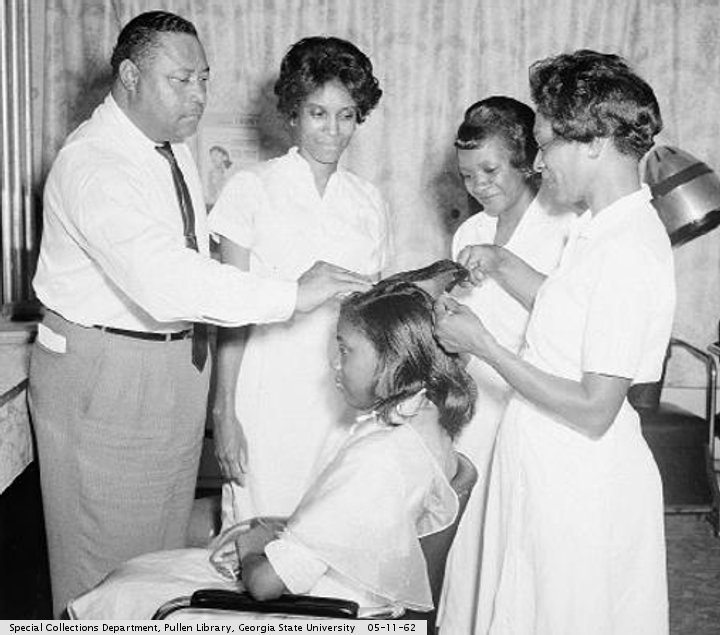
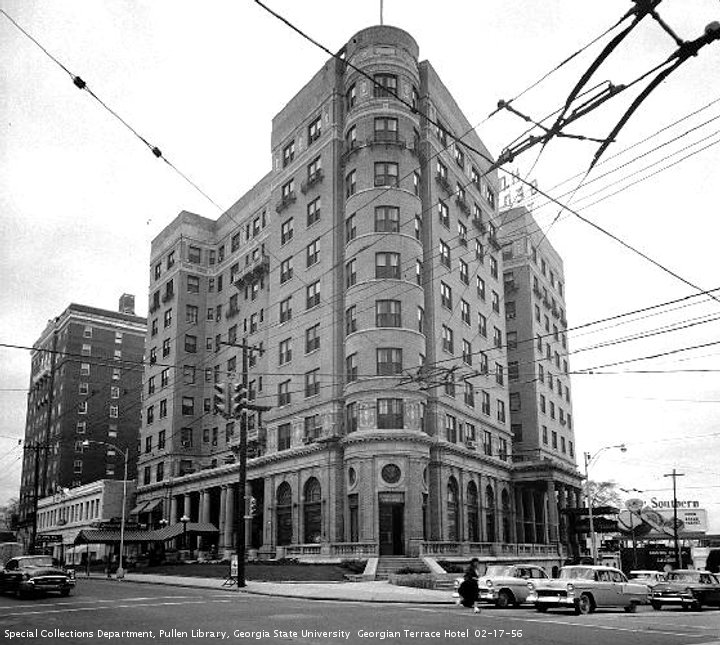

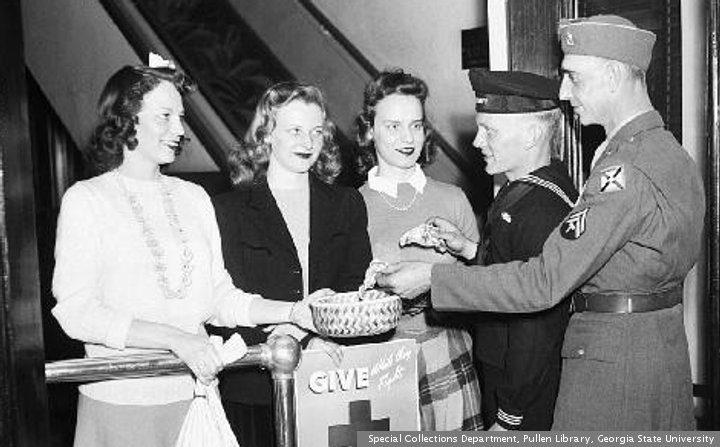


The Georgian Terrace hotel used to have an adjacent ballroom. The building opened as the “Lucky Strike”, featuring “Duck Pin” bowling. At some time, it became a 1300 seat ballroom. It was not the grand ballroom, where events for the premiere of “Gone With The Wind” were held. As time moved on, the ballroom became a music performance hall. I saw shows there under four different business names. After the Agora Ballroom closed, the building was vacant, until a fire August 30, 1987. The site of the ballroom is now occupied by an annex of the Georgian Terrace Hotel.
The first show I saw at this facility was in 1972. The name of the business is forgotten, as is the act that performed. A band, comprised of people I went to high school with, played before he got there.
In 1974, “Big Time” promoter Alex Cooley opened “Alex Cooley’s Electric Ballroom”. (Alex Cooley died December 1, 2015.) The first show that I saw was Dr. John The Night Tripper. A few months later, Capricorn artists Cowboy played, with a vulgar New York band named Mercury opening. Gato Barbieri played, with some wondering how people could dance to that type of music.
Several major acts appeared at the Ballroom, mostly without me in the audience. KISS played there in 1974, and photographs from backstage are in the video. In April of 1974, Steely Dan was across from the Fox. In the summer of 1974, The Tubes played a week at the ballroom, with another heavily hyped show. On January 23, 1976, The Patti Smith Group played at the ballroom.
In 1975, Bruce Springsteen was on the covers of Time and Newsweek, and was receiving a promotional push unlike anything seen before. He played a show at the ballroom that summer, with a generous press party in the balcony. (At one unforgettable show Alex was caught off guard by a Bruce Springsteen request. “He asked if we could shut down the cash registers because they were making too much noise!… That’s the only time I ever did that.” Alex admits.)
I attended two shows in 1975. Mckendree Spring opened for Fanny, while I drank too many bourbon and cokes. In November of 1975, Juice Newton opened for Hot Tuna. Miss Newton seemed to be a bit pale, and performed “Get drunk and screw”. Hot Tuna was amazing. They went on stage at 10:55, and played, without a break, until 2:50. The drummer wore a shirt, mother fucking hot tuna. Few would argue that night.
In autumn of 1977, some brave soul opened a place called “The Ballroom” in the space on Peachtree Street. One night, I went with some friends to see an act, Happy the Man. There seemed to be a bit of chaos in the management of the facility. The Great Southeast Music Hall loaned a few microphones for the show. When the show was over, I walked out to a car, whose motor was running, with the driver asleep inside.
In the summer of 1978, the ballroom opened as The Agora Ballroom. Apparently, there is a music hall in Cleveland with that name, and they opened branch facilities around the country. There were some shows that I did not attend. Todd Rundgren opened the facility August 19, 1978. On October 2, 1979, The Clash played. Pictures from the crowd appeared on an album by the band. On December 2, 1981, U2 made their Atlanta debut.
A few weeks after the opening, PG won tickets to an all Texas show. Marcia Ball opened. I got bored and went to a neighborhood bar to drink beer. I returned later, and stayed long enough for the singer with Asleep at the Wheel to ask the crowd, Are you stoned?
In November of 1978, I called a radio station, and asked to be put on the guest list for Talking Heads . (For Talking Heads, and three links in the following paragraphs, the link is for a previous Chamblee 54 post about the show.) The first six people he called were busy, but the last one agreed to go. On the bus going home, a group of black men started to make unfriendly comments. At the next stop, a black friend got on the bus, and went to talk to me.
A few weeks later, Tim Curry made his United States debut. Some record company invested a lot of money in him, and supplied him with an outstanding band. I was wandering around the balcony after the first show, and saw Tom Waits sitting at a table. The bodyguard said no, that’s not Tom Waits, it is just someone that looks like him. At a bar, after the show, I was raving about what he had seen, when a lady came up to him. What color are your eyes? They are brown, because you are full of shit. Soon, the 23 Oglethorpe was taking him home.
Somewhere in the haze of 78 and 79, Ultravox brought their synthetics to the Agora. A local band, First Blood, was more entertaining as the opener. I drank a very large can of Foster’s beer, and floated through the proceedings. After the show, I was invited to a party in Candler Park. On the way there, there was a horrific car crash on Ponce de Leon. At the party, friends of First Blood dissected their performance, between lines of coke.
One night, I was enjoying drink specials at a neighborhood bar. He took a break, walked over to the Agora, and saw a few minutes of a show by Freddie Hubbard.
In early 1979, the B 52s were on the verge of stardom. (Here is a nifty feature about the Atlanta local music scene in those days.) The opener for the 52s was The Brains , yet another talented band that never made it big. At the table next to PG, a lady wore a dynamite World War Two army uniform.
Later in 1979, Ted Turner had an idea for a TV show, “Live at the Agora”. The first show was filmed in Atlanta, and featured Graham Parker and the Rumor. If they ever show that film again, and you see a crowd shot, that is me wearing a white T shirt, with a white Agora iron on logo. Parker was a great musician, who had the misfortune to look like Big Bird’s nerdy little brother. If Graham Parker looked like Bruce Springsteen, he would have been a superstar.
In March of 1980, Lene Lovich came to the Agora. About a year later, Spirit played on Peachtree Street. The show was sponsored by a radio station, and tickets were $2.96. Despite the low price, and high musical quality, the balcony was closed, and only about a hundred people were at the show. I thought this was odd, but little surprised me by this time.
The last show that I caught at the Agora was The Ramones. Joey and the pinheads were past their prime, with only two original members playing. It was an all ages show, with alcohol served in the balcony. Downstairs was a festive party, with costumes and enthusiastic high school kids. The balcony was the same rock and roll drunks you had seen for years. The Ramones would have made a great oldies band, if they could have quit dying. This is a repost, with pictures from “The Special Collections and Archives, Georgia State University Library”.

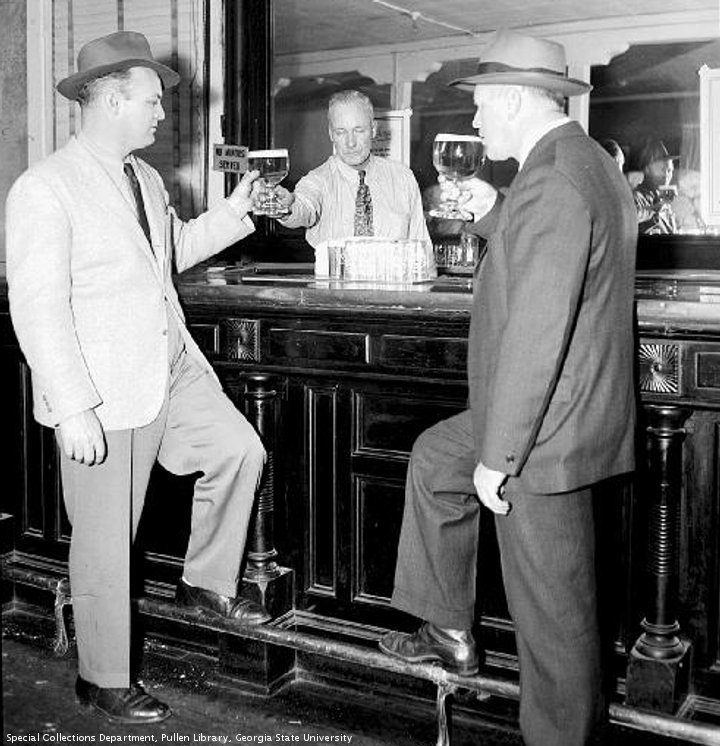
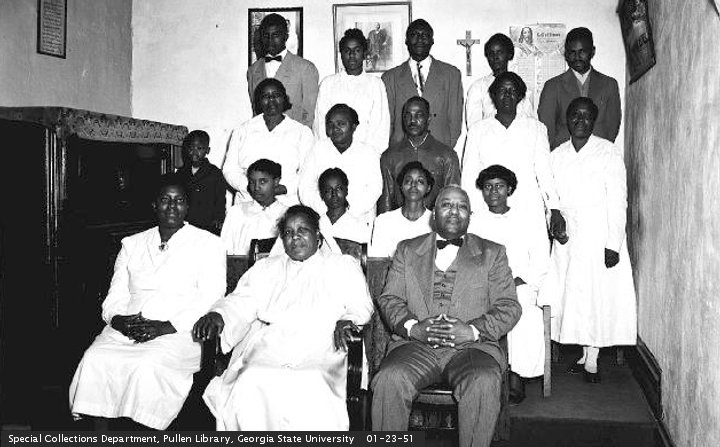

Mardi Gras



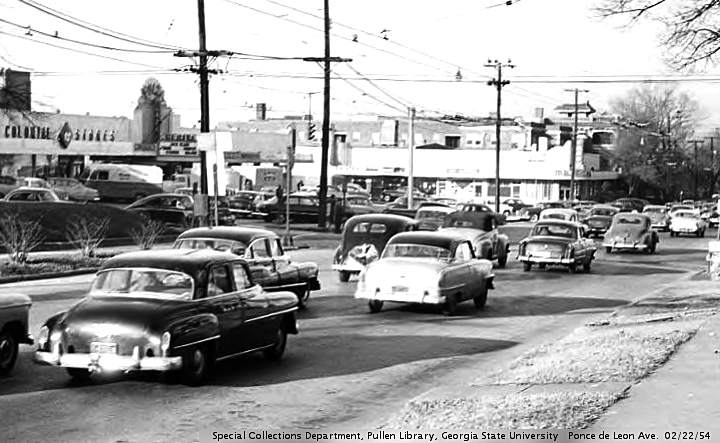

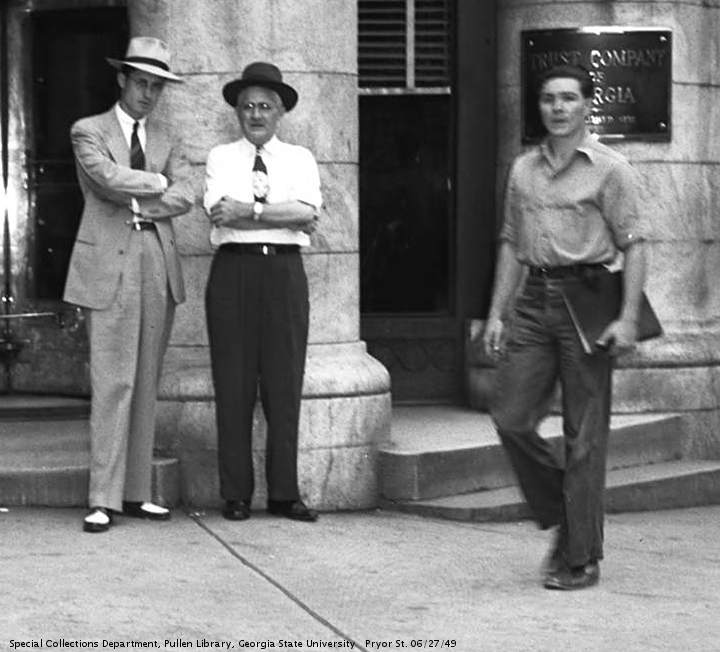


It is fat tuesday again. For someone who lived most of his life in Georgia, it is just another day.
In 1990, PG went to carnival. He rented sleeping bag space in a house on Marigny Street, just outside the quarter. It was like nothing he had ever seen.
This was 14 months after PG quit drinking. If he had life to do over, he would have gone to Mardi Gras first. He did feel good about going through that much drinking without being tempted to participate.
By the end of the Rex Parade, PG was getting tired of the whole shebang, Mob scenes of drunks, in costume, can get old. PG has not been back.
Two years later, the Grateful Dead was playing at the Omni, and the camp followers were in the parking lot. PG would go on his lunch hour and observe. A young lady walked by, and PG said Happy Mardi Gras. She gave him a string of beads.
Five years after that, PG had a boss from New Orleans. He looked like the Grinch who stole Christmas. He also hated Mardi Gras. PG did not know this, and greeted him Tuesday morning with a cheerful Happy Mardi Gras. If looks could kill, PG would have dropped dead. This is a repost, with pictures from “The Special Collections and Archives, Georgia State University Library”.




James Baldwin And The Magic Word

In the spring of 1963, KQED filmed a show, “Take this hammer, featuring James Arthur Baldwin. The snippet in the video seems to have been the last three minutes of the show. Here is a transcript. Mr. Baldwin discusses a six letter insult. The n-word is more about the speaker, than the spoken of. A 2010 blogger had this to say. The original link no longer works.
“I’ve often felt that people’s projections of me are oftentimes just that – their projections. However, Baldwin’s ending sums up a solution to this perfectly: “But you still think, I gather, that the n****r is necessary. Well he’s unnecessary to me – he must be necessary to you. Well, I’m going to give your problem back to you…you’re the n****r, baby…not me.”
It is now 2024. (All discussions of race must mention the year.) The TV show was sixty one years ago. A few things have changed. To many white people, overt expressions of racism are seen as bad manners. The n-word is taboo in polite company. The overall attitudes may not have changed, but most white people are careful how they say things.
Mr. Baldwin offered an insight into who the user of this nasty word was really talking about. Now, there is another nasty word being casually tossed about these days. This other nasty word is Racist. What would happen if you took Mr. Baldwin’s talk, and substituted racist for nasty? It is an interesting way to look at things. What follows is not a perfect fit, and may be offensive to some. A few times, it is very close to the truth.
Who is the racist? Well I know this…and anybody who has tried to live knows this. What you say about somebody else, anybody else, reveals you. What I think of you as being is dictated by my own necessities, my own psychology, my own fears…and desires. I’m not describing you when I talk about you…I’m describing me.
Now, here in this country, we got somebody called a racist. It doesn’t in such terms, I beg you to remark, exist in any other country in the world. We have invented the racist. I didn’t invent him, white people invented him. I’ve always known, I had to know by the time I was seventeen years old, what you were describing was not me and what you were afraid of was not me. It had to be something else. You had invented it so it had to be something you were afraid of, and you invested me with it. … I have always known that I am not a racist … but if I am not the racist … and if it is true that your invention reveals you … then who is the racist?
I am not the victim here. I know one thing from another. I know that I was born, am gonna suffer and gonna die. And the only way that you can get through life is to know the worst things about it. I know that a person is more important than anything else. Anything else. I’ve learned this because I’ve had to learn it. But you still think, I gather, that the racist is necessary. Well he’s not necessary to me, so he must be necessary to you. So I give you your problem back. You’re the racist baby, it isn’t me.
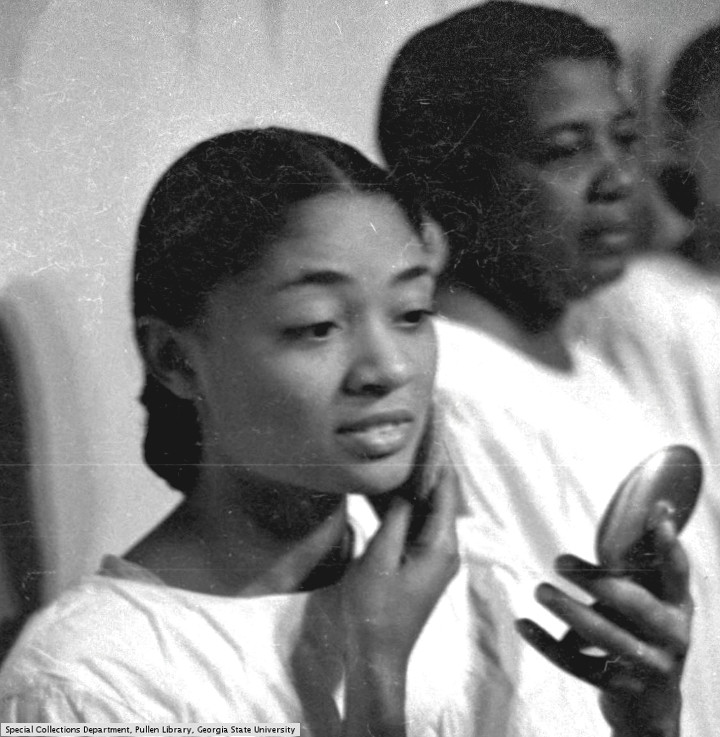
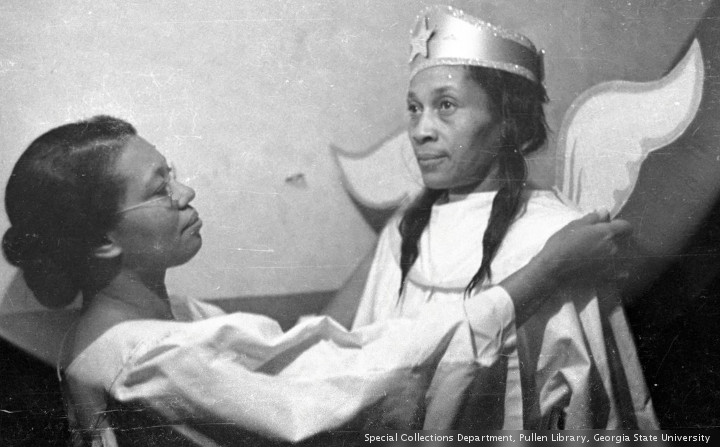
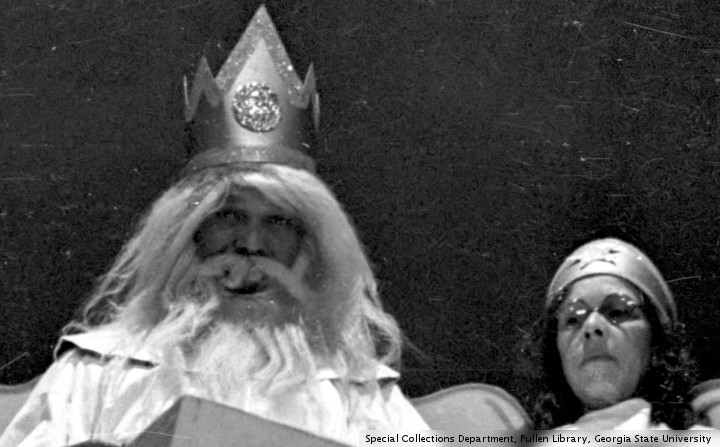
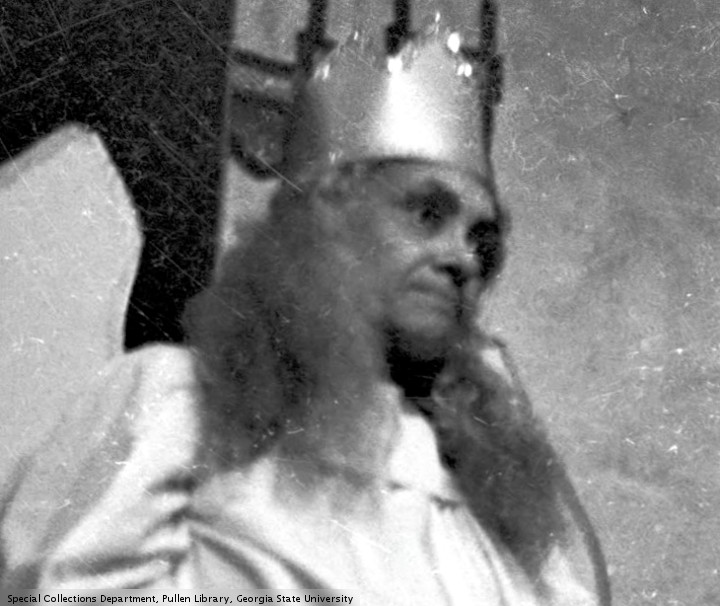
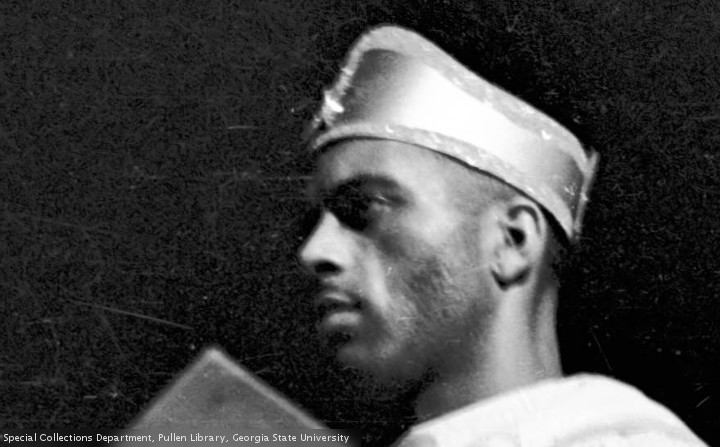
This is a repost. Pictures are from Special Collections and Archives, Georgia State University Library. These images are from the morality play “Heaven Bound,” staged by the Big Bethel African Methodist Choir, at the Atlanta Theatre (23 Exchange Place), Atlanta, Georgia, August 1937.” Chamblee54 has discussed Mr. Baldwin before. One Two

Happy Birthday Bill Burroughs


February 5, 1914, was the birth day of William Seward Burroughs Jr. For the rest of this piece he will be known as WSB. This is both a handy abbreviation, as well as a touch of irony for Atlanta readers. WSB radio is a 50k watt clear channell am station, owned by the same media oligarchs that own the fishwrapper and channel two. The radio tv clusterfuck has long been the symbol of Peachtree Street white column respectability. Just to be clear/queer, from here on out in this feature WSB will mean a certain junkie writer, not welcome south brother.
This is a good day for birthdays. Hank Aaron in 1934. Adlai Stevenson in 1900. Peg Entwhistle in 1908. The last one lived until 1932, when she jumped off the Hollywoodland sign.
A well thought of radio institution called “This American Life” has a show this week, Burroughs101. Actually, there is a class by that name, and there will be an exam at the end of the semester. The show is narrated by Iggy Pop. It begins with a warning. “A warning. The following program contains references to homosexuality, drug use, sex with aliens, violence, and kitty cats. What did you expect?” The show was originally cobbled together by the BBC, which might explain things a bit.
Iggy Pop did a show at the 688 club. PG was in the audience. A man named Ivan Kral was in the band. When Mr. Kral came on stage, he blew his nose, and a white powder booger came out. The performance was not so much a concert as it was an endurance test.
The show has the lazy bloggers friend, the transcript. There are some lovely quotes. This show is not going to candy coat the bastard. This is a man who shot his wife while playing William Tell, and got away with it. As one non admirer says “I don’t just take the Burroughs myth with a pinch of salt. I view it as a unpleasant slug crawling across the lawn of literature. And I like to pour salt on it.”
Or this one. “Having used heroin yourself– I think used is a bit of an understatement. I was a heroin addict on and off for pushing a quarter of a century. For myself, I find the whole Burroughs myth pretty repulsive, actually. Because I understand what happened to me. I was an addict in waiting. I got my form prize or my English prize at The Naked Lunch. And a year and a half later, I was sticking needles in my arm. … You could be lying in some pestilential piss-soaked squat in the bowels of the city listening to some moron totaled on drugs drooling on and talking about Burroughs, because Burroughs was their Leon Trotsky. He was their Archbishop of Canterbury. He was the Pope. “
One of the questions of the early eighties was whether or not WSB was shooting up. Forget the nonsense about there not being any old junkies. Supposedly Ray Charles never really quit using heroin. So, in 1981, WSB was living somewhere in Manhattan, and it was a right of passage to go to the bunker and take heroin to him. Since he was the star, he used the needle first, which was an important distinction in those days … hiv did not have a name but was running wild through the junkie veins and queer buttholes of Reaganite America. We don’t know if WSB got hiv or not. He made it until August 2, 1997, when a heart attack sent him to meet his maker. Contemporary Allen Ginsberg cashed in his chips earlier that year. In Washington, silly billy POTUS was getting knob jobs from Monica Lewinsky, who now gives TED talks by calling herself a social activist. WSB was a social activist, at a time when few would publicly admit to such a distinction.
The answer to your question is, yes, WSB was shooting dope in 1981. Somebody saw this as being an unhealthy situation, and arranged for him to move to Lawrence KS. This was his home until WSB went to live with Jesus, who was pissed because WSB didn’t bring him any smack.
So WSB was living the beat life, shooting dope, fucking boys, and just being a general mess. In his spare time he was writing books. Naked Lunch was busted for obscenity, and became his best known work. It is the first thing by WSB that PG tried to read, making it to page twenty six before declaring the endeavor a hopeless waste of brain cells.
It is not known how much of Naked Lunch Dorothy Kilgallen read. She was called as a witness during an obscenity trial for Lenny Bruce. ” …There’s another book called The Naked Lunch which I couldn’t even finish reading, but it’s published, and I think the author should be in jail and he used– Q. Unfortunately we can’t do everything at once, Miss Kilgallen. Are you judging the non-obscene quality and the artistic quality of Bruce by the fact that The Naked Lunch is a book which, as of this date, is sold in the community? A. No, I’m not. I just mentioned it because you asked me for some books. Q. And The Naked Lunch is a book you found impossible to read, is that correct? A. Yes, I found it revolting. Q. What was revolting about it? A. Just the way it was written.”
Another expert witness to testify … to a BBC reporter, not a New York courtroom … is Marcus Ewert. A Dunwoody native, Mr. Ewert took literary groupiedom to ridiculous lengths with Allen Ginsberg and WSB. “We’re getting into bed, and I’m sticking my legs down under the covers. There’s this bump that my legs feel. And I’m like, “Oh, what’s this hard thing my legs are bumping against, William?” And he said, “Oh, that’s the gun.” I said, “Is it a loaded gun?” He said, “Of course it’s loaded.” You’d sleep with a lover with a loaded gun in your bed. That’s kind of a metaphor waiting to happen.”
Mr. Marcus is now a children’s book author. An Amazon reader says this about 10,000 Dresses. “I returned mine today and was appalled as I read the story to my son before reading it to myself. Kids need to feel safe at home, especially when dealing with gender non-conformity. I wish the author would have reconcilled the reactions of the family members. It is great to have stories out there addressing gender non-conformity in kids, but we have a huge responsibility to make sure they are sending the right message.”
The death of Joan Vollmer is discussed. This is the lady who was playing William Tell one night, with fatal consequences. Some say accident, some say intentional. The word uxoricide is used, meaning the act of killing one’s wife.
The cut up technique is discussed. The show goes on to talk about how much WSB liked cats. He died, and people said nice things about him. Pictures tonight are from The Library of Congress. This is a repost. Last year, PG found an audiobook of Junky, read by Mr. Burroughs. A two part post, Junky, and Junky Part Two, was the result.


 Chamblee54
leave a comment