688


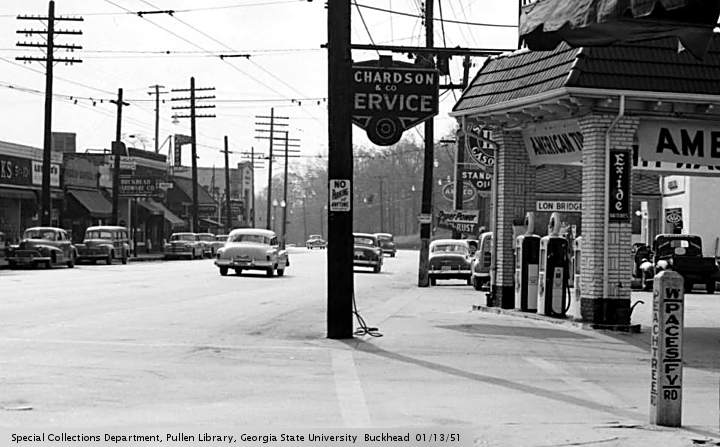

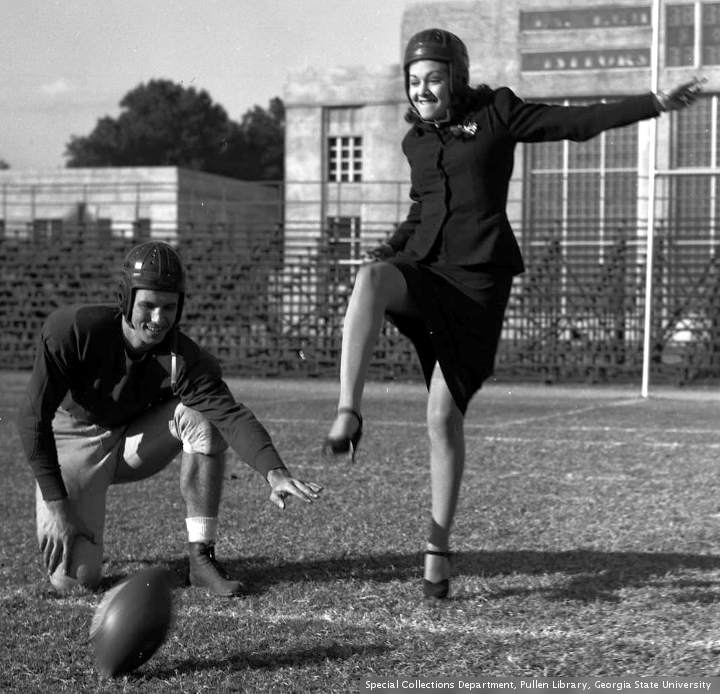
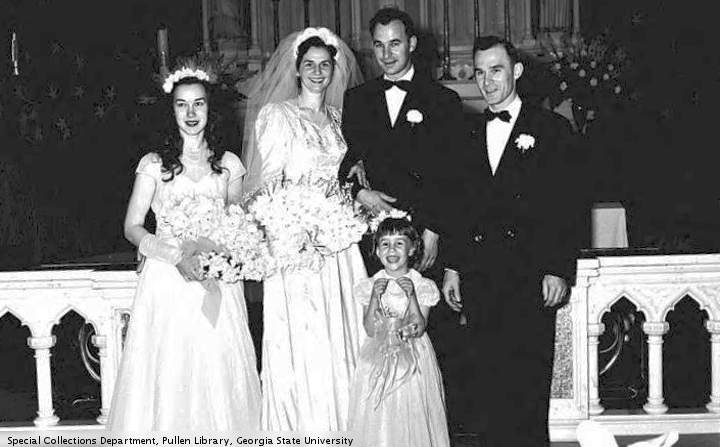
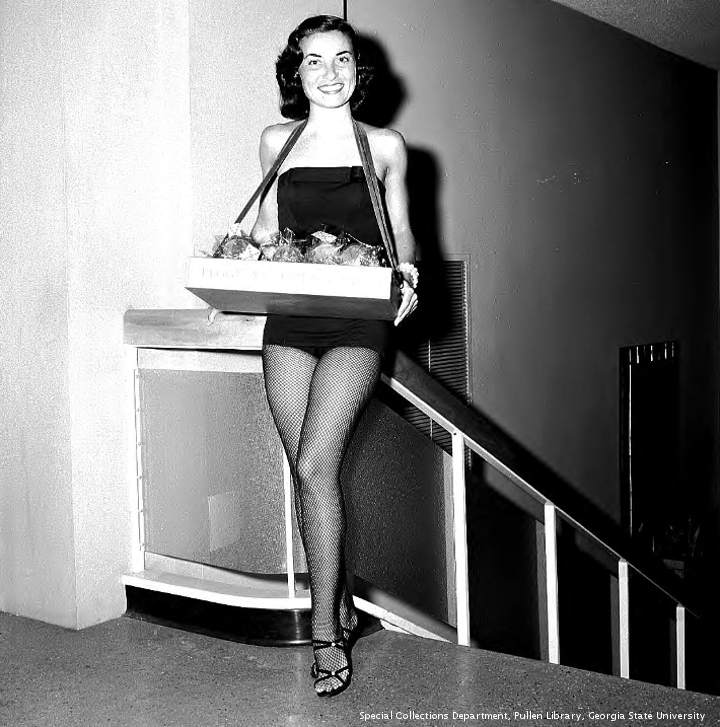





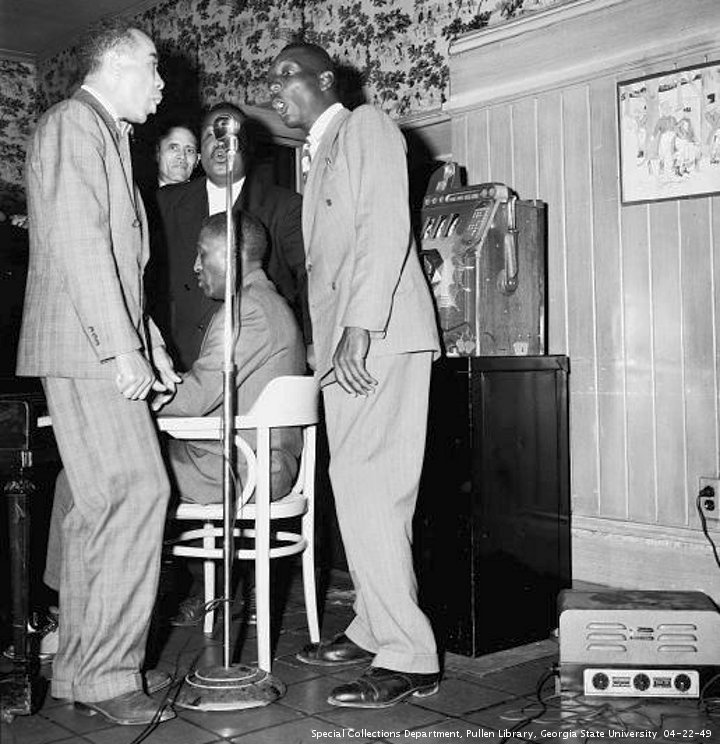
There was a comment at Chamblee54. “Steve Loehrer – So tell me what you know about Rose’s Cantina. I booked the music there from 1978-80 – Thorogood, Delbert, The Thunderbirds, The Fans, The Razor Boys and on and on. I was the one that did it. And I probably know you.” This blog has previously published features about the Great Southeast Music Hall, Richards, and the Georgian Terrace Ballroom. One more music venue post is not going to hurt anyone, and will be a good excuse to post some more pictures, from “The Special Collections and Archives, Georgia State University Library”. This is a repost.
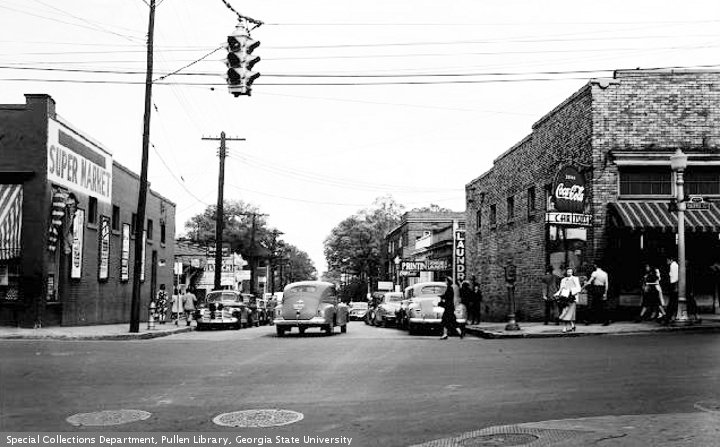
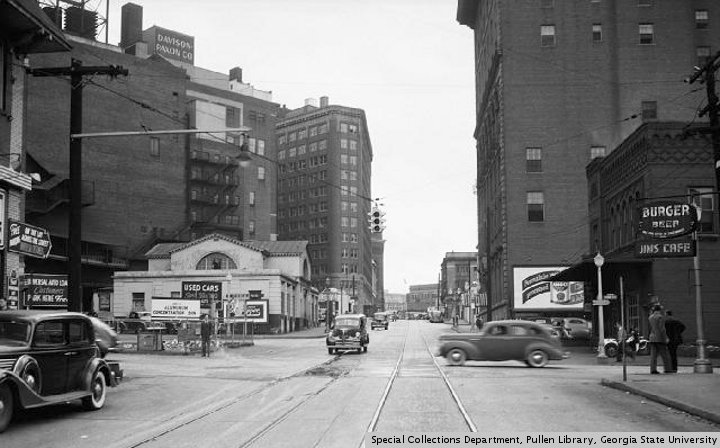
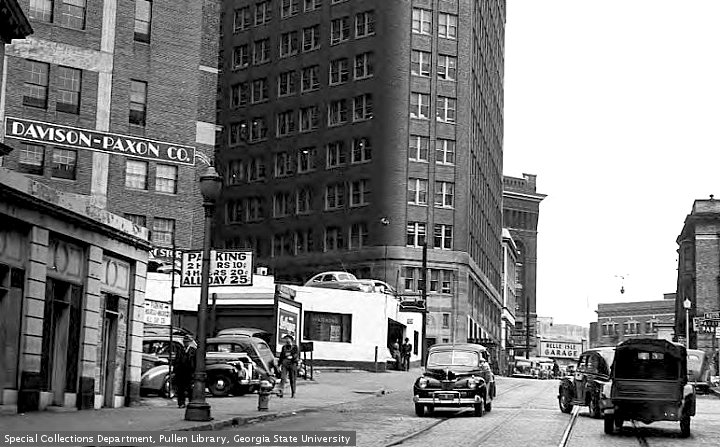
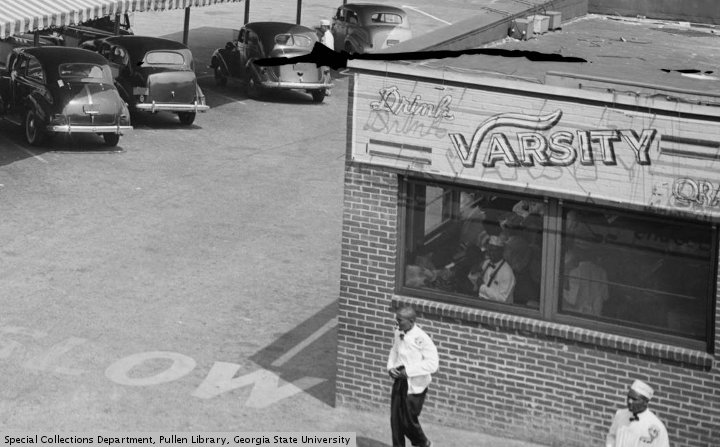
688 Spring Street is a nondescript building, located down the hill from the Varsity. At one time, a company called Southern Tailors made wine jackets there. It is currently a Concentra Urgent Care Center. In between, it was the site of two rock and roll nightclubs, Roses Cantina and 688. One block over, at 688 West Peachtree, is a Catholic Construction management office.
House manager Rose Lynn Scott is quoted as saying “You know, we really aren’t sure exactly when it all started and ended,” Scott said. “Honest to God, we weren’t paying that close attention.”PG first knew about it around 1977, and really didn’t go very often. There is a running list for this post, and whenever a new band sinks into the mush, it is duly noted. Some band did “Love Gun,” which sounds remarkably similar to “Amphetamine Annie” by Canned Heat.
The punk rock revolution did not completely pass Atlanta by. A band called the Fans said they were making the pop music of the eighties. PG saw them twice at Roses, and they might be the only time he ever paid to get in. They were an impressive outfit, doing Velvet Underground and Telstar. Later, they opened for Talking Heads at the Agora, and were pretty awful. Much, much later, PG shared an apartment with the brother, of the drummer, for the Fans. Also living there was the brothers wife, a cable guy, seven snakes, a ferret, and a cat.
Back to the words of Rose Lynn, “It was a dive bar supreme and proud of it.” The stage was in the middle of the house, with a game room behind the stage. If you liked to shoot pool and listen to bands, this was the place. As for drinking, PG might get a beer or two, but mostly got bombed at other spots.
In those days, PG would go rambling from club to club, often accompanied by his friend Dinkson. One night, they stumbled in on a three piece band. They did a song called “Madison Blues”, with the guitar playing slinging riffs, and the bass playing playing the same notes over and over, never changing the look on his face. This was George Thorogood and the Destroyers.
One other night, PG stumbled in on the last few minutes of a show by the Brains. They wrote a song called “Money Changes Everything” that Cyndi Lauper did well with. This is another great local band that never seemed to get a national audience. Another night, some old black man, possibly John Lee Hooker, was playing guitar.
Around about this time, PG decided to either grow up, or take his childhood seriously. He wound up in Seattle WA. That wore off after a while. On the greyhound bus going home, PG talked to a young lady, who said something about a punk rock club in the Roses Cantina space. This was the 688.
A few weeks later, Iggy Pop did a week at 688. Here, through the miracle of copy paste, is the story. It isn’t plagiarism when you wrote it yourself.
At any rate, by the time PG got back from Seattle, some brave investors decided to have a punk rock club at 688 Spring Street. Soon, Iggy Pop would be playing a week there. In the seventies, the bands would play for five days at the great southeast music hall or the electric ballroom, two shows a night, and if you were really cool you would go on a weeknight before it got too crowded. Soon after that, it was one night in town only, and you either saw it or you didn’t.
PG had a friend at the Martinique apartments on Buford Hiway. There was someone living in the complex known as ZenDen, who sold acid. You would go to his place, wade through the living room full of grown men listening to Suzi Quatro, and purchase the commodity.
On to the the 23 Oglethorpe bus, and downtown to 688 Spring Street. Before anyone knew it, the band was on the stage. A veteran of the Patti Smith Group, named Ivan Kral, was playing bass. Mr. Kral sneezed, and a huge cocaine booger fell across his face. He was not playing when the show ended.
There was a white wall next to the stage, and someone wrote the song list on that wall. That list of songs stayed on the wall as long as 688 was open. “I want to be your dog” was on the list, as well as the number where Iggy pulled his pants off and performed in his underwear. Supposedly, in New York the drawers came off, but the TMI police were off duty that night.
The show was loud and long, and had the feel of an endurance event…either you go or the band does. Finally, the show was over, and PG got on the 23 Oglethorpe bus. You got the northbound bus on West Peachtree Street. You could look down, from Fourth street, and see the Coca Cola sign downtown. Freeway expansion sent that section of West Peachtree to old road hell.
Twenty years after that, PG worked in a building at that corner of Fourth and West Peachtree. If he had known about the future of working for Redo Blue, PG might have jumped under the 23 Oglethorpe bus, instead of getting on it. The Coca Cola sign was long gone by then.
There was band called Human Sexual Response in those days. PG caught their act at 688. They had three vocalists, wearing matching outfits, and sang a lot of lyric happy songs with really cool harmonies. The problem was, PG was not familiar with those oh so witty lyrics, and did not know what it was all about. At least he got out of the house.
Kevin Dunn played guitar for the Fans. (He had an ad for guitar lessons on the bulletin board at Wax and Facts. It said that raising racing turtles was more profitable than playing guitar.) One night at 688, he performed with his band The regiment of women. They opened for someone, possibly the Plastics, who we will get to in a minute. So, this guy plays guitar and sings, and a woman plays a drum machine. No skin pounding drummer, but a lady who twisted the knobs on a machine.
The Plastics were from Japan, and did a killer version of “Last Train to Clarksville”. It was about this time that PG got a job, and decided that he liked sleeping better than hanging out downtown.
One night, about 1983 or so, PG made an exception. The band that night was Modern English. Before the show, PG ate three z burgers from the Zestos on Ponce de Leon. During the show, the singer rubbed his stomach, and said to feel the music. About this time, the z burgers were making their presence known, and PG could feel something, but it wasn’t the music.
The last show PG saw at 688 was Hüsker Dü. The best guess is February 14, 1986. There was a totem pole, made of old TV sets, in the front part of the club in 1986. Here is the story.
Hüsker Dü means “do you remember” in Danish and Norwegian. PG saw them sometime in the eighties. It might have been the metroplex, but it might have been the 688. There is a list of shows they played, and the metroplex is not on there.
PG saw a show at the Metroplex the next night. The band is forgotten. The metroplex was a dark spooky building on Marietta street near the omni. The balcony was very dark, with everything painted black. PG tripped over a bench.
688 was a different story. PG saw a bunch of shows there, both as 688 and Rose’s Cantina. HD may have been the last show PG saw before they closed. PG was well into the work/sleep lifestyle that preoccupied his life after a certain point, and just didn’t make it out much anymore. A friend won tickets to the show or he wouldn’t have made it.
PG didn’t get into the show very much. HD was a trio, with the later-outed Bob Mould as the guitar g-d. For all of his musical skills, Mould is not much for onstage charisma. PG felt that if he had been more familiar with their music, he would have enjoyed it more. Some bands you can see without hearing their records and get into it right away, where others need a bit of familiarity.






Blue Tail Fly


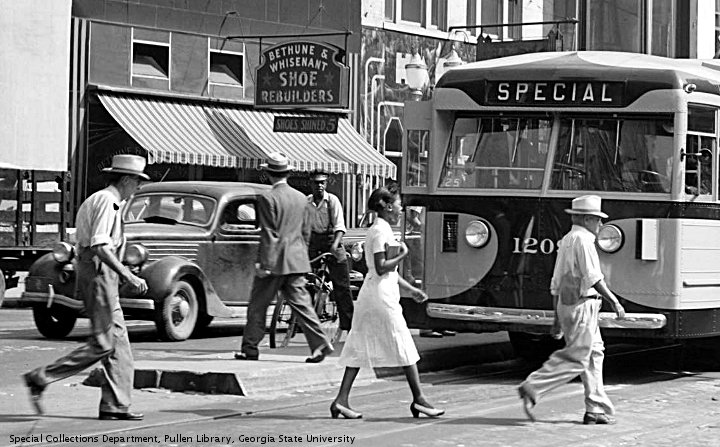

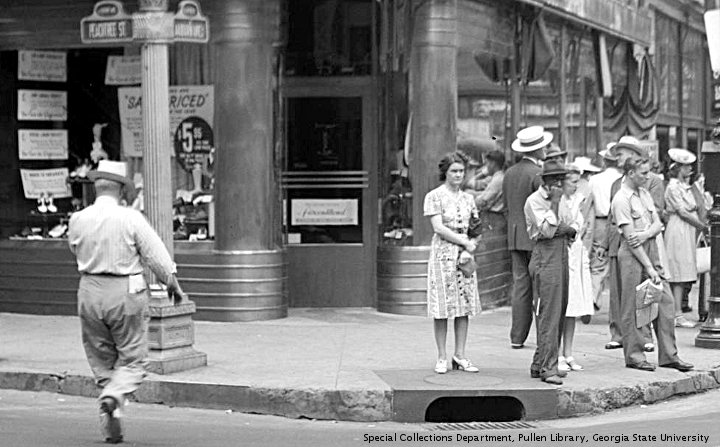

Q: What does “Jimmy crack corn” mean, and why does he not care?—Matt, Columbus, Ohio
PG was trolling stupidquestion.net when there was a convergence of stupidity. (The site does not exist in 2012.) All his life he had heard “Blue Tail Fly”, and been embarrassed. And there, in (pardon the expression) black and white, was someone who wondered the same thing.
It seems as though “Blue Tail Fly” started out as a minstrel song. For those who don’t know, minstrel shows were white people putting on black makeup, and imitating African Americans. Minstrel shows are not well thought of these days.
The story of BTF involves a man named Jimmy. A fly bit the pony the old massa was riding, the pony was offended, and threw the old massa off. He was hurt landing, and died. Jimmy still has to crack corn, but he doesn’t care, because old massa has gone away.
Dave Barry took a poll once to find out the stupidest song of all time. The overwhelming winner/loser was “MacArthur Park”. The combination of over the top show stopping, while singing about a cake left out in the rain, makes this ditty a duh classic.
In the spirit of corny convergence, the video is a karaoke version featuring Donna Summer. Miss Summer is a talented singer, who happened to connect with Giorgio Moroder. Lots of singers could have hit the big time by fronting those records. Donna Summer hit the jackpot.
For a proper post, there needs to be a third stupid song. This is not about stupid bands, singing about being D U M B. Even though they totally don’t belong, there is a video of the Ramones included. PG saw the Ramones at the Agora Ballroom in 1983. This was after their prime, and before a homeless man caught the Ballroom on fire.
We still need a third stupid song, and PG wants to get this posted with as little research as possible. Just like some writer was once given twenty minutes to write a song, and he decided to do the worst song he could think of. The result was “Wild Thing”. PG used to have a 45 of someone who sounded like Bobby Kennedy singing “Wild Thing”. Let the good times roll.
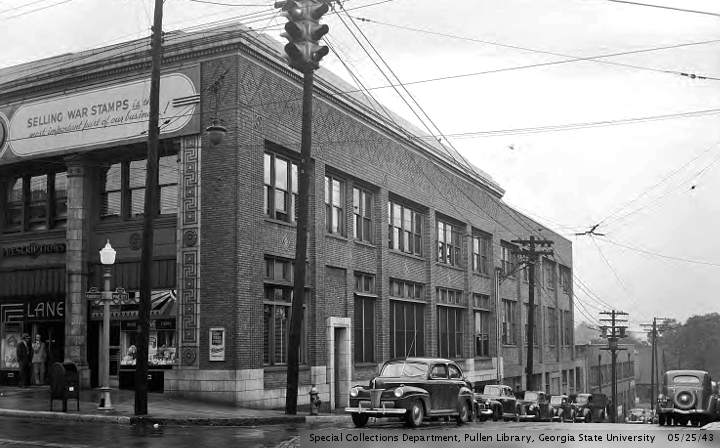
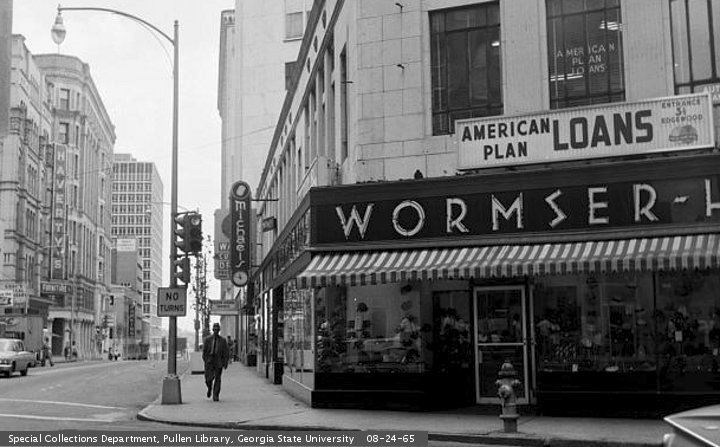
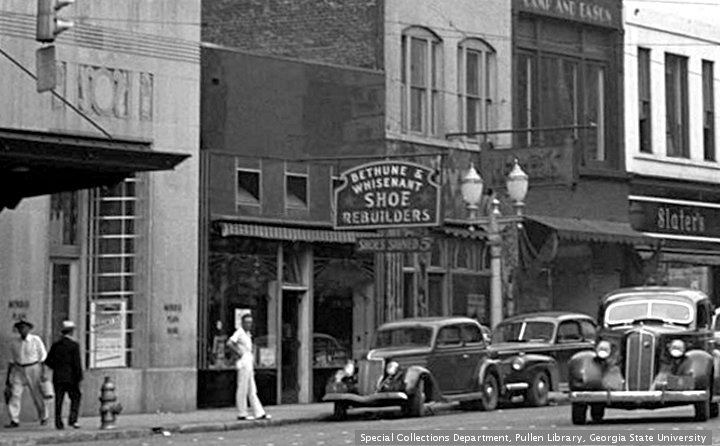
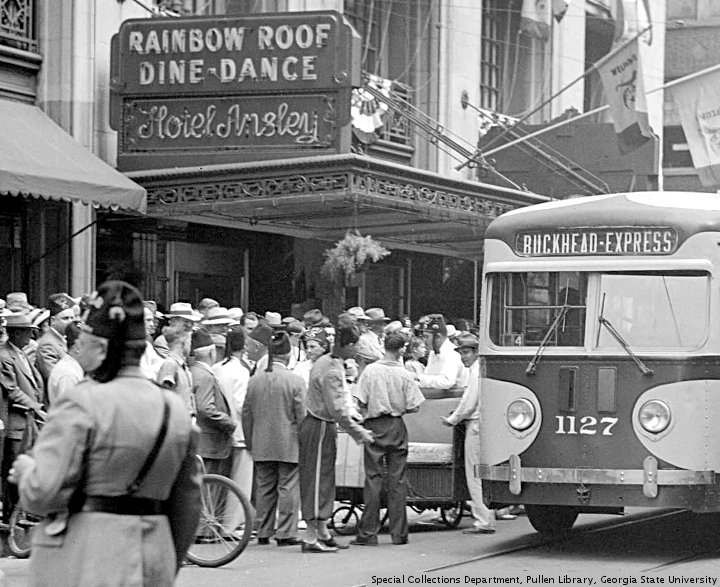
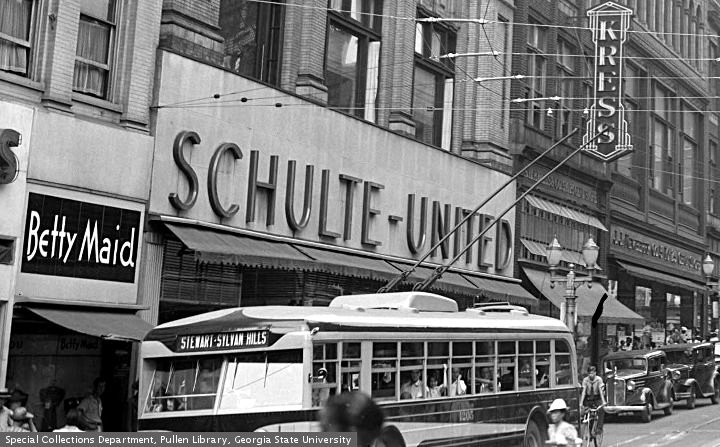
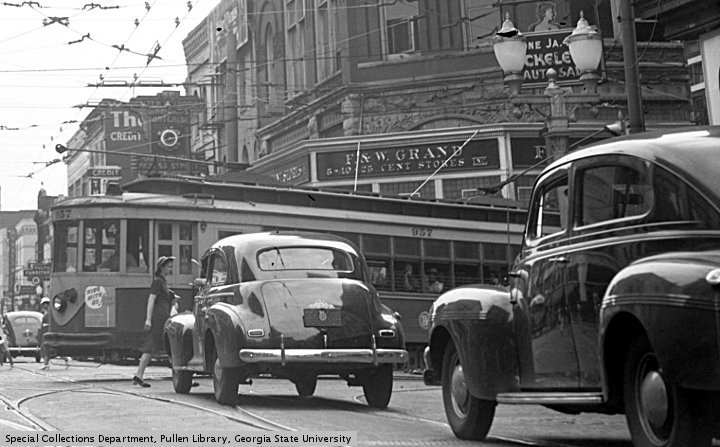
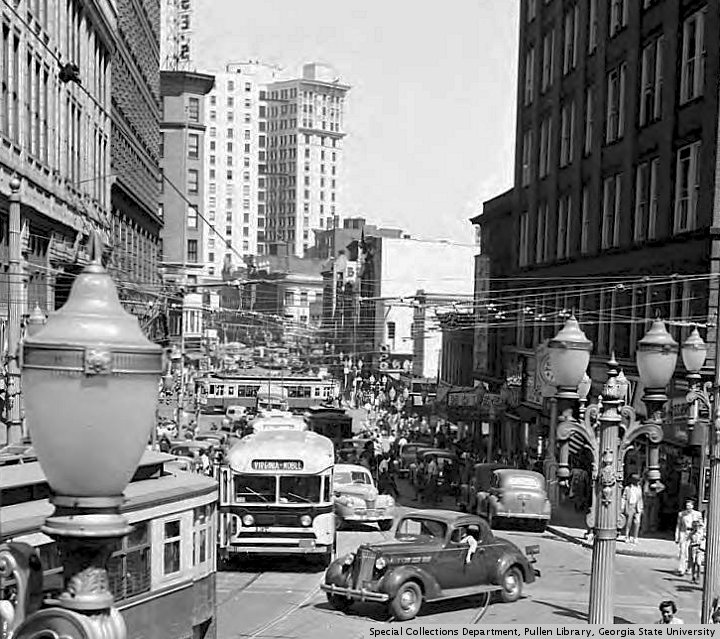
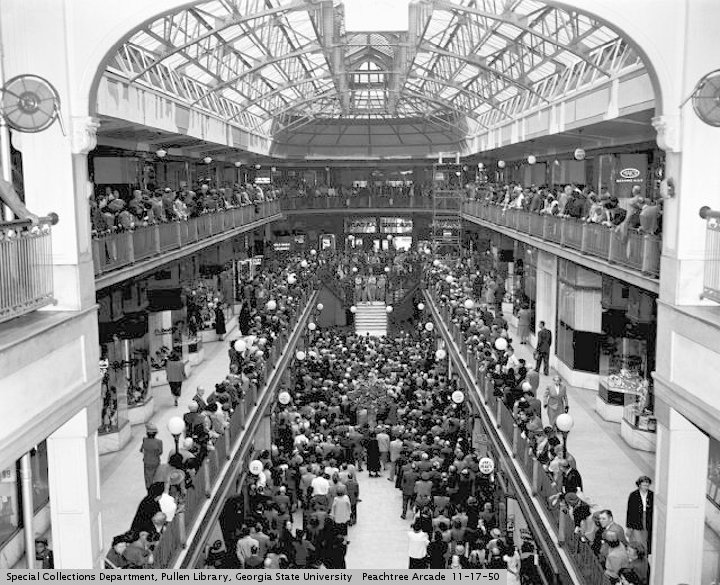
These four hundred and twenty hastily chosen words are a repost. Pictures are from “The Special Collections and Archives, Georgia State University Library”. This was downtown Atlanta in 1941.



Nappy Hair Where?


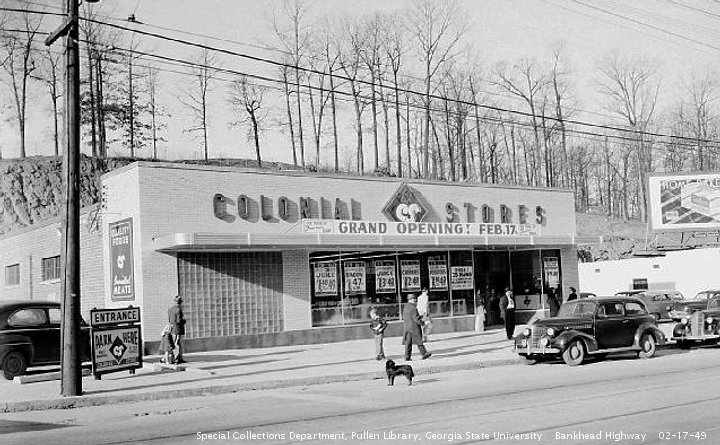

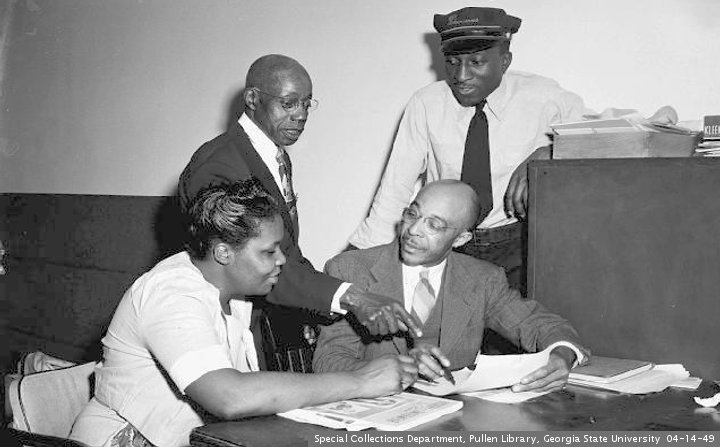
This is a repost from 2011. A link about white privilege now directs to The Story Behind ‘Alice’s Restaurant’ – the 50-Year-Old Song that Is Forever Young. Pictures are from “The Special Collections and Archives, Georgia State University Library”.
PG was reading facebook, minding his own business, when he saw something that made his head explode. It started with a post with the splashy title White Liberals Have White Privilege Too! . There is something about online discussions about white privilege that make well meaning people want to type a lot of words into little boxes on the monitor. PG usually avoids such a conversation, as if it were an amway pitch, but made an exception this fateful afternoon.
The seminal article was written in 2007, and mentioned the media controversy of the day. It seemed as though Joe Biden said “I mean, you got the first mainstream African-American who is articulate and bright and clean and a nice-looking guy … I mean, that’s a storybook, man.” Mr. Biden is currently the Vice President, serving under the FMAA.
There was a link to a bit of archaic html called ” Black People Love Us!, which tells the story of Sally and Johnny… “We are well-liked by Black people so we’re psyched (since lots of Black people don’t like lots of White people)!! We thought it’d be cool to honor our exceptional status with a ROCKIN’ domain name and a killer website!!” The fun starts when a facebook paster quoted a letter to BPLU.
“I swear, if one more white person says that they want to touch my hair, I am gonna puck a f*ckin mousetrap in it so their f*ckin hand gets caught in it. anyways… GET WITH THE PROGRAM! Have any of you ever heard of sarcasm? Irony? Satires? Canterbury Tales? Shakespeare’s “As You Like it” and “Much Ado About Nothing?” If some of you would actually get your heads out of your asses for one second and read a f*cking book or get educated, you will see that this website is NOT trying to break down PEOPLE, but break down BARRIERS and erase STEREOTYPES…With much love for Sally and Johnny… A Black University of Michigan Student with nappy-ass hair”.
The resulting visual ruined the day for PG. BUMS should keep their pants on, and not burden the world with the sight of nappy hair on their posterior. The same thing goes for any asian, latino, caucasian, native american, or zorlack with this problem.


PG was recently reading a list of rules for writing. He began to think of a few. A wordpad was opened, and before long 18 suggestions appeared. Many are only marginally about writing.
When you publish a list like this, you are placing a target on your back, with the word hypocrite written above. PG does not claim to take all these suggestions all the time. What follows is a goal to work for, not a script for a situation comedy.
When in doubt, shut up.
A halo is best worn over one ear.
If you want to be forgiven, forgive. If you want to be understood, understand.
There are few situations that cannot be made worse with anger and loud talk.
You have two ears and one mouth. Listen twice as much as you talk.
A douche is a hygiene appliance. The verb form refers to using this device, for cleaning purposes. Neither the noun nor the verb is appropriate for use as an insult.
A sentence has one period, placed at the end. Do not place a period after every word to make a point. You should find another way to show emphasis.
Not everyone enjoys the sound of your voice as much as you do.
Do not place “ass” between and adjective and the object. “Ass” is a noun that refers to either a donkey or a butt. An adverb is used to modify an adjective, and is placed before the adjective. Using “ass” as a misplaced adverb is improper. This applies to “a$$”as well.
Before you “call out” somebody for “racism”, drape a towel over your mirror.
The third commandment says to not use the word G-d “in vain”. The G word should only be used for worship and respectful discussion. Improper uses include expressing anger, swearing to, selling life insurance, and pledging allegiance to a nationalist symbol.


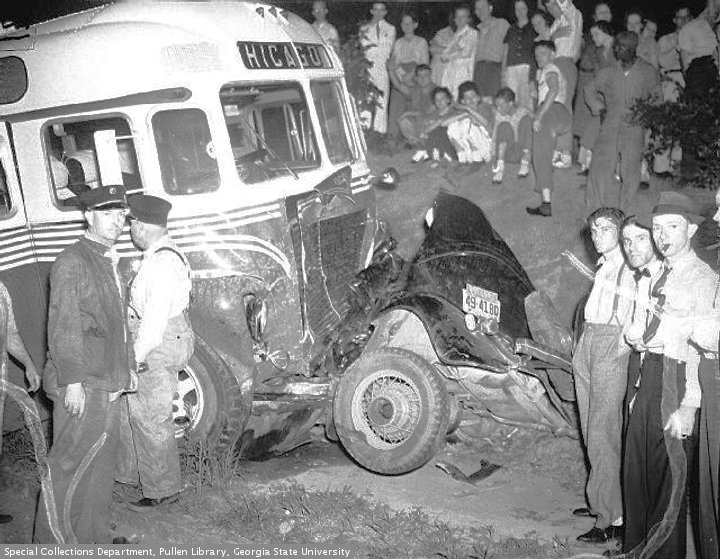
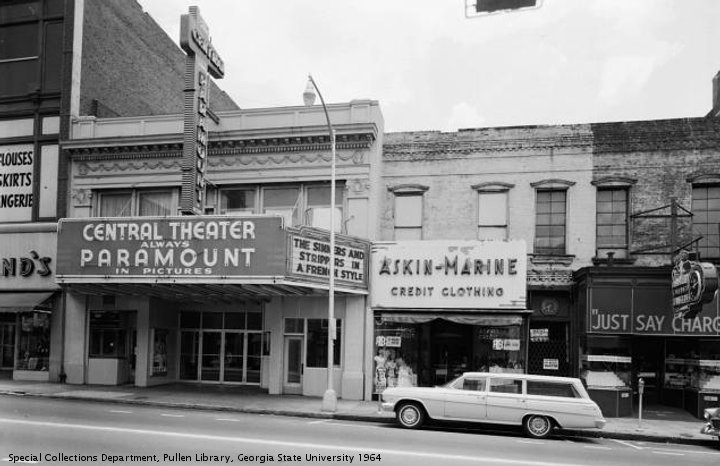
Monroe Drive Or Boulevard

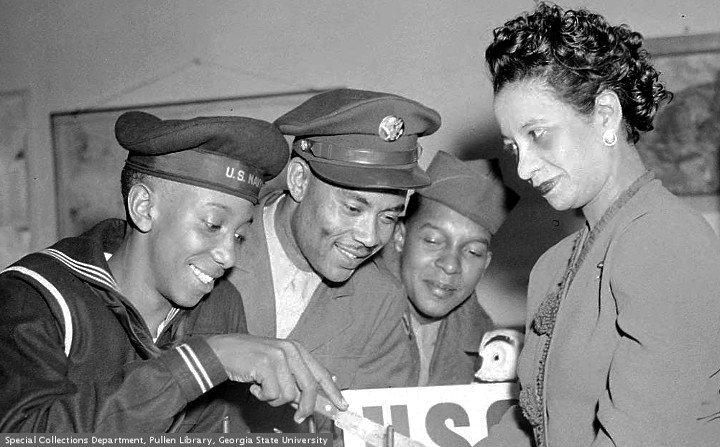
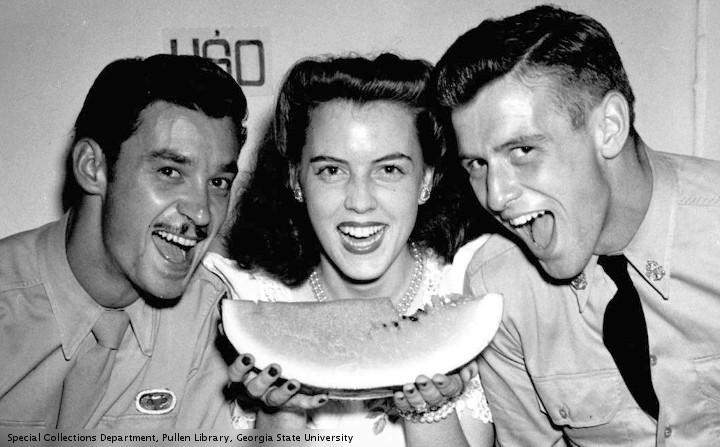


It is an Atlanta cliche. Boulevard turns into Monroe Drive because one was black, and the other white. The white people did not want to live on a street with the same name as the black neighborhood. You hear this all the time, with very little explanation. It is plausible. At one time, Ponce de Leon Avenue was a dividing line between the white, and black, neighborhoods. There are, however, a few questions about this name change business. This is a repost.
In the space between I-85 and Dekalb County, there are four streets that change names when they cross Ponce De Leon Avenue. These are Juniper/Courtland, Charles Allen/Parkway, Monroe/Boulevard, and Briarcliff/Moreland. Several streets cross Ponce without changing names, including Spring Street, Peachtree Street, Piedmont Avenue, and North Highland Avenue.
Four thoroughfares are affected by the Ponce rebranding. Juniper/Courtland is mostly commercial, at least south of Ponce. Briarcliff/Moreland is mostly white until you get to the railroad tracks south of Little Five Points. When Moreland Avenue goes under the MARTA line, the neighborhood is Reynoldstown….which was not named for Burt Reynolds.
Charles Allen/Parkway does change from white to black at Ponce. The street name then changes to Jackson Street, the original name, at Highland Avenue. Monroe/Boulevard, one block east of Charles Allen/Parkway, also goes from white to black at Ponce. However, when you cross the railroad tracks, Boulevard goes through Cabbagetown, a white neighborhood. Boulevard residents change color several times before the road dead ends at the Federal Prison. Oakland Cemetery, and Zoo Atlanta, do not play a role in this drama.
If this litany of street names is boring, it is all right to skip over the text. The pictures today are from “The Special Collections and Archives, Georgia State University Library”.
Roads change names all over the metro area, for a variety of reasons. In the area between Ponce De Leon Avenue and I 20, there are roads that change at railroad tracks (North Highland/Highland, Krog/Estoria.) Others change at Highland Avenue (Parkway/Jackson, Glen Iris/Randolph) or Decatur Street (Hilliard/Grant, Bell/Hill.) Some of these changes are racially motivated, while others are not. Some make sense, while most do not.
No one seems to know when this Monroe/Boulevard thing happened. An 1892 “Bird’s eye view” shows Boulevard sailing off into the horizon, past a racetrack in today’s Piedmont Park. A 1911 map shows Boulevard starting near “L.P. Grant Park,” and sailing past Ponce up to Piedmont Park. A 1940 map shows Boulevard going past Park Drive, only to turn into Monroe Drive at Montgomery Ferry Road. Finally, a 1969 map of “Negro Residential Areas” shows Monroe Drive changing into Boulevard at Ponce De Leon Avenue, like it is today. Boulevard is a stand alone street name at all times.
If anyone knows about this name change business, please leave a comment. It would be interesting to know when these changes were made, and what government agency made them. Google has not been helpful, except for pointing the way to several map collections. UPDATE After the last publication of this post, a comment was made about the namesake of Monroe Drive. A post inspired by this comment is reposted below.






“North Boulevard was renamed Monroe Drive in 1937 to honor noted Landscape Architect W.L. Monroe who built his house and a plant nursery on the road and was noted for his many landscape projects and public parks in Atlanta.” Faset (Bill) Seay, February 4, 2020, 3:48 pm This comment was made to Monroe Drive or Boulevard. MDOB looks at Atlanta roads that change names, and the reputed racial motivations for these changes. The Monroe story takes place in Piedmont Heights.
“In 1823 Benjamin Plaster was granted 3,000 acres of land along Peachtree Creek and Clear Creek in recognition of his military service during the War of 1812. This was two years before Archibald Holland acquired a similar tract several miles to the east where another village called Terminus was founded in 1837, later renamed Marthasville and eventually Atlanta. … Plaster built a bridge across Peachtree Creek and the trail to it became known as Plaster’s Bridge Road. The bridge’s stone abutments still remain on the creek banks and a short section of the old road, running along the northern boundary of today’s Piedmont Heights, is now called Plasters Avenue. As other settlers followed a township called Easton grew up around Walker’s Grist Mill on Clear Creek near the site of today’s Ansley Mall at Piedmont Road and Monroe Drive.”
“Around 1850 Captain Hezekiah Cheshire arrived from South Carolina. His sons, Napoleon and Jerome, settled on opposite sides of the south fork of Peachtree Creek. They built a bridge across the creek near to connect their farms and the road to it became Cheshire Bridge Road. … In 1864 General Sherman’s Union soldiers swept through Atlanta. General T. J. Wood’s troops built entrenchments along the eastern edge of Easton on the property of Benjamin Plaster’s son Edwin, putting the little community in the battle of Atlanta. These entrenchments remained until the 1950s when they were destroyed by the construction of a Holiday Inn. Today a few crumbling stone steps and historic marker on the site honor the Edwin Cheshire family’s handyman “Gold Tooth John” whose ghost is rumored to still wander the halls of the old hotel at night.
“In 1871 the Atlanta and Richmond Air Line Railway opened a line between Atlanta and Toccoa, Georgia with a depot at Easton. Its “Air Line Belle” train, said to be the finest on the line, allowed Easton residents to commute to Atlanta without having to ford Clear Creek which still had no bridge. Train service spurred growth of the township to 100 residents by 1888 but the surrounding area remained rural and mostly devoted to farming and dairying. The rail line serving Easton was called the “Southern Railway Belt Line” and in 1883 the “Georgia Pacific Belt Line Railroad” connected with it just north of Easton at Belt Junction, an area which later became known as … Armour/Ottley. … In 1895 North Boulevard was built, running through Easton parallel to the railroad, as a main route into Atlanta. … In 1912 Fulton County annexed Easton and renamed it Piedmont Heights. Plaster’s Bridge Road was paved in 1917 and its name changed to Piedmont Road.” (According to this narrative, the Boulevard-Monroe thoroughfare was originally called North Boulevard. This is not the same road as North Avenue. Confusing road names is not limited to multiple Peachtrees.)
“In 1925 Landscape Architect W. L. Monroe bought 15 acres on North Boulevard at Wimbledon Road where he operated a popular nursery and landscaping business for many years, … Remnants of two small stone structures that Monroe built … remain on the grounds of today’s Ansley-Monroe Villas Condominiums. In 1927 a portion of North Boulevard was renamed Monroe Drive in honor of Monroe’s many landscape projects in the city.” … “In 1928 the City of Atlanta began annexing Piedmont Heights by taking in the lots along North Boulevard. In the 1930s a new home could be bought for $4,700 on North Boulevard or Wimbledon Road.”
There is a bit of confusion here. One source says the Monroe renaming was in 1927, while another source says 1937. Then there is the story told by maps, found in the original post.
An 1892 “Bird’s eye view” shows Boulevard sailing off into the horizon, past a racetrack in today’s Piedmont Park. A 1911 map shows Boulevard starting near “L.P. Grant Park,” and sailing past Ponce up to Piedmont Park. A 1940 map shows Boulevard going past Park Drive, only to turn into Monroe Drive at Montgomery Ferry Road. Finally, a 1969 map of “Negro Residential Areas” shows Monroe Drive changing into Boulevard at Ponce De Leon Avenue, like it is today.
Two things are worth noting. None of these maps have a “North Boulevard.” The street name is a stand-alone Boulevard. Second, the 1940 map shows the street as Boulevard at Eighth Street, and Elmwood Drive. The first mention of Monroe is at Montgomery Fairy, near the Monroe Nursery. This might contradict the racial narrative.
The information about Mr. Monroe neither proves, nor disproves, the story that black Boulevard was changed to white Monroe. City on the Verge: Atlanta and the Fight for America’s Urban Future states “In 1925 landscape architect W. L. Monroe bought fifteen acres on what was then called North Boulevard, establishing a plant nursery that thrived for many years. In 1937, the street north of Ponce de Leon was renamed Monroe Drive in his honor (and to distinguish it as a white area as opposed to Boulevard to the south of Ponce).” The book offers no evidence for this, and its “woke” tone is cause for skepticism. While there is circumstantial evidence to support the legend, verifiable facts are hard to come by. A similar story might be the 1956 change of the state flag.
“William Lott Monroe, Sr. (1891-1965), landscape designer and nurseryman, is recognized in newspaper articles as the “landscape artist” during the development of North Fulton Park (later renamed Chastain Memorial Park) in the late 1930s and early 1940s. This work was financed partially through WPA (Works Progress Administration) funds and supported with local prison labor. … There are three main areas in Chastain Park with Monroe’s signature style as a landscape designer: (1) the master grill area; (2) the picnic grounds area; and (3) the amphitheater. … Monroe’s Landscape & Nursery Co. is removed from Fulton County’s payroll: “… Drawn more than $17,000 from the county in the last year and one-half… The company was drawing $500 a month for supervising landscaping of county parks, which was in addition to flowers, shrubs and blueprints sold by it to the county.” (“Nursery Company Is Cut Off Pay Roll.” Atlanta Constitution, Jan. 25, 1941)” … “1941 Amphitheater still under construction, originally planned as an outdoor venue for the Atlanta Symphony Orchestra.” … “It is unknown if Monroe oversaw the completion of construction at the amphitheater.” … “October 22, 1965 William Lott Monroe, Sr. dies in Atlanta.” Pictures are from “The Special Collections and Archives, Georgia State University Library”.




35 Broad Street
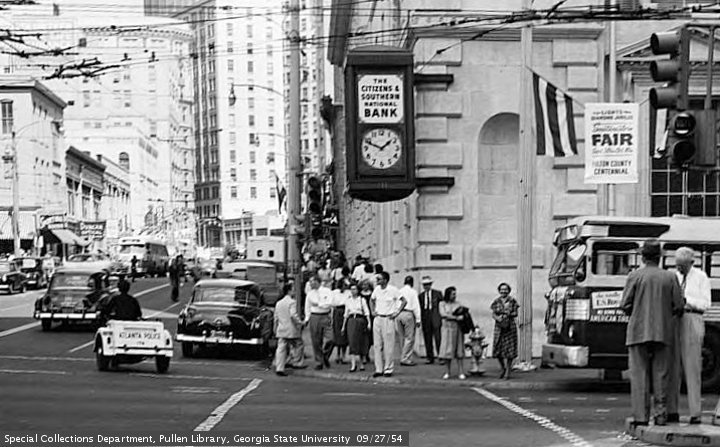
PG was having a delightfully slack afternoon, The one productive activity was editing pictures from “The Special Collections and Archives, Georgia State University Library”. In box seventy two of “corporate bodies”, in the Lane Brothers archive, there was a picture commissioned by King Road Marker Company. It displayed a brand new crosswalk, over Marietta Street at the intersection of Broad Street. The picture was taken at 1:51 p.m. September 27, 1954. This is a repost.
The time caught PG’s eye. 1:51 is one of the times used to display clocks and watches in advertising. Most ads use 10:09. This arrangement of the hour and minute hands makes a welcoming gesture. This allows the logo of the watch to be visible, and is thought to encourage the viewer to purchase the timepiece. The shadows on the buildings indicate that the picture was shot in early afternoon.
The clock with the magic time advertised the C&S national bank. The building behind the clock was the headquarters of that bank. In 1954, Citizens and Southern bank was a prime player in the Atlanta market. (PG’s dad said that C&S stood for choke’m and squeez’m.) At some point, C&S merged with NCNB to become Nationsbank, which was later absorbed by Bank Of America.
C&S kept it’s headquarters at 35 Broad Street for many years after competitors built trophy buildings. Their were constant rumors about where the C&S highrise was going to go. Finally, C&S Plaza was built at Peachtree and North Avenue, a mile north of five points. The building was to become the tallest building in America outside of New York and Chicago. During the construction of this building, C&S became part of Nationsbank, and later Bank of America.
The picture is featured in Atlanta Time Machine. The building is now owned by Georgia State University, with a BOA branch on the first floor. The banking hall is spectacular. It was designed by Philip Shutze, before the great depression. Here is more information.
Nations Bank Building (Citizens and Southern National Bank Building, Empire Building)
35 Broad Street, NW 1901: Bruce and Morgan, Architects, NR.
Remodeling of Lower Floors and Interiors 1929:
Hentz, Adler and Shutze, Architects; Philip Shutze, Designer
Fourteen stories high, the Nations Bank Building was the first steel-frame structure to be built in Atlanta. Its clear-cut silhouette, simple fenestration, and heavily decorated terra-cotta top bear the influence of the Chicago School. In 1929 the building became the headquarters of the Citizens and Southern National Bank, which asked Philip Shutze to redesign its three lower floors. Because the impression of load-bearing masonry was regarded as better suited for a banking establishment than large glass panes were, the original display windows were replaces by classical motifs apparently “carved out” of Indiana limestone.
Philip Shutze was inspired by Italian Mannerism, and especially by the city gates of Verona by Michele Sanmichelo (1484-1559) … Reached from Marietta and Walton streets through lofty arcaded entryways and a more intimate elevator lobby in the early Renaissance style on Broad Street, the banking hall is a long nave articulated by colossal Corinthian pilasters. While its walls and floors feature several kinds of Georgia, Tennessee, and European marbles in a warm gold-brown color scheme, the ceiling, from which hang gigantic chandeliers, is left bare. The Pantheon, which Shutze had measured during his internship at the American Academy in Rome, served as direct source for the pedimented niches, and for the floors with alternate square and circular patterns. Also, of Roman inspiration are the bronze desks and the eagle motif found throughout the design.
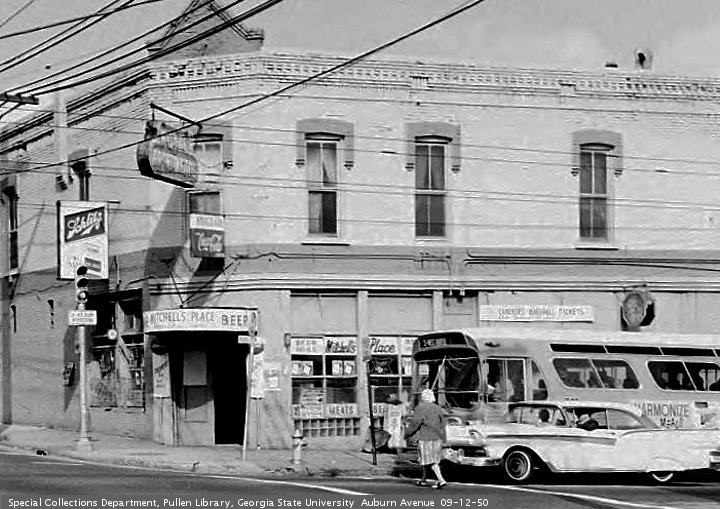


July 3, 1981


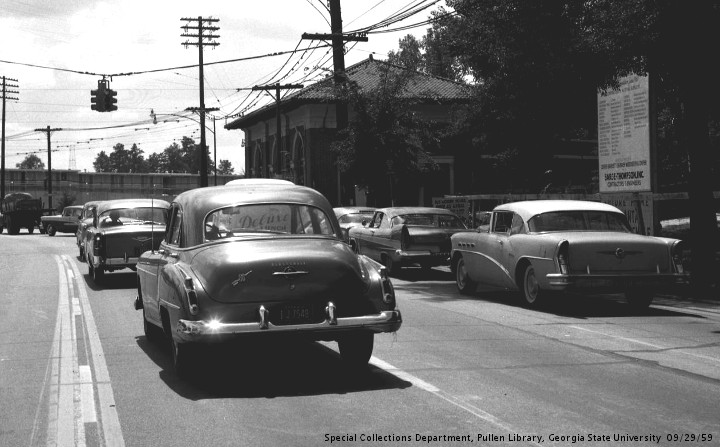

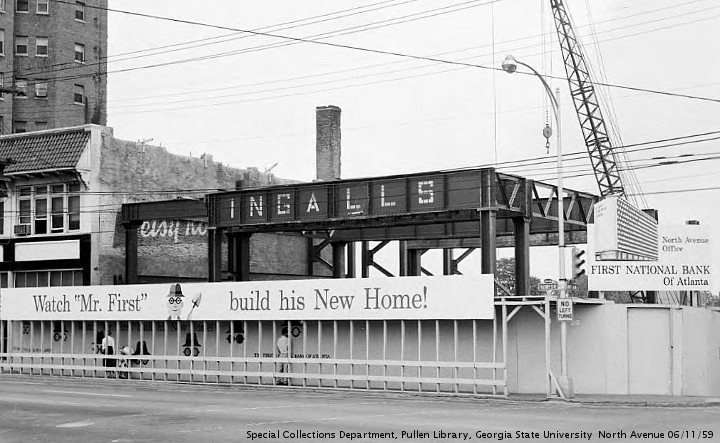

July 3, 1981, was another day before a holiday. The new President, Ronald Reagan, was recovering from gunshot wounds. There was talk of an era of conservatism, with possibly severe repression.
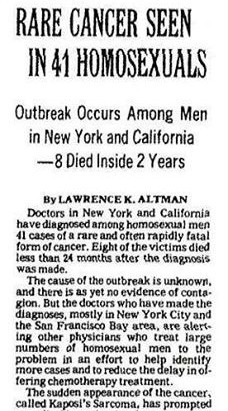
There was an article in the New York Times. RARE CANCER SEEN IN 41 HOMOSEXUALS. “Doctors in New York and California have diagnosed among homosexual men 41 cases of a rare and often rapidly fatal form of cancer. Eight of the victims died less than 24 months after the diagnosis…”
This was the media debut of AIDS. It would not have that name for a while. Almost nobody thought, on that summer day, just how bad AIDS would be. In five years it was obvious how serious AIDS was.
 PG was on another trip to the west coast. It was becoming obvious that this would be a vacation, rather than a relocation. He was riding a bicycle, with a milk carton overloaded with camping gear. Some kids told him to get saddle bags, and carry the weight lower. If you have the weight on top, you would lose control coming down a big hill. PG did not listen to the kids.
On July 4, PG left Patrick’s Point state park, about 300 miles north of San Francisco. Coming down the first hill on highway 101, the bike shook, shook harder, and flipped on its side. PG was thrown off. The front wheel was bent beyond repair. PG gathered his gear, left the bike behind, and got a ride into the nearest town.
PG got a bus ticket to Seattle. That city was in an economic downturn, with less than half a page of help wanted ads. PG found a auto delivery service, and got a VW bug going to Oak Ridge, TN. In a few days he was in Atlanta. A few days later, a temp agency came up with a job as a driver for a blueprint company. PG worked for that company, in one form or another, for the next 24 years.
As for the gay men with Kaposi’s Sarcoma … in all probability, the patients mentioned in that article were all dead within a year. AIDS has become a dominating story in our time. At its worst, it was claiming 50,000 lives a year. With the advent of wonder drugs, the death toll has been greatly reduced. The impact of AIDS on American life cannot be adequately described. This is a repost.
Pictures today are from “The Special Collections and Archives, Georgia State University Library”. Lawrence K. Altman is still writing articles for the New York Times.


Two Hundred Yards Behind
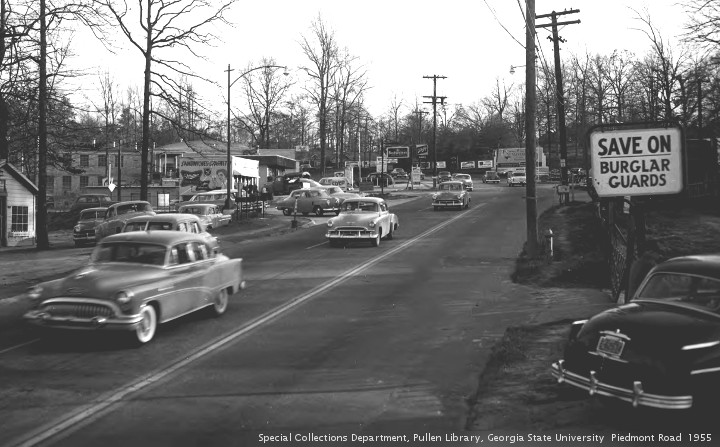


In 1985, PG went to work for Shaky Blueprints. The real name was a Japanese word that nobody knew how to spell. Two of the previous hires were an athletic young lady, and a fat man. Until better nicknames arrive, we will call them AYL and FM for this story.
AYL was trying to get FM to go jogging with her after work. This was an ongoing conversation, with FM always turning her down. One afternoon, PG wore an old pair of jogging shoes to work, and said that he would go running with AYL.
Shaky was just off highway 400, in what is now part of Sandy Springs. There was a road leading away from it. The road went over the highway, and went in a wooded semi circle for a couple of miles. The plan was to go on this loop, and take sidewalks on Roswell Road back to Shaky.
At one time, PG went running every day. He was out of the habit by this time, and always a slow runner. When the work day was over, PG tied his glasses on with a rubber band, did a few stretches, and was ready to take on the course.
AYL and PG left the parking lot, and started up the road. PG trudged along with his head down. When he got to the bridge over the highway, PG looked up. AYL had taken off like greased lightning, and was already two hundred yards ahead. PG hollered for her to slow down, and finished the course.
Pictures for this repost are from “The Special Collections and Archives, Georgia State University Library”. Have a happy July.



Midtown

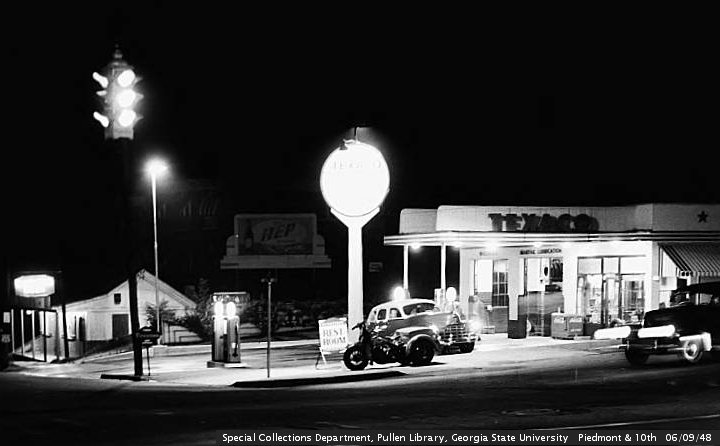


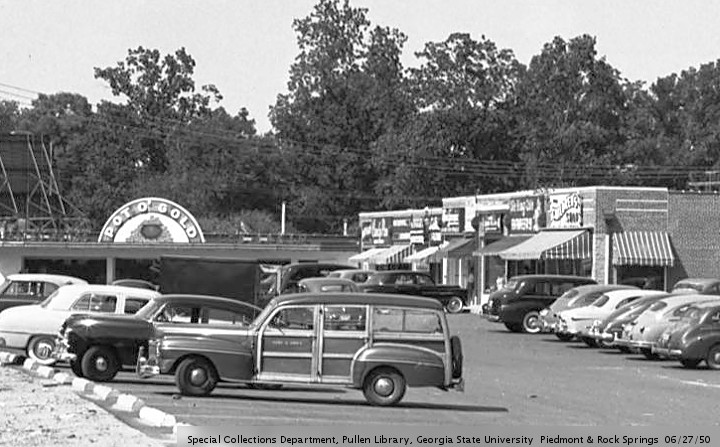
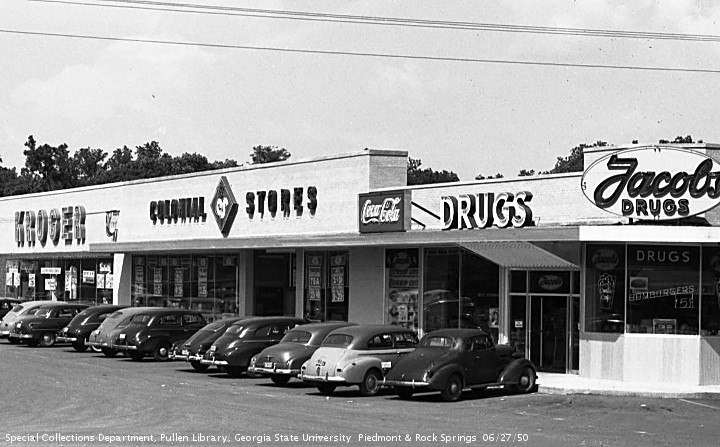
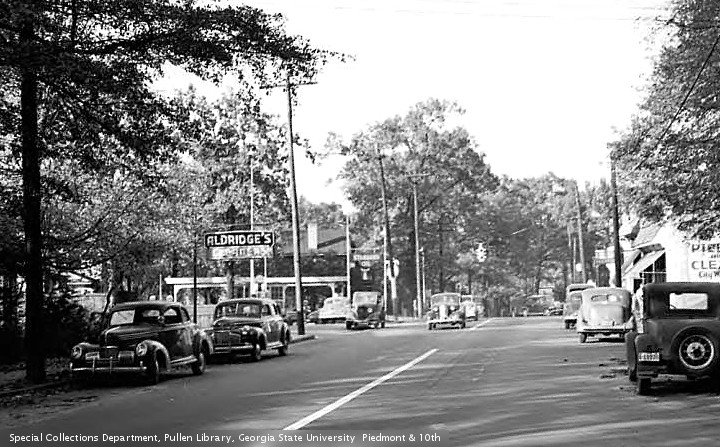
The neighborhood along Peachtree Road has always been a great place to be a freak. For a long time it didn’t have a name. It is north of downtown, between Piedmont Park and Georgia Tech. Sometime in the early eighties, people started to call it Midtown, and the name stuck.
In the time after the War Between the States, this area was a shantytown called “Tight Squeeze”. It evolved into a pleasant middle class area. In the sixties, hippies took over. The area was known as the strip, or tight squeeze. Many stories could be told.
After the flower children moved on, the area went into decline. Gays started to move in, with the battle cry “Give us our rights or we will remodel your house.” Developers, worshiping the triune G-d of location, location, location, began to smell money. The neighborhood became trendy, then expensive, then more expensive. The freaks with money remain. This is a repost. Pictures are from “The Special Collections and Archives, Georgia State University Library”.
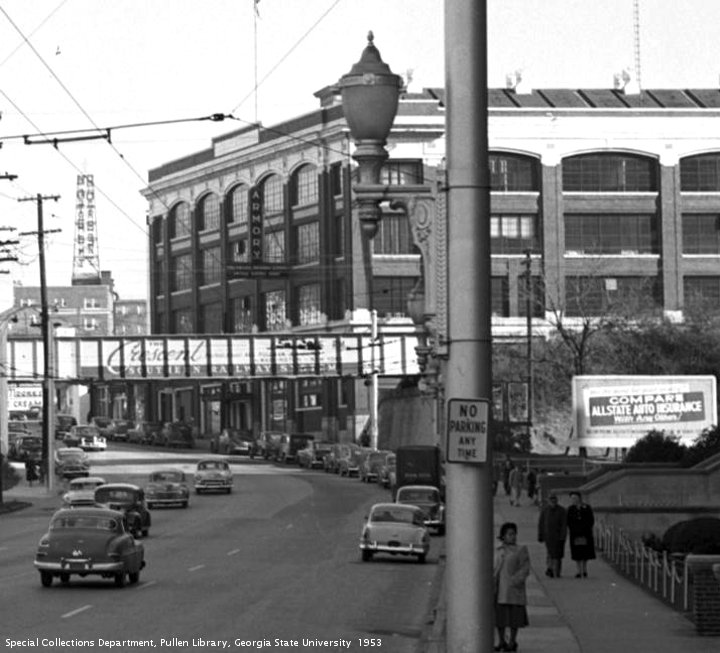

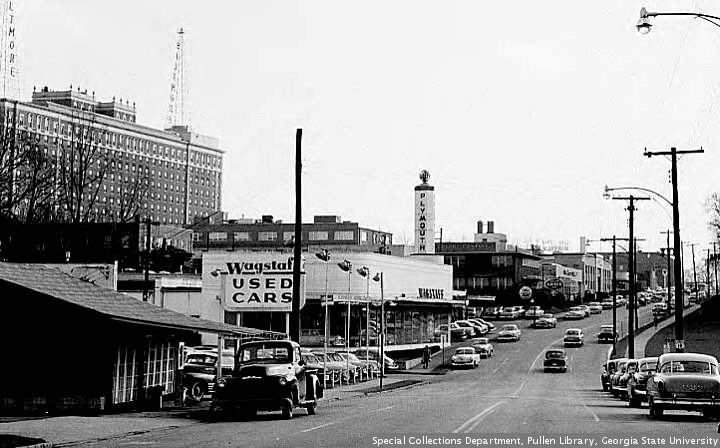

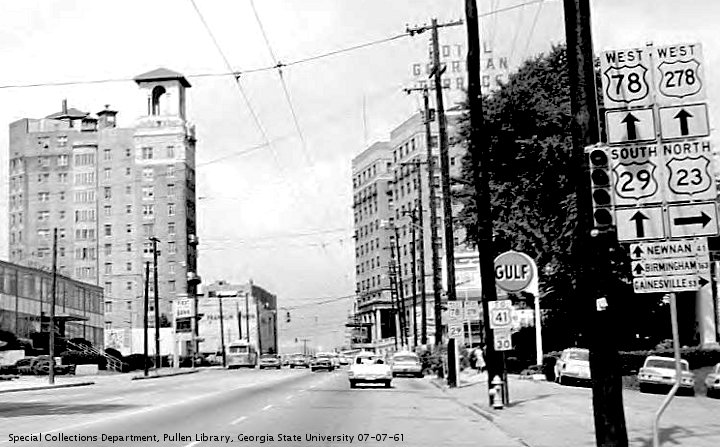


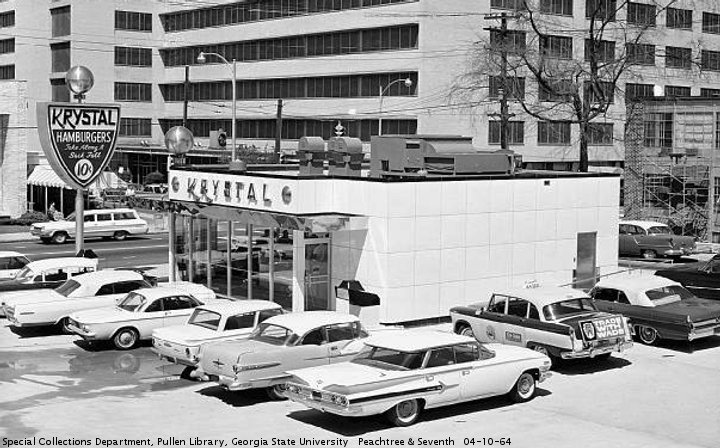
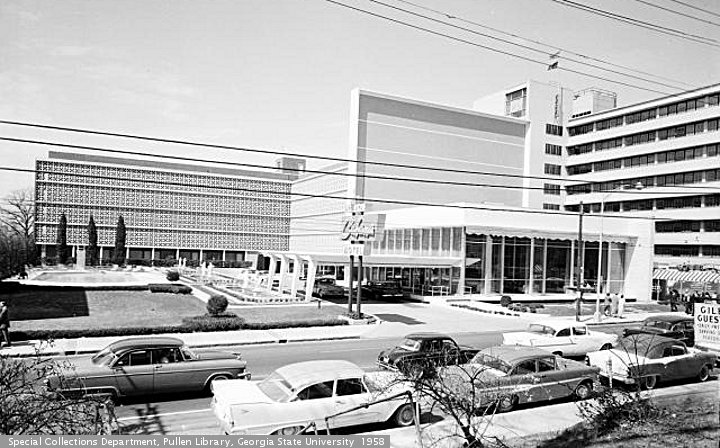

There was a nifty webcam up when this feature was written. It shows the progress of a high rise going up now at 12th and Peachtree in midtown. The location of the camera itself is not certain. The most likely location is 999 Peachtree, on Tenth Street, two blocks south of the project.
A glance at the image reveals a curve in the road, between the two glass boxes under construction. Atlanta does not have wide, straight boulevards extending to the horizon. It is said that Atlanta did not build roads, but paved the cow paths.
People of a certain age will remember this area as the strip. The tenth street district was a neighborhood shopping area, up until the mid sixties. At some point, the old businesses started to move out and the hippies moved in. For a while, it was a festive party. Soon enough reality returned, and the area went into a crime filled decline.
The 999 complex is the neighborhood story in a nutshell. Before 1985, it was a block of small businesses. There was a hardware store, with the peace symbol set in tiles in the sidewalk. On Juniper Street stood the Langdon Court Apartments. They were named for PG’s great uncle Langdon Quin. Ru Paul used to stay there. He would sit out on a balcony, and wave to the traffic going by.
Across the street was a chinese restaurant, the House of Eng. A staircase on the side led to the Suzy Wong Lounge. Behind the building was an apartment building. It was one of the residences of Margaret Mitchell, while she wrote “Gone With The Wind”. She called it “the dump”, which was fairly accurate. The museum on that site would have amazed her.
PG went to the House of Eng for lunch one day in 1985. He noticed that he was the only customer in the house, at 12:30 pm on a weekday. After finishing his lunch, PG knew why.
At some point, it was decided to build a high rise there. Heery was one of the equity partners, along with a law firm and an ad agency. The building was designed by Heery (duh).The ad agency folded before the building opened, followed within a couple of years by the law firm. Heery was sold to a British company. PG does not know who owns 999 Peachtree now.
This is a repost, with pictures from “The Special Collections and Archives, Georgia State University Library”. The building, at 12th and Peachtree, is finished.



Steve Martin
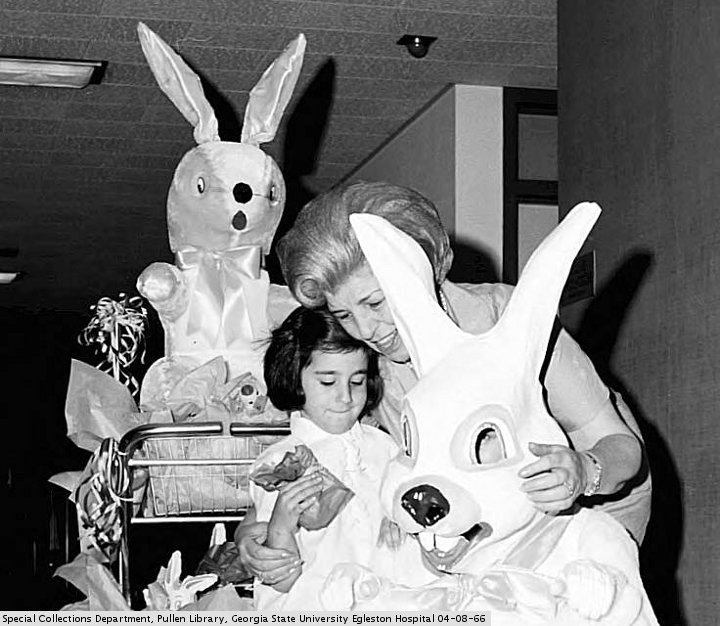


There is a form letter floating through the intercourse now. It is a letter that Steve Martin used to send to his fans. (The letter was recently immortalized at Letters of Note.)
He …that is Stephen Glenn “Steve” Martin (born August 14, 1945) … has moved up in correspondence with his adoring fans. Mr. Martin now gives out business cards, with the message “This card certifies that the holder had met Steve Martin and found him genuinely friendly”. What a wild and crazy guy!
 This is becoming one of those really really modern days here. Listening to a djmix with a Lady Gaga song, drinking coffee out of a Mcdonalds plastic cup, and writing a tribute to Steve Martin. What a day! Oh, before we forget, there is the story about the drive in theater on I85 that was showing “Father of the Bride”. One day, the h fell off the marquee, and the title of the movie became “Fater of the Bride”. Good times.
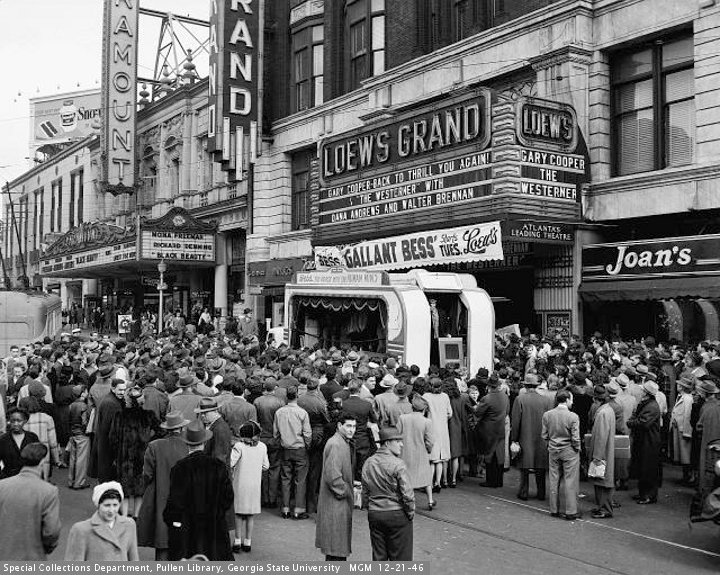
The story of Steve Martin and PG began one night at the Great Southeast Music Hall. PG got tired of hearing how great the Nitty Gritty Dirt Band was, and decided to see a show. The show started when some guy in a white suit came out with a banjo. John McEuen stood next to him, and kept falling into the microphone stand and saying “this guy cracks me up”.
Steve Martin, the white suit guy, said that he paid somebody five thousand dollars for a joke. He then took this arrow, with a coat hanger wire attached to it, with a shape for his head to fit in, and put it on. That got a laugh, but not worth five thousand dollars. There was another gag…”do you mind if i smoke, no do you mind if i fart”. That got a slightly bigger laugh.
In those days, you could not sell alcohol in public on sunday night in Georgia. To compensate, the Music Hall sold children’s tickets for the sunday night shows. Mr. Martin was not used to having children in the audience. “Hey kid I gotta joke for you. There were these two lesbians…”
The show went over well with the Nitty Gritty crowd. However, it is doubtful that anyone thought, this is the beloved entertainer of our generation.
Mr. Martin was not through for the night. At one point, the NGDB moved to the back of the stage, and a smarmy lounge lizard, in a white suit, came on stage. While the band played “The girl from Ipanema”, Mr. Martin sang about the girl with diarrhea.
 This was one of the last shows that Steve Martin did as an opening act. (He did return to the Great Southeast Music Hall. Once, he did a week with Martin Mull, called the Steve Martin Mull Revue.) Within two years, he was a guest host on Saturday Night Live, and a certified wild and crazy guy. A couple of years later, he was famous again as “The Jerk”. Steve Martin had arrived.
This is a repost. The pictures today are from “The Special Collections and Archives, Georgia State University Library”. The animated dentures are from chattering teeth. The check is in the mail.




Arrested In Atlanta

The display of a link on this page does not indicate approval of content.
George Zimmerman Arrested In Atlanta On DUI Charges
sex work is about providing someone with something they cannot otherwise obtain.
At least 55 protesters arrested for trying to get onto interstate, governor says
‘One in 10 million’: An oral history of Zack Greinke’s years with the Royals
Protesting Racism Versus Risking COVID-19: ‘I Wouldn’t Weigh These Crises Separately’
Democratic Leaders Praise George Floyd Protesters, Show Contempt for …
Boris Johnson says 3m people in Hong Kong will get path to British citizenship
They have destroyed our capitalist democracy and replaced it with a mafia state.
6 officers have died in the last 10 days. The media has barely said a word.
3 protesters tracked officers to their homes, torched their police cars, authorities say
10 colorful facts about ‘Munster, Go Home!’
Genetics is not why more BAME people die of coronavirus: structural racism is
Suspect in Ahmaud Arbery murder used N-word while standing over body, GBI says
Lady yells at women who are cleaning graffiti off of a federal building
plurality of Democrats would support calling in U.S. military to aid police during protests, poll shows
Antifa members talk eye gouging, ‘destroying your enemy,’ undercover video claims
Converting your BathTub into a Walk-In Tub Demo
Toledo activists call their own shots when planning protests
We need highly formal rituals in order to make life more democratic
Arrested And Fired! Cyclist Who Attacked Teens Putting Up Signs About George Floyd Is Charged
‘SYSTEMIC RACISM’ Did George Floyd have a criminal past and why was he stopped by police?
Live Fb video from Candace Owens #Truth
“If everybody’s thinking alike, somebody isn’t thinking”
Demonstrators are hammering on a hollowed-out structure, it very well may collapse.
Mayor Durkan Kicks Off Pride Month Festivities with Rainbow-Colored Tear Gas
Tom Cotton: Send In the Troops The nation must restore order. The military stands ready.
Stan Wischnowski resigns as The Philadelphia Inquirer’s top editor
third of Americans surveyed engaged in risky cleaning behaviors during pandemic.
American Racism: We’ve Got So Very Far to Go, journey must continue step-by-step.
George Floyd missing footage out of all the other videos
It Looked Like Fire On August 10th, 2014, one day after Michael Brown was shot …
#8toAbolition ~ email ~ Little Richard ~ language ~ nerdy jokes ~ dark urine
Soldiers from the Household Cavalry scrub graffiti off Whitehall while George Floyd protesters berate them for protecting ‘precious memorials’ ~ @bariweiss The civil war inside The New York Times between the (mostly young) wokes the (mostly 40+) liberals is the same one raging inside other publications and companies across the country. The dynamic is always the same. (Thread.) ~ “If everyone is thinking alike, somebody isn’t thinking.” – George S. Patton I saw a meme of this quote, and decided to look for a source. Someone on reddit says numerous other people said it. The reddit guy says that Patton probably would have used some profanity. The Patton wikiquote does not show this quote. @QuoteResearch ~ Gen. George Smith Patton Jr. No bastard ever won a war by dying for his country. He won it by making some other poor dumb bastard die for his country. ~ @jk_rowling If sex isn’t real, there’s no same-sex attraction. If sex isn’t real, the lived reality of women globally is erased. I know and love trans people, but erasing the concept of sex removes the ability of many to meaningfully discuss their lives. It isn’t hate to speak the truth. ~ Presidential Brat was read last night at a virtual open mic ~ salivating media predators, in the last Alabama senate race, have zero Republican senators, will never apologize for my face, supporter of our #MAGA agenda, I am deeply sorry for thinking that, shallow and broken man of surrender, complete moron of presidental brat. ~ pictures for this pre-summer compendium of digital effuvia are from “The Special Collections and Archives, Georgia State University Library”. ~ selah


Dorothy Parker




PG first heard of Dorothy Parker in tenth grade. His friend Bob Gibson cut the poem Resume out of the literature text book, and carried it in his wallet. Mrs. Parker had been dead for two years at the time, with her ashes resting in her attorney’s filing cabinet. As the years rolled on, there were stories about the round table at the Algonquin hotel, and a poem about W.R. Hearst … “Upon my honor, I saw the madonna, by the door, in a niche, of a well known whore, and a prominent son of a bitch.” There was another famous comment: Re “The Cardinal’s Mistress” by Benito Mussolini, Dorothy Parker wrote one of my favorite bon mots: “This is not a book to be tossed aside lightly. It should be thrown with great force.” Wikiquotes lists both of these items as “misattributed.”
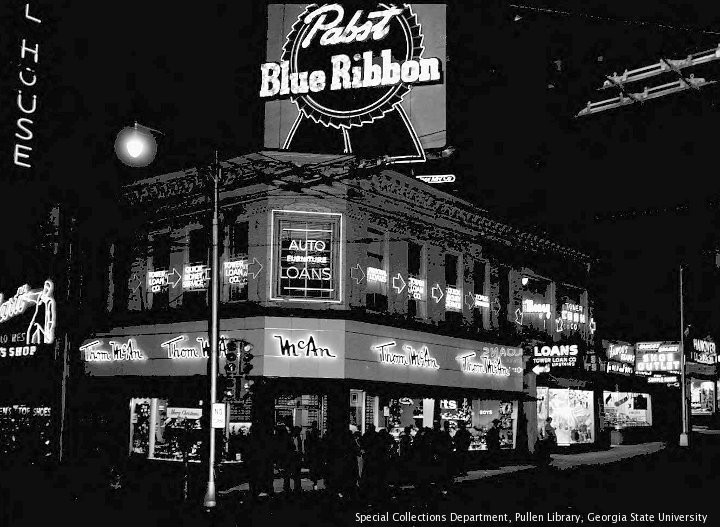
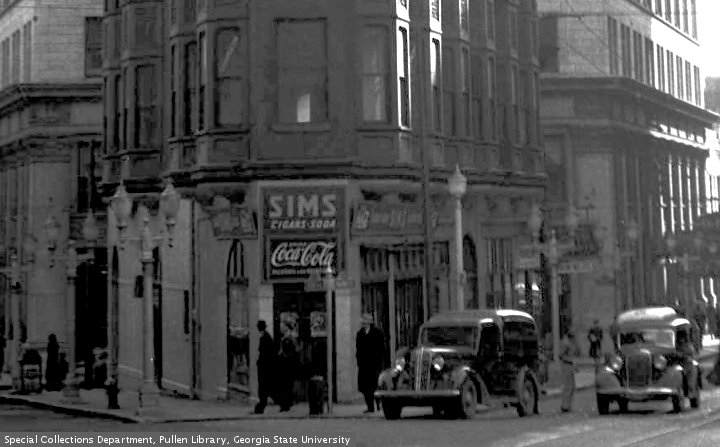
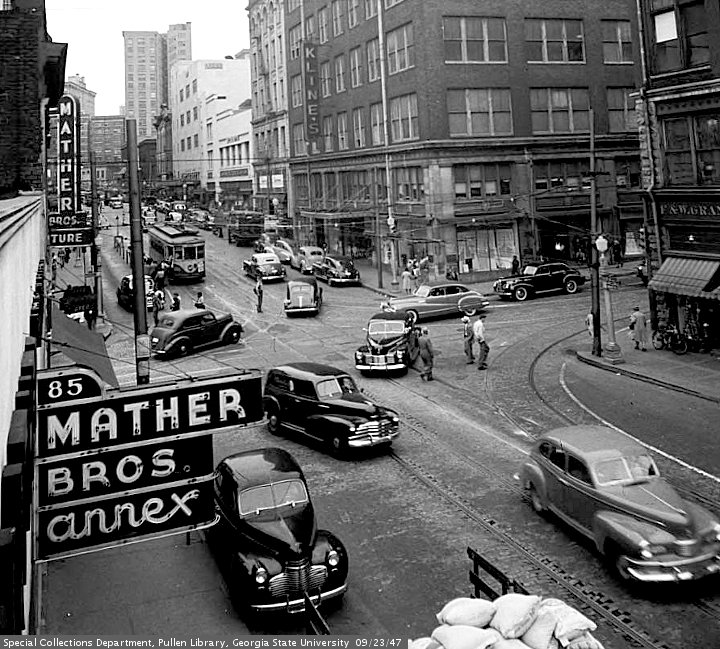
It is now 2019, several years after the first DP post. Born Dorothy Rothschild, on August 22, 1893, Miss Parker did nicely without a middle name. Chamblee54 has featured Miss Parker several times (one, two, three, four.) Today, these four posts will be combined into one. Pictures are from “The Special Collections and Archives, Georgia State University Library” and The Library of Congress. If you want a list of clever sayings, google is your friend. The quote investigator has five pages of the alleged sayings of Miss Parker.




It was 5:25 pm. PG had not heard from either person who was supposed to be at his house at 5:30. While muttering things about unreliable people, he started to look at a writing contest. The idea was to write 100 words or less. The challenge was to produce a “a quick, honest and heartfelt response” to an image. The meme is seen below the fold.
The image has a quote. “I hate writing. I love having written. Dorothy Parker.” When PG sees words of wisdom, with a famous name at the end, his impulse is to check it out. When you search the wikiquote page on Miss Parker, and look for hate, love, and writing, you will not see the quote. 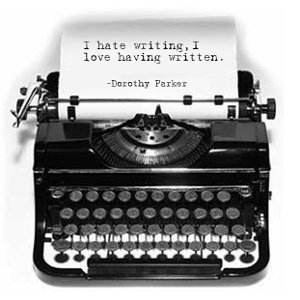
There was one item in wikiquotes that made PG laugh. It was in the “Misattributed” section. “Upon my honor, I saw a Madonna. Standing in a niche, Over the door, Of the glamorous whore, Of a prominent son of a bitch.” Said to have been written in the guest-book of Hearst Castle, referring to the room occupied by Hearst’s mistress, Marion Davies. Parker always denied it, pointing out that she would never have rhymed “honor” with “Madonna”.” Nor would the entertainer.
When PG saw that quote, he knew that this piece would be longer than 100 words. Inserting quotes into a piece will bloat the word count every time. About this time the phone rang. His friends were in the front yard, being eaten by mosquitoes. PG put on a white shirt, and left.
Later that night, 99 sick well chosen words fell out of the fingers, and into the ether.
The quote is suspect. Wikiquotes does not show it, after a search for love, hate, and written. The image is probably manufactured. The image is a piece of paper, coming out of a vintage manual typewriter. The main text is one size. The author credit is another size. Vintage manual typewriters only produced one size of product. This one size is considerably smaller than either size in this image. The text in this image was produced elsewhere. This rendering of a bogus quote is then pasted onto a blank sheet of paper, seen merging from a vintage manual typewriter.





The other day there was a post here on the dotty subject of Dorothy Parker quotes. The departed dipsomaniac would seem to be a quote magnet.
One quote, that appears to be genuine, is about another quote magnet, Oscar Wilde. “A Pig’s-Eye View of Literature: Oscar Wilde If with the literate I am, Impelled to try an epigram, I never seek to take the credit, We all assume that Oscar said it.” (First printed in Life, (2 June 1927) p. 13 When you can give a source for a quote, the chances of it’s legitimacy go up tremendously.)
The original plan for this post was to do a wikiquotes search of the quotes in this post. This concept very quickly turned out to be too much work. The first paragraph of the original post has a clue.
PG first heard of Dorothy Parker in tenth grade. His friend, Bob Gibson, cut the poem Resume out of the literature text book, and carried it in his wallet. Mrs. Parker had been dead for two years at the time, with the ashes resting in her attorney’s filing cabinet. … there was another comment : Re “The Cardinal’s Mistress” by Benito Mussolini, Dorothy Parker wrote one of my favorite bon mots: “This is not a book to be tossed aside lightly. It should be thrown with great force.”
In the post the other day, it was discovered that the poem about W.R. Hearst was written by someone else. Which brings us to “The Cardinal”s Mistress”. Yes, that was written by Hitler’s BFF, Benito Mussolini. When he wasn’t making the trains run on time, he wrote a sappy novel. And the comment by Miss Parker is great. But did she really say it?
A blogspot facility called Heavens to Mergatroyd has the text from a New Yorker review of TCM. It is a delightful read. However, the landmark quote is not there. The spell check suggestion for mergatroyd is derogatory.
Wikiquotes calls the comment “misattributed”. “Quoted in The Algonquin Wits (1968) edited by Robert E. Drennan, and Try and Stop Me. As noted at Snopes, Drennan’s source seems to be a Parker review which does not seem to contain this quote. If Parker wrote this statement anywhere the primary source seems to have gone missing.”
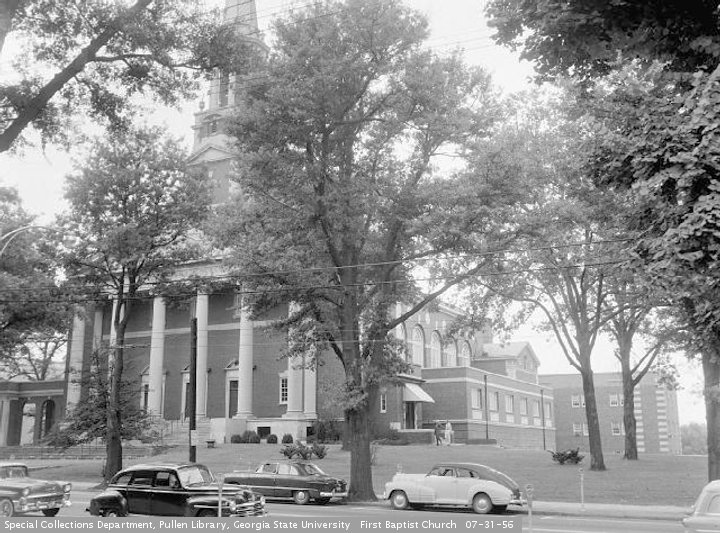
Try and Stop Me is a newspaper column by Bennett Cerf. The link is to The Dispatch, Lexington N.C., October 12, 1962. Next to the column is The Dispatch Religious Activities, Directory of Churches. The pastor of First Baptist is David Hoke Coon, Jr.
While preparing this commentary, an effort was made to find the text for “Resume”. It is a bona fide quote, first printed in New York World August 16, 1925. While looking for the text, Google suggested a search for “resume dorothy parker analysis.” One result was sponsored by a politician, Michelle Nunn. Another had this to say. “We know that we’re being a bit obvious here. But check it out: almost every single line in this poem offers an idea for a different way to die. When it comes to wordplay, Parker’s not messi…” Maybe she meant to say messy.








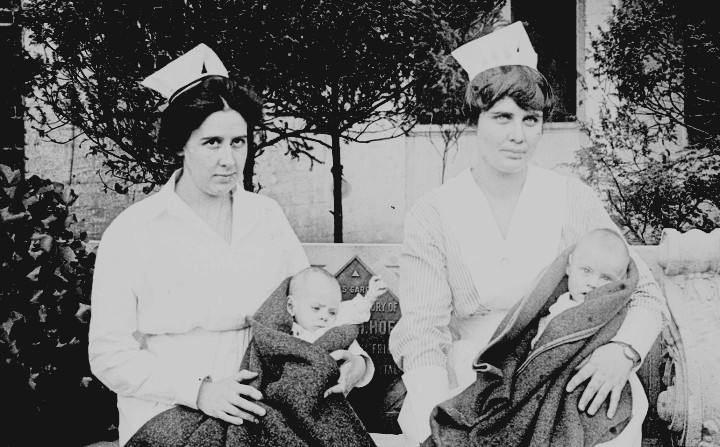

BigO is a site with mp3 downloads. Most of them are concerts. PG found one exception. It was a 1960 interview, STUDS TERKEL WITH DOROTHY PARKER/BOB NEWHART – CHICAGO 1959/1960. Pictures today are from The Library of Congress. This is a repost.
Dorothy Parker is somewhat of a legend. There were the funny sayings, a few poems and stories, and her life. Mrs. Parker was well known as a witty person during the twenties. She drank, a lot, and talked often of suicide. It was surprising to find a 1960 interview.
In fact, Dorothy Parker died in 1967, at the age of 73. By 1960, she was in decline, living at the Manhattan’s Volney Hotel. “Edmund Wilson … paid occasional painful visits to her at the Volney. (“She lives with a small and nervous bad-smelling poodle bitch, drinks a lot, and does not care to go out.”) … She was still revered, a legend, but she had also become a pathetic relic. Yes, “you might as well live,” but for what? And on what? Not only was she running out of old friends, she was running out of money, though uncashed checks, some quite large, were strewn around her apartment (along with the empty bottles), not helping with unpaid bills.”
There were some zesty quotes in the interview with Mr. Terkel. “I can’t call myself a critic. Honestly. I can only put down what I think and pray there isn’t a libel suit.” “I’m not a poet, you know, I just write verse” “The beat boys aren’t saying anything except look at us aren’t we great … I don’t think the beat generation is much worth worrying about. Very soon, in the very near future, they will be as forgotten as mah jongg.”
Towards the end of the interview, Mr. Terkel said “i know some people would want me to ask, did she really say all those things that she was quoted as saying” “… no, no, and it was a curse on me, it was simply awful the things that were attributed to me. I wouldn’t have minded if they had been good. I was, in effect, the shaggy dog of my time.”
Another quote magnet for the meme generation is Thomas Jefferson. PG saw yet another inspiring quote on facebook today. Mr. Google was consulted. It turns out the quote is real.
Thomas Jefferson to William Hamilton, 22 April 1800 is the source. Vice President Jefferson was going to be elected President later that year. It is not known what effect that had on the quote in the meme. “I never considered a difference of opinion in politics, in religion, in philosophy, as cause for withdrawing from a friend.” It is not known whether a twenty first century Jefferson would unfriends anyone who says anything unappealing.



Inner Life Of Catastrophe




The display of a link on this page does not indicate approval of content.
The De-Watergating of American Journalism Bob Woodward and Carl Bernstein
Did Actor Who Played Eddie Haskell on Leave it to Beaver Later Work in Adult Films?
We had to destroy village in order to save it
“It became necessary to destroy the town to save it”, unknown, 1968
Destroying a Quote’s History in Order to Save It
SOMETIMES MILITARIES MUST “DESTROY THE TOWN TO SAVE IT”
Washington: The Flies That Captured the Flypaper
CONSENSUS CONFERENCE ON WHEELCHAIRS FOR DEVELOPING COUNTRIES
set list Judy Garland at Boston Garden October 27, 1961
On This Day In Judy Garland’s Life And Career – October 28
The Hayes Boys – I Don’t Want Her-You Can Have Her-She’s Too Fat For Me
25-year-old shot, killed outside DeKalb County subdivision
Attorney for man who shot video showing Arbery killing says client fears for life
@ChrisDStedman Reading the Hillary novel might actually kill me
Stacey Abrams Brutally Rejected On Live TV For VP Spot
Ed Buck’s Notorious Laurel Avenue Apartment Is Back on the Market
How Exponent Grew a Course Business to $100,000 with Video Content
Joe Rogan’s podcast is becoming a Spotify exclusive
Ahmaud Arbery family attorney says new videos show pattern of mistreatment
Deadly attack at Toronto erotic spa was incel terrorism, police allege
Maybe Trump Isn’t Lying The president does not seem to grasp the most basic aspects …
Ram Dass – Here and Now – Ep. 162 – The Transition from Somebody to Nobody
Asian-American doctors and nurses are fighting racism as well as the pandemic
How To Administer IV Medication Using Gravity Infusion
Pitches Micro-Housing Project; Greystar Presents Plans for 34-Story Tower
GBI arrests man who recorded video of Ahmaud Arbery shooting
Zaid Jilani absolutely annihilates media celeb culture obsession with Stacey Abrams
Jaydon Hayden Caught Beating Up Elderly Nursing Home Patients In Michigan
75 Burning Man Photos That’ll Blow Your Mind
The Past We Can Never Return To – The Anthropocene Reviewed
psoas muscle ~ swear nerds ~ useless science ~ brad majors ~ ronan farrow ~ tara reade
“It became necessary to destroy the town in order to save it.” This is perhaps the most famous quote from Vietnam. It applies to today’s response to COVID-19. It was reported by Peter Arnett of AP. Some people dispute whether it is a genuine quote. ~ The unfollow feature on facebook is great. I find unfriending to be unnecessarily aggressive and hurtful. (which may be why many people are fond of it) If someone pisses me off more than a couple of times, I unfollow them. They don’t have to know. ~ Lizejane May 21, 2020 at 5:15 pm Deborah McCall played and Silverman with Ron Norris and Carl Cuzio. Deborah went on to play with Jimmy Buffett Coral reefer band.Ron played with at least one touring group, did studio work in Atlanta and I think he played with Ron Kimble at some point. I knew them from The Bistro days before the Music Hall opened ~ Silverman was a 3 piece group w Debra McColl, Ron Norris and Carl Cuzio. Debra played in Jimmy Buffet’ s Coral Reefer Band and Ron played. With at least one national touring band, did studio work and I think he played w Ron Kimble I knew them from the Bistro days ~ pictures today from “The Special Collections and Archives, Georgia State University Library”. ~ selah



 Chamblee54
1 comment