Lost Atlanta


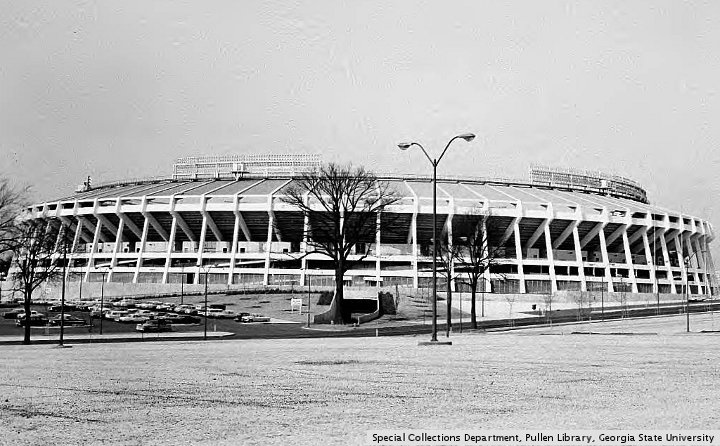


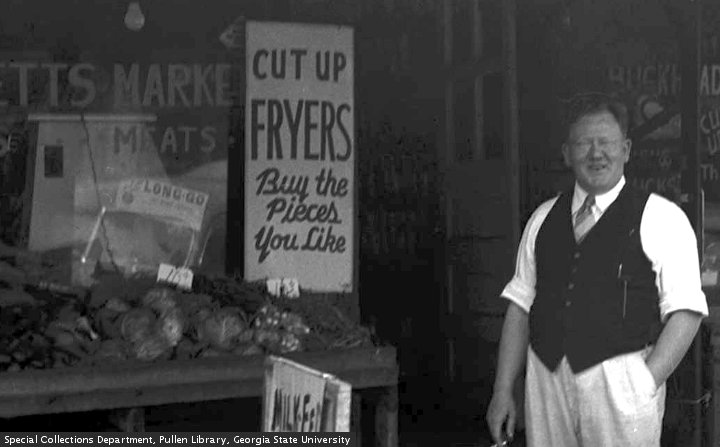

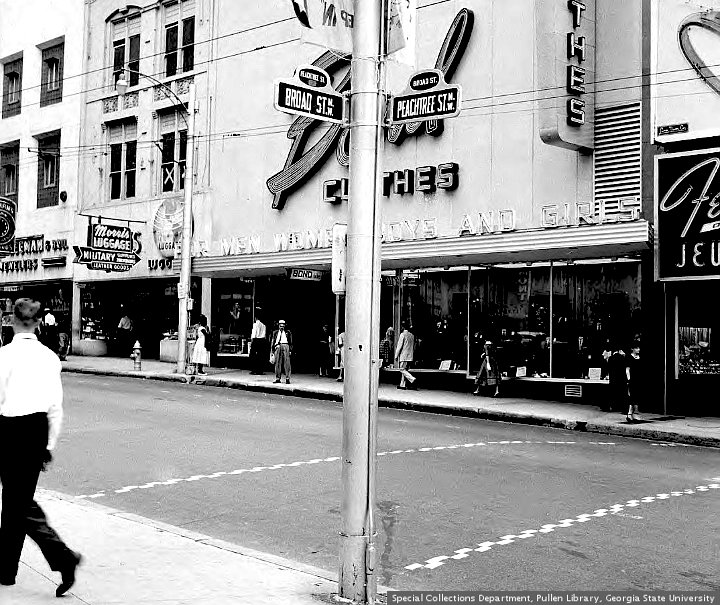
Lost Atlanta is a coffee table book. The content is the buildings, and institutions, that no longer exist. Atlanta has a long love affair with the wrecking ball. General Sherman was a minor player. Pictures for your Wednesday morning entertainment are from “The Special Collections and Archives, Georgia State University Library”. This is a repost.
PG is a native, and knows a few things about the city. While looking through LA, he began to take notes of things he did not know. The names behind the Ferry Roads is one. Plantation owner James Power established Power’s Ferry in 1835. Hardy Pace established his ferry in the 1850s. The fare was 62 cents for a full wagon, 50 cents for an empty wagon, 12 cents for a man and a horse, and 4 cents per head of cattle. The last ferry to cease operations was the Campbellton Ferry, in south Fulton county. The Campbellton Ferry ceased operations in 1958.
Wheat Street Baptist Church is a prominent Atlanta institution. If you look for Wheat Street on google, all you see is Old Wheat Street. It turns out that Wheat Street was renamed Auburn Avenue. “Originally called Wheat Street, the road was renamed in 1893 at the request of white petitioners who believed Auburn Avenue had a more cosmopolitan sound.”
Bald Hill, aka Leggett’s Hill, was leveled in 1958 to make way for the East Expressway, later known as I-20. On July 22, 1864, the Battle of Atlanta was fought there. After the unpleasantness, Frederick Koch bought farm land on the site. His house was at 382 Moreland Avenue. The house was demolished in 1953. South of I-20, 1400 McPherson Avenue has a monument. Maj. Gen. James B. McPherson was killed at that location.
The outfield wall at Ponce De Leon park was covered with advertising. One sign was for Southern Bread. The picture had a “Southern Colonel”… apparently the only type of officer in the CSA … saying “I’d even go North for Southern Bread.” This ad was also painted on the side of a building on Tenth Street, just off Peachtree. The late Jim Henson produced a tv ad for Southern Bread.
Jacobs Drug Store was a prominent chain at one time. It was founded by Joseph Jacobs. Mr. Jacobs had a store in the Norcross building, on Peachtree Street at Marietta Street. In 1886, the soda fountain mixed John Pemberton’s patent medicine with carbonated soda water. The rest is history.
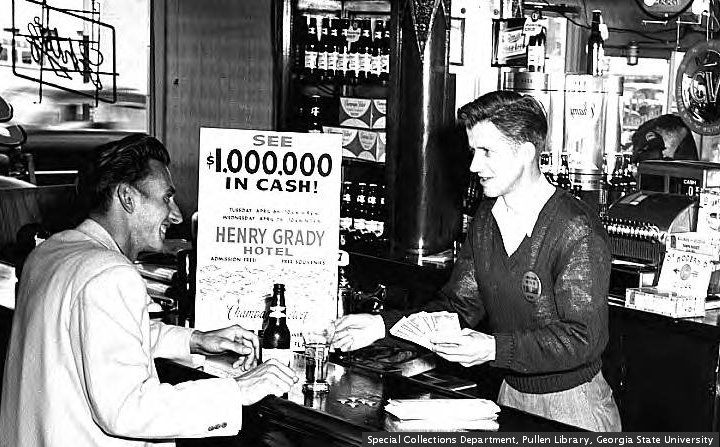
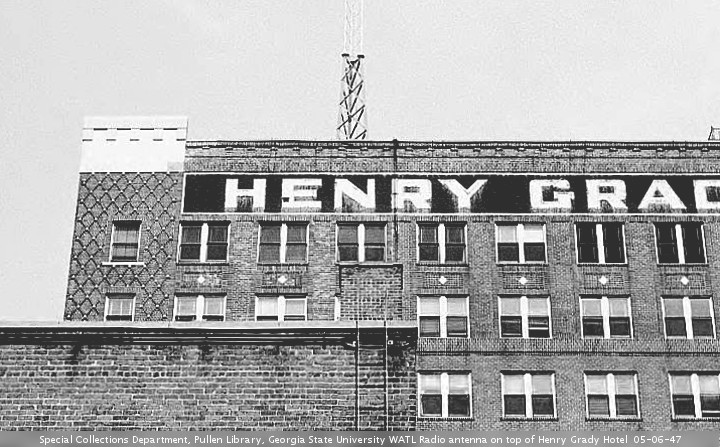
There are a few notes, which do not justify a paragraph. The Governor’s Mansion was at 250 The Prado, in Ansley Park, until a new GM was built on West Paces Ferry road. The Henry Grady hotel did not have a thirteenth floor, but went from 12 to 14. This did not stop the building from being demolished, to make way for the Peachtree Plaza hotel.
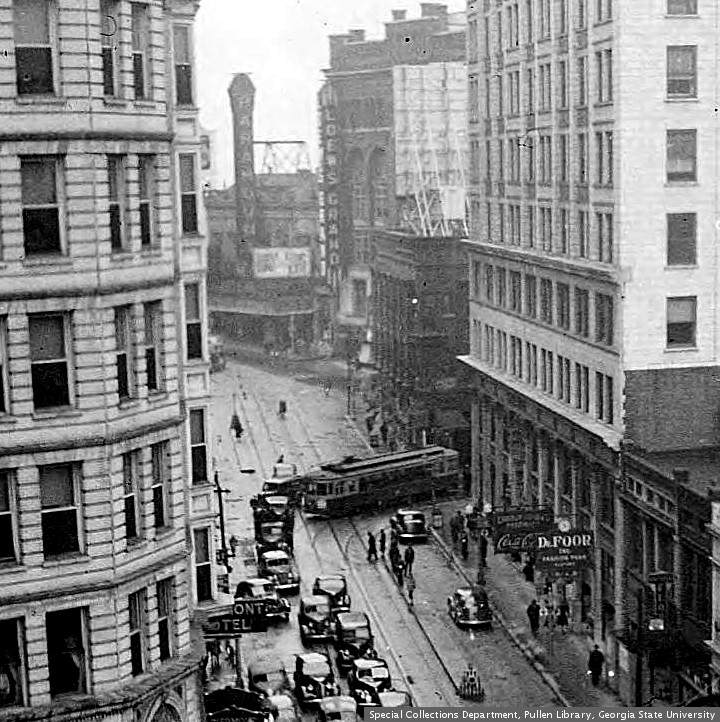
When Laurent DeGive built his grand opera house at Peachtree and Houston (Now JW Dobbs,) people were horrified. The central business district was south of five points. The area north, where the opera house went up, was residential. In 1932, the opera house was renovated, and opened as the Loew’s Grand. In 1939, it hosted the world premiere of “Gone With The Wind.” On the other side of Houston Street was the Paramount Theater, and across Peachtree was the Coca Cola sign. The GP building occupies the site today.



More Monroe And Boulevard





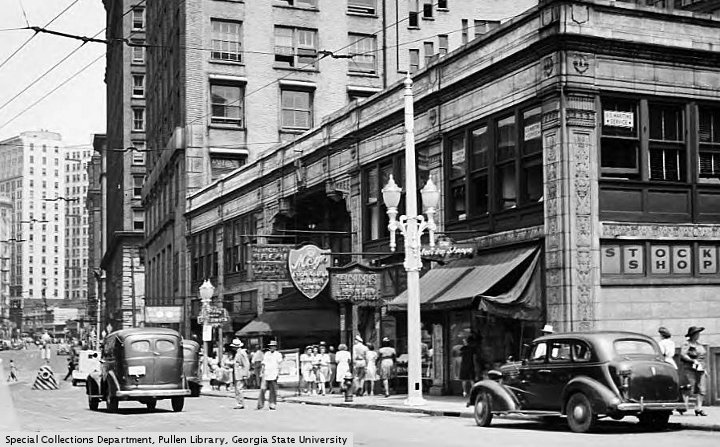
A recent facebook discussion covers that old crowd pleaser, why does Monroe Drive turn into Boulevard? The story is that the street name changed because White people live North of Ponce De Leon Avenue, and Black people live south. Chamblee54 has covered this topic before. The information today will be a bit dry. If you want to skip over the text, you can always enjoy the pictures, from “The Special Collections and Archives, Georgia State University Library.”
“The name changes were intentional and rooted directly in racism.” This judgment from Atlanta magazine is a popular opinion. Unfortunately, there are some street name changes that apparently are not racial. In discussions like this, once racism is blamed, the conversation shuts down. Asking any questions, or exploring the possibility of nuance, is considered racist.
The Atlanta magazine article does not really address Monroe/Boulevard. A 1913 measure, the Ashley Ordinance, is brought up, as well as some of the skirmishing in SW Atlanta over integration. None of those items were in play in the Monroe/Boulevard matter.
The opinion of chamblee54 has not changed. It is entirely possible that Monroe/Boulevard was racially motivated. That sounds like something a Georgia government, of a certain era, would do. However, it does not address the other streets. When were the names changed, and by what government? The answers to the last two questions have been elusive. If anyone reading this has any answers, please leave a comment.
In the space between I-85 and Dekalb County, there are four streets that change names when they cross Ponce De Leon Avenue. These are Juniper/Courtland, Charles Allen/Parkway, Monroe/Boulevard, and Briarcliff/Moreland. Several streets cross Ponce without changing names, including Spring, Peachtree, Piedmont, and North Highland. A wikipedia page, List of former Atlanta street names, has some information about the name changes. More information was found in a collection of maps at the GSU library.
It turns out that Juniper/Courtland change names at North Avenue, one block south of Ponce. As early as 1895, those streets have the same names. On old maps, Juniper ends at North, and Courtand starts a quarter-block west. Wikipedia adds this about Courtland: “North Collins Street (for pioneer James Collins — renamed because of South Collins Street’s reputation as a red light district)”
Briarcliff/Moreland has always been a problem for the racism hypothesis. The race change has traditionally been at the railroad tracks, a half mile south of Ponce. Moreland Avenue was originally County Line Road. It was renamed in honor of a Confederate officer, Major Asbury Fletcher Moreland. “He owned quite a bit of land between County Line Road and Pike Road, which is now Euclid Avenue, some of which is now part of the city’s Bass Recreation Center. Ever the businessman, Moreland built rental homes and a park, which featured a pond and animals — appropriately called Moreland Park — that became a summer getaway for city dwellers.”
Briarcliff was originally known as Williams Mill Road. It changed to Briarcliff after Asa Griggs “Buddy” Candler Jr. built a palace at 1260 Briarcliff Road. The house still stands, barely, and served as the GMHI facility for many years. In 1911 and 1917, Briarcliff is known as Williams Mill, before changing into Moreland. In 1925, and maps issued after 1925, the road is shown as Briarcliff.
Charles Allen/Parkway, one block west of Monroe/Boulevard, was originally known as Jackson Street. The road is still known as Jackson Street, south of Highland Avenue. The earliest map to show Jackson is 1895. By 1930 it has been changed to Parkway, ending at Piedmont Park. Charles Allen Drive does not appear until 1959. Charles Allen was the pastor at Grace United Methodist Church.
Wikipedia has this on Boulevard: “Jefferson Street (marked in 1878 map from North Ave. to Foster St. (now Edgewood Ave.) in today’s Old Fourth Ward) – Rolling Mill Street (north of the railroad) from the late 1860s to about 1880, for the Confederate Rolling Mill, which the retreating Confederate army inadvertently destroyed in 1864.”
Wikipedia has a surprise “Monroe Drive (to honor the Monroe Landscaping Company which did extensive plantings in the area)[17]” The footnote links to a Morningside neighborhood newsletter. There is no mention of Monroe Drive in the cited newsletter.
Before going further with Monroe, we should look at a controversy involving the landscaper William Lott Monroe. “1941 (Jan. 25) Monroe’s Landscape & Nursery Co. is removed from Fulton County’s payroll: “…[D]rawn more than $17,000 from the county in the last year and one-half… The company was drawing $500 a month for supervising landscaping of county parks, which was in addition to flowers, shrubs and blueprints sold by it to the county.” (“Nursery Company Is Cut Off Pay Roll.” Atlanta Constitution, Jan. 25, 1941)” In 1941, Mr. Monroe was working on North Fulton Park, later known as Chastain Park. This park was annexed into the City of Atlanta on January 1, 1952.
The first time Boulevard is mentioned on maps is 1895. The first mention of Monroe Drive is 1951, when Monroe starts at Montgomery Ferry. (Before the Northeast Expressway was built, the road ended at Plasters Avenue, north of the present I 85.) It is not until 1959 that Monroe appears immediately north of Ponce De Leon.
These maps were used in researching this feature. 1878 1895 1911 1917 1921 1925 1930 1930 1931 1934 1935 1939 1946 1951 1952 1952 1954 1959 1967


Flannery O’Connor


With one day before it was due, PG finished reading Flannery: A Life of Flannery O’Connor , by Brad Gooch. The author is a professor of English at William Patterson University in New Jersey. He spares no citations. You can see where he gets his information. This is a repost.
Chamblee54 has written before about Miss O’Connor , and repeated the post a year later. There is a radio broadcast of a Flannery O’Connor lecture. (The Georgia accent of Miss O’Connor is much commented on in the book. To PG, it is just another lady speaking.)
Mary Flannery O’Connor was born March 25, 1925 in Savannah GA. The local legend is that she was conceived in the shadow of St. John the Baptist Cathedral, a massive facility on Lafayette Square. Her family did leave nearby, and her first school was just a few steps away. This is also a metaphor for the role of the Catholic Church in her life. Mary Flannery was intensely Catholic, and immersed in the scholarship of the church. This learning was a large part of her life. How she got from daily mass, to writing stories about Southern Grotesque, is one mystery at the heart of Flannery O’Connor.
Ed O’Connor doted on his daughter, but had to take a job in Atlanta to earn a living. His wife Regina and daughter Mary Flannery moved with him, to a house behind Christ The King Cathedral. Mr. O’Connor’s health was already fading, and Mother and Daughter moved in with family in Milledgeville. Ed O’Connor died, of Lupus Erythematosus, on February 1, 1941.
Mary Flannery went to college in Milledgeville, and on to the Iowa Writer’s Workshop. She dealt with cold weather, went to Mass every day, and wrote. She was invited to live at an artists colony called Yaddo, in upstate New York. She lived for a while with Robert and Sally Fitzgerald in Connecticut, all while working on her first novel, “Wise Blood”. In 1950, she was going home to Milledgeville for Christmas, and had been feeling poorly. She went to the hometown doctor, who thought at first that the problem was rheumatoid arthritis. The illness of Flannery O’Connor was Lupus Erythematosus.
Miss O’Connor spent much of that winter in hospitals, until drugs were found that could help. She moved, with her mother, to a family farm outside Milledgeville, which she renamed Andalusia. She entered a phase of her life, with the Lupus in relative remission, and the drugs firing her creative fires, where she wrote the short stories that made her famous.
Another thing happened when she was recuperating. Flannery was reading the Florida “Market Bulletin”, and saw an ad for “peafowl”, at sixty five dollars a pair. She ordered a pair, and they soon arrived via Railway Express. This was the start of the peacocks at Andalusia, a part of the legend.
During this period of farm life and writing, Flannery had several friends and correspondents. There was the “Bible Salesmen”, Erik Langkjaer, who was probably the closest thing Flannery had to a boyfriend. Another was Betty Hester, who exchanged hundreds of letters with Miss O’Connor. This took place under the stern eye of Regina O’Connor, the no nonsense mother-caregiver of Flannery. (Mr. Gooch says that Betty Hester committed suicide in 1998. That would be consistent with PG stumbling onto an estate sale of Miss Hester in that time frame.)
The book of short stories came out, and Flannery O’Connor became famous. She was also dependent on crutches, and living with a stern mother. There were lectures out of town, and a few diverse personalities who became her friends. She went to Mass every day, and collected books by Catholic scholars. Flannery was excited by the changes in the church started by Pope John XXIII, and in some ways could be considered a liberal. (She supported Civil Rights, in severe contrast to her mother.)
In 1958, Flannery O’Connor went to Europe, including a trip to the Springs at Lourdes. Her cousin Katie Semmes (the daughter of Captain John Flannery, CSA) pushed Flannery hard to go to the springs, to see if it would help the Lupus. Flannery was reluctant…” I am one of those people who could die for his religion sooner than take a bath for it“. When the day for the visit came, Flannery took a token dip in the waters. Her condition did improve, briefly. (It is worth speculating here about the nature of Flannery’s belief, which was apparently more intellectual than emotional. Could it be that, if she was more persuaded by the mystical, emotional side of the church, and taken the healing waters more seriously, that she might have been cured?)
At some point in this story, her second novel came out, and the illness blossomed. Much of 1964 was spent in hospitals, and she got worse and worse. On August 3, 1964, Mary Flannery O’Connor died.


PG remembers the first time the name Flannery O’Connor sank in. He was visiting some friends, in a little house across from the federal prison.
Rick(?) was the buddy of a character known as Harry Bowers. PG was never sure what Harry’s real name was. One night, Rick was talking about Southern Gothic writers, and he said that Flannery O’Connor was just plain weird. ”Who else would have a bible salesman show up at a farm, take the girl up into a hayloft, unscrew her wooden leg and leave her there? Weird.”
Flannery O’Connor was recently the subject of a biography written by Brad Gooch. The book is getting a bit of publicity. Apparently, the Milledgeville resident was a piece of work.
PG read some reviews of this biography, and found a collection of short stories at the library. The book included ” Good Country People”, the tale about the bible salesman. Apparently, this story was inspired by a real life incident. (Miss O’Connor had lupus the last fifteen years of her life. She used crutches.) And yes, it is weird. Not like hollywood , but in the way of rural Georgia.
Some of the reviews try to deal with her attitudes about Black people. On a certain level, she is a racist. She uses the n word freely, and her black characters are not inspiring people. The thing is, the white characters are hardly any better, and in some cases much worse. In one story, “Everything That Rises Must Converge,” a black lady is the hero.
The stories are well crafted, with vivid descriptions of people and places. The reader floats along with the flow of the story, until he realizes that Grandma has made a mistake on a road trip. The house she got her son to look for is in Tennessee, not Georgia. She makes him drive the family car into a ditch. Some drifting killers come by. Grandma asks one if he prays, while his partner is shooting her grandchildren. Weird.
In another story, a drifter happens upon a pair of women in the country. The daughter is thirty years old, is deaf, and has never spoken a word. The drifter teaches her to say bird and sugarpie. The mother gives him fifteen dollars for a honeymoon, if he will marry her. He takes the fifteen dollars and leaves her asleep in a roadside diner.
There was a yard sale one Saturday afternoon. It was in a house off Lavista Road, between Briarcliff and Cheshire Bridge. The house had apparently not been painted in the last forty years. Thousands and thousands of paperback books were on the shelves. The lady taking the money said that the lady who lived there was the friend, and correspondent of, the “Milledgeville writer” Flannery O’Connor. This is apparently Betty Hester, who is mentioned in many of the biography reviews.
PG told the estate sale lady that she should be careful how she said that. There used to be a large mental hospital in Milledgeville, and the name is synonymous in Georgia with mental illness. The estate sale lady had never heard that.
UPDATE: PG sometimes reads poems at an open mic event. His stage name is Manly Pointer. This is the bible salesman in “Good Country People.” This is a repost. Pictures are from “The Special Collections and Archives, Georgia State University Library.” It was written like James Joyce. An earlier edition of this post had comments.
Fr. J. December 10, 2009 at 3:00 pm I am glad you take an interest in Flannery, but to say baldly that she is a racist is to very much misunderstand her. For another view on Flannery and race, you might want to read her short story, “Everything that Rises Must Converge.”
chamblee54 December 10, 2009 at 3:17 pm “On a certain level, she is a racist.” That is not the same as “baldly” labeling her a racist. (And I have a full head of hair, thank you). As a native Georgian, I am aware of the many layers of nuance in race relations. I feel that the paragraph on race in the above feature is accurate.



Fruitcake




December 27 is National Fruitcake Day PG sees a chance for some text to put between pictures. He would be nutty as a fruitcake to turn down this chance. This is a repost.
Fruitcakes were buried with the dead in Ancient Egypt. It’s true. Ancient Egyptians used to fill the tombs of the dead with all the supplies that they would need to enjoy the afterlife, including food and water. Fruitcake was often put into the tomb of a deceased person because a fruitcake soaked in a natural preservative like alcohol or fruit juice would last a long time. It was thought that the preserved fruitcake would not spoil on the journey to the afterlife. Fruitcake was a staple food of other ancient Middle Eastern, Southeast Asian and Mediterranean cultures as well
Candied fruits are used in fruitcake because using sugar was the only way to preserve the fruit long enough to get it back to Europe from the Middle East. When the Crusaders began carrying exotic fruits back to their European home the fresh fruit would spoil long before they were able to get it home. Ingenious traders began drying the fruits by candying them with sugar which made them an even more delicious treat and preserved them indefinitely. Once the candied fruits were sent to Europe and to other parts of the world they were baked into cakes so that they could be shared with family and friends on special occasions.
Fruitcakes will last for years without spoiling. It’s true. A fruitcake that is properly preserved with an alcohol soaked cheesecloth that is then wrapped in plastic wrap or foil can be kept unrefrigerated for years without spoiling. In the past, before refrigerators came along, families would make fruitcake for holidays and special occasions months in advance of the actual event and then let the covered fruitcakes sit wrapped in an alcohol soaked cloth until the event happened. As long as the cloth was remoistened with alcohol occasionally the cakes not only didn’t spoil, they actually tasted richer and sweeter because they had been soaking in brandy and rum for a couple of months.
To millions of fruitcake consumers, the town of Claxton GA is very special. This south Georgia town, just down the road from Reidsville, is home to Claxton Fruit Cake . The story of the Claxton Fruit Cake company is a sweet one. Savino Tos founded the Claxton Bakery in 1910. He hired Albert Parker in 1927, and sold him the business in 1945. Mr. Parker decided to sell Fruit Cake to America.
No story about fruitcake is complete without mentioning the “Fruitcake Lady.” Marie Rudisill, an aunt of Truman Capote, wrote a book of fruitcake recipes. She became a tv celebrity, before going to the bakery in the sky on November 3, 2006.
The urban dictionary has nine listings for fruit cake. The ones for homosexuals and crazy people are there. UD gets creative with this selection: “The act of releasing green chunky diarrhea onto your partners face then, ejaculating on it, then punching him/her in the nose causing the colors to mix together to form a fruit cake like color.”
If you tire of jokes about fruitcake, you can go to The society for the protection and preservation of fruitcake . (If you click on the “new URL”, you will be invited to join in the green card lottery.) There used to be a link on the society page that enables you to buy Fruitcake Mints. “Keep your breath fruitcake fresh with these festive mints!”
Pictures are from “The Special Collections and Archives, Georgia State University Library”.


White Margarine
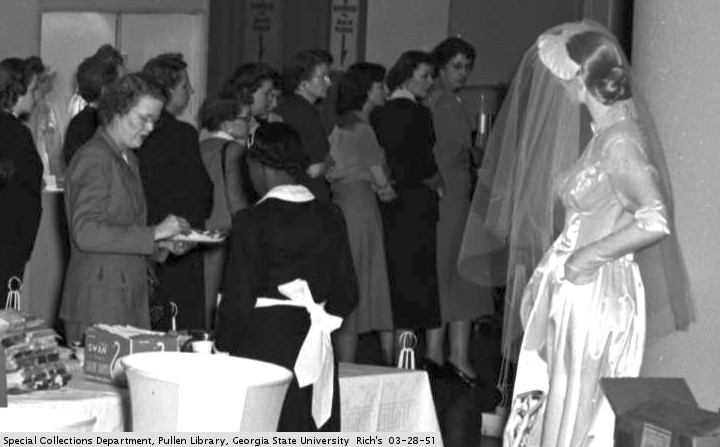

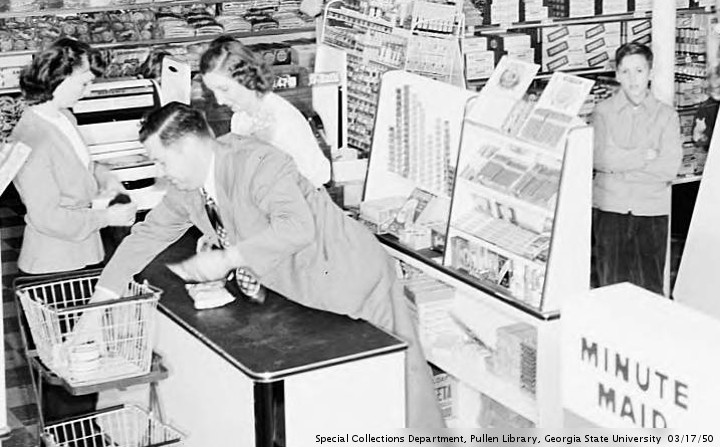
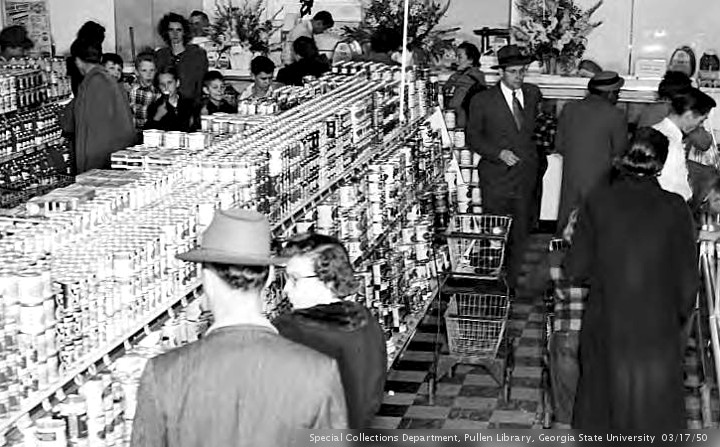
PG used to hear old timers talk about margarine being a white paste. The consumer would add the yellow color later. This bit of information had gone undisturbed for many years, until the 12:58 point of the Useless Information Podcast. There was a 1947 radio commercial for Delrich E-Z Color Pak.
Delrich E-Z margarine came in a plastic bag, along with a capsule. You broke the capsule, and yellow dye flowed out. You knead the bag, until the dye mixes with the margarine. It was considered an improvement over the mixing bowl.
Margarine was invented in 1869. “French chemist Hippolyte Mège-Mouriès … patented a lower priced spread made from beef tallow. He dubbed it oleomargarine–from the Latin oleum, meaning beef fat, and the Greek margarite, meaning pearl, this last for its presumably pearlescent luster.”
The dairy industry saw margarine as unfair competition for butter. In 1886, the federal Margarine Act was passed. Many oppressive taxes and regulations were put in place. Maine, Michigan, Minnesota, Pennsylvania, Wisconsin, and Ohio enacted a legislative ban on the use of margarine.
Most butter is dyed. The rich yellow that we associate with butter only comes from grass fed cows. If the cows are grain fed, butter is a pale yellow.
Yellow was more appealing than pink. In an effort to further demonize margarine, Vermont, New Hampshire, and South Dakota required margarine to be dyed pink. The Supreme Court overturned the pink laws, citing the laws’ effect on interstate commerce.
During World War II, butter was in short supply. Margarine became more popular. Finally, the laws requiring the sale of white margarine were repealed. Wisconsin kept the white margarine law until 1967, and forbade use of margarine in public places, unless requested, until 1971.
99% Invisible recently did a show, “I can’t believe it’s pink margarine.” PIctures today are from “The Special Collections and Archives, Georgia State University Library.” This is a repost.

Mithras Is Born




Until 2009, PG had never heard of Mithras.
Mithras is a Persian deity, from the Zoroaster tradition.(That is pronounced Zor uh THRUS ta.) Not much is known about Mithras … did he really exist, or was he a legend? There was a cult of Mithras in the first century Roman empire.
There are supposed to be similarities between Mithras and Jesus. These include the virgin birth, the birth on December 25, and rising from the dead after three days. Some spoilsports say the early christians grafted Jesus onto the legend of Mithras.
One indication that this might be true is The Catholic Encyclopedia. “Some apparent similarities exist; but … it is quite probable that Mithraism was the borrower from Christianity.” This repost has pictures from “The Special Collections and Archives, Georgia State University Library”.





Judy Roasting On An Open Fire


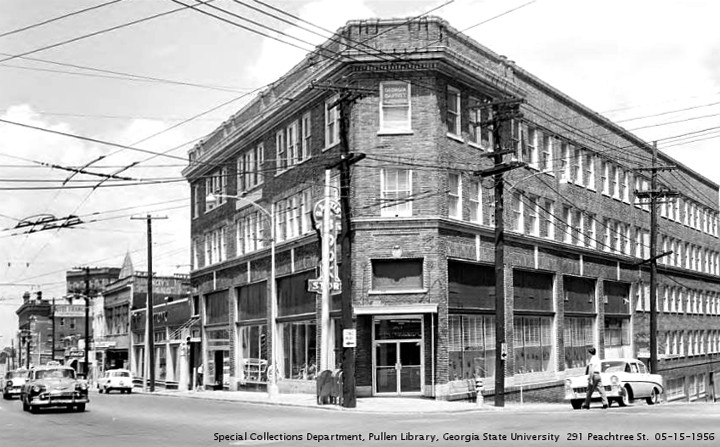
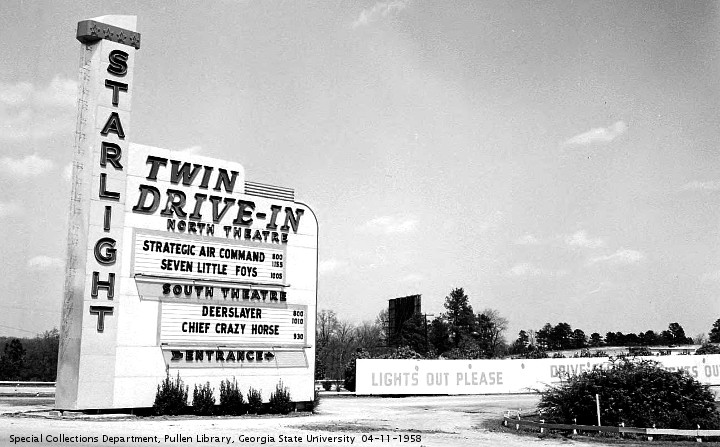
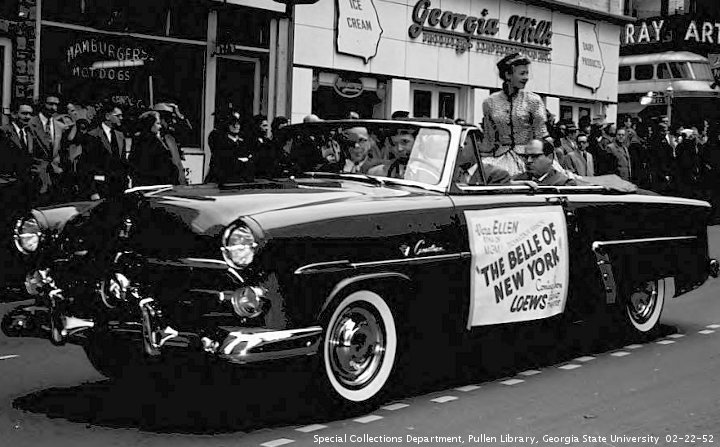
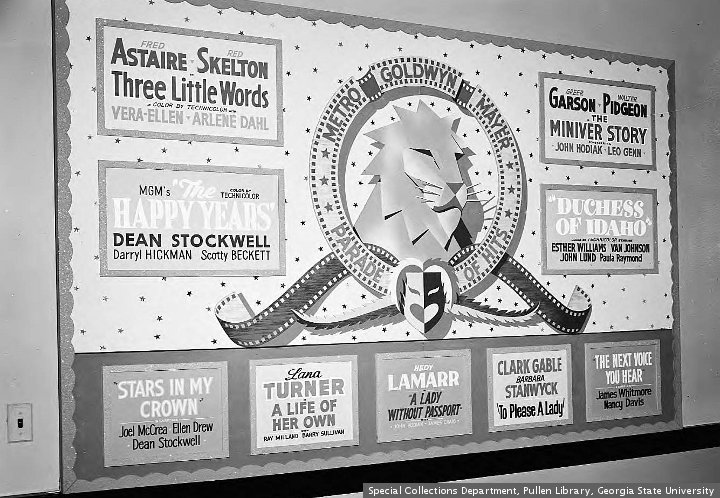
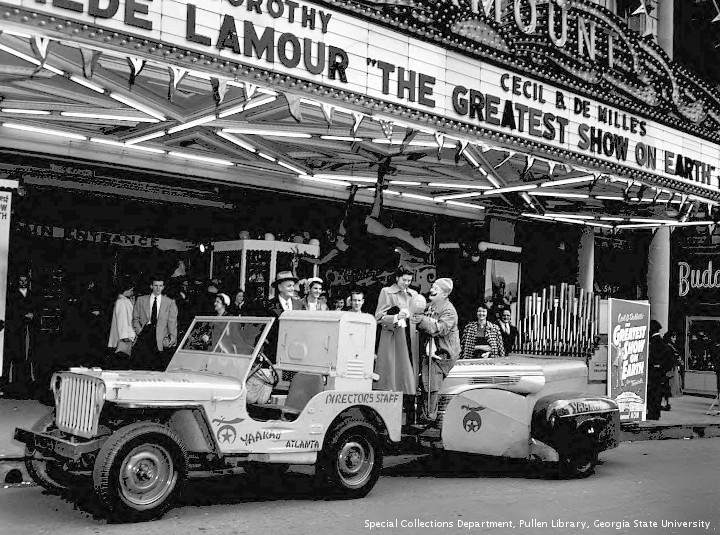
SFFILK (Not his real name) passes along a story about Mel Tormé. It seems like Mr.Tormé was eating a leisurely breakfast at a food court in Los Angeles, and a quartet appeared singing Christmas songs. They wound up performing “The Christmas Song” for co- author Tormé … and the singers had no idea who he was. It is a good story, better told in the link. This is a repost, with pictures from “The Special Collections and Archives, Georgia State University Library”.
According to the inerrant Wikipedia, Mr. Tormé collaborated with Robert Wells, until they had a falling out. One afternoon, on the hottest day of July in 1945, Mr.Tormé went to visit Mr.Wells, and saw the first four lines of “The Christmas Song” (including “Chestnuts roasting on an open fire, Jack Frost nipping at your nose”). The lines were on a note pad, and the two agreed to beat the heat of summer by completing the song. Supposedly, Mr. Tormé did not like the song very much. After three divorces, he probably didn’t see many of the royalties.
Mel Tormé was the music director of the ill fated “Judy Garland Show” in the early sixties. He wrote a book about it… The Other Side of the Rainbow: With Judy Garland on the Dawn Patrol . The story is that Miss Garland would get blasted, call Mr.Tormé in the middle of the night, and pour out her troubles. (This review is much less sympathetic towards Mr. Tormé.) While the show did not last longer, there are some great youtube clips left over.


Georgia On My Mind

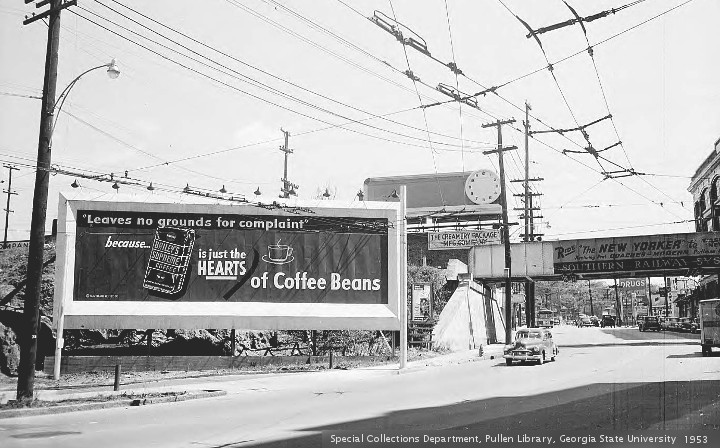
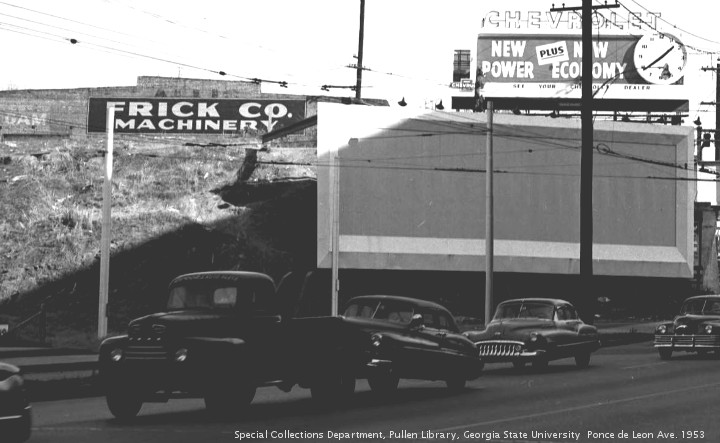
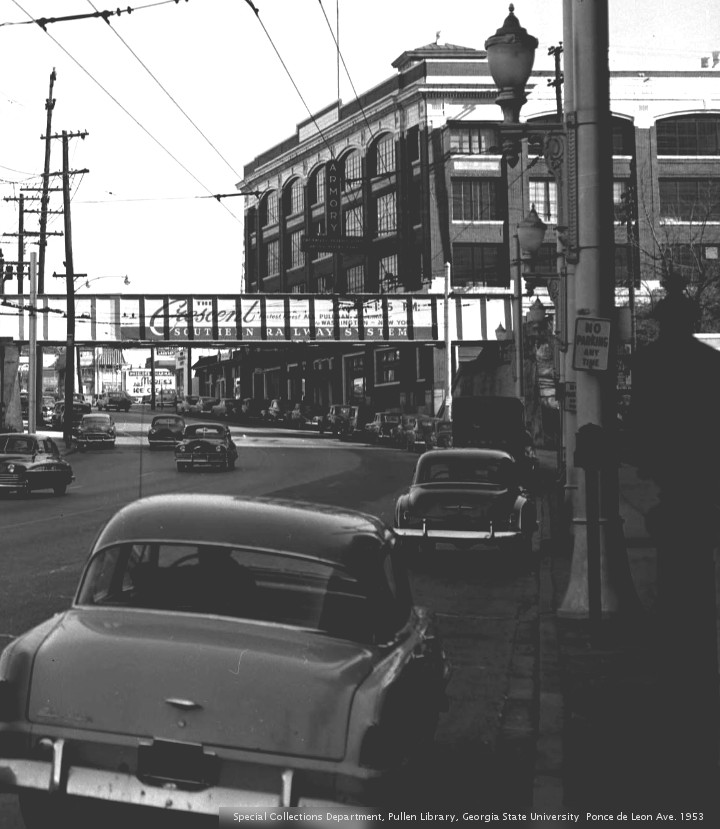


“Georgia On My Mind” turned up of facebook this morning. Pictures today are from “The Special Collections and Archives, Georgia State University Library”. This is a repost from 2020.
Youtube turned up the original “© Written in 1930 by Hoagy Carmichael (music) and Stuart Gorrell (lyrics) © Gorrell wrote the lyrics for Hoagy’s sister, Georgia Carmichael. However, the lyrics of the song are ambiguous enough to refer either to the state or to a woman named “Georgia”. Carmichael’s 1965 autobiography, “Sometimes I Wonder”, records the origin: a friend, saxophonist and bandleader Frankie Trumbauer, suggested: “Why don’t you write a song called ‘Georgia’? Nobody lost much writing about the South.” Thus, the song is universally believed to have been written about the state.”
National Anthems has a story about GOOM. (The 90’s website has a retro-illustration.) “STUART GRAHAM STEVEN GORRELL (1901-1963) and HOAGLAND HOWARD CARMICHAEL (1899-1981), wrote the song in 1930 almost as a lark … Hoagy Carmichael went to Indiana University, and one of his best college chums was Stuart Gorrell. Hoagy Carmichael was going to be a lawyer and Stuart Gorrell, when not hanging around the local “jazz joint” (called The Book Nook!) had promised someone that he would eventually be a success in the world of business.”
“The two of them were together at a party in New York and Hoagy Carmichael played what he had of the “Georgia” music line for Stuart Gorrell and some friends. After the party broke up, the two of them went back to a friend’s apartment and worked on the tune throughout the night. Stuart Gorrell wrote what he thought would be a good lyric line on the back of a post card, (now displayed in the Carmichael Room at Indiana University) and showed it to Hoagy Carmichael. One can still plainly see the few, but important, changes that Hoagy Carmichael made on that small piece of cardboard to Stuart Gorrell’s lyrical scratchings. The song was improved upon, and the lyrics written, in that boozy early morning, and recorded in September 1930 by a band that included Hoagy Carmichael’s great friend, Bix Beiderbecke – a recording session that proved to be Bix’s last.”
“Hoagy Carmichael went on to write many more songs, some of them hits, and Stuart Gorrell kept his promise and became a Vice President at Chase Bank. Stuart Gorrell never tried to write another song lyric, but ‘Georgia on my Mind’ became a hit after World War II and Hoagy Carmichael, true to his word – although Stuart Gorrell was not legally credited as the lyricist by the music publisher – always sent Stuart Gorrell a cheque for what would have been his share of royalty. The royalty income from that song is substantial and, after Stuart Gorrell died, the income put his daughter through college.”
Mr. Gorrell wrote a letter to the Bremen (Indiana) Enquirer, August 3, 1961. “This accompanied his response to his home town’s Teen Hop patrons choosing the song as their theme song. … “Georgia on my mind” was composed more than a quarter of a century ago on a cold and stormy evening in 1930 in New York City. Hoagy Carmichael and I, in a third floor apartment overlooking 52nd street, with cold feet and warm hearts, looked out the window and, not liking what we saw, turned our thoughts to the pleasant southland. Thus was born a hauntingly sweet song. My mother, who died in Bremen in 1942, once asked a very penetrating question about the song. I had sent her a copy of the sheet music and, after reading the words over several times, she wondered aloud: “What is Georgia? A girl—or state? What do you think? Hoagy and I just love every one of you Bremen Teen Hoppers for honoring out tune by making it your theme song. Sincerely, Stuart Gorrell”






Democrats Do Not Respect The Law
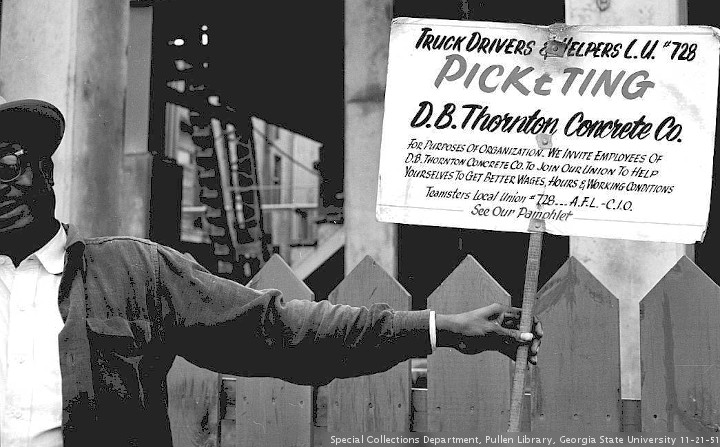



Georgia Democrats do not believe in the orderly rule of law. Three high profile incidents demonstrate this lack of orderly governance. While none of these incidents are on the same level as the January 6 riot at the U.S. Capitol, they all show the same contempt for basic law and order.
In August 2017, progressives held a convention in Atlanta. Democratic candidates for Governor spoke. While Stacey Evans spoke, actors in the crowd disrupted her speech, chanting “trust Black women.” As “author and zen priest” Angel Kyodo Williams says, “This is what democracy looks like.”
Later, the candidate who was allowed to speak, Stacey Abrams, defended shouting down her opponent. “I do not believe that you silence those who feel they are voiceless, because the minute we do that we are no better than those who tell people they can’t kneel in protest.” The DSA, who staged the disruption, is far from voiceless.
As many of you know, Ms. Abrams won the Democratic primary, and came very close to winning the general election. The central issue of the Abrams campaign was voter suppression. While the votes were being counted, some actors decided to have a rally inside the state capitol. State law clearly prohibits disruptive protest inside the capitol. (O.C.G.A. 16-11-34.1 (g)) Like a church, or a court of law, some activity is not acceptable inside the state capitol.
State Sen. Nikema Williams chose to violate this law, and was arrested. She was widely praised for this action, and later elected to the U.S. Congress. Almost no Democrats condemned this illegal protest by Sen. Williams. Many of these same actors routinely call on Republicans to disavow support from anyone deemed unworthy.
Two years later, the legislature passed SB 202. This law regards voting access, and is loudly denounced by Democrats. Many observers see SB 202 as being a mild bill. One provision calls for voters to write their drivers license/state id number on absentee ballot applications. SB 202 has turned into a political disaster, with the racism-happy POTUS calling SB 202 “Jim Crow on steroids.”
The March 25, 2021, bill signing, for SB 202, was a bi-partisan embarrassment. Governor Brian Kemp held the signing at the Capitol, immediately after the bill was passed. This was possibly done to provoke Democrats, who seldom need a reason to behave badly.
State Representative Park Elizabeth Cannon took the bait, and got arrested. She made a scene outside the bill-signing. Rep. Cannon tried to get arrested February 26, but the State Patrol did not comply. Once again, this disruption was widely praised by state Democrats.
Democrats have made great gains in Georgia, and may possibly win the Governor’s office next November. They will face many problems, not least of which is declining respect for law and order. When you look at the lack of respect that Democrats show for Georgia law, you wonder how they are going create respect-for-order in the general population. Pictures today are from “The Special Collections and Archives, Georgia State University Library.”





When You Can’t Say Anything Good



Writers block is real. You have all of modern media at your beck and call, and yet you don’t have a message. TwentyTwoWords posts the story of a medical study into writers block. The study wastes no words in it a pithy treatment of this issue. It is an unspoken masterpiece, the treatment that dare not speak it’s name. The research was financed by a block grant.
The findings of this study were replicated in 2007. The report is included here, in it’s entirety. The editor noted “I did not change one word, and this is a first in my tenure as editor.” There is no word on whether the report was submitted before the deadline.
Ben Hecht tells a story in his autobiography “Child of the Century”. As a young, underpaid newspaper writer in Chicago, Mr. Hecht was hired to participate in literary debates. In the era before movies and radio, these were considered after dinner entertainment. One night, Mr. Hecht got together with his opponent, and hatched a plan. The topic of the debate was “People who attend literary debates are idiots”. The first speaker did not say a word, but gestured towards the crowd. The second speaker said, “you win.”
“Child of the Century” is now out of print. In 1994, PG thought he was going to have to move, and the first step was to throw away things. His copy of “Child of the Century” was one thing he pitched.
The sound that you hear is one hand clapping. Those reading with one hand can join in with the other one. Appreciation is always welcome. Vintage pictures are from “The Special Collections and Archives, Georgia State University Library”.
This is a repost. PG thinks writer’s block should be called writer’s tackle, but few agree.



CK7 Hot Dog
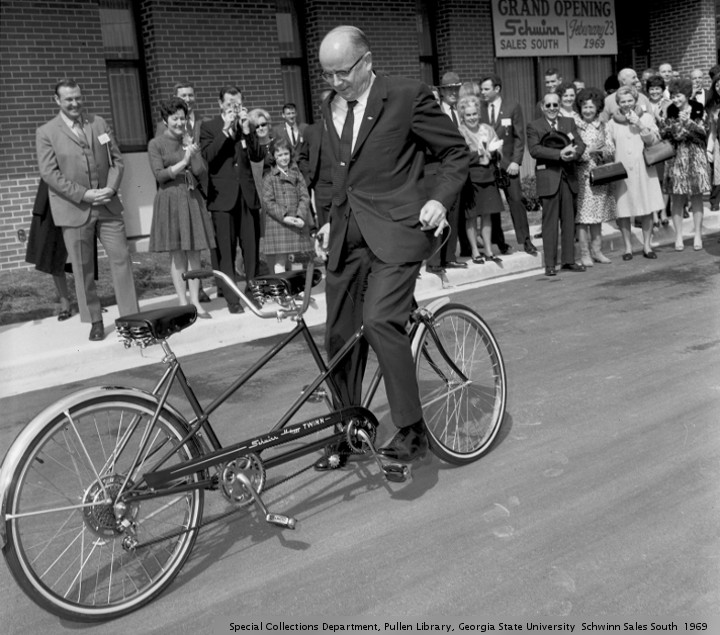




Hot Dog “3 – verb to perform in a conspicuous or often ostentatious manner especially : to perform fancy stunts and maneuvers (as while surfing or skiing).” A hot dog is more than a sandwich. Show offs have been called hot dog for a long time. This is a repost. Pictures today are from “The Special Collections and Archives, Georgia State University Library”.
Which brings us to Colin Kaepernick. PG has thought there was something fishy about #7 since his protest began in 2016. What would happen if you google “Colin Kaepernick Hot Dog”?
In 2013, after the Niners beat the Falcons in the NFC championship game, a restaurant in Turlock, CA, held a contest to name a hot dog in honor of the Niners young quarterback. “Kaepernick Special: Hot dog wins competition in Turlock Colin Kaepernick is a hot dog. That’s not a critique of the quarterback’s playing style; that’s a fact. The Kaepernick Special made its first appearance on the menu at Main Street Footers Thursday. The restaurant, a mainstay in downtown Turlock for decades, held a contest to come up with a hot dog named for the former Pitman High football standout. … Football and hot dog aficionados submitted a variety of ideas … One suggestion: a hot dog topped with crab, shrimp and cocktail sauce. … Jim Yettman, 76, said he entered the contest “on a whim” … Yettman’s concoction: A hot dog with chili, cabbage, red and yellow bell peppers, jalapeños and a secret sauce consisting of mustard, horseradish, thousand island dressing, and cayenne pepper. … He beat out a pulled pork-topped hot dog and a pizza-themed version with pepperoni and olives.”
As you may have heard, Mr. Kaepernick sat down during the National Anthem, before a 2016 pre-season game. One of the first casualties, in the uproar that followed, was the CK7 hot dog. “A hot dog named in honor of Colin Kaepernick at a restaurant in his hometown of Turlock, Calif., no longer is available. The hot dog called CK7 — Kaepernick’s initials followed by his jersey number — has been pulled off the menu at Main Street Footers after the San Francisco 49ers quarterback refused to stand for the national anthem before a preseason game against the Green Bay Packers on Friday. The hot dog that was topped with chili, coleslaw, jalapenos and “Kaep Sauce’’ was a hot item for $6.05 when Kaepernick helped lead the 49ers to the Super Bowl after the 2012 season but had become a “political football,’’ restaurant co-owner Glenn Newsum said.”
In 2016, the Carolina Panthers were coming off an NFC championship. Their star quarterback, Cam Newton, gave an interview with GQ, and said some controversial things. After the Niners played the Panthers, Mr. Kapernick and Mr. Newton were photographed together. Some twitter wits speculated about what was said. @TribalThrasher “Kaep: A hot dog isn’t a sandwhich.. Cam: SQUARE UP”
Don’t be surprised if a google search for “dog” yields a story featuring Mike Vick. “Colin Kaepernick tweets Stockholm Syndrome definition after Michael Vick advises him to get a haircut Recently retired NFL quarterback Michael Vick has some advice for Colin Kaepernick, who is still looking for a job after opting out of his contract with the San Francisco 49ers in March. “First thing we gotta get Colin to do is cut his hair,” Vick said Monday. … (photo comment) Kaepernick had short, neatly cut hair when he led the 49ers to the Super Bowl following the 2012 season. But before last season, he grew it all out, often sporting a large Afro or sometimes cornrows. … “Just go clean cut, you know? Why not?” said Vick, who sometimes wore his own hair in an Afro or cornrows in his younger days. … “The most important thing that he needs to do is just try to be presentable.” … it’s not the Colin Kaepernick that we’ve known since he entered the NFL. … I love the guy to death and I want him also to succeed on and off the field. … “He is a great kid and the reason he’s not playing has nothing to do with the national anthem, I think it’s more solely on his play.” … In what some are interpreting as a response to Vick’s comments, Kaepernick took to Twitter and Instagram on Tuesday morning and posted the definition of Stockhom Syndrome.”



Unarmed Black People



Police killing unarmed Black people continues to be a hot topic. Every once in a while, someone will quote some exact numbers. Finally , curiosity got the best of PG. He went to the Washington Post Police Shootings database. As of December 5, 4 Black people have been shot to death, by police, in the United States. 7 unarmed White people met a similar fate.
Lindani Myeni April 14, 2021 Honolulu, HI
Daverion Kinard February 13, 2021 Fontana CA
Jenoah Donald February 4, 2021 Vancouver, WA
Patrick Lynn Warren January 10, 2021 Killeen TX
Every case is different. At least two of these four cases involve a physical altercation. Both police, and family attorneys, have been known to lie. It comes down to who’s side of the story you choose.
Chamblee54 ran a 29 week series in 2017-18, Killed By Police, and a report in 2020. Pictures are from “The Special Collections and Archives, Georgia State University Library.”


 Chamblee54
leave a comment