The Cynic’s Word Book E – G




What follows are selections from The Devil’s Dictionary, by Ambrose Bierce. Many things could be said about Mr. Bierce. TDD began as a newspaper column, and was later published as The Cynic’s Word Book. TDD is a dictionary, going from A to Z. Today’s selection covers E – G. More selections are available. A – D Pictures today are from The Library of Congress. This is a repost.
EAT, v.i. To perform successively (and successfully)
the functions of mastication, humectation, and deglutition.
ECONOMY, n.
Purchasing barrel of whiskey that you do not need for price of cow that you cannot afford.
EDIBLE, adj. Good to eat, and wholesome to digest, as a worm to a toad,
a toad to a snake, a snake to a pig, a pig to a man, and a man to a worm.
EGOTIST, n. A person of low taste, more interested in himself than in me.
ELOQUENCE, n. The art of orally persuading fools that white is the color that it appears to be.
It includes the gift of making any color appear white.
EMOTION, n. A prostrating disease caused by a determination of the heart to the head.
It is sometimes accompanied by a copious discharge of hydrated chloride of sodium from the eyes.
EPICURE, n. An opponent of Epicurus, an abstemious philosopher who, holding that pleasure should be the chief aim of man, wasted no time in gratification from the senses.
EPITAPH, n. An inscription on a tomb, showing that virtues acquired by death
have a retroactive effect. Following is a touching example:
Here lie the bones of Parson Platt, Wise, pious, humble and all that,
Who showed us life as all should live it; Let that be said—and God forgive it!
ERUDITION, n. Dust shaken out of a book into an empty skull.
ETHNOLOGY, n. The science that treats of the various tribes of Man,
as robbers, thieves, swindlers, dunces, lunatics, idiots and ethnologists.
EULOGY, n. Praise of a person who has either the advantages of wealth and power,
or the consideration to be dead.
EVANGELIST, n. A bearer of good tidings, particularly (in a religious sense) such as assure us of our own salvation and the damnation of our neighbors.
EXCOMMUNICATION, n.
This “excommunication” is a word In speech ecclesiastical oft heard,
And means the damning, with bell, book and candle,
Some sinner whose opinions are a scandal—
A rite permitting Satan to enslave him Forever, and forbidding Christ to save him.
EXHORT, v.t. In religious affairs, to put the conscience of another upon the spit
and roast it to a nut-brown discomfort.
EXISTENCE, n.
A transient, horrible, fantastic dream, Wherein is nothing yet all things do seem:
From which we’re wakened by a friendly nudge Of our bedfellow Death, and cry:”O fudge!”
FASHION, n. A despot whom the wise ridicule and obey.
FEAST, n. A festival. A religious celebration usually signalized by gluttony and drunkenness, frequently in honor of some holy person distinguished for abstemiousness.
FIDDLE, n. An instrument to tickle human ears by friction of a horse’s tail on entrails of a cat.
FLOP, v. Suddenly to change one’s opinions and go over to another party.
The most notable flop on record was that of Saul of Tarsus,
who has been severely criticised as a turn-coat by some of our partisan journals.
FORK, n. An instrument used chiefly for the purpose of putting dead animals into the mouth. Formerly the knife was employed for this purpose, and by many worthy persons is still thought to have many advantages over the other tool, which, however, they do not altogether reject, but use to assist in charging the knife. The immunity of these persons from swift and awful death is one of the most striking proofs of God’s mercy to those that hate Him.
FRIENDLESS, adj. Having no favors to bestow. Destitute of fortune.
Addicted to utterance of truth and common sense.
FUNERAL, n.
A pageant whereby we attest our respect for the dead by enriching the undertaker,
and strengthen our grief by an expenditure that deepens our groans and doubles our tears.
GALLOWS, n. Whether on the gallows high Or where blood flows the reddest,
The noblest place for man to die— Is where he died the deadest.
GENTEEL, adj. Refined, after the fashion of a gent.
Observe with care, my son, the distinction I reveal: A gentleman is gentle and a gent genteel.
Heed not the definitions your “Unabridged” presents, For dictionary makers are generally gents.
GHOUL, n. A demon addicted to the reprehensible habit of devouring the dead. The existence of ghouls has been disputed by that class of controversialists who are more concerned to deprive the world of comforting beliefs than to give it anything good in their place.
GLUTTON, n. A person who escapes the evils of moderation by committing dyspepsia.
GOUT, n. A physician’s name for the rheumatism of a rich patient.
GRAVE, n. A place in which the dead are laid to await the coming of the medical student.
GUILLOTINE, n. A machine which makes a Frenchman shrug his shoulders with good reason.


Rainbows





Lately, I have been walking to the gym. It is about 1.4 miles one way. I go there, do my workout, and walk home. One consequence is not riding the stationary bike, and listening to podcasts. When it is a good story, this can be transformative. It is an magical escape from one place, into another.
Today, I chose to listen to a story while walking home. The story was Rainbows, by @JosephONeillx. It was one of the good ones. By the time I went through the railroad underpass off Peachtree Road, my pace had grown even more glacial than normal. I did not want to miss a single detail. It did help that I was off the busy main road, whose loud traffic drowned out the action.
Listening to a story, as opposed to reading it, is a different path for the information. The author’s voice telling the tale is a more intimate connection that reading dead tree text. In this story, the reading author is a man. I assumed the lead character, Clodagh, was also male. When a Aoife, the daughter, appeared, and a husband named Ian, I just thought this was just the trendy New Yorker. It wasn’t until much later in the story, that it dawned on me that Clodagh might be female. The gender is never confirmed one way, or the other.
The story is rather disturbing. (Spoiler to follow) Aoife is being sexually harassed at school, and files a complaint. The boy who gets metooed is the son of a laundry owner. Clodagh Nolastname is a VIP customer. (This all happens in New York. Clodagh is not poor.) The Chinese laundry lady tells Clodagh to take her business elsewhere. Clodagh is mortified that it was not handled family-to-family, but through the authorities.
I continue to walk through a glorious October afternoon. The election is in two weeks, and we will see what becomes of the anti-christ POTUS. The story ends when I get into the house, and I listen to the credits. Theme music is by North American Plastics, which somehow sounds as New Yorkeresque as not knowing whether mom is a man, or a woman. This is a repost.





Einstein, Facebook, God


“I love this … When Einstein gave lectures at U.S. universities, the recurring question that students asked him most was: Do you believe in God? And he always answered: I believe in the God of Spinoza. Baruch de Spinoza was a Dutch philosopher considered one of the great rationalists of 17th century philosophy, along with Descartes.
(Spinoza) : God would say: Stop praying. What I want you to do …” Today’s commodity wisdom goes on for 687 words. The bs detecter was buzzing. It was time to consult with Mr. Google.
“At home in Berlin in April 1929, Albert Einstein received an urgent telegram from Rabbi Herbert S. Goldstein of New York: “Do you believe in God? Stop. Answer paid 50 words.” Boston Archbishop William Henry Cardinal O’Connell had derided Einstein’s famous relativity theories as “befogged speculation” conjuring “the ghastly apparition of Atheism.” An alarmed Goldstein sought to douse these rhetorical flames with reassurance from the great man himself.
“Einstein wired back “I believe in Spinoza’s God, Who reveals Himself in the lawful harmony of the world, not in a God Who concerns Himself with the fate and the doings of mankind.” (“Ich glaube an Spinozas Gott der sich in gesetzlicher Harmonie des Seienden offenbart, nicht an Gott der Sich mit Schicksalen und Handlungen der Menschen abgibt.”) The rabbi might have saved himself a little money; in the end, Einstein’s reply in the original German used only 25 words.”
“Einstein often saved ink by referring this way—a sort of philisophical shorthand—to Benedict (Baruch) de Spinoza, the 17th-century philosopher and scientist excommunicated from Amsterdam’s Sephardic Jewish community for his beliefs. … Spinoza did in fact “remain alone” for most of his life. Raised in an Amsterdam enclave of Marranos—Jews converted under the inquisitions of Spain and Portugal who had returned to Hebrew tradition in the Netherlands—Spinoza was considered a stellar pupil by his rabbis. When he began questioning the idea of a biblical God, however, they expelled him from the sect. Rather than convert to Christianity, he defied convention by living without organized religion. He never married and supported his life of scientific and philosophical inquiry through solitary work in a “high-tech” industry of his day, lens grinding.”
The key word in the question, “do you believe in God”, is believe. Whether you say G0d, Allah, Nature, or Football, there seems to be a consensus that something exists. Is belief the best way to approach this issue? What are the middle three letters of believe?
FWIW, Dr. Einstein pondered the God question from time to time. While video of Dr. Einstein does exist, there is little way of knowing whether students asked him about God, at every lecture.
The facebook wisdom-fest does not offer a source, for Spinoza’s ideas about Mary’s babydaddy. PG is not a Spinoza scholar, and quit reading the facebook post after a few sentences. He did look at a wikipedia page, and a document from Stanford University. A search was done for the phrase “God would say: Stop praying.” The terms “stop” and “pray” do not appear in either source.
God is in the details. Instead of “do you believe in God”, the question could be “do you believe in a facebook meme?” Pictures are from The Library of Congress. This is a repost.


Mansplain


There was a link on facebook to a rather wonky article, Mansplaining 101: How to Discuss Politics and Feminism Without Acting Like a Jackass. The concept is that men sometimes do not show women adequate respect when talking to them. The Urban Dictionary has entries for both mansplain and womansplain. Neither entry is complimentary. This is a repost. Many of the links no longer work. The pictures are more entertaining.
The policymic feature is a few months old, and apparently was the scene of a lively comment debate. Unfortunately, Some people flagged a bunch of the comments. Little is left. This is the top comment: “Feminism doesn’t need to make room for men, men need to make room for feminist ideas in their spaces.” In one sentence you managed to discredit your entire argument. Who wants to argue with someone who thinks any opinion from the opposite sex isn’t worthwhile? “
When you google mansplain you are referred to a tumblr, Academic Men Explain Things to Me. This is supposed to be an authority on mansplaining. As this post is written, the top three posts are a boss who mispronounces a name, a grandfather who tells girls how to shave their legs, and an eavesdropping customer who tells a woman how to get to sleep better. This is not especially helpful.
Blank splaining seems to be a versatile label. It seems to be a way of attacking the messenger, instead of dealing with the content of the comment. It is true that the tone of comments can be troublesome. People often come across as condescending, especially when they are. It just seems to this observer that little is gained by putting a label, like mansplaining, on this phenomenon.
PG has been in many discussions where he was spoken down to. Jesus worshipers are notorious for not respecting people who don’t agree with their ideas about religion. There is also the possibility that people use this attitude of superiority as a weapon to cover up uncertainties about their position. Human beings are funny animals. We are not always the fair, logical creatures we think we are.
Another label to be put in front of splaining is white. The urban dictionary says this about whitesplain: “The act of a caucasian person explaining to audiences of color the true nature of racism; a caucasian person explaining sociopolitical events and/or history to audiences of color as though they are ignorant children.” Contrast this to the word on blacksplain: “Explaining things pertaining to African American history and culture, to someone who is racist or racially ignorant.” The white person is always wrong in this scenario. Pictures today are from The Library of Congress.



25 Things About Georgia

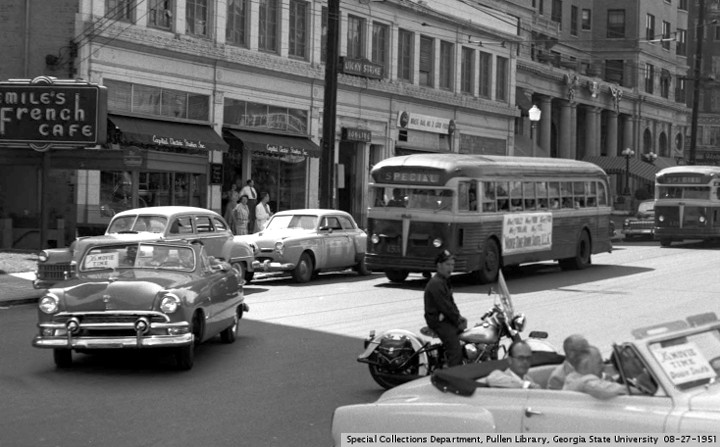
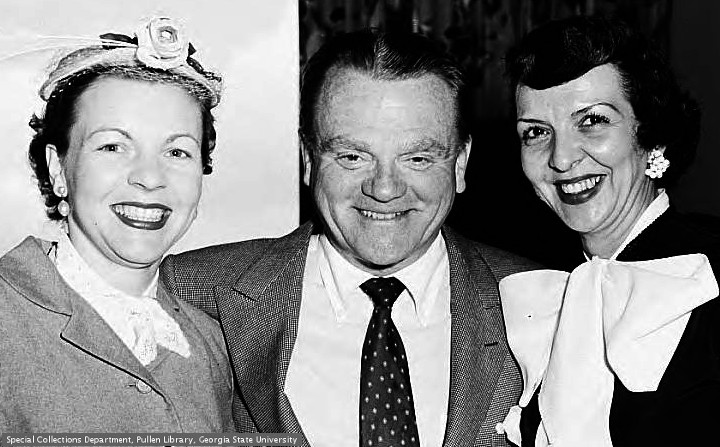
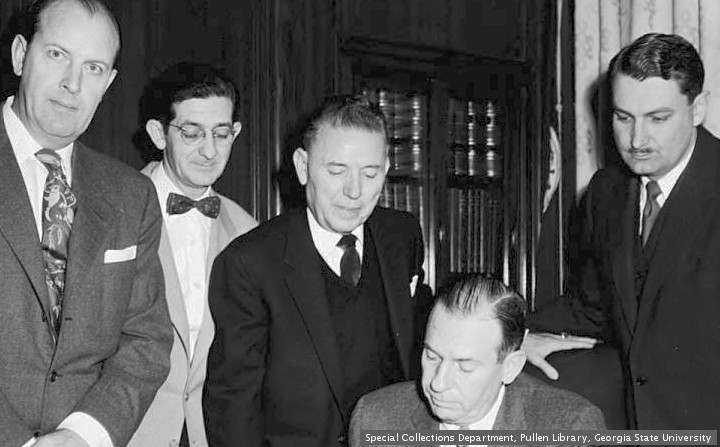


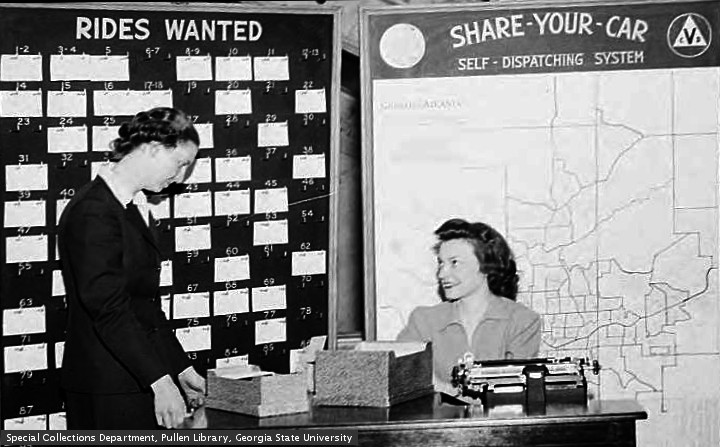

These daze, there is more media than messages. People need things to write about. One popular theme, at least in itp/otp, is lists about life in Georgia. A web facility that should know better, thought catalog, recently put out 25 Things You Need To Know About Georgia.
25TYNTKAG was written by Jeremy Populus Jones. He seems to be the CEO of something called GAFollowers. (@GAFollowers on twitter) From the fine print: “GAFollowers was created on a “strength in numbers” foundation, finding a creative way to use free online social networking sites to strengthen the “bond” between people in Georgia to help better form this state. … GAFollowers is one of the largest twitter accounts in the state of Georgia that spans nearly every corner of the region.”
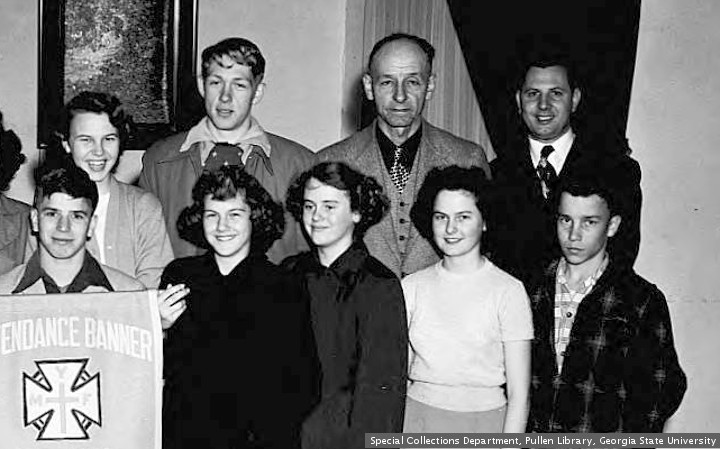
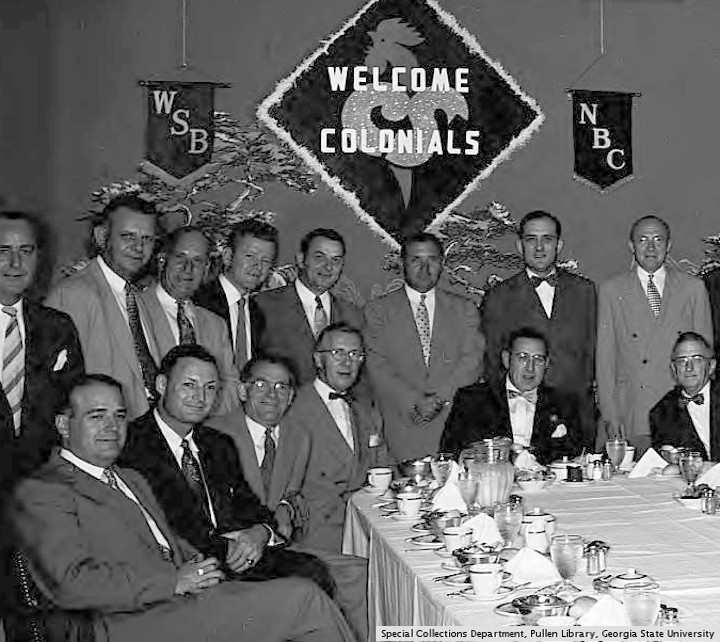
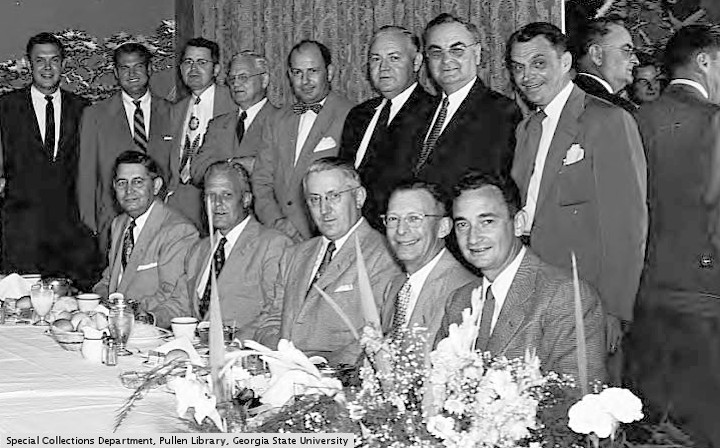
These lists about Georgia life usually have a few common comments. There is the heat, the bugs, the traffic, the multiple Peachtrees, and southern accents. They seldom mention the shameless corruption, religious mental illness, rampant obesity, or racial pandemonium. Lets take a look at 25TYNTKAG. Mr. Jones will be in blue, and Chamblee54 in green. This is a repost, with pictures from “The Special Collections and Archives, Georgia State University Library”.
1. The weather here is just as inconsistent as your ex-girlfriend. Not really. It gets cold in January, hot in July. Your ex-girlfriend is staying out of this.
2. We call all interstates in Georgia, “The Highway”. Most people use the number.
3. Only in Atlanta is everything named “Peachtree” without a single tree with peaches around. Peachtree is all over OTP.
4. Terio and Honey Boo Boo were born and raised here. You couldn’t do this without google. Terio is a chubby kid who dances. Sometimes ignorance is bliss.
5. “Knuck if you Buck” is the song we will always get hype to no matter the age. Yuck.
6. White girls wear Nike shorts with big t-shirts covering their shorts. (How many can you spot?) Maybe there was a sale on big t-shirts at Walmart.
7. Zaxbys is what you eat. The TC comments said this is not accurate. They mentioned a certain spelling challenged company, that specializes in overpriced chicken sandwiches. At least the son of Mr. Zaxby doesn’t run off potential customers with his big mouth.
8. We call it a “rag” not a “washcloth”. Do people up north say a woman is on the washcloth?
9. Going outside at anytime during the summer instantly guarantees a minimum a 7 bug bites. This is mostly true. Who is counting?
10. In Georgia when someone ask, “Where you from?”, people usually reply with a county not a city. In Atlanta, when you say “Where are you from?” it is almost always somewhere outside of Georgia.
11. The speed limit is 65 mph but if you’re not going at least 80 mph you’ll be ran off the road. This is also true on surface roads. In hilly Atlanta, there are few places to pass on two lane roads.
12. In Georgia it’s not a shopping cart, it’s a buggy. Do people really say shopping cart? At Kroger it is a bascart. The stores have a bascart corral.
13. We get more inches of pollen in a week than inches of snow in a full year. Pollen season hits in early spring. It is rough for many people. The rest of the year gets relatively little pollen. There is a good ice/snow storm every ten years or so. This one is probably true.
14. You say Georgia, we say Jawja. Others say George-ah. To untrained ears they sound the same.
15. Sweet tea is our water. Very few people wash cars with sweet tea.
16. The night has been a success if you ended up at Waffle House. This is especially true if you are scattered, smothered, and covered.
17. In Georgia it’s necessary to look at the weather before picking out an outfit. A reason not to do numbered lists. Just think of what you have to say, write it down, and hope it is not copyrighted.
18. We pray that we get snow during the winters. The people who pray for winter storms are merchants. They have an inventory of batteries, milk, ice, and eggs to sell.
19. We are the creators of, “Turn Up”. You can’t squeeze blood from a turnip.
20. Here in Georgia white girls can twerk. No Miley Cyrus. Ditto reaction to number 17. What was PG thinking of when he decided to do this post?
21. You will usually be 30 minutes away from just about every destination that you’re heading to. 22. There’s a Waffle House in walking distance of every Waffle House. These two have been combined, for obvious reasons. Do people proofread these lists before sending them out?
23. Any dark soda is simply called “Coke”. Many say Cocola, without the second syllable.
24. We pronounce it “Atlanna”. Whatever. Sometimes the second t is audible, sometimes not. It definitely is not the ATL, except to radio shouters.
25. Braves, Falcons & UGA are the teams we really care about. Tech fans may disagree. Ditto taxpayers, who don’t care if Rankin Blank gets a new stadium.





Shoes



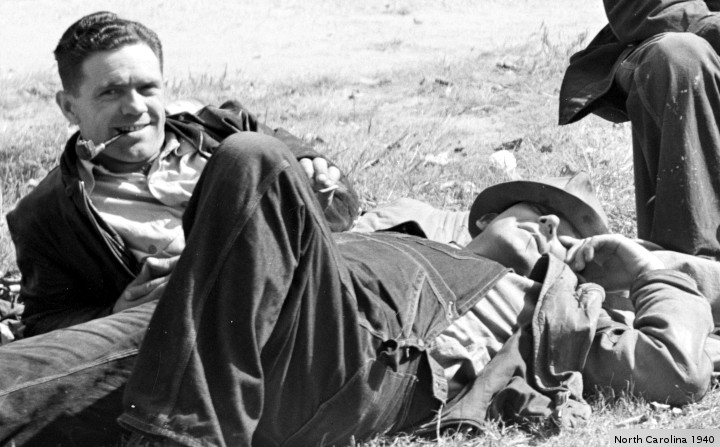


“Before you judge someone, walk a mile in their shoes. Then, who cares? They’re a mile away and you have their shoes.” This item turned up on my facebook feed recently. “Walk a mile …” is a metaphor. You should consider a person’s life experience before judging them. Nobody expects you to actually put your foot in their sneakers. If you do, please make sure your feet are clean.
Recently, I got to walk a 200 yards in someone else’s shoes. There was at an event, where people took their shoes off. When getting ready to leave, I saw a pair of basic black jogging shoes. I put them on, and they fit. I walked to my cabin, and went to sleep.
The next morning, I put these shoes on, and went to the dining hall. A man, who I will call Tom, told me that I had his shoes on. I looked under the table, and did not see the under armor logo on my feet. Tom said we could go to his vehicle after breakfast, and get my shoes.
What did I learn about Tom by walking 200 yards in his shoes? He wears the same size shoe as I, and his feet don’t stink. He handles a potentially embarrassing situation with kindness and tact. If I had to judge Tom, after walking 200 yards in his shoes, I would say that he is a cool dude. Pictures for this size twelve morning are from The Library of Congress.




The Scarlet R





This is a repost from 2016, with horrible sound. … Bloggingheads.tv released a chat with Glenn Loury and John McWhorter. With election days 35 days away, there was lots of talk about Donald and Hillary. It only took 1:44, to learn what is expected. The assignment is to call DJT a racist, and lament what a terrible thing that is. This is political discourse in 2016.
At 3:28, there was an aha moment. The line was that DJT, instead of an orange haired ogre, was really just a seventh grade bully. When PG was in seventh grade, there was a mean person who gave him problems. This individual is now a facebook friend, and regularly posts memes supporting DJT. PG likes to know what the “other side” thinks. Ignoring the memes is always an option.
At 9:22, the importance of identifying racism in others is stressed. This is said to totally justify the appeal of DJT. Once you call someone a racist, you no longer have to work to understand their motives. When the scarlet R is super glued to somebody, that is all you need to know.
The Scarlet Letter is the rip roaring tale of Hester Prynne. She got caught fooling around, and had the scarlet A, for adultery, pinned to her chest. It was pinned to her chest, and she could see who did the pinning. In today’s “woke” world, the scarlet R, for racist, is super glued to the back of the terrible person. The person never knows who gave them this dreaded, irrevocable, label.
At 21:28, John tells an amusing story. He was talking to a well meaning white woman, said to be helpful in selling more books. At some point, the woman felt obligated to say that “we don’t like to talk about race.” John was too polite to laugh in her face.
The truth is that talking about race is the new national pastime. Does anyone listen? In all that talk, is anything worthwhile said? These questions are considered rude, and probably racist.
At 31:09, John said the n word. It is not known whether it ended with -er, or with -a. Pictures today are from The Library of Congress.







Four Rules


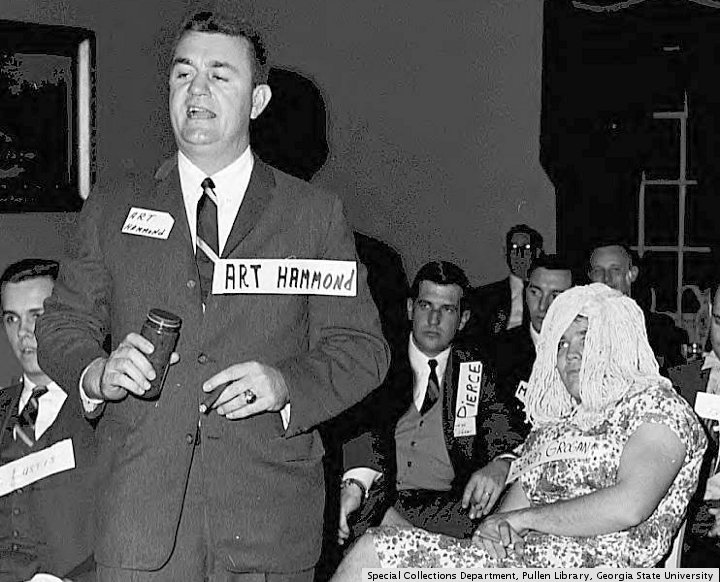


This is a double repost. Historic pictures today are from “The Special Collections and Archives, Georgia State University Library”. This was written like David Foster Wallace.
“The Four-Way Test of the things we think, say or do” features the logo of the Rotary Club. The four rules are simple, on the surface. Is it the TRUTH? Is it FAIR to all Concerned? Will it build GOODWILL and BETTER FRIENDSHIPS? Will it be BENEFICIAL to all concerned?
The Four Way Test was written by Herbert J. Taylor. In 1932, Mr.Taylor took over the bankrupt Club Aluminum Company of Chicago. Trying to revive the company during the depression, Mr. Taylor wrote a code of ethics, that would be the basis for the company’s actions.
Many said that the four way test was not practical for the business world. The balancing of integrity and ambition can be daunting. It was said that “This emphasis on truth, fairness and consideration provide a moral diet so rich that it gives some people “ethical indigestion.”
PG maintains that fair is a baseball hit between first and third base. Sometimes, the umpire makes the wrong call. In the “real world”, the different points of view in a dispute make rendering a fair judgment a difficult task, if not an impossible one.
There is a story about the revival of Club Aluminum. “One day, the sales manager announced a possible order for 50,000 utensils. Sales were low and the company was still struggling at the bankruptcy level. The senior managers certainly needed and wanted that sale, but there was a hitch. The sales manager learned that the potential customer intended to sell the products at cut-rate prices. “That wouldn’t be fair to our regular dealers who have been advertising and promoting our product consistently,” he said. In one of the toughest decisions the company made that year, the order was turned down. There was no question this transaction would have made a mockery out of The Four-Way Test the company professed to live by.”
How did the sales manager learn of the intentions of this buyer? Was he tipped off by one of the “regular customers” who feared competition? Was this “regular customer” lying? Many inspirational stories leave out crucial details.
As it turns out, Club Aluminum did sell enough product to emerge from bankruptcy. “By 1937, Club Aluminum’s indebtedness was paid off and during the next 15 years, the firm distributed more than $1 million in dividends to its stockholders. Its net worth climbed to more than $2 million.”
Club Aluminum cookware was cast, not spun. It is heavy, and is a prized collectors item today. As for the Club Aluminum company “Standard International Corporation bought it in 1968. Regalware made and marketed Club Aluminum for a while, but went out of business in the mid-1980s. The brand name was eventually obtained by the Mirro Company.”
This is a repost. Philosophy and rules for living is always a crowd pleaser. Whether or not you practice what you preach is beside the point.
There is a story above. A company, facing bankruptcy, turned down a huge order because of concerns about how the product would be resold. Today, this seems quaint. Today, the moral thing to do would be to take the order, keep your factory busy, and not worry how it was going to be resold. While some pretend that moral rules are unchanging, the truth is that they do change with the times.
This reminds PG of a story from his days as a blueprinter. With ammonia developed prints, every print is fed by hand, and you have the option to adjust the speed of the machine. Slower prints mean less background, which to some is a higher quality print. (This is not an issue with digital printing. Some change is indeed progress.)
The company PG worked for was affiliated with a small, family run company in a neighboring city. This company was run by an old fashioned lady, who insisted on adjusting every print to get the perfect background. This was different from the company PG worked for, which ran large jobs for the big city market. To his customers, quality meant getting an acceptable print, DELIVERED ON TIME. Who had the higher standards? Maybe that is a question for the customer to judge.




These thoughts are for you to use. They were articulated by a man named Don Miguel Ruiz. They are called the The Four Agreements .
PG does not claim to live up to these ideals. Number two is especially tough for him. The main thing is to try, and to always do your best. This is not about what you believe or think, it is about what you do. This is about you. If you fall short in some way, work on improving yourself, instead of looking at someone else. This is about you.
agreement 1–Be impeccable with your word – Speak with integrity. Say only what you mean. Avoid using the word to speak against yourself or to gossip about others. Use the power of your word in the direction of truth and love.
agreement 2–Don’t take anything personally – Nothing others do is because of you. What others say and do is a projection of their own reality, their own dream. When you are immune to the opinions and actions of others, you won’t be the victim of needless suffering.
agreement 3–Don’t make assumptions – Find the courage to ask questions and to express what you really want. Communicate with others as clearly as you can to avoid misunderstandings, sadness and drama. With just this one agreement, you can completely transform your life.
agreement 4–Always do your best – Your best is going to change from moment to moment; it will be different when you are healthy as opposed to sick. Under any circumstance, simply do your best, and you will avoid self-judgment, self-abuse and regret.


Pauline Kael, Gina James, And James Broughton



Pauline Kael was the rockstar film critic. James Broughton was the radical faerie poet laureate. They were lovers, and had a daughter, Gina James. Pauline and James were not married, contrary to what some naysayers would tell you. This is a repost.
Much of the information in this feature is taken from online reviews of Pauline Kael: A Life in the Dark, a 2012 biography written by Brian Kellow. Gina James, also known as Gina Broughton, was not interviewed for the book. Neither did she participate in the making of Big Joy, a movie about James Broughton. (A wig store, Gina Beauty Supply is located at 25 W Broughton St, Savannah, GA 31401.)
Pauline Kael was born June 19, 1919, Petaluma, CA, died September 3, 2001, Great Barrington, MA, and stood 4 feet 9 inches tall. James Broughton was born November 10, 1913, Modesto, CA, and died May 17, 1999, Port Townsend, WA. Neither one had a middle name. Both used their birth name throughout life. Both had lives, before meeting in the late forties.
When she met James Broughton, Miss Kael was living what would later be called the bohemian life. After moving to New York, and being dumped for composer Samuel Barber, Miss Kael moved back to California. “Returning to the Bay Area with her tail between her legs in 1945, Pauline became involved with the incredibly effeminate avant-garde filmmaker James Broughton. He managed to impregnate Pauline but threw her out as soon as she told him, whereupon she moved to Santa Barbara to give birth to her daughter, Gina, in 1948.”
“Like her early career, Kael’s personal life was also fraught with failures. Kellow says “she had a habit of falling for gay men” earlier in her life because “they tended to share her passions and enthusiasms.” She had a daughter … with one of them, experimental filmmaker James Broughton.”
“For a time, during the 1940s, he lived with future film critic Pauline Kael. She encouraged his filmmaking endeavors but their relationship ended after she got pregnant. … Pauline Kael thought that Broughton made the biggest mistake of his life when he turned down a studio film after winning the prize at Cannes.” (Apparently Mr. Broughton was from a wealthy family, and could afford this attitude. Regarding his movie The Bed, Mr. Broughton said “It was the only film I created that ever made any money.”)
“Which brings us to the strange tale of Pauline’s only child, Gina James. … In 1948, at age 29, Kael got pregnant after she “talked her way into moving in” with James Broughton, a bisexual poet living in Sausalito. By Kellow’s account, Broughton was furious at the news of Kael’s pregnancy; he felt trapped and tricked by her. One of Broughton’s friends reported that he kicked Kael out of his house. She moved to Santa Barbara to have the baby. The birth certificate listed the father as “Lionel James, a writer”. It is one of the disappointments of the book that Kellow shines little light on Kael’s passion — or whatever it was — for Broughton, on how she processed that cruel rejection and on whether Broughton ever recognized Gina as his daughter.”
James Broughton moved on with his life. He made experimental films, got married, and fathered two more children. At some point he met Joel Singer, and began the romance that would last the rest of his life. It is tough to say whether he was genuinely bisexual, or whether he was playing the role society expected of him.
This review of Big Joy continues: “But interviews with Singer, waxing poetic about his years with the artist, are balanced by reminiscences from Broughton’s ex-wife and his abandoned son. Rather than only celebrating silliness, I found it admirable that the directors didn’t gloss over the pain he caused his wife and children. After all, when you think about it, he spent all of his life unable to decide if he was gay or straight; leaving a lot of broken hearts in his wake.
We learn from Kael that he flirted with everyone he met. “He rode off into the sunset with some guy,” his wife, Suzanna Hart tells us. “That was very sad for me, but not for him, which was…very irritating.” In her segments, Hart keeps her emotions in check but you can clearly read the sadness and anger in her face. The son doesn’t have much good to say about his absent father and the two daughters (the first by Kael and the second by Hart) both refused to be interviewed for the film. Singer has a lot to say about their blissful decades together, but he also comes off a bit heartless when he shows no guilt over breaking up what he calls Broughton’s “loveless” marriage.”
The baby daddy leaves, and the struggling writer becomes a single mom. “… Kael’s relationship with her actual daughter was something out of a Tennessee Williams play, and not in a good way. Kael home-schooled Gina and, as the girl grew up, kept her close, as a typist, projectionist, driver and right-hand man, and she banished any friend who actively encouraged the young woman to break out on her own. Though she was in many ways a loving and committed mother, helping to raise Gina’s son and always living nearby, one senses a Gothic selfishness in her mothering.”
Gina James declined to talk with Kellow for his book, but the author says Kael and her daughter had a sort of symbiotic relationship. “Pauline did not type, Pauline did not drive — Gina performed both those functions for her. And Gina was a very good critic of Pauline. She got to see Pauline’s copy before anyone else did and she often had very, very important and influential things to say. But Pauline really wasn’t wild about the idea of Gina breaking away and having her own life apart from her, and she didn’t do anything really to encourage her in that direction as far as I can see.”
Amazon one star comment: And her poor daughter – what a fate – TYPING all that. Poor Gina, — I can see her – Kellow described sitting silently in some coffee shop while her mother raved on and ON with her pet directors.
An affair with the experimental filmmaker James Broughton produced a child, Gina, whom Kael raised by herself, Mildred Pierce–like, heroically supporting them with a number of odd jobs, including running a laundry. Gina’s heart condition required expensive surgery, and Kael ended up enticing Edward Landberg, the owner of a local art-house theater, Berkeley Cinema Guild. They had begun as co-programmers. As Landberg tells it: “One day, when I was over at her place, I happened to graze her breast with my hand, and she kind of looked up and said, ‘What have you got to lose?’” Their marriage proved a fiasco, but Landberg agreed to pay for Gina’s operation, which Kellow suspects had been Kael’s motive all along…. Kellow shows more independence in assessing Kael’s treatment of her daughter Gina, whose ambitions to become a dancer or a painter she did little to encourage, preferring to keep her on “a silver cord . . . she had also grown accustomed to the steady, dependable role that Gina played—as secretary, driver, reader, sounding board—and she was loath to give her up.” Gina, for her part, was mistrustful of the dynamic she witnessed between Kael and her acolytes.“
“The closest and longest-lasting partnership of her life was with her daughter, Gina James … James considered speaking to Kellow, but finally declined, leaving a blank space at the center of this otherwise vividly detailed biography. Gina lived with her mother till she was over 30, typed up her reviews after Pauline stayed up all night writing them in longhand, and gave up both college and a shot at a dance career to serve as her mother’s caretaker, companion, and driver….
Kellow cites the text of the breathtakingly passive-aggressive eulogy that Gina delivered at her mother’s funeral in 2001: “My mother had tremendous empathy and compassion, though how to comfort, soothe or console was a mystery that eluded her … . Pauline’s greatest weakness, her failure as a person, became her great strength, her liberation as a writer and critic . … she turned her lack of self-awareness into a triumph.”
One more chapter remains. “Gina lived with Kael well into her thirties … That she married and had a child, Will, seemed to catch Kael by surprise, though she ended up adoring her only grandchild, someone with whom she could watch action movies with.
Kael died in 2001, when Will was about 19. Unfortunately, and Kellow made no mention of this in his book whatsoever, there’s a horrible postscript, one that may well have been the reason for why Gina declined to be interviewed for the book. On October 6, 2007, Will, then 25, went hiking in the East Mountain State Forest in the Berkshires. He was an avid hiker, not to mention a devoted martial artist. He had a girlfriend. He never came back. Gina reported him missing, but his body wasn’t found for more than week, on October 15. … “authorities found camping equipment nearby and while cause of death has not been determined, foul play is not suspected.”
Pictures today are from The Library of Congress. UPDATE These two comments were made to the original post. Anonymous said, on June 16, 2017 at 9:18 pm Your piece on Kael and Broughton is rife with misinformation and judgements galore and unbelievably badly written. Get a life and stop spreading falsehoods. And next time you put your fingers to a keyboard do your due diligence! James’ son was NOT ABANDONED! He lived happily with the two of us after the divorce. You fail to recognize that James’ ex-wife was a classic fag hag who had been married to another gay man before her relationship with James. She had been in psychotherapy for years before they got together and for many years after they split up. James certainly did not spend the rest of his life uncertain about his sexuality. Read his autobiography COMING UNBUTTONED and you’ll discover how misinformed your take on him is. You have done a great disservice to your readers by publishing such homophobic nonsense. Joel Singer ~ Sterling Wilson said, on August 19, 2017 at 1:40 pm Curious about this autobiography, I found the following from a Publishers Weekly review “Broughton forsakes introspection for literary gossip and name-dropping: Kenneth Rexroth, Pauline Kael, Dylan Thomas, Anais Nin. The birth of a daughter is dispensed with in two sentences. Broughton’s insistence on making himself the center of attention increasingly intrudes.”
UPDATE A journey down an internet rabbit hole uncovered this item. It is from “Remembering Harry and John”, by Mark Thompson on the occasion of Harry’s 100th anniversary “I remember the night we were socializing at the San Francisco Art Institute at a gala tribute for James Broughton. Harry (Hay) and James had sparked briefly as Stanford University undergraduates, but didn’t meet again until fifty years later at a faerie gathering. Few people knew that James had fathered a daughter with esteemed film critic Pauline Kael during their bohemian Berkeley days, but Harry was alert to the fact. Kael and Broughton were having their own reunion at the moment when, with typical impudence, Harry interrupted the conversation by loudly asking, “So, who was the mother and who was the father?” The stunned silence was punctured only by the whoosh of Kael’s furious departure.”





Know What To Do





This is a repost from 2020. … James Lindsay still thinks 2+2=4. There was another conversation. @ConceptualJames talked about a conversation with one of “my actual right-wing friends.”
“I was talking to one though, and this guy’s like you know old school, and super super right-wing … so he said the word racist doesn’t mean anything to me anymore, at all, if somebody calls me racist it doesn’t mean anything, however … I know what the word racist means for me and i’m going to continue not being racist by that definition.”
@ConceptualJames has a lively twitter feed. Yesterday brought “Critical race theory in a single image.” The picture was from another youtube show, Ashleigh Shackelford gives a presentation on Racism. Someone is standing in front of a group of white people, with a sign that says “all white people are racist.” The lady is “Hunter Ashleigh Shackelford (she/ they) … Black fat cultural producer, multidisciplinary artist, nonbinary shapeshifter, hood feminist, and data futurist”
“all white people are racist so I put this up because I really want any white person in the room to know up front that this is what we’re dealing with, that it’s not going to be this coddling of white tears … we’re not going to discuss oh maybe some of us have work it out no you’re always going to be racist actually so even when you’re on your path to trying to figure out how to be a better human being … I believe that white people are born to not be human … instead of people of color and black folks being dehumanized that actually everyone is human … within white supremacy that y’all are born into a life to not be human and … y’all are taught to do to be demons so in this particular way white people are all racist so I just want y’all to know that it’s wrong”
Pictures are from The Library of Congress.




Tubby Boots










PG found Classic Television Showbiz while reserarching a recent feature about the late Sherwood Schwartz. The site is a treasure, with youtubes of classic tv shows, and interviews with “entertainers”. Somewhere in the sidebar was a link to a story about Tubby Boots. This is a repost.
Charles “Tubby” Boots was born around 1926 in Baltimore MD. He was a nightclub comedian. Mr. Boots weighed 375 pounds, had bleach blond hair, and often performed without a shirt. He wore pasties on his boobs, and would twirl them simultaneously in opposite directions.
The parts in blue are borrowed from Classic television showbiz. Tubby’s parents were a vaudevillian dance team called Boots and Barton. At the age of seven this youngster was clocking in at an astounding two hundred pounds, a constant target of ridicule in his Baltimore schoolyard….During his childhood, Tubby managed to witness a performance by comedy’s greatest cult icon, Lord Buckley … Tubby Boots recalled shortly before his death, “[Lord Buckley] was like a father figure to me. I met Buckley when I was seven years old when I was working at the Hippodrome in Baltimore, Maryland, and I was in awe of him. I saw his act every time he would come back to play the theater … I would sit in the theater all day and watch the shows. I’d stay out of school for the whole week – my mother would pack me a lunch – she knew what I was doing because I wanted to learn about show business. Buckley would do his hat-switching act. Every other show he would get me to do it with him. I’d hang out with him backstage, we’d go out for lunch or dinner, he’d sneak me back into the theater and I’d watch the whole stage show again. I started working nightclubs when I was eleven. I weighed 250 pounds and passed myself off as twenty-one. I got arrested in a strip joint and the police said: ‘We’re not going to throw you in jail but you’re not going to work in this town again – you’re too notorious.’ So they actually put me on a train and said ‘Where you wanna ticket to?’ I said, ‘New York.’ I didn’t run away – I was forced to leave. So when I got to New York I called Buckley and, pretending to sob, said, ‘My mama died in a car crash…my father was with her…’ Unbeknownst to me, he called my mother and told her, ‘He’s with me.’ So he got me a job at The Three Deuces, passing me off as twenty-one.” The Three Deuces was one of Manhattan’s major jazz holes in the thirties and forties, regularly featuring Dizzy Gillespie and Charlie Parker. Lord Buckley was connected to the jazz world for most of his career, performing in their clubs and utilizing a great deal of the Black hipster vernacular in his act.”
Mr. Boots got a job as the emcee for burlesque shows, frequently in traveling carnival shows. He was doing well, when Lord Buckley called him from Hollywood. Supposedly, there was a movie job waiting for Mr. Boots. When he got to California, he found out otherwise. “Tubby became affectionately known as Princess Lily. “He used to call me Princess Lily but Prince Charles of Booth was my title. Buckley used to say: ‘Lil! You had the misfortune to be born with the beautiful body of a woman in the ridiculous body of a man!””
In 1959, Mr. Boots was in a bizarre accident. He was taking a bath, and the controls for the hot and cold water were in another room. Lord Buckley was handling these controls, and poured scalding hot water into the tub. Mr. Boots was stuck in the tub, and was badly burned. He spent a week in the hospital, and was not friends with Lord Buckley later.
After he recovered, Mr. Boots moved to Miami Beach. He performed in motel lounges for many years, and developed a following. Comedy albums were becoming popular, and Mr. Boots contributed “Thin my be in but fats where its at”. The albums were sold at his shows. The legend is that no copies exist that were not autographed.
The various search engines are sketchy about Tubby Boots. The Lady Bunny tells about going to see Mr. Boots in a supper club on Long Island in the eighties. Reportedly Mr. Boots did well during the comedy club explosion of the eighties.
PG saw a show by Tubby Boots. It was December 1974, at a dingy Atlanta bar called The Cove. PG was hanging out with someone we will call McClain, who liked the drag shows at The Cove. The bar was a former electronics warehouse, with a sign for Ballantines Beer by the front entrance. Ballantines had not been sold in Georgia for a long time, but the sign stayed. This was on Monroe Drive, behind Piedmont Park. Tubby Boots was a friend of somebody, and did a show at The Cove one night.
If you can stand to look at the embedded video, you get an idea about his show. Forty years later, PG can remember a few of the jokes. There was a one liner about an *African American* who took a shit, and thought he was melting. There was a routine based on the role Katherine Hepburn played in “Suddenly Last Summer”. My boy is not queeyer, he’s carnivorous. After a while, the shirt came off, and he twirled pasties from his boobs in different directions.
After the show, PG talked to a black friend, who did not want to meet the comedian. Meanwhile, Tubby Boots and McClain were making out. Before long, McClain came over to PG, and said he wanted to go somewhere else. McClain died in July, 1992. Tubby Boots died in August, 1993. Pictures are from The Library of Congress.











Greeted As Liberators






One thing that PG likes to do is investigate “things he has always heard”. With google, you can often find the source, and a few things more. Some urban legends are tough to trace, often because they don’t exist. Others pop up 575k results is .49 seconds. This is a repost.
The myth PG was chasing was the notion that government officials said our army “will be greeted as liberators” in Iraq. On March 16, 2003, Vice President Dick Cheney was on Meet the Press.
MR. RUSSERT: If your analysis is not correct, and we’re not treated as liberators, but as conquerors, and the Iraqis begin to resist, particularly in Baghdad, do you think the American people are prepared for a long, costly, and bloody battle with significant American casualties?
VICE PRES. CHENEY: Well, I don’t think it’s likely to unfold that way, Tim, because I really do believe that we will be greeted as liberators. I’ve talked with a lot of Iraqis in the last several months myself, had them to the White House. The president and I have met with them, various groups and individuals, people who have devoted their lives from the outside to trying to change things inside Iraq. And like Kanan Makiya who’s a professor at Brandeis, but an Iraqi, he’s written great books about the subject, knows the country intimately,… The read we get on the people of Iraq is there is no question but what they want to the get rid of Saddam Hussein and they will welcome as liberators the United States when we come to do that.
There are a few things to say 18 years later. Why did the Vice President have this much power? The VP is supposed to dedicate buildings and go to funerals. Dick Cheney was clearly a very powerful man, and he was not elected to that job.
Mr. Russert, rest his soul, seems to have gotten one detail wrong. The conquest of Baghdad went smoothly, with relatively few American casualties. It was the occupation that would be “long, costly, and bloody… with significant American casualties.”
There probably were many Iraqis who welcomed the change, Clearly, Mr. Hussein had some enemies, and there were some who did see the invasion as liberation. There were others who did not. Players in other countries saw an opportunity to come to Iraq and make trouble. The regime that was changed had many employees, who were bumped out of jobs. “The people of Iraq” were no more a monolithic force, all acting the same way, as the people of America would be if they were invaded.
Even if the Americans were “greeted as liberators”, there would be many challenges. The country had no experience in dealing with democracy. The different ethnic groups did not like each other. Sunnis were seen as having been privileged, and many were looking to settle the score. It seems obvious that these problems were not anticipated.
There is a debate in The United States about the use of torture. It seems apparent that “enhanced interrogation” was used extensively in Iraq and elsewhere. The use of torture would seem to be an admission that we were not greeted as liberators.





 Chamblee54
leave a comment