Other Things Are Happening



As you may have heard, lawyers are presenting arguments to SCOTUS about same sex marriage. This has gotten a lot of attention. People are talking. Facebook status photographs are being changed to graphic symbols. Preachers are reading the bible.
Not everyone is amused by this lawyer generated hoopla. A blog post came out, 6 Things That Happened While Y’all Were Preoccupied With Gay Marriage. The six things in this post are a corporate written law signed by BHO, two proposed laws in state legislatures, a rapper saying something tacky, people being arrested, and more people becoming homeless. All of these things are serious issues. Ignoring the rapper would seem a painless solution to one problem.
All of these issues are focused on the United States. It is bad enough to obsess about tax regulations that seem to benefit the wealthy. This commentary by BGD does not consider the ninety plus percent of the population that lives outside the lower forty eight. Here are a few of the things happening in the rest of the world. No facebook graphics are available for many of these issues.
1- The United States is conducting a war of choice in Afghanistan. Men, women, and children are being killed. The production of heroin is being protected. Billions of borrowed dollars are being spent in a worthless endeavor. Revenge for 911 has long ago been taken.
2- The United States is sending unmanned aircraft to conduct air slaughter of defenseless populations. These men, women, and children are residents of countries the United States is not at war with. In the case of Pakistan, we are allies. With allies like that, who needs enemies.
3- Oil products are being used without any consideration of the future. Carbon Dioxide is pumped into the atmosphere at a much faster pace than the trees of the planet can process. Oil is being extracted from increasingly more environmentally sensitive areas.
4- The government of Syria is slaughtering it’s own people. Israel takes in zero refugees.
5- Billions of narco dollars flow into criminal hands in Latin America. This money is causing problems.
6- Millions of Jesus Worshipers are about to celebrate Easter. They don’t seem to care about the neighbors, who are sick and tired of hearing about that religion.
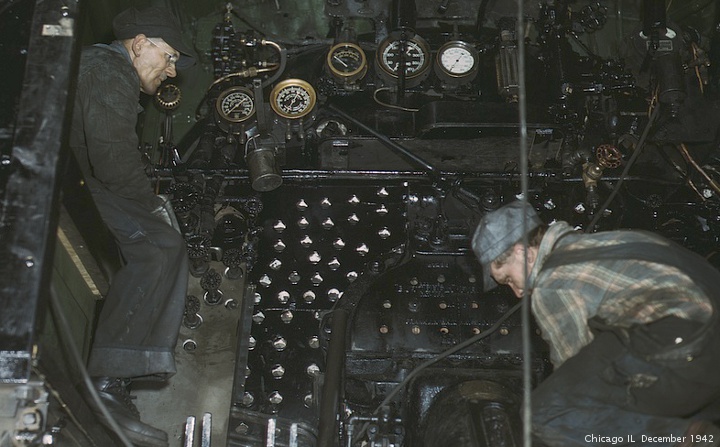
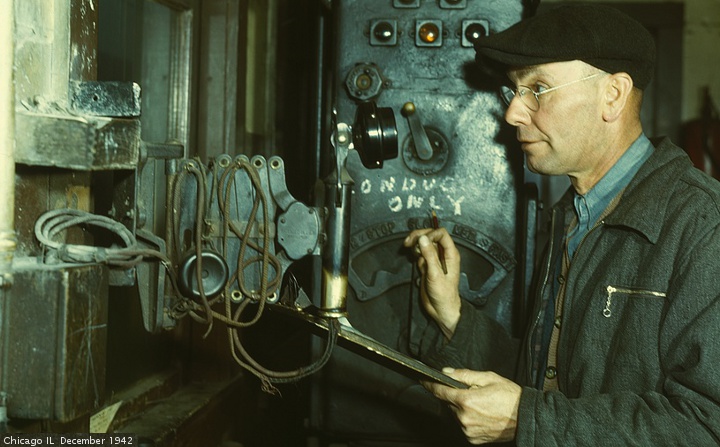
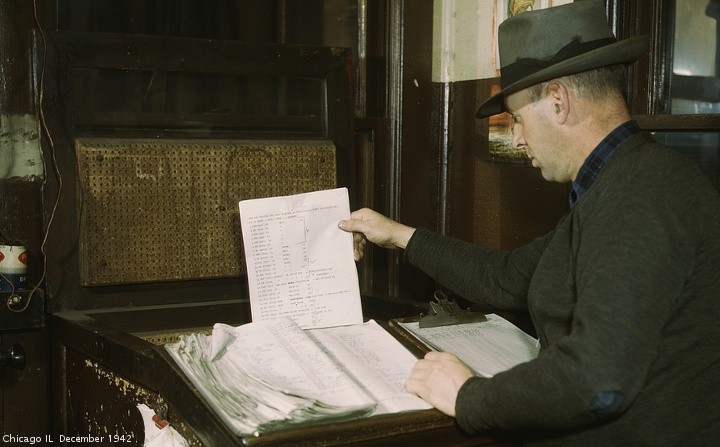
The list could go on, ond on, and on. Pictures today are from The Library of Congress. This was written like H. P. Lovecraft.


C.S. Lewis






There was a facebook link to a feature, Ayn Rand Really, Really Hated C.S. Lewis. It turns out to be verbatim droppings from Ayn Rand’s Marginalia : Her Critical Comments on the Writings of over Twenty Authors. If you are interested in details, there are the links.
Miss Rand has read more C.S. Lewis than PG. There was a copy of a CSL work at a yard sale once, which PG invested a quarter in. He read as far as the appearance of a pig named trufflehunter. Maybe it was a bad day for books, but PG put CSL down, never to make another attempt.
There was a sixth grade english teacher at Ashford Park named Mrs. Ruff. Lots of people talked about how sweet she was, but PG was not impressed. One day, between handing out mimeographed copies of poems to be memorized, Mrs. Ruff started to talk about Narnia. It was a fantastic and amazing story. With a hint of primness, she told the class that Narnia was really about Jesus.






Conversation At Starbucks






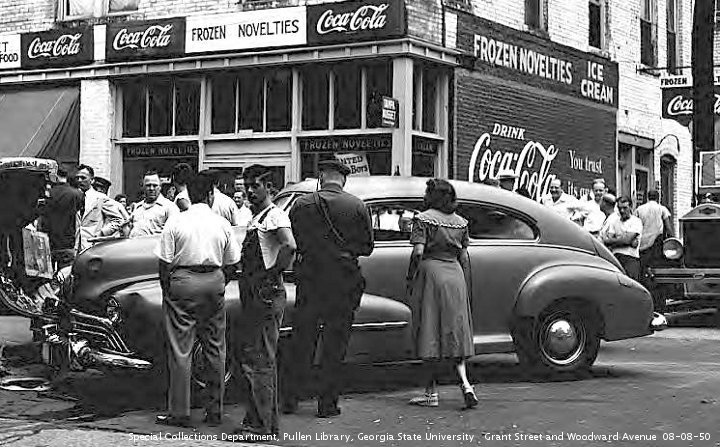
This may come as a surprise, but some of the stuff at Chamblee54 is copied from other sources. Some folks come up with things that just cannot be improved. That is why G-d invented copy paste. This story below originated at a site called World Class Stupid. Pictures are from “The Special Collections and Archives,Georgia State University Library”.
I’ve been reading a lot about how supportive parents are to their unconventional kids these days, but I never really believed it. All the stories seemed just a little too good to be true: The dad who overhears his son talking about coming out and writes him a note that says he’ll love him no matter what. The two construction workers on the subway who proudly talk about their gay sons. The mom who walks in on her son having sex with his boyfriend and responds with a lock for his bedroom door and a note saying, “I always knew you were gay and I’m fine with it! Sorry to disturb your blowjob!”
Needless to say, I was totally surprised when I witnessed a scene that makes all of them look like Pat Boone eating cheese. I’d never have believed it if I hadn’t seen it. Get the Kleenex ready as we fade in on the local Starbucks.
I was drinking a frappuccino and listening to music when two guys in white robes and pointy hoods walked in. Despite the fact they were covered from head to toe in starched white cloth, I knew beyond a shadow of a doubt they were really racist, sexist Southerners — the kind of guys who snapped towels at each other in the locker room and called guys “faggot” when they listened to Erasure over and over (even the new record!).
I always ignore people in costume since they usually ask me for candy, but this time I couldn’t help myself. The tape in my Walkman jammed just as Sheryl Crowe was going to tell me what kind of a road a day is like, and I heard Guy #1 say this: “My wife wants me to stop killing squirrels, but I don’t feel right just turning them loose after I’ve cut off their skins.” It piqued my curiosity so I put a blank tape in my Walkman and hit RECORD. Ordinarily I don’t have time to waste on meaningless strangers but I figured my Yelp review could wait.
Guy #2: That don’t sound much like Wilma. She ain’t one to spoil a good hobby.
Guy #1: She wants me to spend more time with our son Ralph, who’s fifteen and plays football.
Guy #2: How is Ralph anyway? Haven’t seen him in awhile.
Guy #1: Oh, he’s good. This year he’s quarterback.
Guy #2: He’ll definitely have the girls hanging around him now.
Guy #1: Yeah if he had any time for them.
Guy #2: Focused on football?
Guy #1: Focused on terpsichory.
Guy #2: You’re shittin’ me!
Guy #1: I kid you not. Last week he told me and Betty that he wanted to join the Bolshoi Ballet.
Guy #2: Holy Jesus on the cross. I don’t see how anybody can tolerate that parade of patriarchal cliché.
Guy #1: Amirite? Amirite? I tell ya, it hit me like a ton of bricks.
Guy #2: Well, it don’t surprise me none. He always seemed soft, even ignoring the tutu.
Guy #1: How’s Marvin Jr.?
Guy #2: Last week I caught him en pointe with his boyfriend doing a tour jeté. His sister told me he wants to sign with Martha Graham.
Guy #1: Hoo-wee! Well, we all saw that coming.
Guy #2: You’re the eighth person to tell me that. How’d everybody see it but me?
Guy #1: It was just a feelin’, Elbert. In their class photo he’s the only one pretending to be a tree.
Guy #2: I guess you’re right. But hell, Charlie — Martha Graham? Critics say her Bacchanale achieves a subtle, sublime lyricism but to me it looks like Jackie Chan fighting off locusts.
Guy #1: It definitely eschews the traditional vocabulary of dance.
Guy #2: Shit, Charlie. We both have kids who adore the dance. What do we do now?
Guy #1: We act like normal fathers. We say their tights don’t make their asses look fat and if anybody says their pirouettes are wobbly we jam potatoes into the exhaust pipes of their trucks.
Guy #1: Well, I guess Ralph and Marvin Jr. won’t be getting together like we thought.
Guy #2: I guess not. If they wanna be professional dancers, they’re gonna need significant others who can pay the rent. [LONG PAUSE]
Guy #2: Hey Charlie, you thinkin’ what I’m thinkin’?
Guy #1: I think I am, Elbert. Not here, though — at my place. I just bought a new Scriabin polonaise and all this cotton dampens the poetry of my arms.
By that point I was holding back a little tear, but then they resumed talking about squirrels. I ran home and transcribed the whole thing and posted it here. I hope it brightens your day like it brightened mine. Maybe some day I’ll post an actual copy of the tape but when I scan it it just looks like a beige stripe.






Swat Squad Saturday





I stand in the cold rain
Medicate the pain
And try to remember
To shout out timber
What the rebellion was all about
Liberty cabbage or sauerkraut
As I think about the loss
Of the loudmouth on the cross
And who did what first
And when and where and worst
I wonder if it really matters anymore
When it all seems like a chore
An abyss
Hit or miss
Thank you Lumdog
Pictures are from The Library of Congress





Ten Questions For Phoblography







The Daily Post is a WordPress facility, dedicated to “The Art and Craft of Blogging.” Recently they had a feature, Ten Questions (plus one!) for Phoblography. I decided to copy the feature, delete the published answers, and supply my own. Someone might be interested in reading this. If nothing else, this is a good excuse write some text to go between a collection of pictures. That is what text does at Chamblee54.
The extra question is about telephones with built in cameras, which PG thinks is a cool idea. When the current stupid phone wears out, a camera enabled phone might be a good idea. For the time being, the 12 button wonder phone works just fine. It was purchased at a yard sale for four dollars, and has been worth every penny. As for phoblography, it sounds like a Vietnamese Soup Magazine.
1. What’s your typical process for developing, creating, and publishing a post? There is no typical process. Text ideas come from everywhere… twitter, facebook, dead tree books, the real world. Often, I will hear something, and start thinking about it, and before long a post is on the way. I also keep a list of what I posted at this time each of the last five years, and have frequent reruns. Some posts just need to be repeated. At other times, a repost is the answer for writer’s tackle.
The pictures usually have nothing to do with the text. There are three groups of pictures. There are color photographs that I take, and edit. There are historic pictures from The Library of Congress, and “The Special Collections and Archives,Georgia State University Library”. I am usually working on editing pictures from one of these groups, and often the most recently edited pictures are chosen for the post.
So I write the text, and include links for the sources and quotes. The first draft is written in a separate wordpad document. The text is marked up with HTML. I like to use colored fonts, typically alternating shades of green for each paragraph. The pictures are selected, and moved into a folder for that date. A new post is started, and given a title. The pictures, and text, are moved into the window. The post is saved, and a preview is opened in a separate window. The text is reviewed for typos, misspelled words, and what are known as widows. A widow is a single word, in a line by itself, at the end of a paragraph. These are ugly, and can almost always be corrected. Often there is a useless phrase in the last sentence, which can be painlessly deleted. The writing is usually improved.
When the post is up to the standards of Chamblee54, it is published. The code is copied, and pasted into the word document. The link is posted on facebook, and anywhere else that is appropriate.
2. What does your blogging setup look like? What do you need to be comfortable publishing? The setup is an old desktop, on top of a butcher block table. The computer is a storebought desktop. The desk is in front of a window, overlooking the street. There is a mirror behind the monitor, so I can see the TV set on the other side of the room. I usually have a beverage, usually coffee, tea, or water. Sometimes there is background music playing. If I am writing text, the music needs to be instrumental, with no vocals.
3. Do you do much processing to your photos? Are there photo tools, apps, or software you’d recommend? I edit the hell out of pictures. I use a program called GIMP. Even if I use a self taken picture, without cropping or adjustments, I need to reduce it to 720 pixels wide. This reduces the file size. I started out with a dial up, and learned the value of having small file sizes.
4. What are your top three tips for new/amateur photobloggers? Link to your sources, don’t spill your beverage, have fun.
5. What photo equipment do you use? What would you recommend for someone who’s ready to move on from a cameraphone or a point-and-shoot camera? On the historic pictures, I have a solid internet connection. For my own pictures, I use a Nikon coolpix L24. It was on sale at Walmart.
6. How many photos do you think you take for each photo you decide to feature on the site? What’s your process for trying to capture the “perfect” shot? I take as many pictures as the occasion demands. I edit them, and put them away. There is a list of folders to be used, and I go through that list folder by folder. I also repeat good collections of pictures, often when I repeat the post.
I really don’t go for the perfect shot. The pictures I take are just fodder for the desktop. Often at events, I just shoot, shoot, shoot, and take as much garbage as I do usuable images.
7. Why did you choose WordPress.com for your site? I used blogspot until google wouldn’t let me into my account. I registered with WordPress to make a comment at a blog, and decided to try writing there. I have been very happy with WordPress .
8. Tell us five of your daily reads / favorite photography blogs. The Fishwrapper, Peach Pundit, Bloggingheads, Trifecta, Yo is this racist, and Facebook. Podcasts include 99 percent invisible, backstory, radiolab. I would rather listen to something, while I work on pictures, than read.
9. Which of your posts has had the most influence on your readers, and why? I wrote Shock And Awe Day 2013 on Monday, and it is getting a good response. None of the posts really influences anyone. A few people enjoy them, which is all I have a right to expect.
10. What are your favorite things/locations/people to photograph? Is there something you’d never feature on your blog? I like dogs, graffiti, mannequins, and ethnic diversity. In history, I like group photographs broken into individuals. Public domain is a magic phrase. I would never print the truth, the whole truth, and nothing but the truth. G-d is too busy to help me.







Mundane Stories




The group started to tell mundane stories. PG waited his turn. He had ridden his bike up Ashford Road, and saw the wife of an old friend walking. Is your name Diana, with an A, or Diane, with an E? PG was correct on his first guess. It happens that the parents of several friends had died in the last fifteen years, and PG did not hear about it.
Ashford Road is a treasure. It is a residential road, where the trees grow together in the midddle to form a canopy. The original plan for MARTA had been to connect Ashford Road with Ashford Dunwoody with an underpass. The neighborhood association was not amused.
The next person to speak said that he likes to pee sitting down. PG wondered if, truth be told, how many men would say the same thing. The convenience of piss standing is well known, but sometimes things happen when you are seated.
With a flush toilet, it is a moot point. In a composting outhouse, mixing urine with feces has unpleasant results. There are some things you learn from basic living.
Pictures are from The Library of Congress. This is written like Charles Dickens.



Singers Who Wear Wigs








If you go to google, and type in “singers that wear wigs”, the first name to appear is Mary J. Blige. PG does not follow her closely, but went to youtube and found a video. This is probably not her real hair.
Dolly Parton is known for a lot of things, at least two of which are real. The hair is not. If you ask her “How long does it take to do your hair?”, she says “I don’t know, I’m never there”
If anyone is known for enhancing her natural attributes, it would be Cher. Her fondness for plastic surgery is well known, as is the way her head fits in a hairpiece. In this number, Mrs. Bono talks about some of her favorite people.
Grace Slick is basically retired these days. In her hey day, she never appeared in public in her real hair. PG saw her at the Omni once, and was horrified by her wig. (Grace sells her paintings these days. Her white hair is cut short. The wigs are in a museum.)
RuPaul is not really blonde. That is a part of her wardrobe. In this video, she co stars with Martha Wash, in a remake of “It’s Raining Men”. The working title for this video was Piggly Wiggly.
It is a bit of show business wisdom that you put the horses at the end of a parade. Deaundra Peek fills this important role today. Last year it was a remake of “Supermodel”, which has copyright issues. Today, it is a cooking lesson. The last three characters of the Youtube code are M2M.
This is a repost. Pictures are by Chamblee54. As a bonus to our reader(s), we will explore the issue, Does Lady Gaga wear a wig? The answers are a bit contradictory, which is somehow fitting. One page says she does not wear a wig, but does wear extensions in some videos. Another answer is that dying her hair is damaging to the hair, if she went to a salon the paparazzi would see her, so yes, she does wear a wig. If you have too much free time, here is a forum discussion on this subject.







Pie Day




Today is 3-14. It is a monday, and 314 are the first three digits of pi (affectionately known as π ). It is a math thing, the number you multiply a diameter by to get the circumference. When your grammar school math teacher told you about π, she probably used 3.14, or 3 1/7. (PG went to school when Hewlett and Packard were still in the garage.)
You might also have heard the formula for the area of a circle, the racy π r squared . This means that you multiply π by the radius ( half the diameter, a line from the border to the center point), and then multiply the whole contraption by the radius again. The formula has a funny sound to it. Pie are not square, cornbread is square, pie are round. Like Sly Stone says, all the squares go home.
According to wikipedia, π seems to have been known as early as 1900 b.c. The pyramids of Egypt have a π based feature. The Greek letter π is the first letter of the Greek word περίμετρος (perimeter) . This was determined OTP.
The pyramid- π function is fairly simple. The total length of the four sides, at the base, will be the same as the height of the pyramid, times two, times π. PG likes to make model pyramids. They are 6″ tall, and the base sides are 9 3/8″. The combination of these four sides is 37 1/2″. If you multiply 6x2x3.14, you get 37.68″ The .18″ is because of a measuring error.
A lady named Eve Astrid Andersson has a page of her website dedicated to π. The only trivia question that PG understood was the first one…1. What is the formal definition of pi? …the ratio of a circle’s circumference to its diameter // 3.14159 // the radius of a unit circle // the surface area of a sphere of diameter 22/7 // a delicious dessert, especially if it contains cherries.
There is the football cheer from M.I.T. ” Cosine, secant, tangent, sine 3.14159 // Integral, radical, u dv, slipstick, slide rule, MIT!”
In 1998 a movie titled π was released. It caused brain damage in 3.14% of those who saw it. Perhaps it is not a coincidence that 1998 = 666 x 3.
π has been calculated to over five million digits. The second part of this feature are a few of those numbers. There are 82 characters in each line. This feature shows π extended to 10,165 digits. This is .02% of five million. The pictures today are from ” The Special Collections and Archives,Georgia State University Library”. This is a repost.





3.14159265358979323846264338327950288419716939937510582097494459230781640628620899
8628034825342117067982148086513282306647093844609550582231725359408128481117450284
1027019385211055596446229489549303819644288109756659334461284756482337867831652712
0190914564856692346034861045432664821339360726024914127372458700660631558817488152
0920962829254091715364367892590360011330530548820466521384146951941511609433057270
3657595919530921861173819326117931051185480744623799627495673518857527248912279381
8301194912983367336244065664308602139494639522473719070217986094370277053921717629
3176752384674818467669405132000568127145263560827785771342757789609173637178721468
4409012249534301465495853710507922796892589235420199561121290219608640344181598136
2977477130996051870721134999999837297804995105973173281609631859502445945534690830
2642522308253344685035261931188171010003137838752886587533208381420617177669147303
5982534904287554687311595628638823537875937519577818577805321712268066130019278766
1119590921642019893809525720106548586327886593615338182796823030195203530185296899
5773622599413891249721775283479131515574857242454150695950829533116861727855889075
0983817546374649393192550604009277016711390098488240128583616035637076601047101819
4295559619894676783744944825537977472684710404753464620804668425906949129331367702
8989152104752162056966024058038150193511253382430035587640247496473263914199272604
2699227967823547816360093417216412199245863150302861829745557067498385054945885869
2699569092721079750930295532116534498720275596023648066549911988183479775356636980
7426542527862551818417574672890977772793800081647060016145249192173217214772350141
4419735685481613611573525521334757418494684385233239073941433345477624168625189835 6948556209921922218427255025425688767179049460165346680498862723279178608578438382
7967976681454100953883786360950680064225125205117392984896084128488626945604241965
2850222106611863067442786220391949450471237137869609563643719172874677646575739624
1389086583264599581339047802759009946576407895126946839835259570982582262052248940
7726719478268482601476990902640136394437455305068203496252451749399651431429809190
6592509372216964615157098583874105978859597729754989301617539284681382686838689427
7415599185592524595395943104997252468084598727364469584865383673622262609912460805
1243884390451244136549762780797715691435997700129616089441694868555848406353422072
2258284886481584560285060168427394522674676788952521385225499546667278239864565961
1635488623057745649803559363456817432411251507606947945109659609402522887971089314
5669136867228748940560101503308617928680920874760917824938589009714909675985261365
5497818931297848216829989487226588048575640142704775551323796414515237462343645428
5844479526586782105114135473573952311342716610213596953623144295248493718711014576
5403590279934403742007310578539062198387447808478489683321445713868751943506430218
4531910484810053706146806749192781911979399520614196634287544406437451237181921799
9839101591956181467514269123974894090718649423196156794520809514655022523160388193
0142093762137855956638937787083039069792077346722182562599661501421503068038447734
5492026054146659252014974428507325186660021324340881907104863317346496514539057962
6856100550810665879699816357473638405257145910289706414011097120628043903975951567
7157700420337869936007230558763176359421873125147120532928191826186125867321579198
4148488291644706095752706957220917567116722910981690915280173506712748583222871835
2093539657251210835791513698820914442100675103346711031412671113699086585163983150
1970165151168517143765761835155650884909989859982387345528331635507647918535893226
1854896321329330898570642046752590709154814165498594616371802709819943099244889575
7128289059232332609729971208443357326548938239119325974636673058360414281388303203
8249037589852437441702913276561809377344403070746921120191302033038019762110110044
9293215160842444859637669838952286847831235526582131449576857262433441893039686426
2434107732269780280731891544110104468232527162010526522721116603966655730925471105
5785376346682065310989652691862056476931257058635662018558100729360659876486117910
4533488503461136576867532494416680396265797877185560845529654126654085306143444318
5867697514566140680070023787765913440171274947042056223053899456131407112700040785
4733269939081454664645880797270826683063432858785698305235808933065757406795457163
7752542021149557615814002501262285941302164715509792592309907965473761255176567513
5751782966645477917450112996148903046399471329621073404375189573596145890193897131
1179042978285647503203198691514028708085990480109412147221317947647772622414254854
5403321571853061422881375850430633217518297986622371721591607716692547487389866549
4945011465406284336639379003976926567214638530673609657120918076383271664162748888
0078692560290228472104031721186082041900042296617119637792133757511495950156604963
1862947265473642523081770367515906735023507283540567040386743513622224771589150495
3098444893330963408780769325993978054193414473774418426312986080998886874132604721
5695162396586457302163159819319516735381297416772947867242292465436680098067692823
8280689964004824354037014163149658979409243237896907069779422362508221688957383798
6230015937764716512289357860158816175578297352334460428151262720373431465319777741
6031990665541876397929334419521541341899485444734567383162499341913181480927777103
8638773431772075456545322077709212019051660962804909263601975988281613323166636528
6193266863360627356763035447762803504507772355471058595487027908143562401451718062
4643626794561275318134078330336254232783944975382437205835311477119926063813346776
8796959703098339130771098704085913374641442822772634659470474587847787201927715280
7317679077071572134447306057007334924369311383504931631284042512192565179806941135
2801314701304781643788518529092854520116583934196562134914341595625865865570552690
4965209858033850722426482939728584783163057777560688876446248246857926039535277348
0304802900587607582510474709164396136267604492562742042083208566119062545433721315
3595845068772460290161876679524061634252257719542916299193064553779914037340432875
2628889639958794757291746426357455254079091451357111369410911939325191076020825202
6187985318877058429725916778131496990090192116971737278476847268608490033770242429
1651300500516832336435038951702989392233451722013812806965011784408745196012122859
9371623130171144484640903890644954440061986907548516026327505298349187407866808818
3385102283345085048608250393021332197155184306354550076682829493041377655279397517
5461395398468339363830474611996653858153842056853386218672523340283087112328278921
2507712629463229563989898935821167456270102183564622013496715188190973038119800497
3407239610368540664319395097901906996395524530054505806855019567302292191393391856
8034490398205955100226353536192041994745538593810234395544959778377902374216172711
1723643435439478221818528624085140066604433258885698670543154706965747458550332323
3421073015459405165537906866273337995851156257843229882737231989875714159578111963
5833005940873068121602876496286744604774649159950549737425626901049037781986835938
1465741268049256487985561453723478673303904688383436346553794986419270563872931748
7233208376011230299113679386270894387993620162951541337142489283072201269014754668
4765357616477379467520049075715552781965362132392640616013635815590742202020318727
7605277219005561484255518792530343513984425322341576233610642506390497500865627109
5359194658975141310348227693062474353632569160781547818115284366795706110861533150
4452127473924544945423682886061340841486377670096120715124914043027253860764823634
1433462351897576645216413767969031495019108575984423919862916421939949072362346468
4411739403265918404437805133389452574239950829659122850855582157250310712570126683
0240292952522011872676756220415420516184163484756516999811614101002996078386909291
6030288400269104140792886215078424516709087000699282120660418371806535567252532567
5328612910424877618258297651579598470356222629348600341587229805349896502262917487
8820273420922224533985626476691490556284250391275771028402799806636582548892648802
5456610172967026640765590429099456815065265305371829412703369313785178609040708667
1149655834343476933857817113864558736781230145876871266034891390956200993936103102
9161615288138437909904231747336394804575931493140529763475748119356709110137751721
0080315590248530906692037671922033229094334676851422144773793937517034436619910403
3751117354719185504644902636551281622882446257591633303910722538374218214088350865
7391771509682887478265699599574490661758344137522397096834080053559849175417381883
9994469748676265516582765848358845314277568790029095170283529716344562129640435231
1760066510124120065975585127617858382920419748442360800719304576189323492292796501
9875187212726750798125547095890455635792122103334669749923563025494780249011419521
2382815309114079073860251522742995818072471625916685451333123948049470791191532673
4302824418604142636395480004480026704962482017928964766975831832713142517029692348
8962766844032326092752496035799646925650493681836090032380929345958897069536534940
6034021665443755890045632882250545255640564482465151875471196218443965825337543885
6909411303150952617937800297412076651479394259029896959469955657612186561967337862
3625612521632086286922210327488921865436480229678070576561514463204692790682120738
8377814233562823608963208068222468012248261177185896381409183903673672220888321513
7556003727983940041529700287830766709444745601345564172543709069793961225714298946
7154357846878861444581231459357198492252847160504922124247014121478057345510500801
9086996033027634787081081754501193071412233908663938339529425786905076431006383519
8343893415961318543475464955697810382930971646514384070070736041123735998434522516
1050702705623526601276484830840761183013052793205427462865403603674532865105706587
4882256981579367897669742205750596834408697350201410206723585020072452256326513410
5592401902742162484391403599895353945909440704691209140938700126456001623742880210
9276457931065792295524988727584610126483699989225695968815920560010165525637567856
6722796619885782794848855834397518744545512965634434803966420557982936804352202770
984294232533022576341807039476994159791594530069752148293366555661567873640053666




Six Pack Of Post This







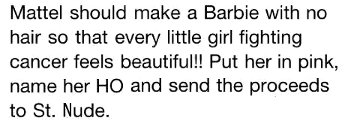

It has been two and a half weeks since this blog declared war on passive aggressive facebook graphics. This means most signs that tell you to repost this if you agree. The first six days saw one, two, three, four such posts. In the next eleven days, PG copied six offending signs. The trend shows no sign of slowing down, so there will probably be more of these posts.
There is a synchronicity of sorts in this collection. There is moms against guns, paired with a joke about a hitman. There is a fluffy piece about how people would rate you. Number four was about supporting a small business. This is a cause that gets lip service, until there is a chance to save money at Walmart.
The last two were about cancer.This is where it gets personal. PG lost both parents to cancer. While these graphics may bring hope and happiness to some, they bring pain to Brookhaven. And yes, the opinion at chamblee54 is a valid one. The feelings are just as real here as anywhere. You don’t want to be a buzzkill to the well meaning people, but sometimes you just wish they would shut up and go away.
People love to have influence over others. You are bombarded with messages, about what you should buy, how you should feel, how to be a better person, and what cause to support. It can be a drain on the soul. Some build up walls against the onslaught of messages. Some fight back, and get caught in a spiral of negativity. Others judge their neighbor on opinions, and shun those who do not measure up to a mysterious standard. Sometimes, you wish you had never learned how to read.
When the text was combined with the posters, the words only went as far as the fourth sign. The rest of the space will be filled in with random quotes.
@aurosan Perez Hilton now has a child. Please respect my privacy at this time.
@merseytart I was pro gay parenting. Then I discovered Perez Hilton had spawned
@FakeCommish I would rather be adopted by Hitler than Perez Hilton. Somebody go on a rescue mission.
@laurenpippa Perez Hilton is a dad. I am disgusted. No, not because he’s gay, but because he is a bully.
“Last, but not least, avoid cliches like the plague.” William Safire
Every situation is different. Without the specific circumstances of the event in question, it is tough to make a meaningful comment. Sometimes what you see as a stand based on principle is to someone else a selfish stunt.
He who does not understand your silence will never understand your words. -Elbert Hubbard
Other pictures are from The Library of Congress.


Tax Law






There was a bloggingheads discussion with Bob Wright and Ann Althouse. If you are worried about the visuals, it was a split screen, and they kept their clothes on. At the 12:30 mark, Ms. Althouse discussed a DOMA case that is going before the SCOTUS.
The plaintiff in question is probably Edie Windsor. “On Monday, lawyers filed a petition on behalf of Edith “Edie” Windsor, an 83-year-old lesbian from New York, asking the Supreme Court to review her case, … Windsor sued the government in 2010, after the death of her partner of more than 40 years forced Windsor to pay more than $363,000 in federal estate tax on her partner’s estate. Windsor and Thea Spyer were married in 2007, in Canada, and while New York recognized the marriage, the federal government did not. When Spyer got sick, she chose to leave her entire estate to Windsor. Had Windsor been married to a man, she would not have had to pay any estate tax, according to court documents; therefore, her suit argues, DOMA violates the equal protection clause of the U.S. Constitution.”
The rest of the discussion was lively. PG listened to the entire thing. Mr. Wright explained why there was a closed coffin when JFK was buried. Somehow, this secular twosome got onto religion. Ms. Althouse said that people believe what they want to believe. The peroxide did not seem to affect her delivery. There were no commercials.
Pictures are from “The Special Collections and Archives,Georgia State University Library”.






International Women’s Day





PG heard about International Women’s Day on facebook. A fbf friend posted a link to the event. A picture went along with that link. A lady was holding up a sign, “DISCOVER BP’S FEMININE SIDE”. The lady was smiling, and the picture was cropped so that the fingers were seen holding the picture. These fingers were in the same position, on opposite sides of the sign, pointing in. Slick.
This is not getting off to a good start. Fortunately, twitter nation is onto this. Whle BP has facebook, Chevron has the top spot on twitter. @Chevron Happy Intl Women’s Day! How will you celebrate women’s achievements? We help women start businesses. Watch:http://spr.ly/6013neXV #IWD 
@WomensHumor Happy International Women’s Day! Let us remember that we may have a long way to go, but we will always have men by the balls. #IWD
@whitehouse Statement from the President on International #WomensDay: http://at.wh.gov/izQ1H #IWD
@AnnieLennox Please watch & share: @AnnieLennox personal video message: End Gender Based Violence #IWD #MakeItHappen
@safeworld4women #IWD Child brides, female foeticide, genital mutilation: what has changed in 100 years?
@lindatheactor A man just said “Happy Women’s Day Madam” to me. I explained why I would be happy when we no longer need an #IWD. It ain’t Christmas, is it?
@DaveMc99TA :( RT @peterdaou This stat is horrendous beyond words: leading cause of death for pregnant women is homicide http://po.st/nxTsHR #IWD
@yoisthisracist khyros asked: Happy International Women’s day, dogg.
@YourAnonNewsThank the earth for women, especially on this, International Women’s Day. Thanks for everything comrades! We salute you! | #Anonymous #IWD
@BarbieStyle Happy #WomensDay, dolls! Remember… If you can dream it, you can do it. If you believe it, you can be it! #IWD pic.twitter.com/JrI5A9xr5l
@GOPunplugged Mitt Romney celebrated International Women’s Day by only firing women today.
@UNDP In some parts of the world a girl is more likely to be raped than to learn how to read. #stoptheviolence http://on.undp.org/ilA6W #IWD
And so on and so forth. Maybe the best way to celebrate International Women’s Day is to reclaim it from the oil companies and politicians. Celebrate by having a life. A woman played a key role in giving it to you. The pictures are from The Library of Congress.





Pacific Trash Vortex


It was an ISM…internet synchronicity manifestation. There was a much praised video about a plastic bag, that winds up in the Pacific Trash Vortex. The bag has a voice (supplied by uberkraut Werner Herzog), and goes looking for it’s “maker” (silently played by an unknown actress).
The bag has a remarkable existence. First, it is used to carry tennis balls, then dog food, then to pick up the by product of dog food. This is remarkable in itself… the typical krogerbag, if it doesn’t get thrown away on arrival at home, will not be used for more than one chore. But this is a special bag.
After the secondary canine duty, the bag is thrashed. Somehow, it escapes from the municipal destination, and begins a wind propelled odyssey in search of “my maker”. After a while, it is on the beach, and the wind takes it into the ocean. It floats in the sea, has pieces bitten off my non nutrition conscious fish, and heads off for a legendary garbage nirvana.
Before long, the bag is in the “Great Pacific Garbage Patch”. The GPGP is a bit north of Hawaii, and west of California. The bag movie was filmed in Wilmington, N.C. You should not think about this too long. At any rate, the bag is not happy in the GPGP, and moves on to greener pastures.
The feature linked above has a good description of the GPGP. “In the broad expanse of the northern Pacific Ocean, there exists the North Pacific Subtropical Gyre, a slowly moving, clockwise spiral of currents created by a high-pressure system of air currents. The area is an oceanic desert, filled with tiny phytoplankton but few big fish or mammals. Due to its lack of large fish and gentle breezes, fishermen and sailors rarely travel through the gyre. But the area is filled with something besides plankton: trash, millions of pounds of it, most of it plastic. It’s the largest landfill in the world, and it floats in the middle of the ocean.”
The next day, PG goes to a site called Listverse. The feature of the day is “top ten places you don’t want to visit”. Number ten on the list is the Great Pacific Garbage Patch. GPGP is either the size of Texas or twice the size of the lower 48. It is a collection of debris, largely plastic, from the world. It is held in place by a gyre. This is a place where swirling ocean currents bump up against each other.
A visit to google led to a trip to wikipedia. There is an article at Wikipedia about GPGP that is an almost verbatim source for listverse. This takes recycling a bit too far. There is also a band called Pacific Trash Vortex. The link is to MySpace, which apparently is never going away.
Plastic is a petroleum by product, and has many benefits to our world. It’s durability is one of them, and also one of it’s negatives. (The fact that plastic is so cheap to make is another.) A plastic bag cast off into the environment simply does not disappear. Fish eat them, thinking it is good food, and die of starvation. (Does this affect the food chain?) While the film about the plastic bag is an exaggeration, the fact is that plastic is forever.
The vintage photographs are from the “Special Collections and Archives,Georgia State University Library”. The poster is from Treehugger.com. This is a repost from three years ago. Very little has changed in the world of perpetual plastic pollution. It is not known whether, or not, the Pacific Trash location of the Vortex has a no idiot policy.



leave a comment