Esoteric and Pedantic



Obviously,there is something to be said for wanting to speak up, but not having anything to say. To prove that, I am going to talk about a word…esoteric. According to Wiktionary , esoteric is :”1. Having to do with concepts that are highly theoretical and without obvious practical application. 2. Understood only by a chosen few or an inner circle. 3. Confidential; private.”
The “E word” plays a role in a story from 10th grade English. We were discussing a story, “The Rocking Horse Winner”, by D.H. Lawrence. The story was, well, boring and obscure, just like most of what I have seen by Mr. Lawrence.
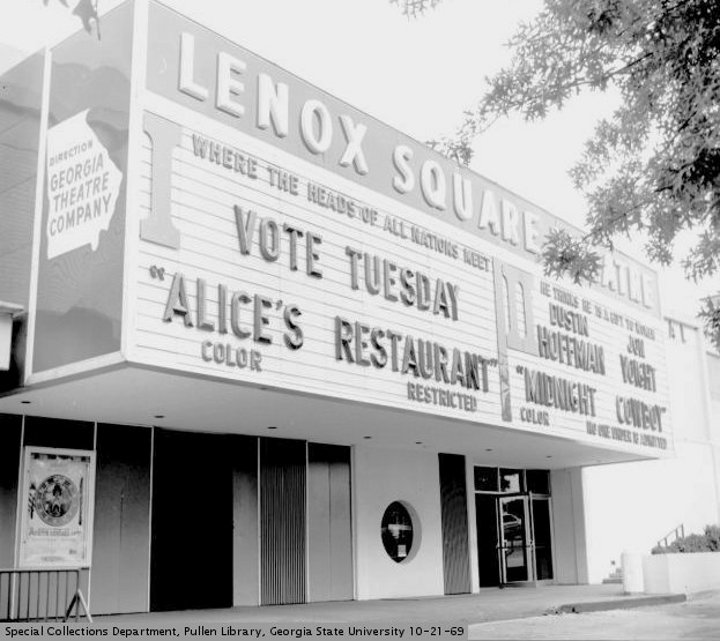
The summer after 10th grade I worked in a movie theater. The ushers wore ghastly yellow uniforms, and saw the movies over and over. When I started, the Lenox Square 2 theater was showing “Women in Love”, based on a novel my D.H. Lawrence. Glenda Jackson copped an oscar for her portrayal of Gudrun Brangwen, and young Larry Kramer was one of the screenwriters. It did not improve my opinion of D.H. Lawrence. If the censors had not touched “Lady Chatterly’s Lover” D.H. Lawrence would be forgotten today.
Back to 10th grade english. We were discussing this wretched story, and a girl raised her hand. Why would any author would write something so esoteric? The teacher had never heard of this word before, and was amazed to hear it.
The Lenox Square 2 theater was a long, slender thing with a small screen. This was in 1970. The multiplex concept had not matured. LS2 was under a grocery store. When their automatic door openers operated, you could hear the motors in the theater below. The movies the rest of the summer were Fellini Satyricon, The Christine Jorgenson Story, and The Landlord.
Back to esoteric…or did I ever go away? Before you can understand esoteric, you must plumb the depths of pedantic. “1. Like a pedant, overly concerned with formal rules and trivial points of learning. 2. Being showy of one’s knowledge, often in a boring manner. 3. Often used to describe a person who emphasizes his/her knowledge through the use of vocabulary; ostentatious in one’s learning. 4. Being finicky or picky with language.” Pedantic is an adjective that describes itself. This repost has pictures from “The Special Collections and Archives Georgia State University Library”.



The Burning Of Atlanta


Around this time 152 years ago, Atlanta was on fire. General Sherman was preparing for his March to the sea, and wanted to destroy anything of value in the city. The fire is reported as being on 11-15 of November, depending on what source you use.
The November fire was the second great fire in Atlanta that year. On September 2, the city was conquered by the Union Army. The fleeing Confederates blew up a munitions depot, and set a large part of the city on fire. This is the fire Scarlet O’Hara flees in “Gone With The Wind”.
After a series of bloody battles, the city was shelled by Yankee forces for forty days. There were many civilian casualties. General Sherman was tired of the war, angry at Atlanta, and ready for action. This is despite the fact that many in Atlanta were opposed to secession.
Click here to hear a lecture by Marc Wortman at the Atlanta History Center. Mr Wortman is the author of “The Bonfire: The Siege and Burning of Atlanta”. The hour of talk is fascinating. This is a repost. The pictures are from The Library of Congress


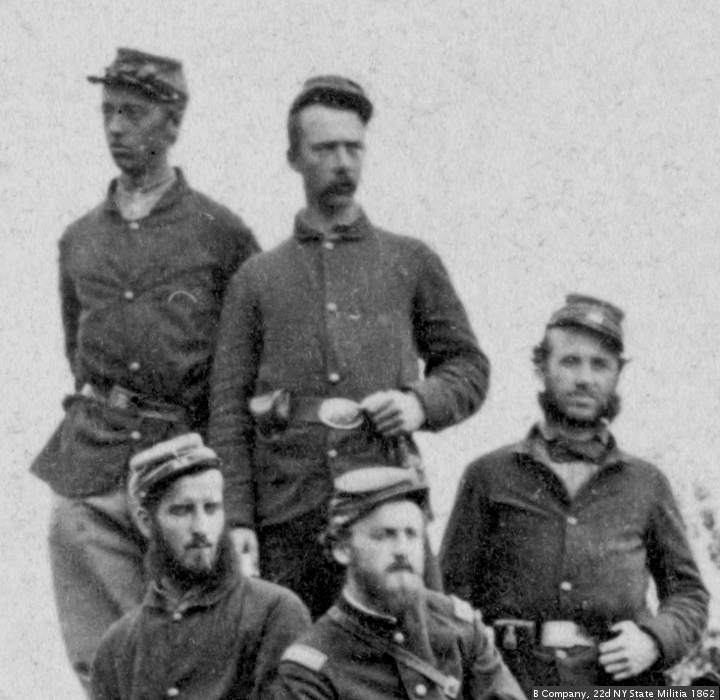
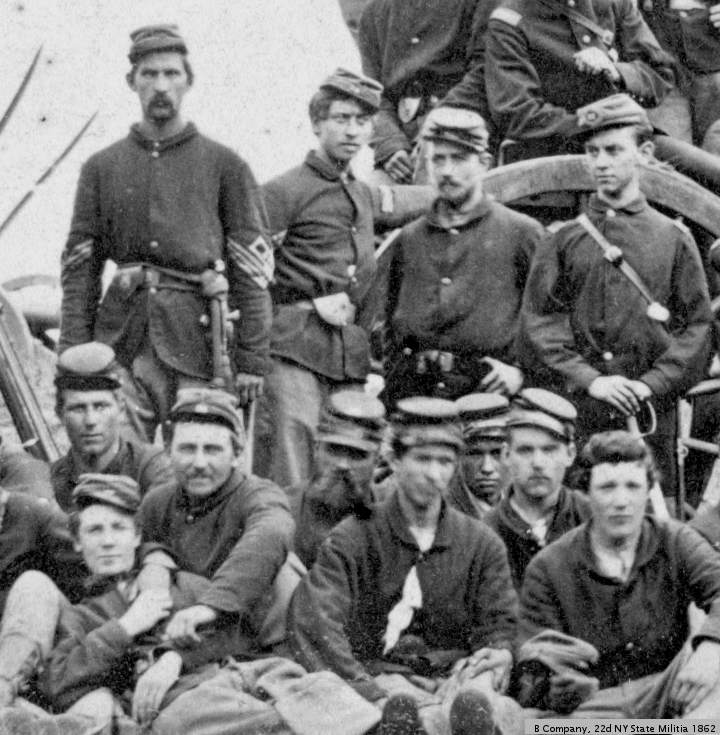


About this time every year, there is a post about the burning of Atlanta. One of the sources is a lecture by Marc Wortman. If you have an hour to spare, this talk is worth your time. One of the stories told is the tale of Mr. Luckie.
“According to folklore, two stories abound as to how Luckie Street was named. The first is that its moniker came from one of Atlanta’s oldest families, and the other, probably closer to the truth, regales the life of Solomon “Sam” Luckie. Luckie, as it turns out, wasn’t so lucky after all. When General William Tecumseh Sherman first came marching through Atlanta in 1864, Luckie, a free Black man who made his living as a barber, was leaning against a gas lamp post in downtown talking to a group of businessmen. A burst from a cannon shell wounded him; he survived, but later died from his injuries. Folklore suggests that he may have been one of the first casualties of the assault on Atlanta during Sherman’s March to the Sea, and Luckie Street, an extension of the city’s famed Sweet Auburn Avenue, was later named in his memory.”
Marc Wortman wrote a book, The Bonfire: The Siege and Burning of Atlanta. The one star review, and comments to that review, are unusually detailed. Here is a selection.
“…People forget – or were never taught in school – that most Confederate soldiers descended from Revolutionary War patriots or were up-country poor sons of farmers. Many Confederate soldiers were relatively recent new arrivals to the U.S., semi-literate dirt poor immigrants from Ireland and Scotland who’d never had the chance to own even an acre of their own land in Europe. In the mix were well-educated, elite merchant business owning French Huguenot refugees of the Catholic Bourbon genocide of Protestants. These immigrants had nowhere else to go, 9 times out of 10 never owned a slave, and fought for the CSA to keep what little they’d hardscrabble carved out over a decade of arrival into the U.S.”
The War Between The States continues to be a source of controversy. After the Charleston church killings, many comments were made about the Confederate battle flag. (If you can’t talk about gun control or mental health, you talk about a symbol.) This led to discussions about the war itself. There were ritual denunciations of slavery, which was assumed to be the sole cause of the conflict. The fact that the vast majority of white southerners did not own slaves was dismissed.
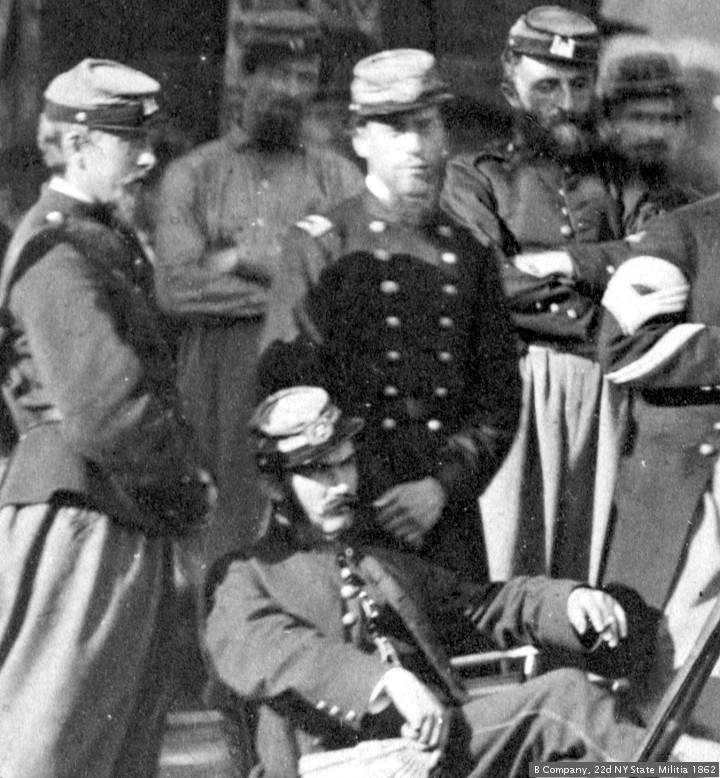
The notion of autonomous states in a federal union was novel when the United States Constitution was written. The debate over federalism versus states rights continues to this day. States that want to legalize marijuana may be the next battleground. (Few are expecting secession over bong rights.) Many in the CSA saw the Union as being a conquering army, and fought to defend their homes. While slavery was certainly a factor in the creation of the CSA, it was not the only Casus belli. Pictures today are from The Library of Congress.



Two Stories




Today’s production is two stories from 2008. PG walked down New Peachtree Road. This is Atlanta, where there are a couple of hundred roads named Peachtree. No one seems to mind that most of the peach farms are south of Macon. The peaches grow a lot better there. They fuzz comes in heavier, and the pits are pittier. One time Dagwood Bumstead asked why peaches have fuzz. His wife Blondie said, if they has arms they could shave. PG was walking down the road in the rain, with a freight train going down the tracks in a southern direction. This is forty percent of the ingredients for the perfect country and western song.
When PG was younger and drunker, there was a place on Clairmont Road called the Watering Hole. He would go there, drink beer, play pool, and have a good old time. As was the custom in such facilities, there was a jukebox. The patrons put money in the box and played the songs that they wanted to hear. A favorite was “you never even called me by my name” There is a little spoken part, where David Allan Coe talks about the perfect country and western song. This song must talk about rain, Momma, trains, trucks, prison, and gettin’ drunk.
New Peachtree Road has this gravel yard where the eighteen wheelers come and go. There was a big rig backing into place when PG walked by, and he may have heard the truck bump into a trailer. PG walked in the rain, between the train, and a big rig going bump against the trailer. The problem was, Mommas gone, PG doesn’t get drunk, and prison is way too much work. So much for the perfect country and western song.
The songwriter is Steve Goodman. He gave a show at the Last Resort in Athens GA, that a friend of PG attended. Mr. Goodman tells a story about performing on a train, during a series of concerts supporting Hubert Humphrey. It seems like Mr. Goodman had to use the restroom on the train. Now, in those days, the trains did not use holding tanks, but just ejected the matter by the tracks as they rode by. Mr. Goodman was told, do not flush the commode while the train is in the station. Mr. Goodman forgot the instructions. Mr. Humphrey said ” I am going to give the people of this country what they deserve”, Mr. Goodman flushed the commode, and sprayed the crowd.
PG told the Steve Goodman story another time. There was a comment.
Great to see your blog post that invokes Arlo Guthrie’s version of Steve Goodman’s “City of New Orleans.” Goodman often doesn’t get his due. You might be interested in my 800-page biography, “Steve Goodman: Facing the Music.” The book delves deeply into the genesis and effects of “City of New Orleans,” and Arlo Guthrie is a key source among my 1,080 interviewees.
The book also delves deeply into “You Never Even Call Me by My Name.” John Prine and David Allan Coe were key interviewees, and the book debunks the notion, promulgated by Coe, that Coe had anything to do with triggering the famous last verse of the song.
Finally, the Humphrey story actually stems from Goodman campaigning for Sen. Edmund Muskie in Florida in early 1972.
You can find out more at my Internet site . Amazingly, the book’s first printing sold out in just eight months, all 5,000 copies, and a second printing of 5,000 is available now. It won a 2008 IPPY (Independent Publishers Association) silver medal for biography. If you’re not already familiar with the book, I hope you find it of interest. ‘Nuff said!




Back to empathy for a minute. The word always takes PG back to an auditorium in Clarkston GA in 1971. PG was in his first quarter at Dekalb College. Today,the institution is known as Georgia Perimeter College. One of the selling points of college has always been the outside speakers that were brought to campus. This day, the subject was abortion.
A note on set and setting is appropriate. In 1971, New York state had legalized the abortion procedure. Roe vs. Wade was in the pipeline that would lead to the Supreme Court. That ruling would not be issued for another fifteen months. In the meantime, abortion was illegal in 49 states, including Georgia. The debate about abortions was not as politicized as today. The nomenclature of choice and life had not entered the vocabulary.
The Vietnam war was still being fought, although with fewer Americans in combat. The withdrawal of US forces took most of the steam out of the anti war movement. The modern spectacle of a person supporting a war, while claiming to be pro life, did not happen.
PG walked into the auditorium and found a seat. The lady began her presentation. After a few minutes of talk…she said something about a woman who was artificially inseminated with masturbated semen… the house lights were dimmed. A black and white film of an abortion was shown. It was noted when the fetus went into the vacuum cleaner attachment. The house lights were brought back up. They should have remained dim, as the woman was not kind on the eyes.
The closing part of her presentation was a song she wrote. She sang acapella. The song was written out of empathy with the not to be born baby. The song was titled ” My mother My grave”. PG left the auditorium, and went to world history class.







She Always Carries Jonquils

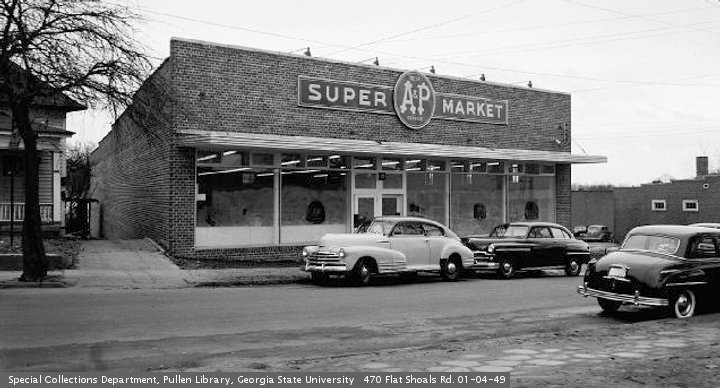

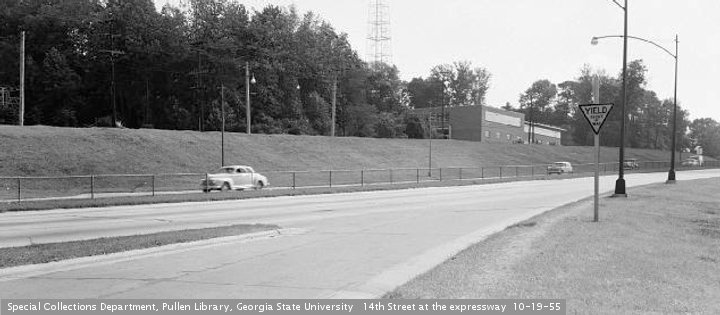
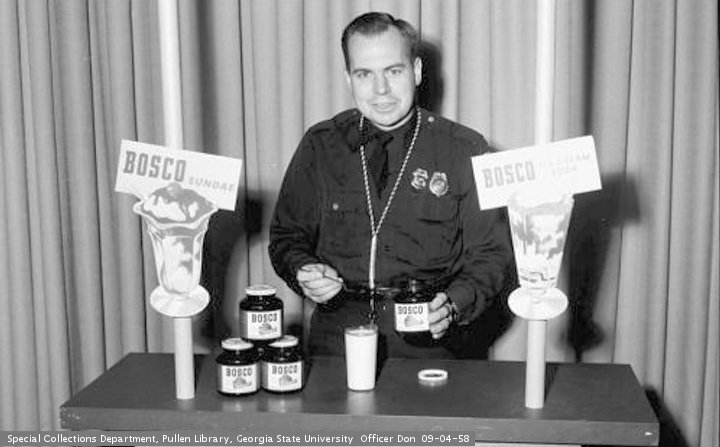
PG found Archival Atlanta: Electric Street Dummies, the Great Stonehenge Explosion, Nerve Tonics, and Bovine Laws : Forgotten Facts and Well-Kept Secrets from Our City’s Past at the Chamblee library. There are always more stories to be heard. This repost has pictures from “The Special Collections and Archives, Georgia State University Library”. It is written like Margaret Mitchell.
In the 1840s, the Western and Atlantic railroad wanted to hook up with the Central of Georgia railroad. The spot for the meeting was called Terminus. One idea was to name the town for William Lumpkin, a former Georgia Governor and a railroad executive. Lumpkinville sounded bad in the mouth, and the new town was named “Marthasville”, after the daughter of the Governor. (Martha is buried in Oakland Cemetery.) Few people liked this name, and someone decided that the feminine form of Atlantic was Atlanta. Unlike the state flag, this is unlikely to change.
The new town prospered, and recovered from the unpleasantness of 1864. In 1875, there was a problem with stray cows. The answer was the “1875 Cow Ordinance”. The law required that cows be kept in a pen at night. A fine of two dollars was assessed for every stray cow that was caught.
About this time, there were a few very busy railroad tracks going through downtown. People were getting tired of waiting for the trains to go through. One by one, viaducts were built over the tracks, creating a forgotten ground floor. This was built up into Underground Atlanta in the sixties, which was red hot for a while, then cooled off, and is now so so.
In 1897, J.W. Alexander was the first person in town to own a “horseless carriage”. One day, he decided to take a ride to East Point. A mule objected, and kicked man and machine into a ditch.
It is a rule that all history books about Atlanta have to discuss Coca Cola and Gone With The Wind. There are only so many stories to go around. This book tells of an Alpharetta farmer who bought the Tara set from MGM. He stored in a barn, the location of which was a secret. Betty Talmadge wanted to buy it, and the price went from $375k to $5k. After a while, the sale was finalized. There was only one problem…the farmer died, and never told anyone where the barn was. Mrs. Talmadge got the money from her husband’s overcoat, went to Alpharetta, and found the barn. The set was moved into another secret location, where it was in 1996, when Archival Atlanta was published, at an undisclosed local location.
Sam and William Venable owned Stone Mountain, and had a quarry there. (The Ku Klux Klan held meetings on the mountain.) (The spell check suggestion for Ku Klux is Kook Klutz.) Sam built a large granite house at 1410 Ponce de Leon Avenue, and stocked it with ammunition. He thought a race war was on the way, and wanted to be prepared. One night, a chimney overheated. The roof caught on fire. The explosives in the attic exploded, and took the roof off. The house was repaired, Mr. Venable died, and the house became part of a Lutheran church.
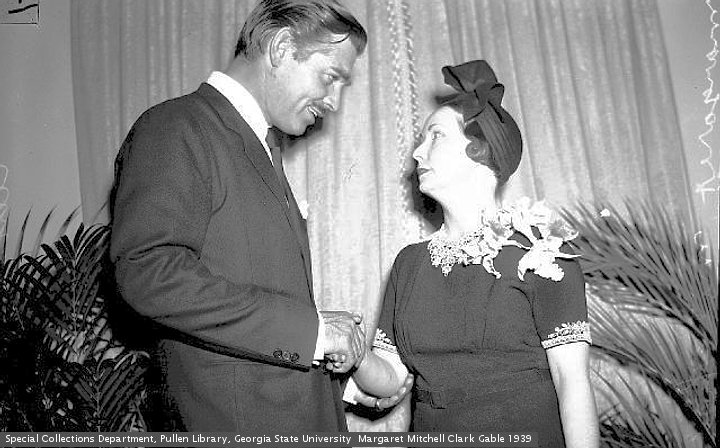
One of the few ante bellum houses in Atlanta is near Grant Park. It was once owned by Lemuel Grant, who donated the land for the park. He stays in a large marble house in Oakland Cemetery now. The Grant Park house was purchased by Mr. and Mrs. John Marsh, in partnership with Boyd Eugene Taylor. After the death of Mrs. Marsh (also known as Margaret Mitchell), she was known to visit the house. “Margaret just wanders through the house, looking things over. She never talks, and she always carries jonquils. The first night she came I was very shocked. I went out to her grave at Oakland Cemetery the next day. I’d never been to the house before. But I was almost certain of what I’d find. The plot is covered by a bed of jonquils.”


12th Street Camera
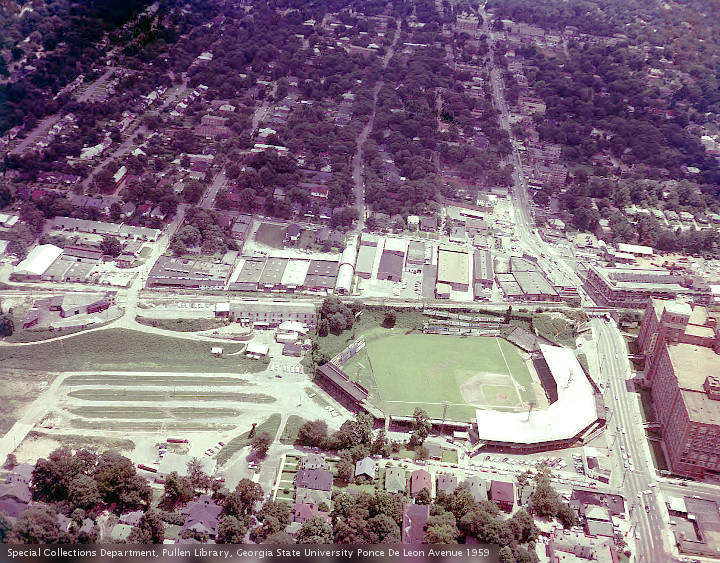
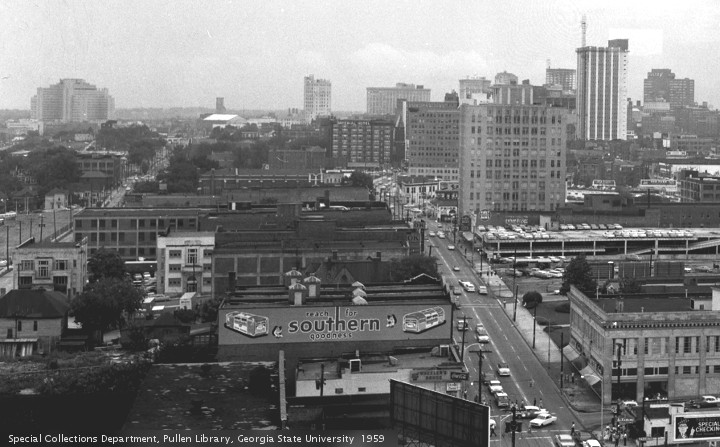
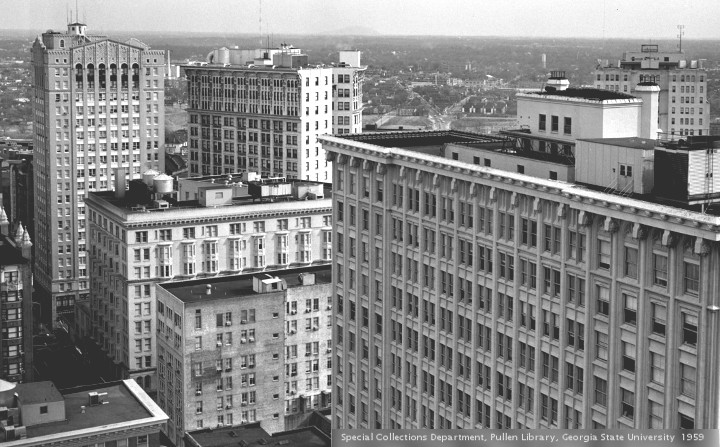
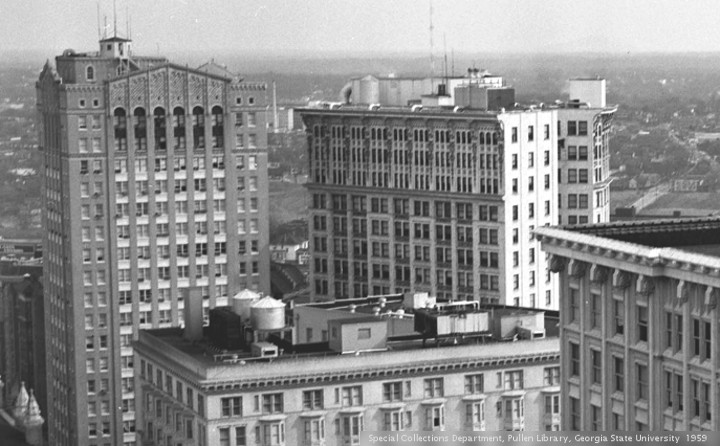
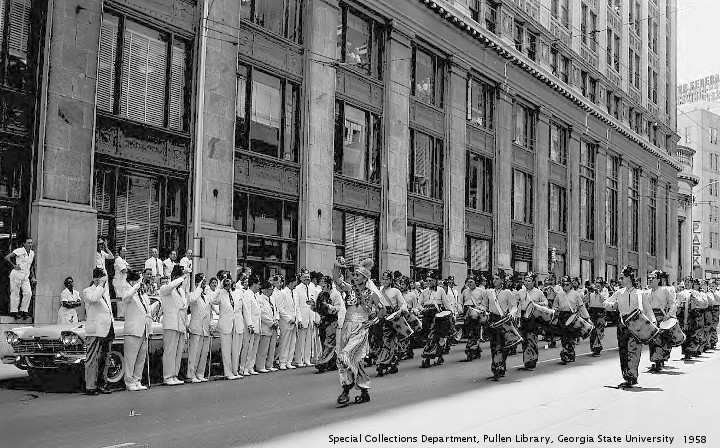
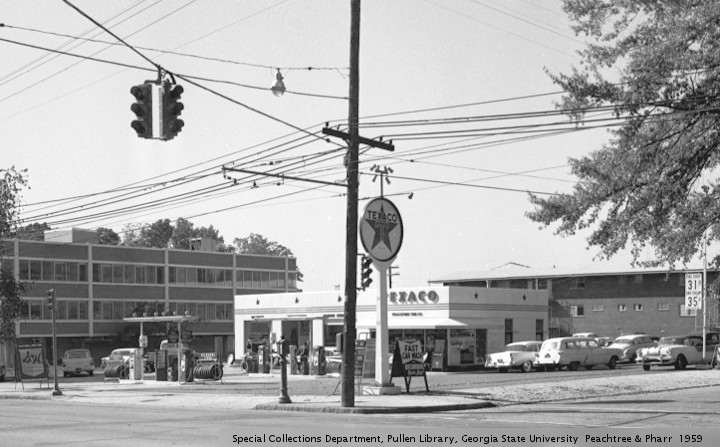


This is a repost, from six years ago. Pictures are from “The Special Collections and Archives, Georgia State University Library”. The link for the camera still works. It has a still photograph from 2010. The neighborhood below continues to change, sometimes for the better.
There is a nifty webcam up now. It shows the progress of a high rise going up now at 12th and Peachtree. The location of the camera itself is not certain, with the speculation centering on 999 Peachtree, two blocks south on Tenth Street.
A glance at the image reveals a curve in the road, between the two glass boxes under construction. Atlanta does not have wide, straight boulevards extending to the horizon. It is said that Atlanta did not build roads, but paved the cow paths.
People of a certain age will remember this area as the strip. The tenth street district was a neighborhood shopping area, up until the mid sixties. At some point, the old businesses started to move out and the hippies moved in. For a while, it was a festive party. Soon enough reality returned, and the area went into a crime filled decline.
The 999 complex is the neighborhood story in a nutshell. Before 1985, it was a block of small businesses. There was a hardware store, with the peace symbol set in tiles in the sidewalk. On Juniper Street stood the Langdon Court Apartments. They were named for PG’s great uncle Langdon Quin. Ru Paul used to stay there. He would sit out on a balcony, and wave to the traffic going by.
Across the street was a chinese restaurant, the House of Eng. A staircase on the side led to the Suzy Wong Lounge. Behind the restaurant was an apartment building. It was one of the residences of Margaret Mitchell, while she wrote “Gone With The Wind”. She called it “the dump.” It was.
PG went to the House of Eng for lunch one day in 1985. He noticed that he was the only customer in the house, at 12:30 pm on a weekday. After finishing his lunch, PG knew why.
At some point, it was decided to build a high rise there. Heery was one of the equity partners, along with a law firm and an ad agency. The building was designed by Heery (duh).The ad agency folded before the building opened, followed within a couple of years by the law firm. Heery was sold to a British company. PG does not know who owns the building now.


Richards


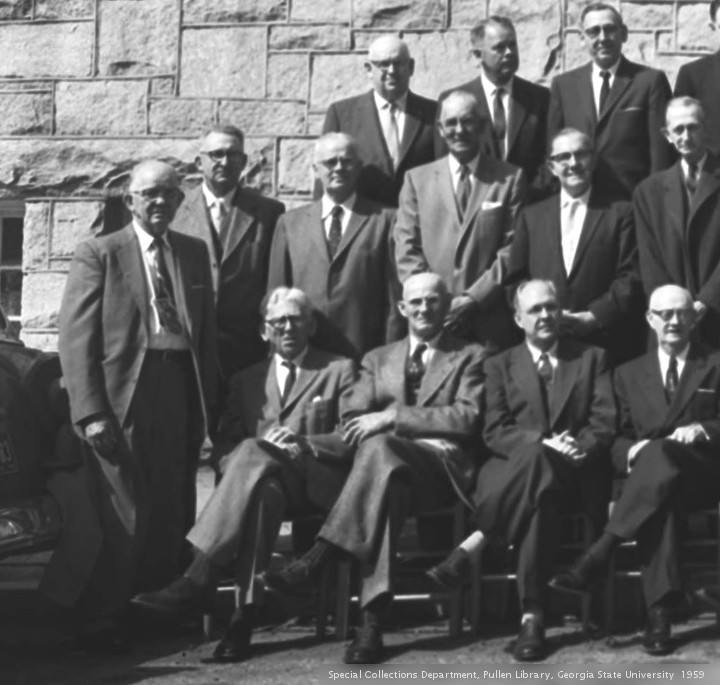
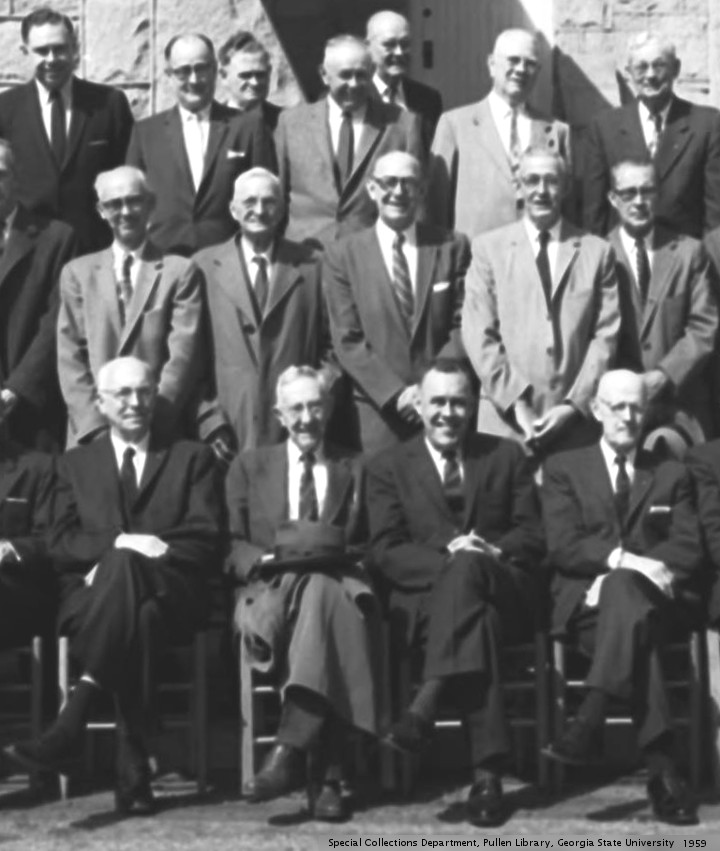
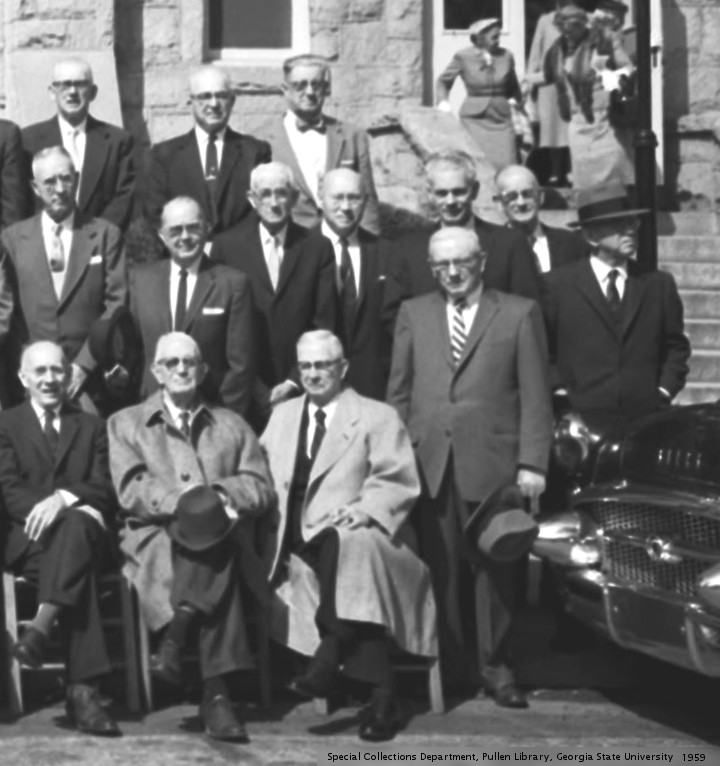
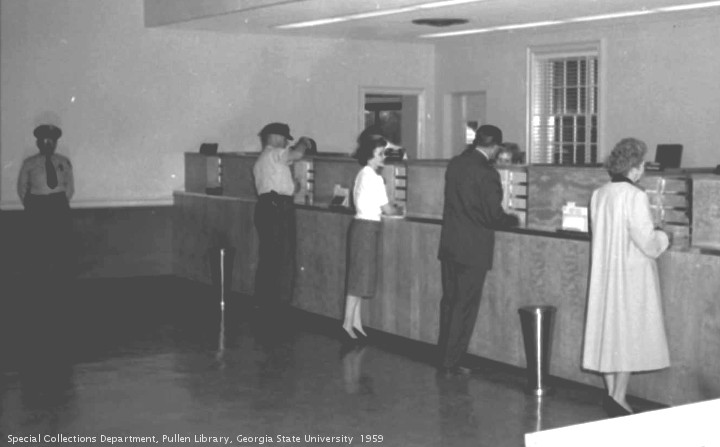
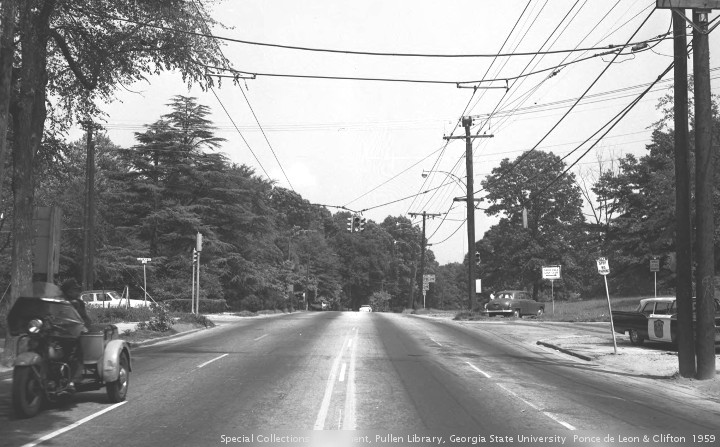
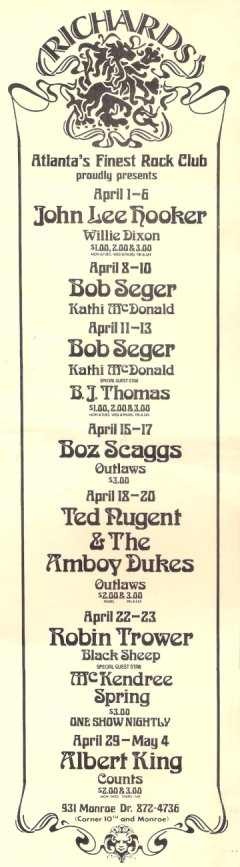
A comment at a recent post mentioned “Jenning’s Rose Room, a classic poor white juke and dance hall … where Trader Joes now sits.” PG had been in that building when it was called Richards. Pictures are from “The Special Collections and Archives, Georgia State University Library”.
There is no telling what the original use of the building at 931 Monroe Drive was. It was across the street from Grady Stadium, and adjacent to Piedmont Park. The railroad tracks that became the beltline ran behind it. The parking lot was primitive, with a marquee sign built at some point. (PG drove by that sign several nights and saw that Lynyrd Skynyrd was playing.)
 There was another nightclub building on the hill behind JRR. One night, PG went to see a jazz band there, accompanied by someone who lived in a nearby house. After seeing the band, PG was led to a horse stable behind the bar. The horses were not well maintained … you could see the ribs sticking out. There is a story of a goat getting loose from the stable, and being chased out of the jazz bar during happy hour.
Jennings Rose Room was before PG’s time. There is a story that some men had lunch there, and made a bet. The idea was to hit a golf ball from the JRR parking lot, and putt it into a hole at Piedmont Park. A biscuit was used as a tee. The first shot went across the street, onto the field at the stadium. Eventually, the ball was hit across Tenth Street, onto a green, and into the cup.
At some point, Jennings Rose Room closed. A gay club called Chuck’s Rathskeller was opened in that location. A rock and roll club or two did business there. Then Richards opened.
The first time PG was in the house was after a Johnny Winter concert at the Fox. There were rumors of visiting musicians dropping by Richards to play after their shows. Mr. Winter was only onstage for a couple of minutes after PG got there.
The most memorable trip to Richards was during the summer of 1973. The headliner was Rory Gallagher, who was ok but not spectacular. The opening act was Sopwith Camel, one of the forgotten bands of the seventies. They performed a novelty hit, “Hello Hello”. Someone in the audience liked it, and paid them to do it again. The band wound up doing “Hello Hello” five times, and said that was the most money they made in a long time.
Average White Band was making the rounds that fall, and had a show at Richards. A lot of the audience was black, and they hit the dance floor in unison when “Pick up the Pieces” was played. Fellow Scotsman Alex Harvey was in town, and joined AWB to sing “I heard it through the grapevine”.
Muddy Waters played at Richards one night. The band did most of the playing, with Mr. Waters tossing in a few licks on bottleneck guitar. He might have sang a couple of times.
About this time, Iggy Pop played a few shows at Richards. One night, someone snuck up on him, and gave him a hug. It was Elton John, wearing a gorilla suit.
PG saw three more shows (that he can remember) at Richards. Richie Havens was worth the two dollar admission. Soft Machine played in the winter of 1974. Larry Coryell played a show that summer, with the Mike Greene Band opening. PG got to talk to Mike Greene that night. The National Association of Recording Arts and Sciences (who do the Grammy Awards) had a President named C. Michael Greene at one time. PG thinks this is the person he talked to that night.
Two friends of PG went, as their first date, to see Spirit at Richards. They were married a few years later. Towards the end of 1974, Richards was running out of steam. They advertised a New Years Eve show starring B.B. King, and sold high priced tickets. When the crowd showed up for the show, they found the doors locked. Richards had closed.
The next tenant for 931 Monroe Drive was going to be Cabaret After Dark, a gay club. There was a fire the night before the grand opening. The building was never used again. Eventually, a shopping center was built on the site.
UPDATE: Here is an article, from the Great Speckled Bird, about Richards. This is a repost.




Citizen On Citizen Crime

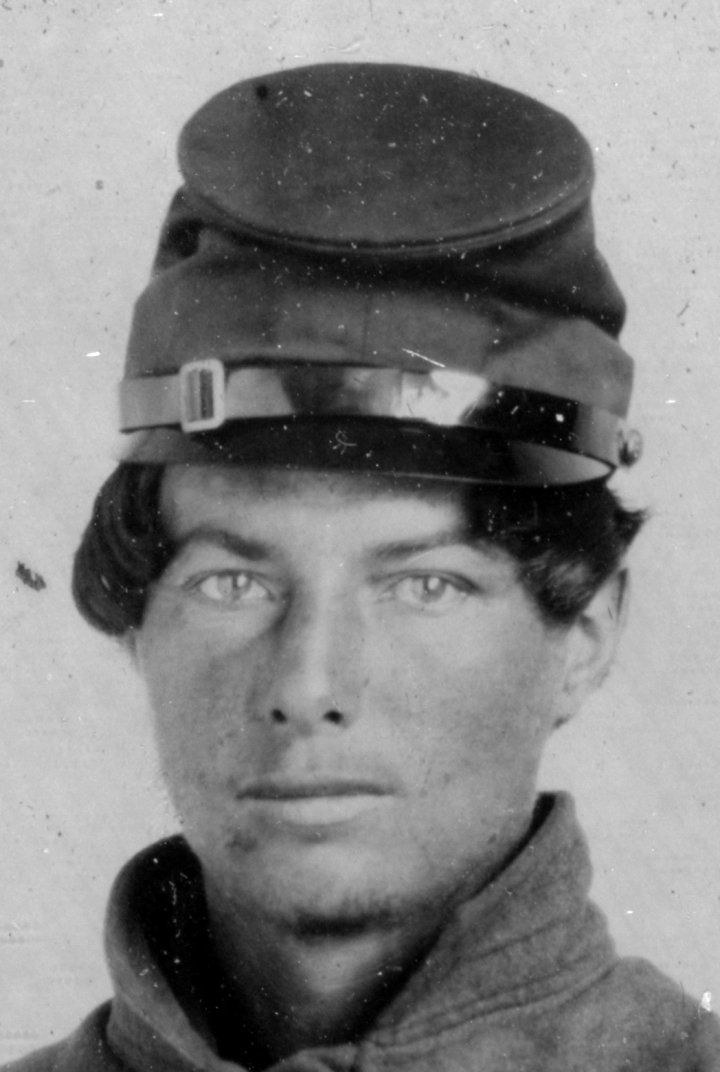

There is a lot of angry talk about police killing citizens. Freeways are being blocked, protesters are marching, and facebook is full of memes. People just don’t have the same passion when citizens kill other citizens. Pictures for this feature are from The Library of Congress.
What follows is a list of citizen on citizen shooting. These links were taken from WSB TV. This is one week, in one metro area. For the purposes of this report, the race of the participants will not be discussed. If you want to know what color the people are, you can click on the link.
Man shot, killed in argument outside gas station Two men were dating the same woman. After the incident. the shooter asked bystanders to call the police. Gwinnett County.
Bryce McCallum was shot to death by his stepfather. Cherokee County
Journey Jones was killed at a Stone Mountain apartment complex. Police say the shooting may be drug related. A friend of the victim says it may be gang related.
Gloria Starr-Armour was caught in crossfire, while waiting to get in her Hapeville apartment complex.
Antonio Gray was shot dead in Union City. “… interviewing witnesses to sort out what happened.”
Robert Troy Phillips and Heather Phillips were found shot to death in their Hall County home. Mr. Phillips was “a former Hall County commission candidate.”
Girl, 14, shot at party in DeKalb County; Somebody was asked to leave a party for middle school kids. Later, someone arrived at the house, and started shooting. The young lady is going to recover.
Police: Homeowner shoots, kills break-in suspect Gwinnett County
Man found shot to death behind daycare. Cobb County

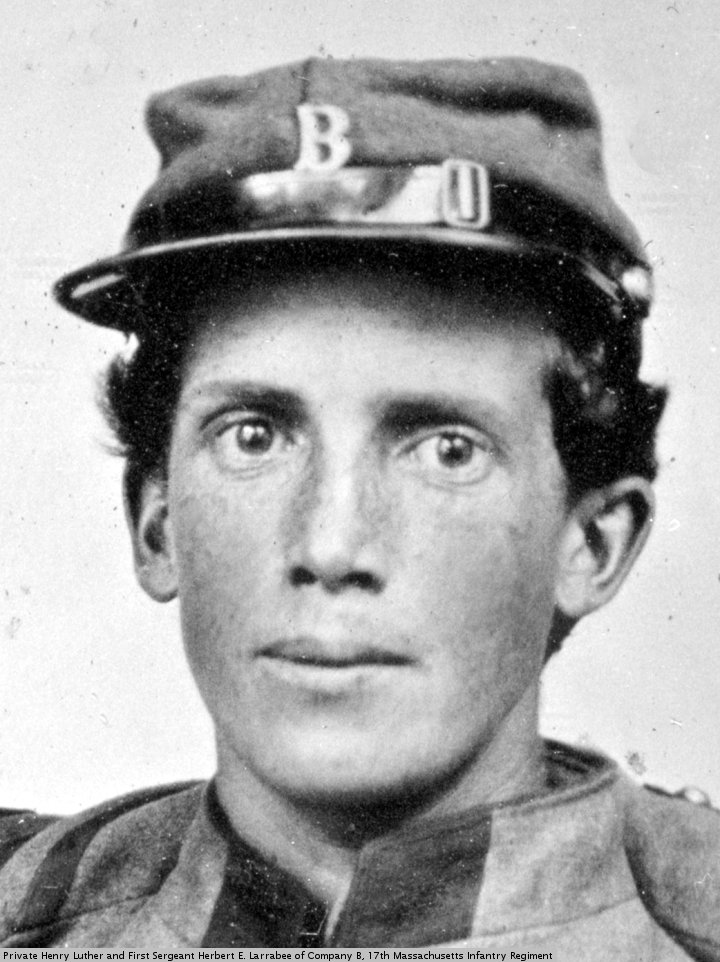
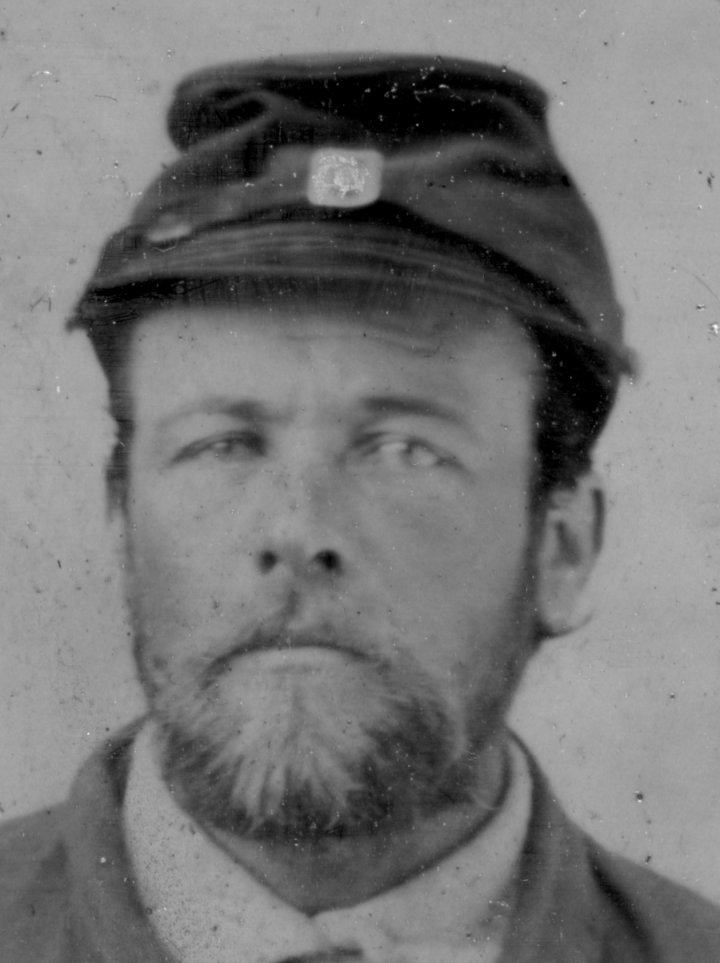


Babe, Hank, Barry, And Joe
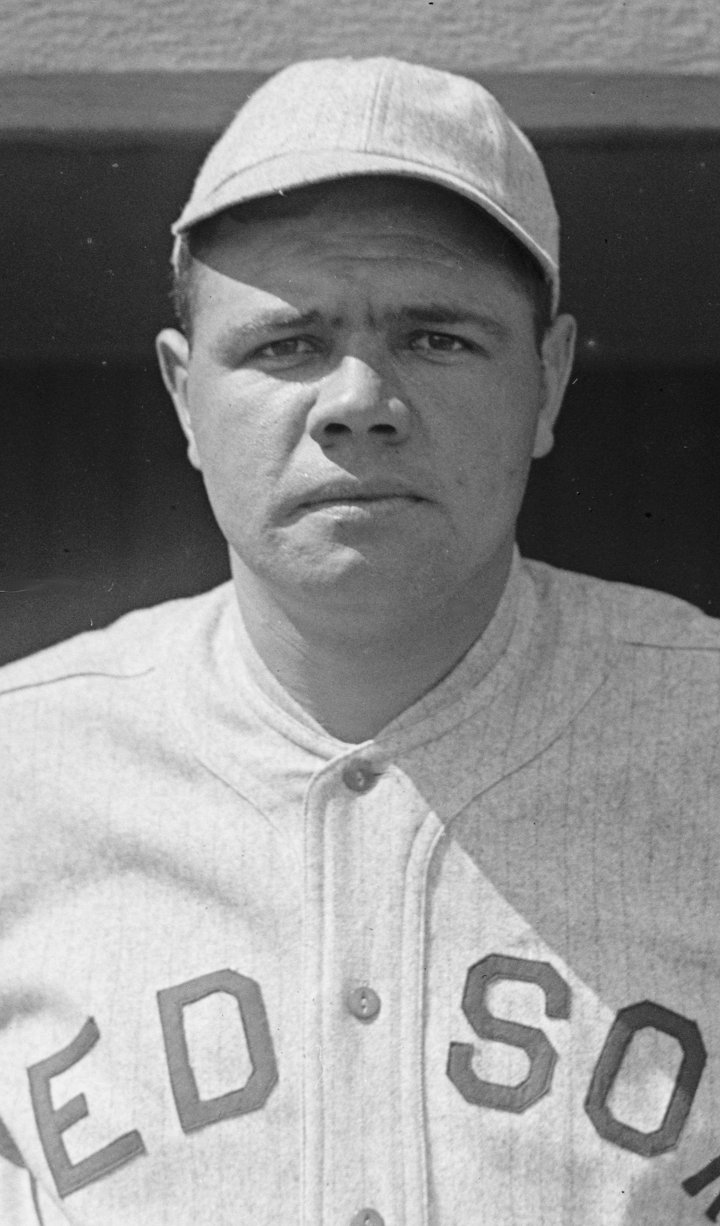
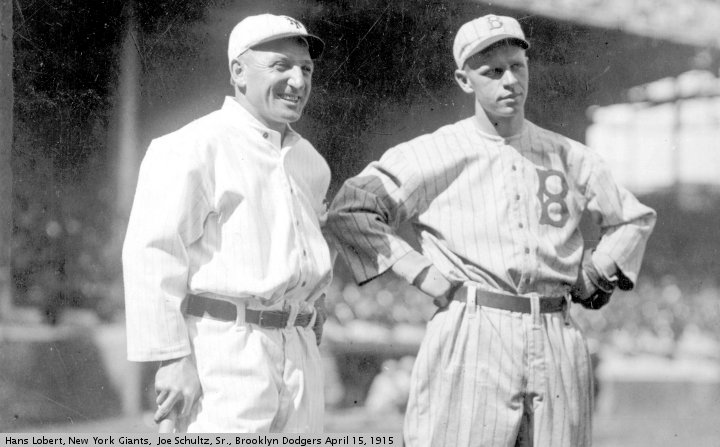


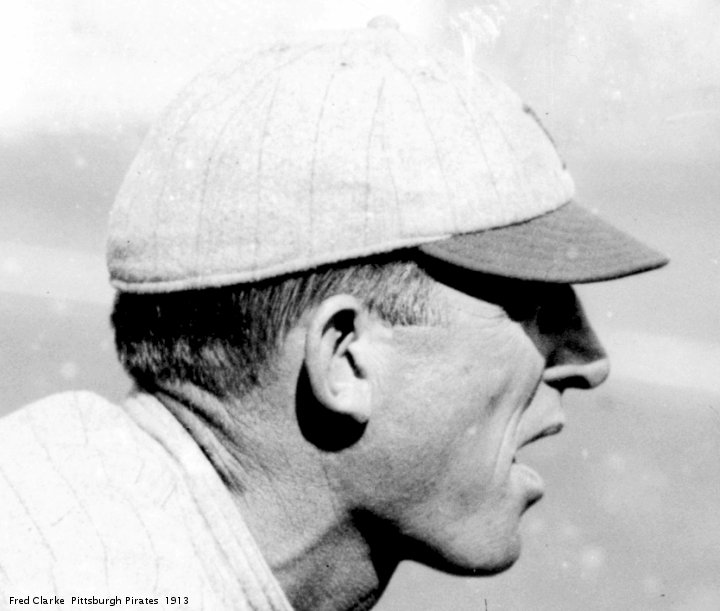

Barry Bonds was about to break the lifetime record for home runs. Folks said the record was tainted because of steroid use, and because Mr. Bonds was not a nice man. There were calls for an asterisk in the record book. This was odd to PG, who was in Georgia when Hank Aaron broke the home run record in 1974. Back then, the line was that Babe Ruth had fewer at bats than Mr. Aaron. A lot of hateful things were said about Mr. Aaron before home run 714.
PG decided to take a look at the metrics. This post is the result. As a bonus to the reader(s), Joe Torre and Hank Aaron gets a summer rerun. It is based on a column by Furman Bisher, who went to the press box in the sky March 18, 2012. Pictures are from The Library of Congress. This is a repost.
There is a certain controversy these days about the eminent breaking of the lifetime home run record. Currently held by Hank Aaron, the record is threatened by Barry Bonds. Before Mr. Aaron held the title, Babe Ruth was the owner.
Controversy about the lifetime home run record is nothing new. In 1974, when Hank Aaron was about to break the record, the admirers of Babe Ruth said that Mr. Ruth had fewer at bats than Mr. Aaron did. Many attributed this criticism to racism, with a black man besting a white man’s record. The current controversy is two fold. There are allegations that Mr. Bonds took steroids to make him stronger, and that he “cheated”. There are also concerns about the personality of Mr. Bonds.
PG does not think steroid use is a big deal. Ballplayers are abusing their bodies to perform, and if they take the risk of using steroids, that is their business. Many people disagree.
A good question to ask is, would Babe Ruth and Hank Aaron have used steroids if they had the chance? Mr. Ruth was a wildman, who drank during prohibition, and was known for undisciplined behavior. Mr. Aaron played in an era where steroid use was not as common as it is today. The answer to the first question is (Mr. Ruth) probably and (Mr. Aaron) who knows.
While you are keeping hypocrisy statistics, Mr. Aaron and Mr. Bonds played on television, where beer commercials were constant. While alcohol is legal, it is a very damaging drug. Any ballplayer who plays on television promotes its use. This is both steroid users, and non users.
As for personalities, there is the widely circulated story about the college team that Mr. Bonds played on voting 22-3 to kick him off the team. At the very least, he does not charm sportswriters.
In 1917, Babe Ruth was suspended for hitting an umpire. He was known for his outlandish behavior throughout his career. It should also be noted that he played in an era when the press did not scrutinize the behavior of players. How would today’s media treat Babe Ruth?
PG once heard a radio show caller say that Hank Aaron was a mean racist, who would just as soon cut your throat as look at you. He had never heard this said out loud before, but had heard hints about Mr. Aaron’s personality over the years. People who achieve great things are not always friendly.
Mr. Aaron is the only one of the three that PG met, however briefly. In July of 1965, the Milwaukee Braves came to Atlanta to play an exhibition game in Atlanta Stadium. After the game, PG was allowed to wait outside the clubhouse, to get autographs from the players as they left. Joe Torre saw the crowd, hid behind a truck, and made a quick getaway. Hank Aaron came out, patiently signing every autograph, while smoking a cigarette.
The fact is, all three men played in different eras. Babe Ruth never played at night, never flew to California, and only played against white players…many of the most talented players of his era were in the Negro League. Hank Aaron played before free agency, interleague play, the DH, and widespread use of steroids. The only way to determine who is the home run champion is to count how many homers are hit, and award the prize to the man who hits the most.
Which of the three made the most money? Barry Bonds, by a wide margin. He played in the free agent era. Babe Ruth had the best line about his salary. In 1930 Ruth was asked by a reporter what he thought of his yearly salary of $80,000 being more than President Hoover’s $75,000. He replied “yea, but I had a better year than he did.”
Who played on the most teams to win a World Series? Babe Ruth 7, Hank Aaron 1, Barry Bonds 0.
The career of Babe Ruth was a long time ago. He made a greater impact on America that the other two combined. He was one of the first sports superstars, as America emerged from the carnage of World War One. Mr. Ruth broke the single season home run record, he hit 29 homers. The next year, he hit 54. There is a possibility of a livelier baseball.
Babe Ruth captured the imagination of America like few personalities ever have. Playing in New York (which dominated the press) did not hurt. He was a man of his times…it is unlikely than anyone could have that kind of impact on today’s superstar saturated America. While his record has been broken, his place in the history of baseball is the same.
UPDATE: As of July, 2016, the lifetime home run leaders were: Barry Bonds, 762, Hank Aaron, 755, Babe Ruth, 714, Alex Rodriguez, 696. Mr. Rodriguez is said to have used steroids.


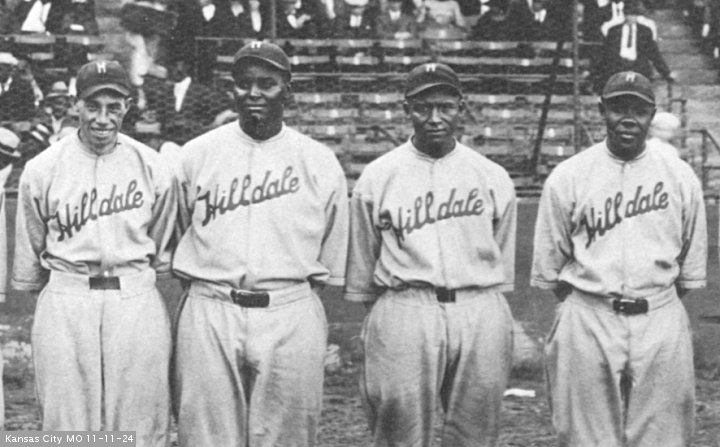
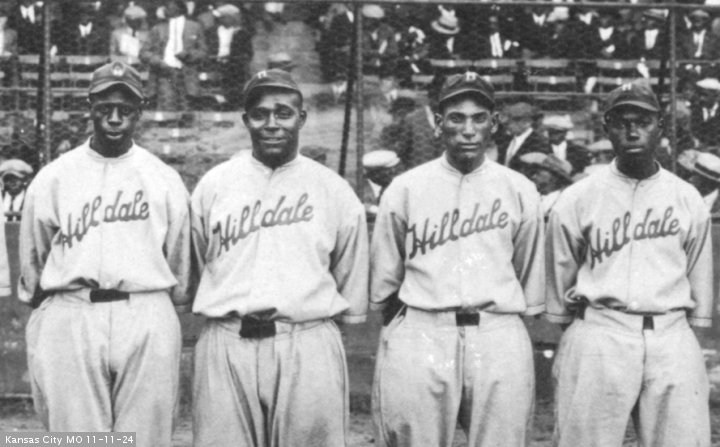

Furman Bisher has a piece at the fishwrapper site about Joe Torre. (The link no longer works.) The punch line is that Mr. Torre “grew up” when the Braves traded him to St. Louis. PG was a kid when this was going on, and did not hear a lot of what went on.
In 1965, the Braves played a lame duck year in Milwaukee before moving to Atlanta. One night, there was an exhibition game at Atlanta Stadium, the Braves against the Yankees. PG got his oh so patient dad to take him to the clubhouse after the game, to get autographs. In those days, you could go into the bowels of the stadium and wait outside the locker room. Hank Aaron signed dozens of autographs while smoking a cigarette. Joe Torre came out, hid behind a truck, and took off running.
Mr. Torre was a raccoon eyed catcher for the Braves. In the first regular season game in 1966, he hit two home runs, in a thirteen inning loss. Soon, the novelty of big league baseball in a toilet shaped stadium wore off. Mr. Torre got at least one DUI, and a reputation as a barroom brawler. He was traded to St. Louis in 1968. Mr. Torre hit .373, and won the national league MVP in 1971.
The comments to the feature by Furman Bisher were interesting. Cecil 34 contributes “The reason that Torre was traded is because on the team’s charter flight back to Atlanta back in 68, a drunken Torre got into a fistfight with Aaron. Aaron popped off to Torre, and thus the fight was on, broken up by the other players. Since Aaron was the face of the franchise at the time, Torre was traded. There had been bad blood between them for years before this incident anyway. Reasons vary. But the final nail in the coffin was this fistfight. I was told Torre could pack a punch and Aaron came out on the worse end of it.”
There has been whispering for years about Hank Aaron and his attitude. Furman Bisher made hints once or twice, but there was never anything of substance. It seems that Mr. Aaron does not lack for self confidence. Mr. Aaron was the subject of much racially based abuse while chasing the home run record in 1973, and some anger is justified.
Hank Aaron was known to not get along with Rico Carty. Mr. Carty is a dark skinned man from the Dominican Republic, who was popular with fans. Mr. Carty was eventually traded. Rico Carty had a barbecue restaurant on Peachtree Road in Chamblee, next door to the Park and Shop.
Joe Torre was the manager of the Braves in the early eighties. The team won a divisional title in 1982, but lost the NLCS. This was after Ted Turner bought the team. Mr. Turner fired Mr. Torre in 1984.
Getting back to the comment thread, Misterwax contributes “Turner cut Joe Torre loose because Ted was in love with Henry Aaron and Aaron thought Joe Torre was a white supremacist….A hangover from the clubhouse days when they were teammates…still does today. And THAT is the only reason he was cut…because Hank Aaron said so.”
Hank Aaron was recently quoted on Barry Bonds and Steroids. Joe Torre retired as manager of the Los Angeles Dodgers in 2010. He won four World Series as manager of the New York Yankees. Furman Bisher outlived Bear Bryant by 26 years, passing away March 18, 2012. Selah.



Monroe Drive or Boulevard



It is an Atlanta cliche. Boulevard turns into Monroe Drive because one was black, and the other white. The white people did not want to live on a street with the same name as the black neighborhood. You hear this all the time, with very little explanation. It is plausible. At one time, Ponce de Leon Avenue was a dividing line between the white, and black, neighborhoods. There are, however, a few questions about this name change business.
In the space between I-85 and Dekalb County, there are four streets that change names when they cross Ponce De Leon Avenue. These are Juniper/Courtland, Charles Allen/Parkway, Monroe/Boulevard, and Briarcliff/Moreland. Several streets cross Ponce without changing names, including Spring Street, Peachtree Street, Piedmont Avenue, and North Highland Avenue.
Four thoroughfares are affected by the Ponce rebranding. Juniper/Courtland is mostly commercial, at least south of Ponce. Briarcliff/Moreland is mostly white until you get to the railroad tracks south of Little Five Points. When Moreland Avenue goes under the MARTA line, the neighborhood is Reynoldstown….which was not named for Burt Reynolds.
Charles Allen/Parkway does change from white to black at Ponce. The street name then changes to Jackson Street, the original name, at Highland Avenue. Monroe/Boulevard also goes from white to black at Ponce. However, when you cross the railroad tracks, Boulevard goes through Cabbagetown, a white neighborhood. Boulevard residents change color several times before the road dead ends at the Federal Prison. Oakland Cemetery, and Zoo Atlanta, do not play a role in this drama.
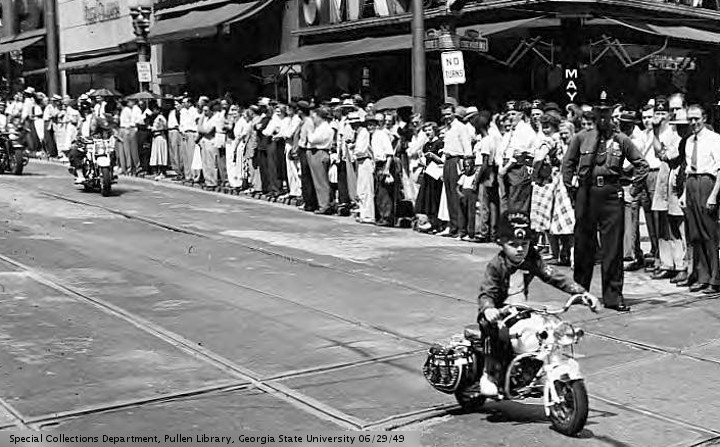
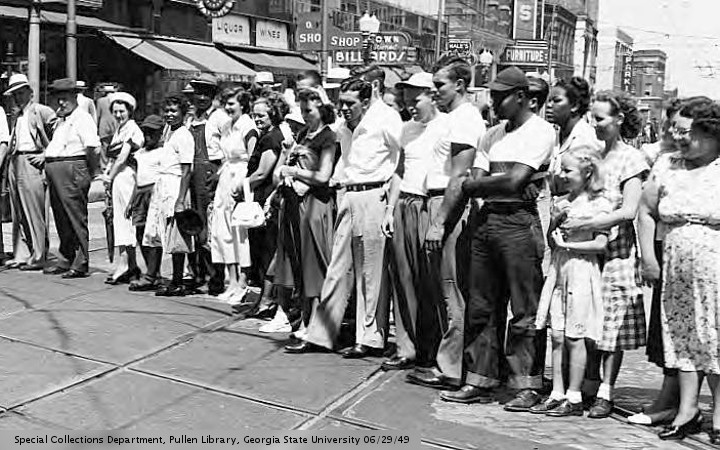
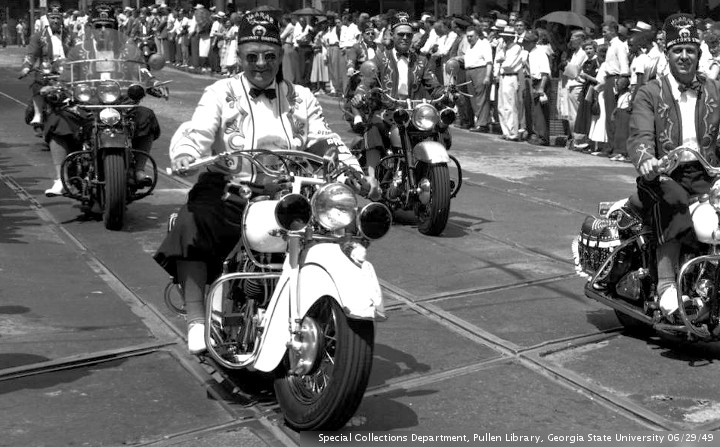
If this litany of street names is boring, it is all right to skip over the text. The pictures today are from “The Special Collections and Archives, Georgia State University Library”.
Roads change names all over the metro area, for a variety of reasons. In the area between Ponce De Leon Avenue and I 20, there are roads that change at railroad tracks (North Highland/Highland, Krog/Estoria.) Others change at Highland Avenue (Parkway/Jackson, Glen Iris/Randolph) or Decatur Street (Hilliard/Grant, Bell/Hill.) Some of these changes are racially motivated, while others are not. Some make sense, while most do not.
No one seems to know when this Monroe/Boulevard thing happened. An 1892 “Bird’s eye view” shows Boulevard sailing off into the horizon, past a racetrack in today’s Piedmont Park. A 1911 map shows Boulevard starting near “L.P. Grant Park,” and sailing past Ponce up to Piedmont Park. A 1940 map shows Boulevard going past Park Drive, only to turn into Monroe Drive at Montgomery Ferry Road. Finally, a 1969 map of “Negro Residential Areas” shows Monroe Drive changing into Boulevard at Ponce De Leon Avenue, like it is today. Boulevard is a stand alone street name at all times.
If anyone knows about this name change business, please leave a comment. It would be interesting to know when these changes were made, and what government agency made them. Google has not been helpful, except for pointing the way to several map collections.




How To Live In Atlanta

Atlanta is composed mostly of one-way streets. The only way to get out of downtown Atlanta is to turn around and start over when you reach Greenville, South Carolina. All directions start with, ‘Go down Peachtree’ and include the phrase, ‘When you see the Waffle House’. ’Except in Mayretta , where all directions begin with, “Go to the Big Chicken”
Peachtree Street has no beginning and no end and is not to be confused with: Peachtree Circle, Peachtree Place, Peachtree Lane, Peachtree Road, Peachtree Terrace, Peachtree Avenue, Peachtree Battle Road, Peachtree Corners, New Peachtree, Old Peachtree, West Peachtree, or Peachtree Industrial Boulevard. Atlantans only know their way to work and their way home. If you ask anyone for directions, they will always send you down Peachtree.
Only a native of Atlanta can pronounce Ponce De Leon Avenue, so do not attempt the Spanish pronunciation. People will simply tilt their heads to the right and stare at you. The Atlanta pronunciation is ‘pawntz duh LEE-awn.’ There is a street named simply, ‘Boulevard.’It becomes Monroe Drive when you cross Ponce de Leon.
The 8 am rush hour is from 6:30 to 10:30 AM. The 5 pm rush hour is from 3:00 to 7:30 PM. Friday’s rush hour starts Thursday afternoon and lasts through 2 am Saturday. The falling of one raindrop causes all drivers to immediately forget all traffic rules. If a single snowflake falls, the city is paralyzed for three days. It’s on all the channels as a news flash every 15 minutes for a week. Overnight, all grocery stores will be sold out of milk, bread, bottled water, toilet paper, and beer.
I-285, the loop that encircles Atlanta, has a posted speed limit of 55 mph (but you have to maintain 80 mph just to keep from getting run over.) It is known as The Perimeter, and the Watermelon 500. In Atlanta you are either ITP (Inside the Perimeter) or OTP (Outside the Perimeter). ITP and OTP people are wary of each other. Don’t believe the directional markers on highways: I-285 is marked East and West but you may be going North or South. The locals identify the direction by referring to the ‘Inner Loop’ and the ‘Outer Loop. Some call the whole dern thing “The Fruit Loop.”
Possums sleep in the middle of the road with their feet in the air. There are 5,000 types of snakes and 4,998 live in Georgia. There are 10,000 types of spiders. All 10,000 live in Georgia, plus a couple no one has seen before. If it grows, it sticks. If it crawls, it bites. If you notice a vine trying to wrap itself around your leg, you have about 20 seconds to escape, before you are completely captured and covered with Kudzu. It’s not a shopping cart, it’s a buggy. ‘Fixinto’ is one word (I’m fixinto go to the store.) Sweet Tea is appropriate for all meals and you start drinking it when you’re 2 years old. ’Jeet?’ is actually a phrase meaning ‘Did you eat?’ ’Momma-nem’ means: How’s Mother and all of the other children and other members of the family doing.
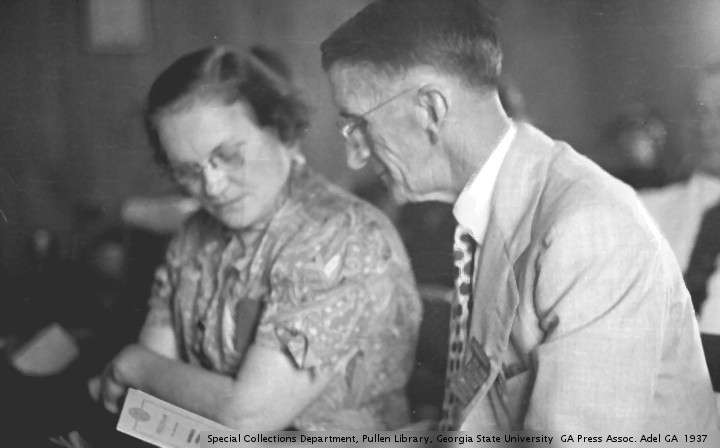
This was written by someone else. Pictures for this entertainment are from “The Special Collections and Archives, Georgia State University Library”. A typical caption: “Member of the Georgia Press Association, during their 51st annual convention, in Adel, Georgia, September 15-18, 1937.”



#PiedmontParkHanging Part Two
Last week, an apparent suicide was found in Piedmont Park. Soon, the twitter people were in an uproar. Rumors were spreading at the speed of light. People said that it was a lynching, and that the KKK held a rally in the park the day before. Others said the klan was handing out flyers.
At first, the corporate media was quiet. WSB TV tweeted we do not report suicides. There are sound reasons for this. Copycat suicides… a depressed person deciding to take their life, after hearing about another person taking this step … is a problem. There is also the decent consideration of privacy. If a person is in such a bad way that they want to take their life, the corporate media should allow them a measure of peace. There are other stories to report.
The name of the young man has been released. Apparently, there were health issues, and a family that did not accept him. The medical examiner reports evidence indicating a suicide, with no sign of foul play. The FBI agrees with the APD… this was not a lynching.
One of the more striking rumors was that the park was a known meet-up spot for the infamous hate group. This referred to the KKK. Most Atlanta residents find the idea of KKK rallies in the park to be absurd. And yet, people swallowed these rumors without a shred of supporting evidence. If someone says so on twitter, then it must be true.
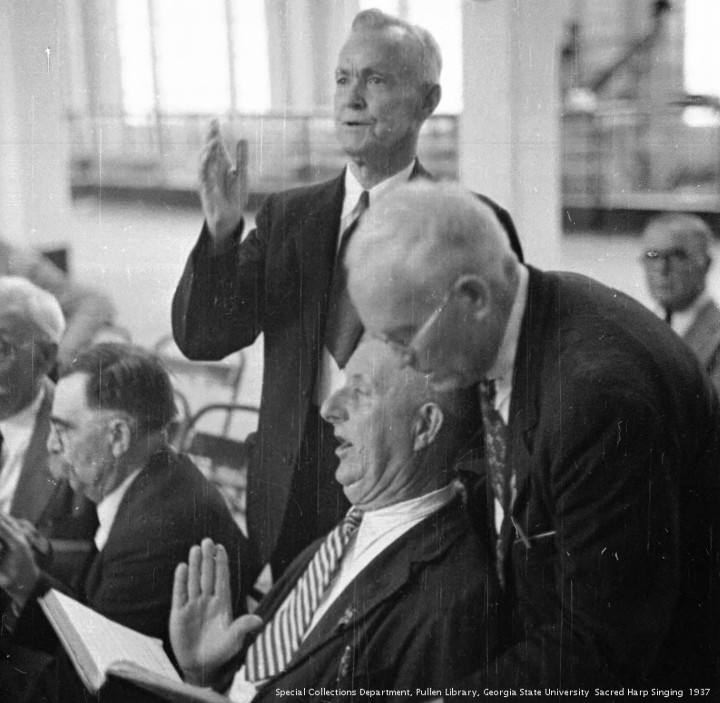
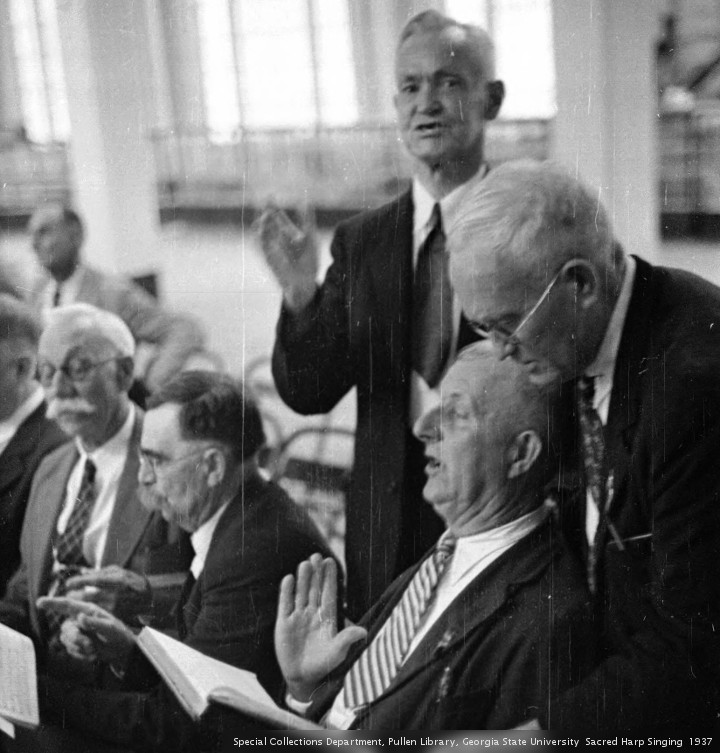
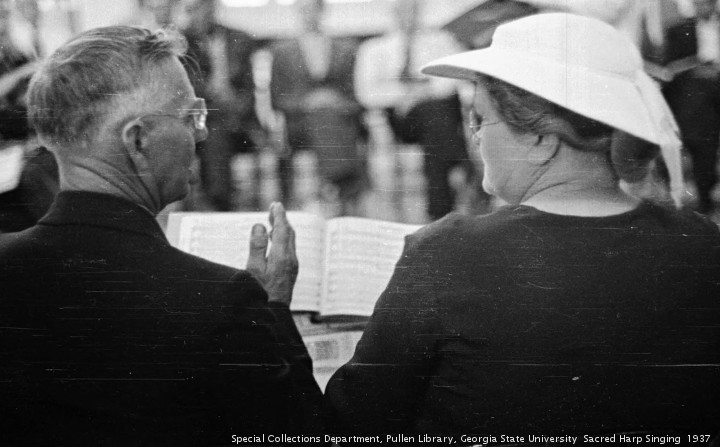
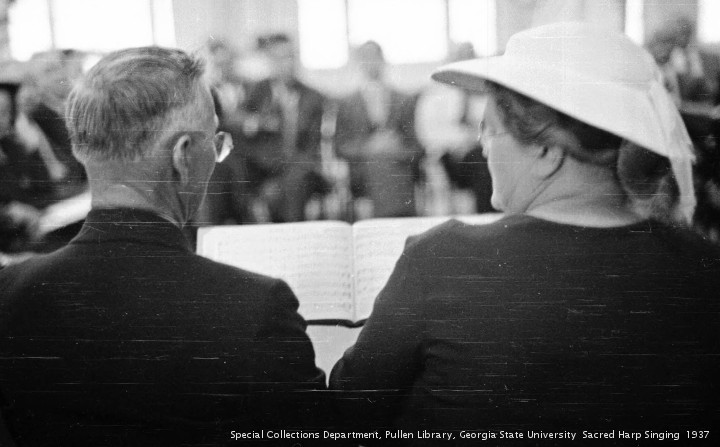
Maybe the young man can find peace now. It is a shame that his tragic death has become the center of a circus. The gossip mongers can find another tragedy to exploit. Pictures today are from “The Special Collections and Archives, Georgia State University Library”.
John Wayne Conner And James T. White


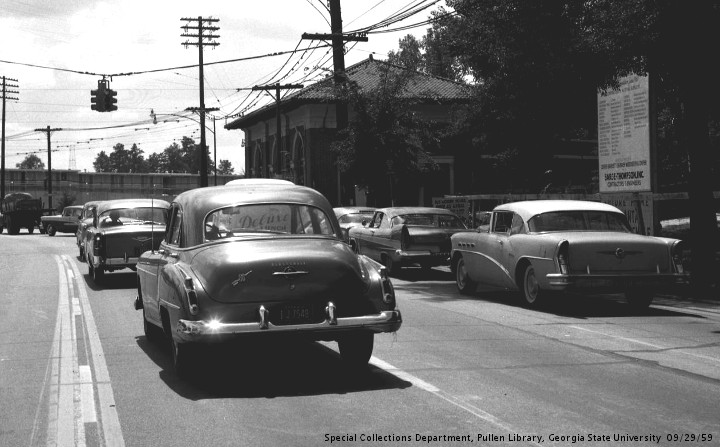

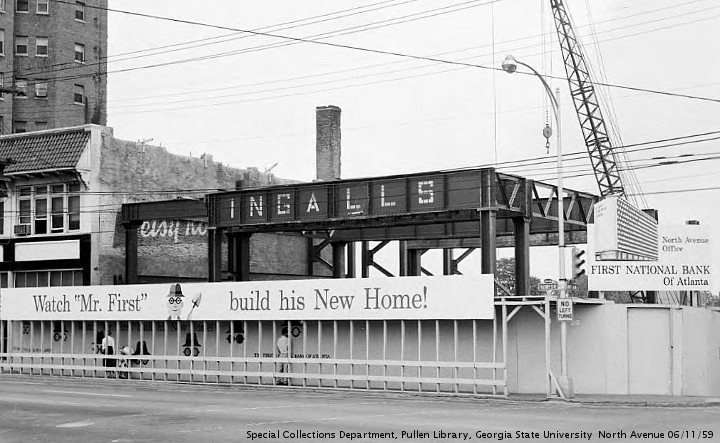


Georgia is fixin’ to poison 0000384035. Here is the what the Attorney General of Georgia has to say: “An execution date for John Wayne Conner has been set for July 14, 2016. Georgia Attorney General Sam Olens offers the following information in the case against John Wayne Conner for the 1982 murder of James T. White.
At the time of the murder, Conner lived with his girlfriend, Beverly Bates, in Milan. On the evening of January 9, 1982, they rode with friends, including the victim, J. T. White, to a party in Eastman. After spending the evening drinking and smoking marijuana, the group returned to Milan around midnight. J. T., described by one witness as “humble and satisfied” and by another as “mellow,” exited the vehicle with Conner and Ms. Bates at their house. Soon afterwards, Conner and J. T. left the house on foot, taking with them a nearly empty bottle of bourbon that Conner had purchased the night before. They walked to the home of Pete Dupree, woke him up, and asked him to take them to get more whiskey. He refused.
Then, according to Conner: “[M]e and J. T. left and went down the road. J. T. made the statement about he would like to go to bed with my girlfriend and so I got mad and we got into a fight and fought all the way over to the oak tree and I hit him with a quart bottle. He run over there to the fence trying to get through or across, I reckon, so I run over there and grabbed him and pulled him back and hit him again and he fell in the water and he grabbed my leg. I was down there at him right there in the ditch where he was at and he was swinging trying to get up or swinging at me to try to hit me one, and there was a stick right there at me, and I grabbed it and went to beating him with it.”
The next day, J. T.’s body was found in a drainage ditch near the Milan Elementary School. Injuries on his forehead bore the pattern of the sole of a tennis shoe. His nose was broken, both his cheekbones were fractured, his eyes were swollen, and his left ear was severely damaged. He had been hit so hard in the face with a blunt object that teeth, as well as portions of the bone to which they were attached, were broken away from his upper and lower jaws. Dr. Larry Howard, who conducted the autopsy, testified that the trauma to J. T.’s head and face caused brain damage and bleeding in and around the brain which extended into his lungs, causing him to drown in his own blood.
Beverly Bates had gone to bed when Conner and J. T. left. When Conner returned, he woke her up and told her that they had to leave; he had had a fight with J. T. and thought he was dead. Conner ripped off his shirt and threw it into the fire. He told Ms. Bates that he knew where a car was with its keys in it. The car was parked in front of the school. Before they left town, Conner told Ms. Bates that “he had to be sure,” and walked toward the ditch. She heard a thud. Conner returned, and said now he was sure, let’s go. They stopped to get gas in Eastman. Ms. Bates gave Conner $ 20 to buy gas with; in return, he gave her a bloody $ 5 bill. They were caught in Butts County.
The $ 5 bill, as well as a whiskey bottle and a tree limb found near the body, were subsequently analyzed and found to have blood on them that was consistent with that of the victim and inconsistent with that of Conner (understandable, since Conner suffered no injuries during the “fight”).”
The next part of this story is from Findlaw.
On January 26, 1982, while in the Telfair County Jail, Conner pounded a bullet into his chest until it exploded. As a result, he was admitted to Central State Hospital (“CSH”) in Milledgeville, Georgia. According to the records from that visit, Conner was “mute, uncooperative and appeared to be semicatatonic” upon admission. He showed “complete psychomotor retardation and [was] unable to answer any questions.” Conner was medicated and placed on “suicide precautions.” He later became cooperative and responsive.
By court order, Conner remained hospitalized at CSH until February 19, 1982, while the staff evaluated him for competency and insanity. ….. An IQ test administered while Conner was at CSH revealed a full-scale Weschler Adult Intelligence Score IQ score of 87, which placed Conner within the normal or average range of intelligence. On February 19, 1982, CSH issued a letter to the trial judge stating that Conner was competent to stand trial and could be held criminally responsible.
Conner’s father initially retained David Morgan to represent Conner in the underlying criminal case. About the same time, Dennis Mullis, a public defender, was appointed to represent Conner in an unrelated case. When it became clear that Conner’s father would not be able to pay Morgan’s fees through the pendency of the criminal case, Mullis was appointed to assist Morgan.
On April 30, 1982, Morgan filed a motion for funds to hire a defense expert to perform a mental examination because he was considering raising an insanity defense. This motion was heard on May 11, 1982. At that time, the court had the benefit of the February 19, 1982 CSH letter stating that Conner was competent to stand trial. Mullis stated that he could not determine if CSH had done anything wrong in its examination without an independent expert to assist him.
Nevertheless, the state trial court deferred ruling on the motion because the defense had not yet filed a motion to raise the insanity defense. At a later pre-trial hearing on June 21, 1982, Morgan withdrew from the case and Mullis became Conner’s sole counsel. At a hearing on June 30, 1982, Mullis announced that he would not be seeking to assert the insanity defense based upon his review of additional information private counsel had obtained from CSH. After that, Mullis did not file any other motion pertaining to Conner’s mental health nor did he request the appointment of an independent mental health examiner.
At his jury trial on July 12–14, 1982, Conner neither testified nor presented any evidence on his own behalf. During his guilt phase closing argument, the prosecutor said the following:
Ladies and gentleman, as prosecutor, as defense attorney, I have been involved in criminal law for seven years. As District Attorney of this circuit, I have prosecuted nine murder cases. I have never before sought the death penalty. I have seen several killings. I have been responsible for prosecuting several terrible killings. I have never before sought the death penalty. (This statement would later be considered improper conduct.)
Conner’s counsel objected. The trial court sustained the objection and gave the jury a curative instruction not to consider the penalty before deciding guilt or innocence.
After deliberating for fifty minutes, the jury found Conner guilty on all counts. Before the sentencing phase, the trial court granted defense counsel a brief recess for Mullis to confer with Conner. When the proceedings reconvened, the court asked Mullis if he planned to present any evidence in mitigation. Mullis responded:
Your Honor, I had planned on calling four witnesses—of course, the defendant, and his brother, and father, and his mother. After the verdict came in I talked to Mr. Conner in a room adjacent to the courtroom and he has informed me that he does not desire me to enter any evidence in mitigation. He does not desire to do that himself, he has told me. I have counsel[ed] him that my advice would be to do otherwise. My advice would be to put in some evidence to mitigate this. He has told me he does not desire to do that.
The following colloquy then took place between the court and Conner: THE COURT: Mr. Conner, do you understand your rights to present evidence? MR. CONNER: Yeah. THE COURT: And you have instructed your counsel and you are telling the Court now that you do not want to put anything in in evidence of mitigation? MR. CONNER: That’s right. THE COURT: All right, sir. That’s your privilege.
The prosecution and the defense then made their closing arguments without presenting any additional evidence. During his sentencing phase closing, the prosecutor once again expressed his personal belief, based upon his experience, that the death penalty was appropriate in Conner’s case… The jury returned a death sentence …
Conner filed his first writ of habeas corpus in state trial court on March 23, 1984. Evidentiary hearings were held on September 24, 1984, and February 11, 1985.
In the first evidentiary hearing, Mullis testified about his representation of Conner at trial. He explained that although raising an insanity defense crossed his mind, he found nothing to substantiate such a claim. When asked about the CSH records, Mullis admitted that he knew that Conner had some psychiatric problems and suffered from drug and alcohol abuse. He further admitted that in seeking the appointment of an independent mental health examiner, he did not reveal to the trial judge any of the information contained in the CSH records.
Mullis testified that while he was considering potential mitigation, he spoke with Conner’s parents and brother. They discussed Conner’s “upbringing” and “socioeconomic information.” Mullis stated that he learned that Conner had a deprived economic background and had not been raised “in the best of circumstances.” After Conner was convicted, Mullis spoke with Conner’s brother about testifying in mitigation. Also during this time, Mullis approached Conner’s girlfriend, Beverly Bates, who had testified against him at trial, about testifying in mitigation, but she refused. …
Mullis stated that his plan to present the testimony of Conner’s family members changed when Conner informed him after the entry of the guilty verdict that he did not want to present any mitigation evidence. Mullis explained that Conner said “something to the effect of letting [the jurors] do what they will.” Mullis testified that he explained the purpose of the evidence to Conner but that Conner did not seem to care about himself….
As for Conner’s relationship with his father, she explained that they were close but that Conner’s father beat him as a child and into his teens. Conner’s mother admitted that he had problems, describing him as a “very troubled young man” who drank alcohol and used drugs. She explained that Conner was always depressed and that he felt unloved. She also stated that Conner tried to commit suicide in 1981. … Conner’s father also described a second suicide attempt, in which Conner tried to kill himself by cutting ropes holding him in a tree while he was working with his father in a tree surgery business. Conner told his father that he was trying to have an accident so that he would fall and kill himself. …
Having determined that we must vacate the District Court’s judgment denying Conner’s petition and remand for further proceedings on the mental retardation claim, it is unnecessary for us to decide anything regarding the other two claims—the ineffective assistance of counsel at sentencing claim and the prosecutorial misconduct claim.
Murderpedia notes “The jury found the following statutory aggravating circumstance: “The offense of murder was outrageously and wantonly vile, horrible and inhuman in that it did involve depravity of mind and aggravated battery to the victim.” The evidence supports this finding. Appellant chased an unarmed, intoxicated victim (who failed to leave a mark on his assailant) from the road, across a drainage ditch and into a barbed wire fence; dragged him back to the drainage ditch; used a whiskey bottle, a heavy stick and his feet to beat and stomp the victim to death; and left him to die, lying in the water. The evidence shows that the defendant unnecessarily and wantonly inflicted serious physical abuse upon the victim prior to his death. The facts of this case distinguish it from those cases in which a finding of would not be appropriate.”
The fiswrapper sees the imposition of the death penalty differently. “Conner’s killing of White during the drunken brawl, while heinous, raises questions about whether the murder was proportionate when compared to others that landed men on death row. Some killed multiple victims. Some killed children. Some committed murder during an armed robbery or a sexual assault. The Atlanta Journal-Constitution, during a two-year-long investigation of Georgia’s death penalty, found that prosecutors rarely sought the ultimate punishment for murders similar to White’s.”
This quote is from a news report. “The tour was for Federal Communications Commission member Ajit Pai, who had come to the prison to meet Corrections Commissioner Homer Bryson and talk about what the federal government could do to help combat the scourge of contraband cellphones. After their meeting, warden Bruce Chatman led a small group on a tour of the Georgia Diagnostic and Classification Prison in Jackson. … Upon entering the row, Chatman acknowledged some cellphones have been found on death-row inmates. “But it’s been a while,” he said proudly.”
While on the tour, the group met John Wayne Conner. “With a broad grin that displayed several missing teeth, John Wayne Conner introduced himself by saying his name was the same as the “little Terminator.” That would be John Connor, the character in the “Terminator” movies who will lead a human revolt against the machines that have taken over the world.
Conner, 59, announced he has been on death row for 33 years. As for his appeals, they’ve almost run out, he said. “I’m hanging in there. I’m still kicking. In here, that’s a good thing.”
When asked how he bides his time, Conner, with a child-like enthusiasm, reached down, lifted the corner of his mattress and pulled out about a half-dozen watercolor paintings. He proudly laid them across his bed for all to see. Most were vibrant landscapes, including one with a majestic waterfall. Conner said it takes about an hour to finish a painting.”
Pictures are from “The Special Collections and Archives, Georgia State University Library”. UPDATE: John Wayne Conner died at 12:30 am, July 15, 2016.


 Chamblee54
leave a comment