Loud Music



By now, the fuss about the Michael Dunn trial has mostly faded away. This is where the man shot some people, after a dispute over loud music. The piece that follows will not try to justify this act, it will not discuss the second amendment, nor will it consider the verdict of a Florida jury. This bit of text is about the way people act about their music.
There are problems about loud music every day. People are way too quick to take the matter personally. It becomes a matter of duelling egos. Anger is expressed, people talk louder and louder, and threats are made. People are showing their neighbors how bad they are. With the wide availability of firearms, and alcohol, it should not be surprising that people get killed.
Between April 1998, and January 1999, PG had two run-ins with co-workers about radios. In the first one, a store manager played a music station at low volume. PG could barely hear it over the noise of the machines. The radio became one more source of unpleasant sound. It was like listening to rice crispies going snap crackle pop, all day, every day.
One morning, PG told the store manager “I do not enjoy your radio.” The lady went into hysterics. A week later, PG was given the choice of going to another store, or being laid off.
A few months later, PG came out of the bathroom one day. A radio was playing on a table beside the entrance. A religious radio station was playing. A lady was praying for entertainment. “The blood of the lambs has cleansed my heart.” PG was grossed out by this confrontation with bleeding lambs. The owner of the radio was listening to something else, using an earplug.
Three weeks later, the radio was still being played. The owner of the radio was still listening to his earplug. PG asked him to turn down the speaker radio. The person went into hysterics. A lawsuit was threatened. The dispute continued, off and on, for the next six years.
In the Florida incident, one party was black, and the other party was white. In the two work related incidents described above, one radio fan was white, the other black.
What happened in the Florida parking lot seems to depend on who you talked to. If four young men had a hysterical reaction to a radio volume request, then Mr. Dunn might have felt threatened. When you are armed, and possibly intoxicated, it is a formula for trouble.
Once again, this feature does not try to justify what Mr. Dunn did. You just don’t shooting people over loud music. What we would like to suggest is that people show some consideration for their neighbors. Not everyone enjoys your music. If someone does not like your music box, turn the damn thing down. You never know when that person is armed and drunk. You do know that they are your fellow human beings, and deserve respect.
Pictures are from The Library of Congress.







World Premieres In Atlanta

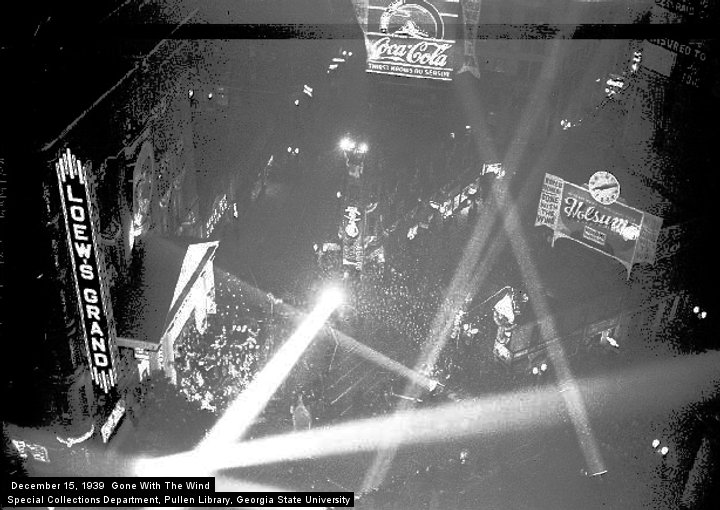
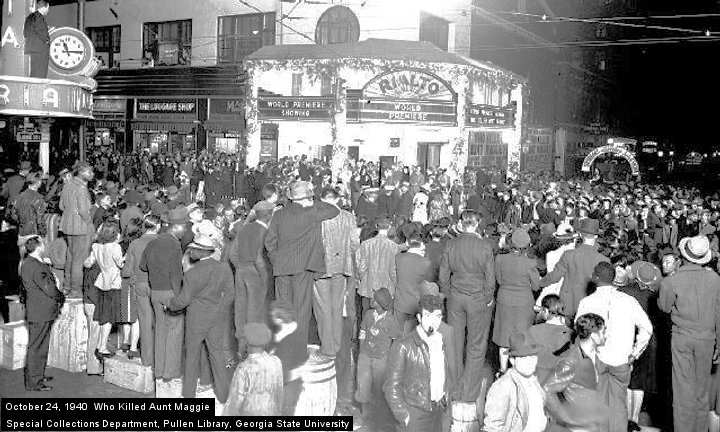

Several movies have had a world premiere in Atlanta. We will take a look today. Pictures are from “The Special Collections and Archives, Georgia State University Library”. Information about the films is from the Internet Movie Database. This is an encore presentation.
As some of you may know, “Gone With The Wind had it’s world premiere at the Lowes Grand Theater on December 15, 1939. The Lowes Grand site is the current location of the Georgia Pacific building. There is a vacant lot next door, on top of some MARTA paraphernalia. This lot was the site of the Paramount Theater, another movie palace that did not survive.
The GWTW premiere was a big deal. Ten year old Martin Luther King Jr. sang with his church choir. Clark Gable requested a private meeting with Margaret Mitchell, who became the envy of every woman in America. When Mr. Gable checked out of his hotel, a lady was going to be given his room. The clerk asked for a minute to change the sheets on the bed, and the lady said, no, I want to sleep on the same sheets as him.
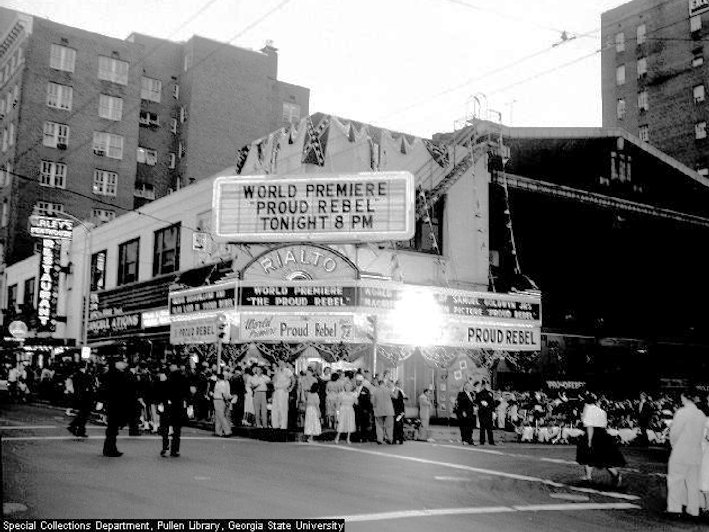
It was the golden age of movies, and the next year Atlanta hosted the first showing of “Who Killed Aunt Maggie”. The premiere was at the Rialto, on October 24, 1940. The review at IMDB said it was an enjoyable mystery, even if it was a cliche fest. It is not often seen today.
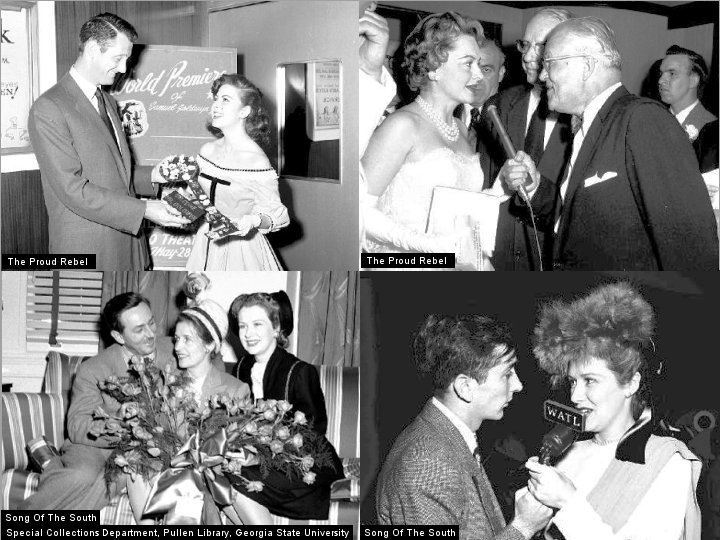
In 1946, “Song Of The South” had it’s premiere at the Fox Theater. SOTS is a controversial item these days. It was based on the Uncle Remus stories, which were written down by Joel Chandler Harris. For those who don’t know, these stories were told by the rural black people that Mr. Harris knew when he was growing up near Eatonton GA. As Wikipedia tells the tale “Controversy surrounding his southern plantation themes, narrative structure, collection of African-American folklore, use of dialect, and Uncle Remus character, however, has denigrated the significance of Harris’ work”. In other words, Brer Rabbit is not politically correct.
The reviews at IMDB tell a different tale. To them, SOTS is a happy children’s movie. The Disney company seems to wish it would go away and be forgotten. Copies are tough to come by these days. PG would say to see it for yourself and make up your own mind, but Disney won’t let you.
The female lead in SOTS was Ruth Warrick. Miss Warrick was a versatile talent. Her first movie role was in “Citizen Kane”, as Kane’s first wife. She was in many movies, before moving to television. She was perhaps best known as Phoebe Tyler, in the soap opera “All My Children”. Wikipedia tells a story about her, that is ironic for the female lead of “Song Of The South”
“In July 2000, she refused to accept a lifetime achievement award from the South Carolina Arts Commission because she was offended by legislators’ decision to move the Confederate flag from the state Capitol dome to another spot on the grounds in response to a boycott of the state by flag opponents. A lifelong supporter of African-American rights, she felt the flag should be removed completely, and commented, “In my view, this was no compromise. It was a deliberate affront to the African-Americans, who see it as a sign of oppression and hate.”
In 1949, the Paramount had the first screening of “The Gal Who Took The West”. The female lead was Yvonne De Carlo, who later achieved immortality as Lily Munster. In November 1951, the spotlights returned to Lowes Grand for “Quo Vadis”.
The last film in the GSU picture collection is “The Last Rebel”. This western had it’s premiere at the Rialto, May 27, 1958. The movie was a return to Atlanta glory for Olivia De Havilland. The film is the story of a man, whose wife dies in a fire during the war between the states. PG questions the use of the Stars and Bars on the marquee.
In 1974, Ringo Starr produced and acted in “Son of Dracula”. The movie had it’s world premiere at the Cherokee Plaza Theater. Cherokee Plaza is a shopping center on Peachtree Road, just east of the Atlanta city limits. The theater was torn down during a renovation, and the space is currently the produce department at Krogers.
A local radio station hired a band to play in the parking lot at the premiere. At some point, a long limousine pulled up to a stage, and Ringo Starr and Harry Nillson got out. Both were wearing sunglasses, even though it was after dark. Ringo got on the stage, waved a wand at the crowd, and said “I am turning you into frogs”. He went inside to see the movie, the crowd went home, and the movie was mercifully forgotten.
In 1981, PG went to a supper in an apartment building (now a vacant lot) across from First Baptist Church on Peachtree Street. There was a commotion down the street at the Fox, and PG went to see what it was. “Sharkey’s Machine” had it’s World Premiere that night.


Eat Drink And Be Kinky




Kinky Friedman is the person his cat thinks he is. It is tough to tell what a feline actually thinks, or if it indeed does engage in humanoid musing, but you have to admit that is a good opening line for a book report. If the kinkstah can turn a Hawaiin travelogue into a detective novel, then a slack blogger can turn a blog post about that volume into an exploration of the feline mind.
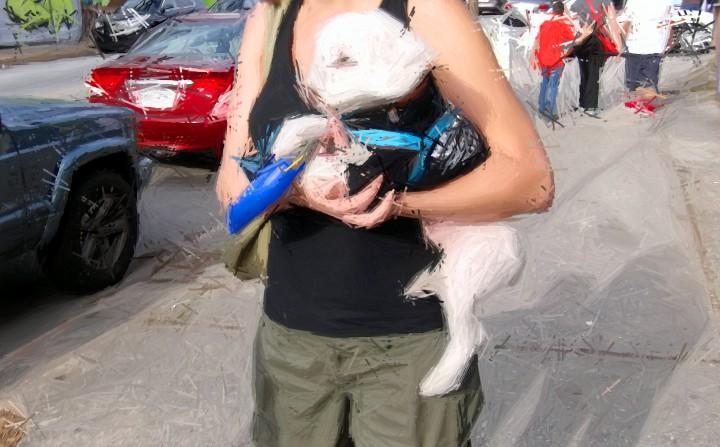
Steppin On A Rainbow starts off with Mr. Friedman, or a name sharing character, in a Manhattan apartment. His wannabe gf is on vacation, shielding her dogs from ethnic cuisine. One friend is ghost writing a book for Howard Stern, while another is working on a book in Israel. Drunken Irish Poet McGovern is in Hawaii, working on a food book, Eat Drink and Be Kinky.
The fun starts when Kinky gets a couple of phone calls. One of the dogs, owned by wgf, has died. Wgf comes home, to seeking comfort and a Jewish detective to insult. The second call has the disturbing news that McGovern has turned up missing.
McGovern once had a chat with a Japanese tourist. The JT asked where the world trade center was. McGovern said that your people were able to find Pearl Harbor. The book is set in 1999, when the world was y2k atwitter. The reality of 2001 was a figment of someone’s imagination. Whether this imagination belonged to an Arab quadrillionaire, the CIA, the Bush family, or all of the above, is an issue for sounder minds to ponder.
So the story unwinds. McGovern does not show up. A billionaire friend pays the way for a search party to go to Hawaii. The players are the moneyman, Kinky, Stephanie (wgf,) and her two surviving dogs. Kinky is liberally insulted, limericks are told, alcohol is consumed, Hawaiian history is discussed, and yapping dogs make noise. And McGovern is probably a shark’s breakfast.
The story, or lack of same, goes on for 45 chapters, and 271 pages. It is great fun, with sparkling dialog and pithy insights. The trouble is, McGovern is still missing. It isn’t until the last few pages, when the story comes to an end. Chamblee54 tries to be a spoiler free zone. The ending is totally improbable, even by Kinky Friedman standards. You don’t read this blog detective stories to wallow in reality.















Douche
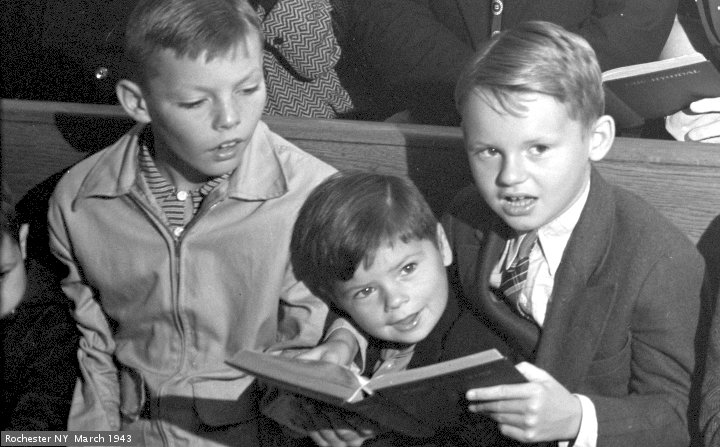



Backstory recently presented a feature, Rinse and Repeat: Cleanliness in America. As the title might suggest, it is about cleanliness. The location of this concept with regard to G-dliness was not discussed. While researching this story, a listener named Micheal Gambil sent a letter to the studio. This letter was read as part of the broadcast.
“This one is going to be great! My comment/suggestion may sound a little strange, but I was having a talk with my 70 year old aunt regarding female hygiene recently. She is still a believer in what is known as doucheing. YUCK! It got awkward…but it really made me think about the history of “lady products”. Flower scented sprays etc…I think there has been change on this issue. Or not…maybe it is just me and my quasi-hippy friends!”
Douching became popular in the nineteenth century. It was originally thought to be useful as contraception. As other methods of controlling fertility became available, douching became more of a cosmetic item. The corporate marketers are good at creating demand for a product.
More recently, the dangers of using this product have come to light. This awareness came into public consciousness at roughly the same time that douche started to be used as an insult. No one knows if the two developments are connected.
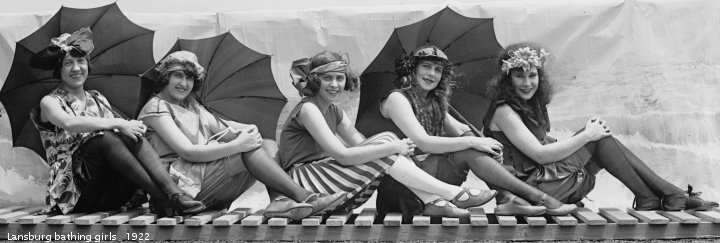
This is a repost. Pictures are from The Library of Congress. This is written like David Foster Wallace.













Happy Mardi Gras

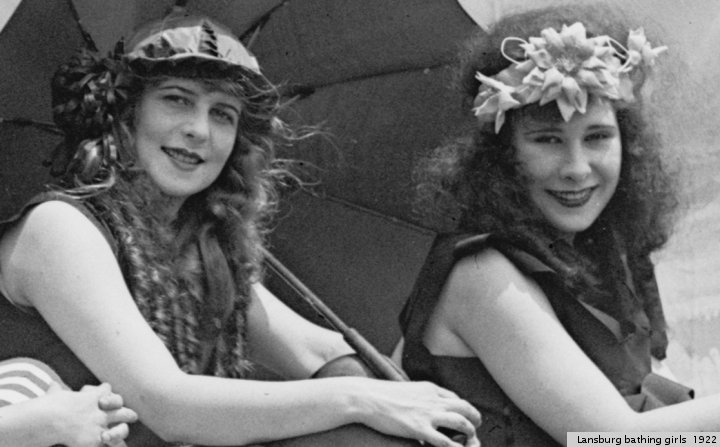

It is fat tuesday again. For someone who lived most of his life in Georgia, it is just another day.
In 1990, PG went to carnival. He rented sleeping bag space in a house on Marigny Street, just outside the quarter. It was like nothing he had ever seen.
This was 14 months after PG quit drinking. If he had life to do over, he would have gone to Mardi Gras first. He did feel good about going through that much drinking without being tempted to participate.
By the end of the Rex Parade, PG was getting tired of the whole shebang, Mob scenes of drunks, in costume, can get old. PG has not been back.
Two years later, the Grateful Dead was playing at the Omni, and the camp followers were in the parking lot. PG would go on his lunch hour and observe. A young lady walked by, and PG said Happy Mardi Gras. She gave him a string of beads.
Five years after that, PG had a boss from New Orleans. He looked like the Grinch who stole Christmas. He also hated Mardi Gras. PG did not know this, and greeted him Tuesday morning with a cheerful Happy Mardi Gras. If looks could kill, PG would have dropped dead.
This is a repost. Pictures from The Library of Congress.

















 Chamblee54
leave a comment