Rhetoric Over History




The symbolic fight today is over Confederate monuments. The high octane rhetoric is heard loud and clear. There is even historic revisionism. “…the real motivation was: to physically symbolize white terror against blacks.” PG finds this reasoning tough to believe. It sounds like another argument, from another symbolic battle. History likes to repeat herself.
In 1993, a movement emerged to change the Georgia state flag. At the time, the Saint Andrews cross, aka the Confederate flag, was on one side of the flag. Many people were offended by this flag, Many people liked this flag, and wanted to keep it. The argument went on for a few years.
In 2001, a new flag was adopted. The 2001 flag was even uglier than the old flag. The 2001 flag was rammed through the legislature. Part of this change was a law, protecting state monuments. “When Georgia took the Confederate battle symbol off the state flag in 2001, part of the compromise lawmakers struck was a new state law that protected Confederate memorials and monuments from being removed, relocated or even altered.” This law did not apply to the state flag, which was changed again in 2003. The current flag is similar to another Confederate flag.
When the flag change movement got started, a bit of historic revision was introduced. The story was that the legislature changed the state flag as a protest against desegregation. The first page of google does not have any of the 1993 rhetoric. The talk was louder, and angrier, in 1993.
PG never did believe the argument that the flag was changed as a protest. PG accepted that the flag was offensive to many, and did not object to changing it. However, he does not like to be lied to. If the flag was offensive to a large part of the state, why would you need to rewrite history? The 1956 legislature was a gnarly bunch… crooked, alcoholic, racist, and overwhelmingly Democratic. If anything else, they were not smart enough to change the flag as a protest. In 1956, protest was not the national pastime. Not everything had a hidden meaning.
Microfilm may wear out, but it does not lie. PG found an article announcing the change in the Atlanta Constitution. There was no mention of protesting integration. The fishwrapper, and the politicians, spoke about honoring the Confederacy.
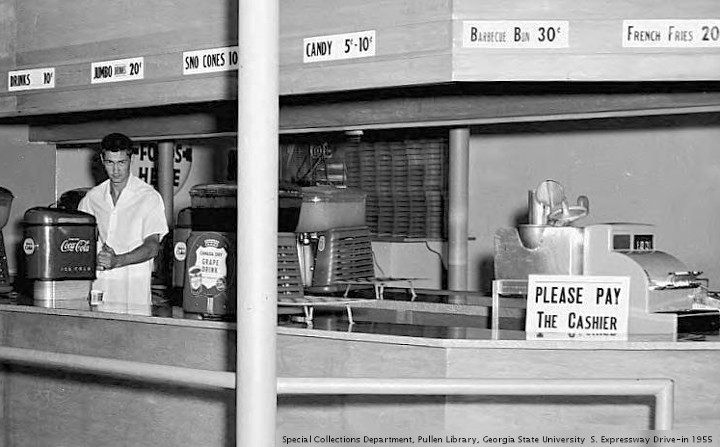
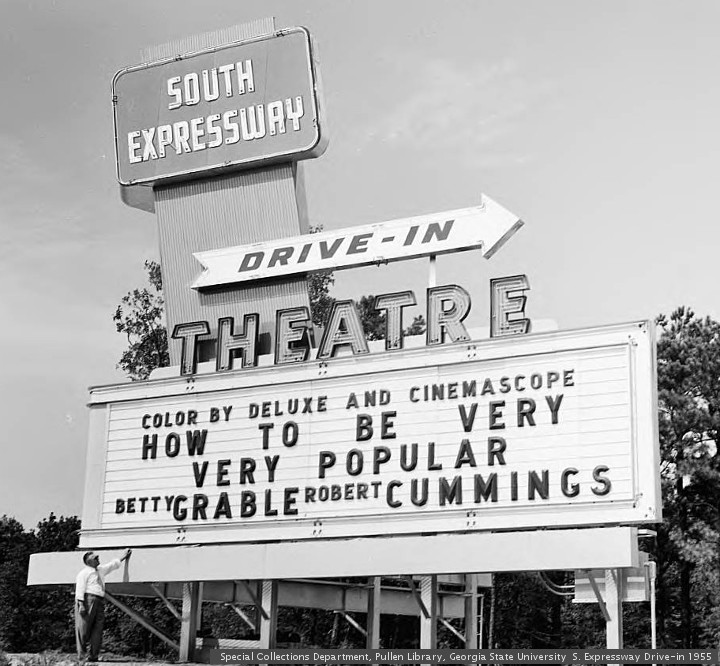
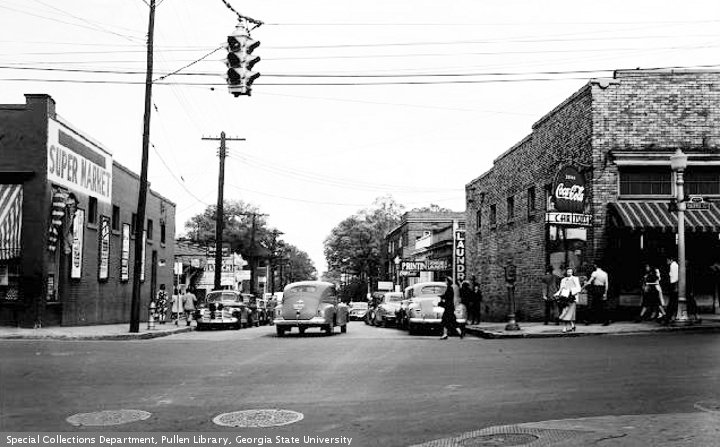
The argument over changing the state flag was totally symbolic. The issues that affect communities of color, and communities without color, were not affected. Economic opportunity, equitable justice, access to housing and education… none of these life or death issues were affected by having the Saint Andrews cross on the state flag. The squabbling over the state flag was a proxy fight over black vs white. Pictures today are from “The Special Collections and Archives, Georgia State University Library”. Most of today’s photos are from 1954 – 1956.
UPDATE This is a repost. The 1993 state flag debate was brought up during the 2018 Governor’s election from hell. The rhetoric was just as foolish as ever. PG took another look at the matter, found some new material, and came to the same conclusions.




She Always Carries Jonquils


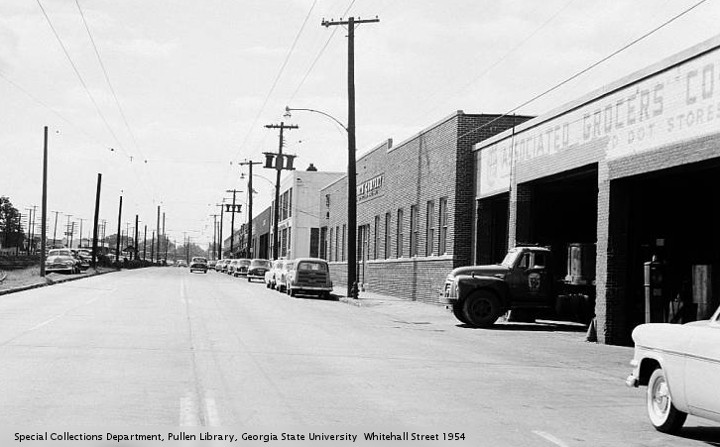
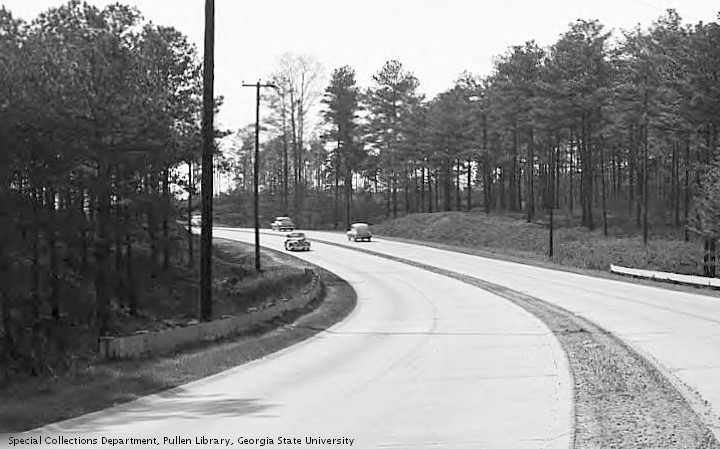
PG found Archival Atlanta: Electric Street Dummies, the Great Stonehenge Explosion, Nerve Tonics, and Bovine Laws : Forgotten Facts and Well-Kept Secrets from Our City’s Past at the Chamblee library. There are always more stories to be heard. This repost has pictures from “The Special Collections and Archives, Georgia State University Library”. It is written like Margaret Mitchell.
In the 1840s, the Western and Atlantic railroad wanted to hook up with the Central of Georgia railroad. The spot for the meeting was called Terminus. One idea was to name the town for William Lumpkin, a former Georgia Governor and a railroad executive. Lumpkinville sounded bad in the mouth, and the new town was named “Marthasville”, after the daughter of the Governor. (Martha is buried in Oakland Cemetery.) Few people liked this name, and someone decided that the feminine form of Atlantic was Atlanta. Unlike the state flag, this is unlikely to change.
The new town prospered, and recovered from the unpleasantness of 1864. In 1875, there was a problem with stray cows. The answer was the “1875 Cow Ordinance”. The law required that cows be kept in a pen at night. A fine of two dollars was assessed for every stray cow that was caught.
About this time, there were a few very busy railroad tracks going through downtown. People were getting tired of waiting for the trains to go through. One by one, viaducts were built over the tracks, creating a forgotten ground floor. This was built up into Underground Atlanta in the sixties, which was red hot for a while, then cooled off, and is now so so.
In 1897, J.W. Alexander was the first person in town to own a “horseless carriage”. One day, he decided to take a ride to East Point. A mule objected, and kicked man and machine into a ditch.
It is a rule that all history books about Atlanta have to discuss Coca Cola and Gone With The Wind. There are only so many stories to go around. This book tells of an Alpharetta farmer who bought the Tara set from MGM. He stored in a barn, the location of which was a secret. Betty Talmadge wanted to buy it, and the price went from $375k to $5k. After a while, the sale was finalized. There was only one problem…the farmer died, and never told anyone where the barn was. Mrs. Talmadge got the money from her husband’s overcoat, went to Alpharetta, and found the barn. The set was moved into another secret location, where it was in 1996, when Archival Atlanta was published, at an undisclosed local location.
Sam and William Venable owned Stone Mountain, and had a quarry there. (The Ku Klux Klan held meetings on the mountain.) (The spell check suggestion for Ku Klux is Kook Klutz.) Sam built a large granite house at 1410 Ponce de Leon Avenue, and stocked it with ammunition. He thought a race war was on the way, and wanted to be prepared. One night, a chimney overheated. The roof caught on fire. The explosives in the attic exploded, and took the roof off. The house was repaired, Mr. Venable died, and the house became part of a Lutheran church.
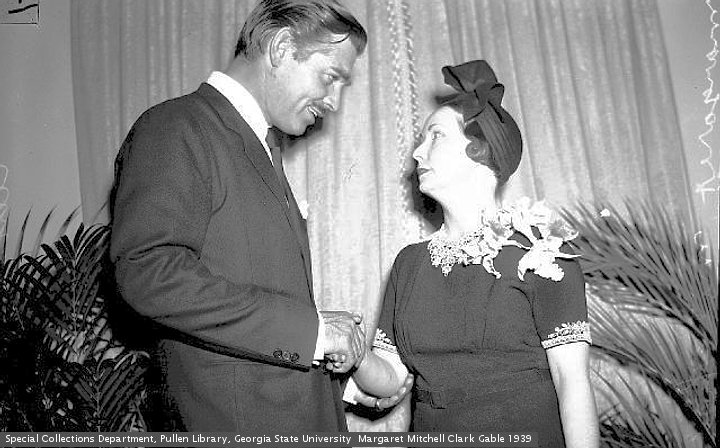
One of the few ante bellum houses in Atlanta is near Grant Park. It was once owned by Lemuel Grant, who donated the land for the park. He stays in a large marble house in Oakland Cemetery now. The Grant Park house was purchased by Mr. and Mrs. John Marsh, in partnership with Boyd Eugene Taylor. After the death of Mrs. Marsh (also known as Margaret Mitchell), she was known to visit the house. “Margaret just wanders through the house, looking things over. She never talks, and she always carries jonquils. The first night she came I was very shocked. I went out to her grave at Oakland Cemetery the next day. I’d never been to the house before. But I was almost certain of what I’d find. The plot is covered by a bed of jonquils.”


One History Of Religion

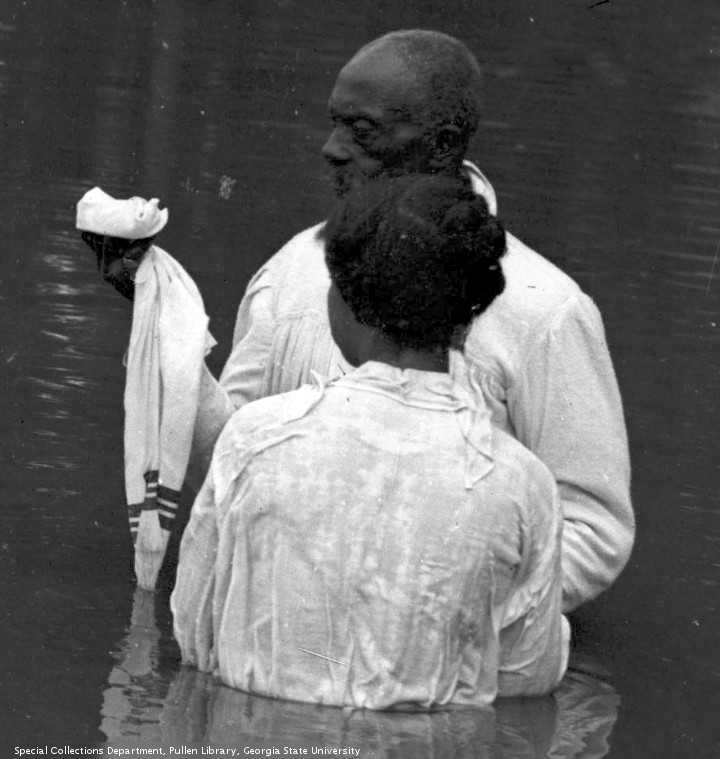


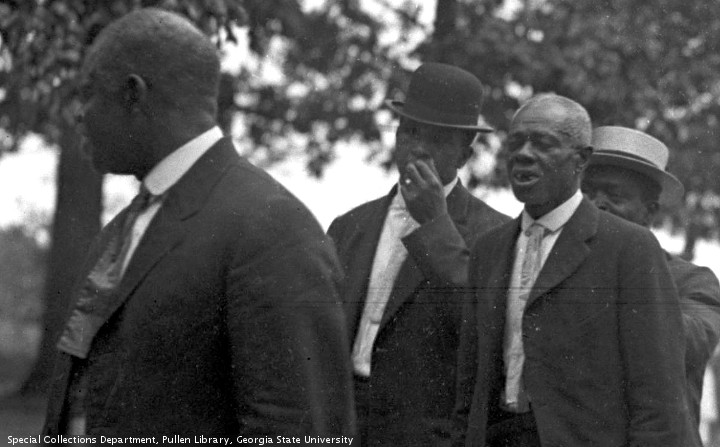
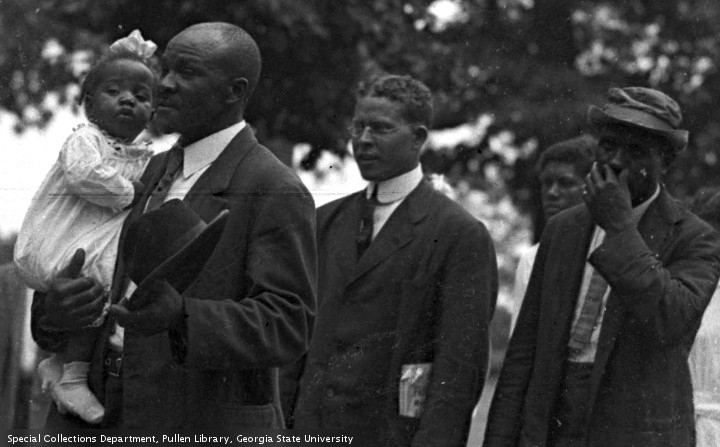
I was a southern baptist all my life. Arguably, I became a baptist when my mother converted in 1938, but really didn’t get with the program until I was born in 1954. The story is that Daddy called the choir director at six in the morning to sign me up.
First Baptist in Atlanta was a big church on Peachtree street, about a mile north of downtown. (A few years ago, they sold the land to a developer, and moved to the suburbs. I was working a block away when they tore down the building, and got some chips of brick as a souvenir.) I sang in the “cherub” choir. This was quite an experience when we performed in front of a full house. I have good memories of Sunday school, vacation bible school, and the choir program.
One thing I did not like, even at that young age, was the preacher. He was a greasy haired man who shouted a lot, and had a mean streak. Years later, I heard persistent rumors that he was gay. (I should note that this is not Charles Stanley. It is the man who preceded him.) One Sunday, we were watching him preach, and he shouted, “this is the word of G-d”. He then waved a Bible in the air, and slammed it into the pulpit. I thought, if that is the word of G-d, maybe he shouldn’t slam it down like that.
In 1962, mom and dad decided to move to a church closer to home. I liked Briarcliff Baptist. About this time, I first heard about being “saved from sin”, and thought it was a pretty cool idea. I also was in the cub scouts, and since their meetings were the same day as choir practice, I quit the choir. I attended church regularly the next few years, but never did join the church, and get baptized. The custom of pressuring children to make a “commitment of faith”, and get baptized, reflects poorly on Jesus.There are some other family issues that came up about this time. They are too personal to get into here, but they affected my attitude towards the church.
After a while, I was 17 years old, and working in a restaurant that was open until 1am on Saturday night. I decided one Sunday that I didn’t want to get up for church. I have only been back to that building once in the intervening 47 years. This is a repost, with pictures from “The Special Collections and Archives, Georgia State University Library”.




Herman Cain



As you may have heard, Herman Cain (no middle name) died. He had been hospitalized following a positive test for COVID 19. Mr. Cain was an outspoken supporter of President Trump. He did not think wearing a mask was a good idea, and said so often.
It should be noted at this point that a mask does not protect the user. A mask assumes that the user might be infected, and can help prevent spreading the virus. We do not know when, and how, Mr. Cain contracted the virus. Wearing a mask would not have prevented Mr. Cain from becoming infected. It might, however, prevented Mr. Cain from spreading the virus further, once he was already infected. Speculation that Mr. Cain was infected at the Tulsa rally is just that… speculation.
The media, both social and anti-social, is having a big time with this. Since Mr. Cain was a Trump supporter, he is deemed worthy of slander and abuse. One facebook friend joined in, and then later claimed not to hate Mr. Cain. This prompted PG to break his do-not-argue-on-facebook rule, and issue a comment: “Maybe it is not hate, but “don”t deserve the air you claim to not be able to breath” comes mighty close. This is another one of God’s children.” PG made another comment, this one for the general population of facebook and twitter.
“Unlike most of the people commenting about the late Herman Cain, I briefly listened to his radio show. Very briefly. His radio show was unlistenable. I did not agree with him on many subjects. Nonetheless, I saw a good bit to admire. Mr. Cain was from humble circumstances. He got degrees from Morehouse University, and Perdue University. Mr. Cain succeeded in business.
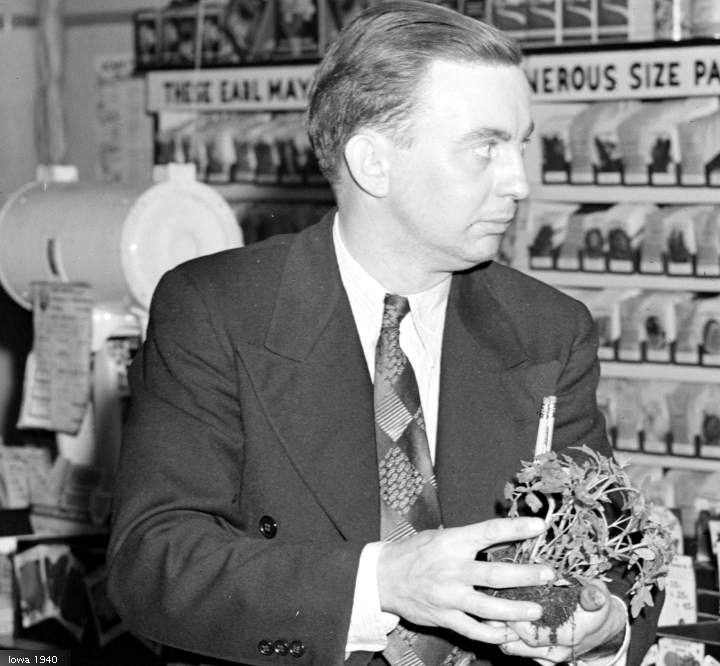
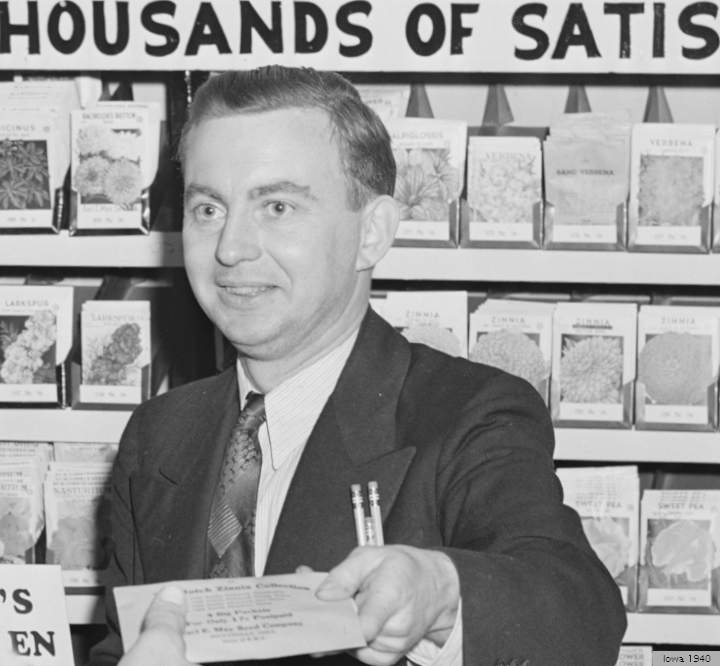
In 2011, Mr. Cain ran for President. He did well for a while, until the “dog stories” from his past forced him out of the race. He opened a campaign headquarters in Doraville, not long after his departure from the race. I went to this opening, and got this picture.
The last few weeks of his life were something. A stage IV cancer survivor, he was no doubt compromised by years of industrial strength medicine. And yet, he made a public spectacle of attending dangerous events. It is an ending to a uniquely American story.”
The Presidential run was quite a story. Mr. Cain probably had little chance of getting the nomination. Still, he was the flavor of the month for a while, and got a bit of attention. Soon, stories of sexual misconduct began to arise, and Mr. Cain was forced to drop out of the race. He wound up back on the radio, and replaced Neal Boortz when that SAWB retired.
The last chapter in the Herman Cain story is a doozie. After beating back a serious cancer, Mr. Cain was clearly at risk. And yet, he made a much publicized refusal to wear a mask, and attended a notorious Trump rally in Oklahoma. Did he think he was virus proof? Or was this the last hurrah of an American? We will probably never know the real answer.
Chamblee54 has written about Herman Cain many times. (one two three four five six seven eight) Pictures today are from The Library of Congress.





688








There was a comment at Chamblee54. “Steve Loehrer – So tell me what you know about Rose’s Cantina. I booked the music there from 1978-80 – Thorogood, Delbert, The Thunderbirds, The Fans, The Razor Boys and on and on. I was the one that did it. And I probably know you.” This blog has previously published features about the Great Southeast Music Hall, Richards, and the Georgian Terrace Ballroom. One more music venue post is not going to hurt anyone, and will be a good excuse to post some more pictures, from “The Special Collections and Archives, Georgia State University Library”. This is a repost.
688 Spring Street is a nondescript building, located down the hill from the Varsity. At one time, a company called Southern Tailors made wine jackets there. It is currently a Concentra Urgent Care Center. In between, it was the site of two rock and roll nightclubs, Roses Cantina and 688. One block over, at 688 West Peachtree, is a Catholic Construction management office.
House manager Rose Lynn Scott is quoted as saying “You know, we really aren’t sure exactly when it all started and ended,” Scott said. “Honest to God, we weren’t paying that close attention.”PG first knew about it around 1977, and really didn’t go very often. There is a running list for this post, and whenever a new band sinks into the mush, it is duly noted. Some band did “Love Gun,” which sounds remarkably similar to “Amphetamine Annie” by Canned Heat.
The punk rock revolution did not completely pass Atlanta by. A band called the Fans said they were making the pop music of the eighties. PG saw them twice at Roses, and they might be the only time he ever paid to get in. They were an impressive outfit, doing Velvet Underground and Telstar. Later, they opened for Talking Heads at the Agora, and were pretty awful. Much, much later, PG shared an apartment with the brother, of the drummer, for the Fans. Also living there was the brothers wife, a cable guy, seven snakes, a ferret, and a cat.
Back to the words of Rose Lynn, “It was a dive bar supreme and proud of it.” The stage was in the middle of the house, with a game room behind the stage. If you liked to shoot pool and listen to bands, this was the place. As for drinking, PG might get a beer or two, but mostly got bombed at other spots.
In those days, PG would go rambling from club to club, often accompanied by his friend Dinkson. One night, they stumbled in on a three piece band. They did a song called “Madison Blues”, with the guitar playing slinging riffs, and the bass playing playing the same notes over and over, never changing the look on his face. This was George Thorogood and the Destroyers.
One other night, PG stumbled in on the last few minutes of a show by the Brains. They wrote a song called “Money Changes Everything” that Cyndi Lauper did well with. This is another great local band that never seemed to get a national audience. Another night, some old black man, possibly John Lee Hooker, was playing guitar.
Around about this time, PG decided to either grow up, or take his childhood seriously. He wound up in Seattle WA. That wore off after a while. On the greyhound bus going home, PG talked to a young lady, who said something about a punk rock club in the Roses Cantina space. This was the 688.
A few weeks later, Iggy Pop did a week at 688. Here, through the miracle of copy paste, is the story. It isn’t plagiarism when you wrote it yourself.
At any rate, by the time PG got back from Seattle, some brave investors decided to have a punk rock club at 688 Spring Street. Soon, Iggy Pop would be playing a week there. In the seventies, the bands would play for five days at the great southeast music hall or the electric ballroom, two shows a night, and if you were really cool you would go on a weeknight before it got too crowded. Soon after that, it was one night in town only, and you either saw it or you didn’t.
PG had a friend at the Martinique apartments on Buford Hiway. There was someone living in the complex known as ZenDen, who sold acid. You would go to his place, wade through the living room full of grown men listening to Suzi Quatro, and purchase the commodity.
On to the the 23 Oglethorpe bus, and downtown to 688 Spring Street. Before anyone knew it, the band was on the stage. A veteran of the Patti Smith Group, named Ivan Kral, was playing bass. Mr. Kral sneezed, and a huge cocaine booger fell across his face. He was not playing when the show ended.
There was a white wall next to the stage, and someone wrote the song list on that wall. That list of songs stayed on the wall as long as 688 was open. “I want to be your dog” was on the list, as well as the number where Iggy pulled his pants off and performed in his underwear. Supposedly, in New York the drawers came off, but the TMI police were off duty that night.
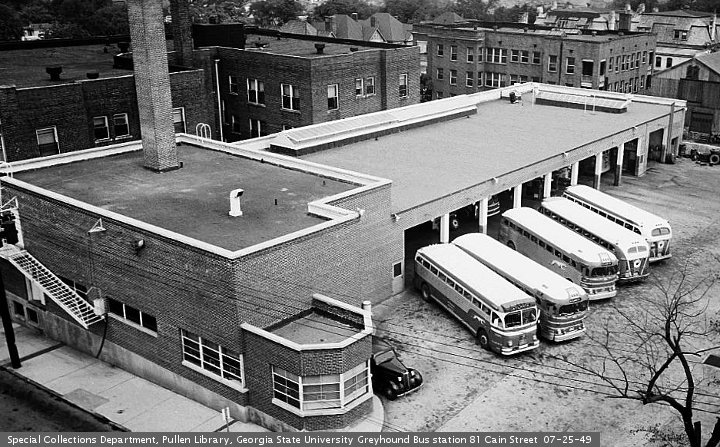
The show was loud and long, and had the feel of an endurance event…either you go or the band does. Finally, the show was over, and PG got on the 23 Oglethorpe bus. You got the northbound bus on West Peachtree Street. You could look down, from Fourth street, and see the Coca Cola sign downtown. Freeway expansion sent that section of West Peachtree to old road hell.
Twenty years after that, PG worked in a building at that corner of Fourth and West Peachtree. If he had known about the future of working for Redo Blue, PG might have jumped under the 23 Oglethorpe bus, instead of getting on it. The Coca Cola sign was long gone by then.
There was band called Human Sexual Response in those days. PG caught their act at 688. They had three vocalists, wearing matching outfits, and sang a lot of lyric happy songs with really cool harmonies. The problem was, PG was not familiar with those oh so witty lyrics, and did not know what it was all about. At least he got out of the house.
Kevin Dunn played guitar for the Fans. (He had an ad for guitar lessons on the bulletin board at Wax and Facts. It said that raising racing turtles was more profitable than playing guitar.) One night at 688, he performed with his band The regiment of women. They opened for someone, possibly the Plastics, who we will get to in a minute. So, this guy plays guitar and sings, and a woman plays a drum machine. No skin pounding drummer, but a lady who twisted the knobs on a machine.
The Plastics were from Japan, and did a killer version of “Last Train to Clarksville”. It was about this time that PG got a job, and decided that he liked sleeping better than hanging out downtown.
One night, about 1983 or so, PG made an exception. The band that night was Modern English. Before the show, PG ate three z burgers from the Zestos on Ponce de Leon. During the show, the singer rubbed his stomach, and said to feel the music. About this time, the z burgers were making their presence known, and PG could feel something, but it wasn’t the music.
The last show PG saw at 688 was Hüsker Dü. The best guess is February 14, 1986. There was a totem pole, made of old TV sets, in the front part of the club in 1986. Here is the story.
Hüsker Dü means “do you remember” in Danish and Norwegian. PG saw them sometime in the eighties. It might have been the metroplex, but it might have been the 688. There is a list of shows they played, and the metroplex is not on there.
PG saw a show at the Metroplex the next night. The band is forgotten. The metroplex was a dark spooky building on Marietta street near the omni. The balcony was very dark, with everything painted black. PG tripped over a bench.
688 was a different story. PG saw a bunch of shows there, both as 688 and Rose’s Cantina. HD may have been the last show PG saw before they closed. PG was well into the work/sleep lifestyle that preoccupied his life after a certain point, and just didn’t make it out much anymore. A friend won tickets to the show or he wouldn’t have made it.
PG didn’t get into the show very much. HD was a trio, with the later-outed Bob Mould as the guitar g-d. For all of his musical skills, Mould is not much for onstage charisma. PG felt that if he had been more familiar with their music, he would have enjoyed it more. Some bands you can see without hearing their records and get into it right away, where others need a bit of familiarity.






Monroe Drive Or Boulevard

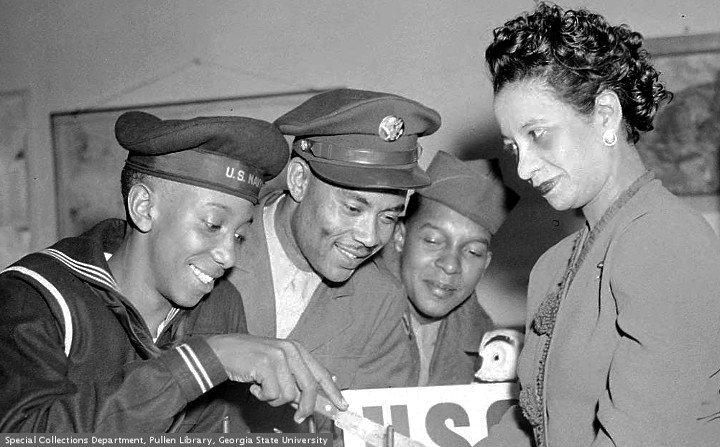


It is an Atlanta cliche. Boulevard turns into Monroe Drive because one was black, and the other white. The white people did not want to live on a street with the same name as the black neighborhood. You hear this all the time, with very little explanation. It is plausible. At one time, Ponce de Leon Avenue was a dividing line between the white, and black, neighborhoods. There are, however, a few questions about this name change business. This is a repost.
In the space between I-85 and Dekalb County, there are four streets that change names when they cross Ponce De Leon Avenue. These are Juniper/Courtland, Charles Allen/Parkway, Monroe/Boulevard, and Briarcliff/Moreland. Several streets cross Ponce without changing names, including Spring Street, Peachtree Street, Piedmont Avenue, and North Highland Avenue.
Four thoroughfares are affected by the Ponce rebranding. Juniper/Courtland is mostly commercial, at least south of Ponce. Briarcliff/Moreland is mostly white until you get to the railroad tracks south of Little Five Points. When Moreland Avenue goes under the MARTA line, the neighborhood is Reynoldstown….which was not named for Burt Reynolds.
Charles Allen/Parkway does change from white to black at Ponce. The street name then changes to Jackson Street, the original name, at Highland Avenue. Monroe/Boulevard, one block east of Charles Allen/Parkway, also goes from white to black at Ponce. However, when you cross the railroad tracks, Boulevard goes through Cabbagetown, a white neighborhood. Boulevard residents change color several times before the road dead ends at the Federal Prison. Oakland Cemetery, and Zoo Atlanta, do not play a role in this drama.
If this litany of street names is boring, it is all right to skip over the text. The pictures today are from “The Special Collections and Archives, Georgia State University Library”.
Roads change names all over the metro area, for a variety of reasons. In the area between Ponce De Leon Avenue and I 20, there are roads that change at railroad tracks (North Highland/Highland, Krog/Estoria.) Others change at Highland Avenue (Parkway/Jackson, Glen Iris/Randolph) or Decatur Street (Hilliard/Grant, Bell/Hill.) Some of these changes are racially motivated, while others are not. Some make sense, while most do not.
No one seems to know when this Monroe/Boulevard thing happened. An 1892 “Bird’s eye view” shows Boulevard sailing off into the horizon, past a racetrack in today’s Piedmont Park. A 1911 map shows Boulevard starting near “L.P. Grant Park,” and sailing past Ponce up to Piedmont Park. A 1940 map shows Boulevard going past Park Drive, only to turn into Monroe Drive at Montgomery Ferry Road. Finally, a 1969 map of “Negro Residential Areas” shows Monroe Drive changing into Boulevard at Ponce De Leon Avenue, like it is today. Boulevard is a stand alone street name at all times.
If anyone knows about this name change business, please leave a comment. It would be interesting to know when these changes were made, and what government agency made them. Google has not been helpful, except for pointing the way to several map collections. UPDATE After the last publication of this post, a comment was made about the namesake of Monroe Drive. A post inspired by this comment is reposted below.


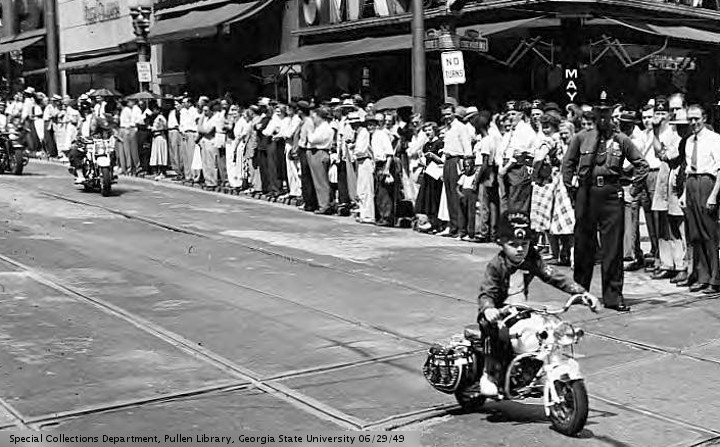
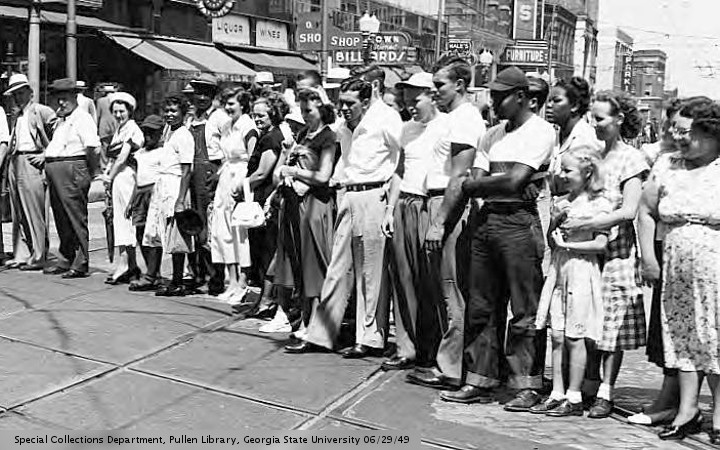
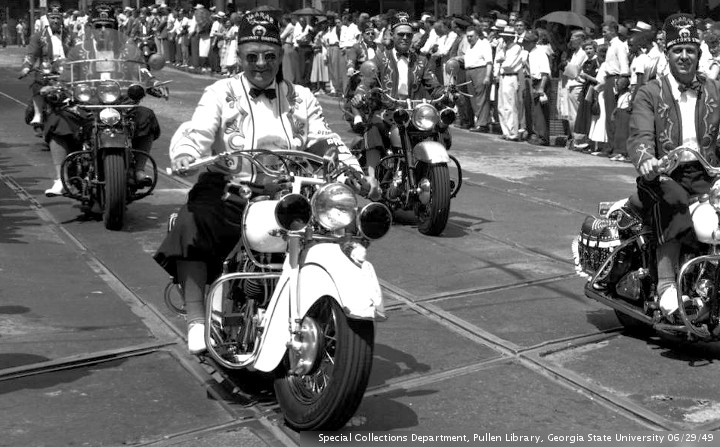


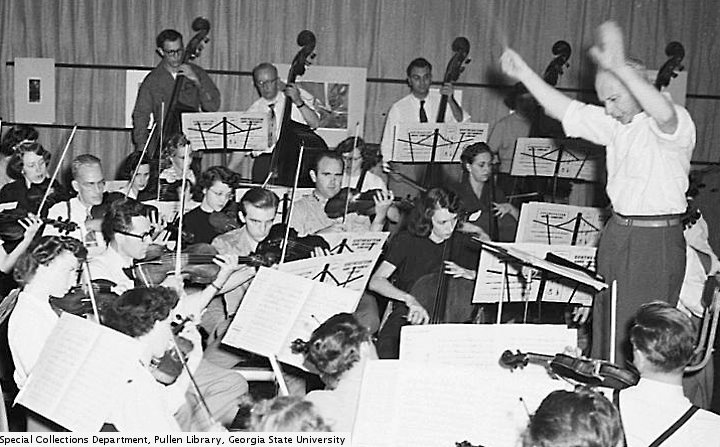


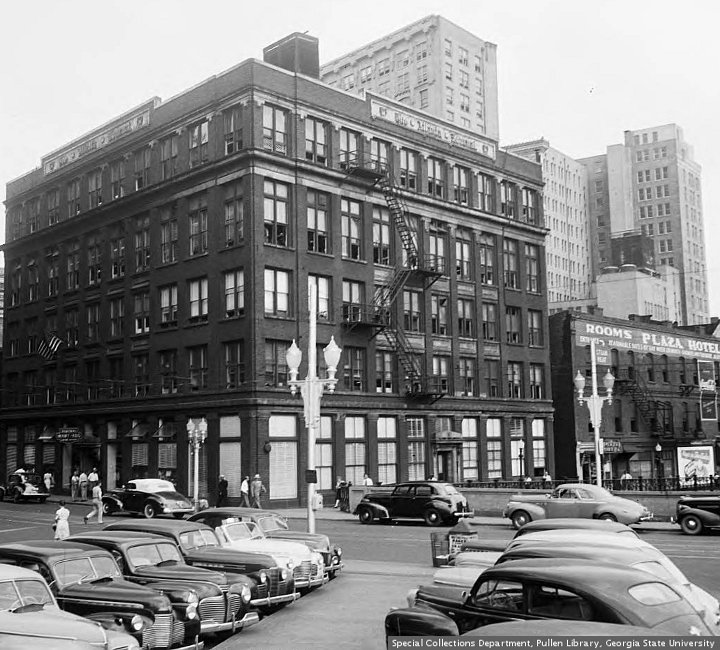
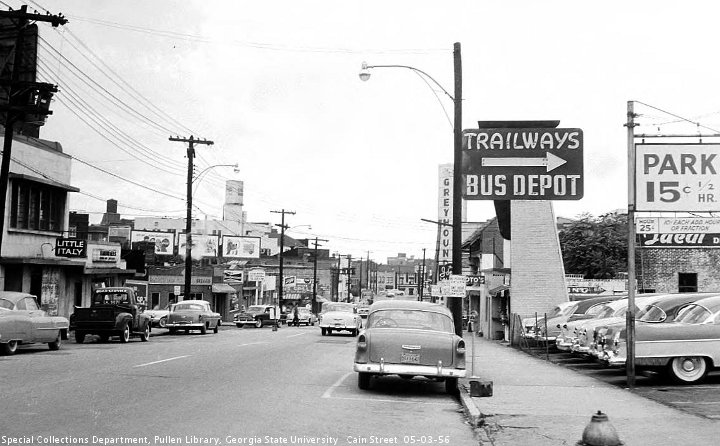
“North Boulevard was renamed Monroe Drive in 1937 to honor noted Landscape Architect W.L. Monroe who built his house and a plant nursery on the road and was noted for his many landscape projects and public parks in Atlanta.” Faset (Bill) Seay, February 4, 2020, 3:48 pm This comment was made to Monroe Drive or Boulevard. MDOB looks at Atlanta roads that change names, and the reputed racial motivations for these changes. The Monroe story takes place in Piedmont Heights.
“In 1823 Benjamin Plaster was granted 3,000 acres of land along Peachtree Creek and Clear Creek in recognition of his military service during the War of 1812. This was two years before Archibald Holland acquired a similar tract several miles to the east where another village called Terminus was founded in 1837, later renamed Marthasville and eventually Atlanta. … Plaster built a bridge across Peachtree Creek and the trail to it became known as Plaster’s Bridge Road. The bridge’s stone abutments still remain on the creek banks and a short section of the old road, running along the northern boundary of today’s Piedmont Heights, is now called Plasters Avenue. As other settlers followed a township called Easton grew up around Walker’s Grist Mill on Clear Creek near the site of today’s Ansley Mall at Piedmont Road and Monroe Drive.”
“Around 1850 Captain Hezekiah Cheshire arrived from South Carolina. His sons, Napoleon and Jerome, settled on opposite sides of the south fork of Peachtree Creek. They built a bridge across the creek near to connect their farms and the road to it became Cheshire Bridge Road. … In 1864 General Sherman’s Union soldiers swept through Atlanta. General T. J. Wood’s troops built entrenchments along the eastern edge of Easton on the property of Benjamin Plaster’s son Edwin, putting the little community in the battle of Atlanta. These entrenchments remained until the 1950s when they were destroyed by the construction of a Holiday Inn. Today a few crumbling stone steps and historic marker on the site honor the Edwin Cheshire family’s handyman “Gold Tooth John” whose ghost is rumored to still wander the halls of the old hotel at night.
“In 1871 the Atlanta and Richmond Air Line Railway opened a line between Atlanta and Toccoa, Georgia with a depot at Easton. Its “Air Line Belle” train, said to be the finest on the line, allowed Easton residents to commute to Atlanta without having to ford Clear Creek which still had no bridge. Train service spurred growth of the township to 100 residents by 1888 but the surrounding area remained rural and mostly devoted to farming and dairying. The rail line serving Easton was called the “Southern Railway Belt Line” and in 1883 the “Georgia Pacific Belt Line Railroad” connected with it just north of Easton at Belt Junction, an area which later became known as … Armour/Ottley. … In 1895 North Boulevard was built, running through Easton parallel to the railroad, as a main route into Atlanta. … In 1912 Fulton County annexed Easton and renamed it Piedmont Heights. Plaster’s Bridge Road was paved in 1917 and its name changed to Piedmont Road.” (According to this narrative, the Boulevard-Monroe thoroughfare was originally called North Boulevard. This is not the same road as North Avenue. Confusing road names is not limited to multiple Peachtrees.)
“In 1925 Landscape Architect W. L. Monroe bought 15 acres on North Boulevard at Wimbledon Road where he operated a popular nursery and landscaping business for many years, … Remnants of two small stone structures that Monroe built … remain on the grounds of today’s Ansley-Monroe Villas Condominiums. In 1927 a portion of North Boulevard was renamed Monroe Drive in honor of Monroe’s many landscape projects in the city.” … “In 1928 the City of Atlanta began annexing Piedmont Heights by taking in the lots along North Boulevard. In the 1930s a new home could be bought for $4,700 on North Boulevard or Wimbledon Road.”
There is a bit of confusion here. One source says the Monroe renaming was in 1927, while another source says 1937. Then there is the story told by maps, found in the original post.
An 1892 “Bird’s eye view” shows Boulevard sailing off into the horizon, past a racetrack in today’s Piedmont Park. A 1911 map shows Boulevard starting near “L.P. Grant Park,” and sailing past Ponce up to Piedmont Park. A 1940 map shows Boulevard going past Park Drive, only to turn into Monroe Drive at Montgomery Ferry Road. Finally, a 1969 map of “Negro Residential Areas” shows Monroe Drive changing into Boulevard at Ponce De Leon Avenue, like it is today.
Two things are worth noting. None of these maps have a “North Boulevard.” The street name is a stand-alone Boulevard. Second, the 1940 map shows the street as Boulevard at Eighth Street, and Elmwood Drive. The first mention of Monroe is at Montgomery Fairy, near the Monroe Nursery. This might contradict the racial narrative.
The information about Mr. Monroe neither proves, nor disproves, the story that black Boulevard was changed to white Monroe. City on the Verge: Atlanta and the Fight for America’s Urban Future states “In 1925 landscape architect W. L. Monroe bought fifteen acres on what was then called North Boulevard, establishing a plant nursery that thrived for many years. In 1937, the street north of Ponce de Leon was renamed Monroe Drive in his honor (and to distinguish it as a white area as opposed to Boulevard to the south of Ponce).” The book offers no evidence for this, and its “woke” tone is cause for skepticism. While there is circumstantial evidence to support the legend, verifiable facts are hard to come by. A similar story might be the 1956 change of the state flag.
“William Lott Monroe, Sr. (1891-1965), landscape designer and nurseryman, is recognized in newspaper articles as the “landscape artist” during the development of North Fulton Park (later renamed Chastain Memorial Park) in the late 1930s and early 1940s. This work was financed partially through WPA (Works Progress Administration) funds and supported with local prison labor. … There are three main areas in Chastain Park with Monroe’s signature style as a landscape designer: (1) the master grill area; (2) the picnic grounds area; and (3) the amphitheater. … Monroe’s Landscape & Nursery Co. is removed from Fulton County’s payroll: “… Drawn more than $17,000 from the county in the last year and one-half… The company was drawing $500 a month for supervising landscaping of county parks, which was in addition to flowers, shrubs and blueprints sold by it to the county.” (“Nursery Company Is Cut Off Pay Roll.” Atlanta Constitution, Jan. 25, 1941)” … “1941 Amphitheater still under construction, originally planned as an outdoor venue for the Atlanta Symphony Orchestra.” … “It is unknown if Monroe oversaw the completion of construction at the amphitheater.” … “October 22, 1965 William Lott Monroe, Sr. dies in Atlanta.” Pictures are from “The Special Collections and Archives, Georgia State University Library”.




The B-52s



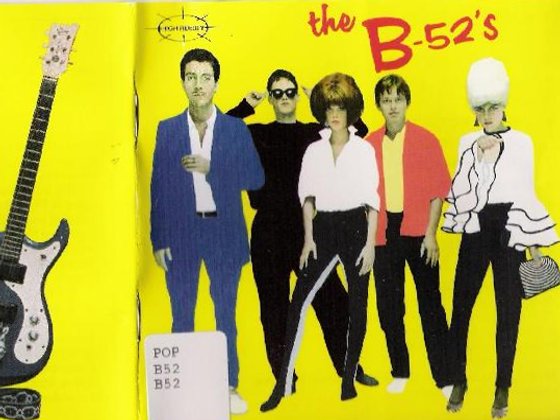
There used to be a chinese restaurant, on the Atlanta Highway, called Hunan House. One night, a few people shared a flaming volcano, and formed a band. The b52s played their first show at a valentines day party in 1977. They were named for a bouffant hairstyle.
The b52’s were Ricky Wilson, his sister Cindy, Kate Pierson, Fred Schneider III, and Keith Strickland. The Wilsons and Mr. Strickland were from Athens. Miss Pierson and Mr. Schneider were from New Jersey. Planet Claire was the ancestral home.
Fred had lived in Atlanta before he moved to Athens. He stayed in an apartment on Monroe Drive, across from S&M clutch and brake company. PG knew some of his neighbors, and once rested his feet on a rug, formerly owned by Fred Schneider.
Somebody had connections, and The b52’s were playing shows in New York before long. They released a 45 on db records, “Rock Lobster” and “52 girls”. The first of the girls mentioned…there are only 23 named…is Effie. There was a famous whorehouse in Athens named Effies.
One night, they played a show at the Big Dipper, on Ponce de Leon Avenue. The Big Dipper was a former Maryland Fried Chicken, and is now something else. After the show, either Kate or Cindy was in the parking lot, talking to a local character named Beulah. As was his way, Beulah was talking about Mick Jagger this, Mick Jagger that. Finally, Kate had enough. “Fuck Mick Jagger. One day Mick Jagger will come see me, me, me.”
The b52’s were a fun band. Ricky had an unusual style on guitar, and Kate played a farfisa organ. The girls always wore big hair wigs. Fred was somewhere up front singing.
On Labor Day, 1978, PG saw the b52’s in Piedmont Park. There was a third girl that day, Wendy, who wore an inflatable beach float, and danced. The only songs PG is sure they did were “Downtown” and “Rock Lobster”. A few months later, PG saw the b52’s at the Agora ballroom. The Brains opened.
Sometime in late 1979, the eponymous first album came out. It became a hit, with dance clubs all over playing “Planet Claire”, “Dance this mess around”, and “6060-842”. In the summer of 1980, PG talked with a former Athenian in a hostel in Cannon Beach, Oregon. He mentioned that Cindy was the only heterosexual in the band.
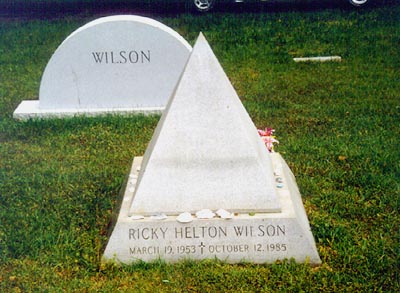
The years went by, and more albums were released. On October 12, 1985, Ricky Wilson died of AIDS. He is buried in Oconee Hill Cemetery, behind Sanford Stadium in Athens. He sold bus tickets at the Greyhound station in downtown Athens before he hit the bigtime.
The band continues to this day. At some point, “Love Shack” was released, and became a hit. It is probably the best known b52’s song today. This is a repost. Pictures are from The Library of Congress.



2:07 P.M.
PG started to feel the familiar stiffness in his big toe. While it was not painful, it could get worse. PG decided to take the offensive, and get treated before the stiffness turns to pain. This means going to the herbal emporium of Dr. Xu. You go to the office , and sign in. He sees you when he sees you.
When facing quality time in a waiting room, it is best to bring a book. The reading material for PG these days is Skinny Legs and All, by Tom Robbins. PG read SLAA in the early 90’s, when he was working in an office downtown. Like all Robbins stories, a re-do reading will uncover noisy nuggets of knowledge, and forgotten figments of imagination.
While warming up the vehicle, PG saw the word “orchidaceous” on page 197. If something like the o-word gets PG’s attention, his response is to note the page number, and put an inkpen dot on both sides of it. As it so happens, on this day PG was looking at page 198, and saw “then allowed” with a ball point bump on both sides. This was referring to a New York art dealer.
The full sentence was “It was as if Gropius had created her, then allowed Gaudi to add the boobs.” The art-monger in question had an unremarkable face, but a generous mammary allowance. The bosomy business lady was discussing the art of Ellen Cherry Petway. At the same time, a vehicle, crafted by Boomer Petway, was eliciting exclamations of magnifque. The automobile was crafted to look like a giant turkey. It had been delivered to Ellen Cherry Charles as a love offering before the wedding. Now, the sheet metal bird was stealing the thunder of Ellen Cherry, who considers herself to be the artiste. This was not a good development for the recently consummated marriage.
The Petways are soon going to trendy New York parties. Ellen Cherry has this country-girl notion of what an art party should be like, and finds the real thing to be lacking. Boomer has another reaction. “I guess that’s what I like about ’em. … They’re just as petty as everybody else.”
Petty is one of those eye-of-the-beholder concepts. Certainly, the current social justice discourse in America explores new levels of petty every day. The five letters p-e-t-t-y can be retrofitted with all five vowels, with y left to ask why. Patty, petty, pitty, potty, putty. All five work. Even pitty does double duty as an “obsolete spelling of pity,” as well as the stage name of a Brazilian rock and roll lady.
PG stumbled onto the art party comment at 1:24 pm, soon after he got down to some serious waiting. A half hour later, Ellen Cherry tore up an invitation to Boomer’s one man show. The arty paper turned into mutually destructive snowflakes and sparks. Could Tom Robbins have foreseen the contemporary disrespect for snowflakes in 1989, when SLAA was written?
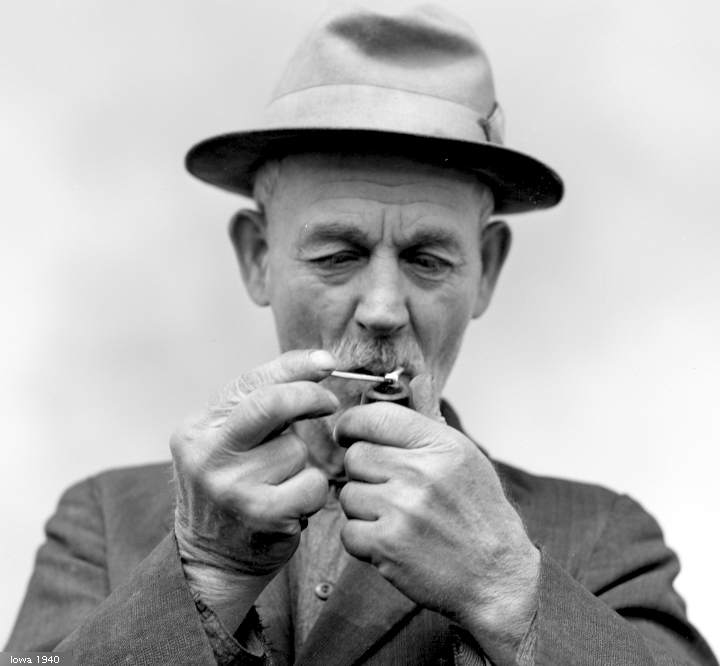
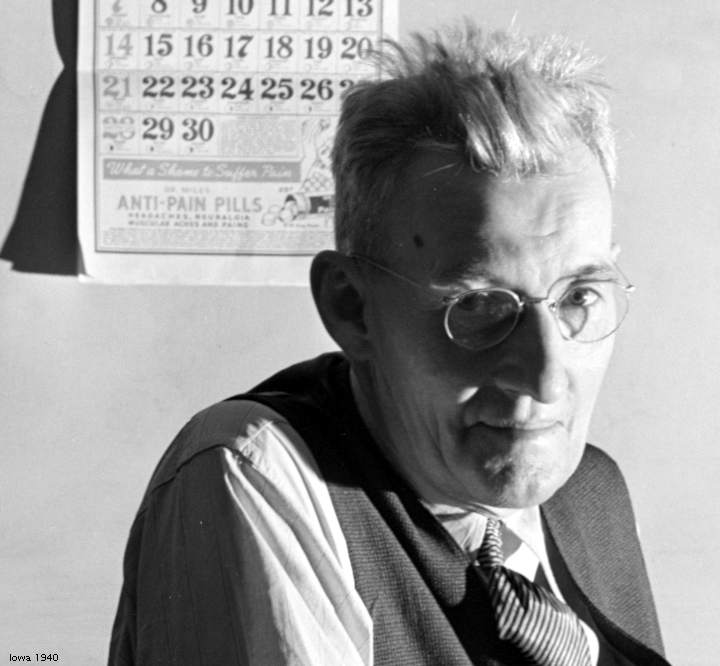
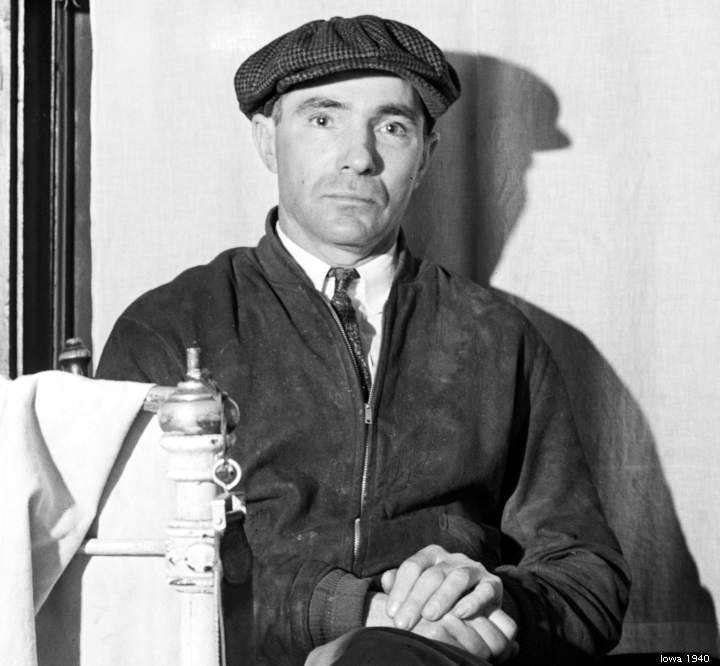
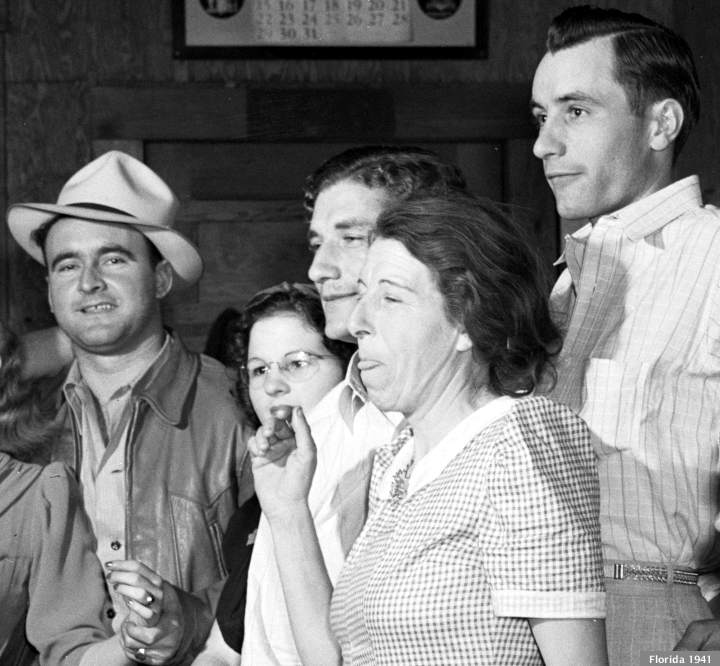
Snowflakes and sparks made their appearance on page 207, and were duly noted. At 2:07 pm, PG was in the middle of his consultation with Dr. Xu. Pictures today are from The Library of Congress.

35 Broad Street
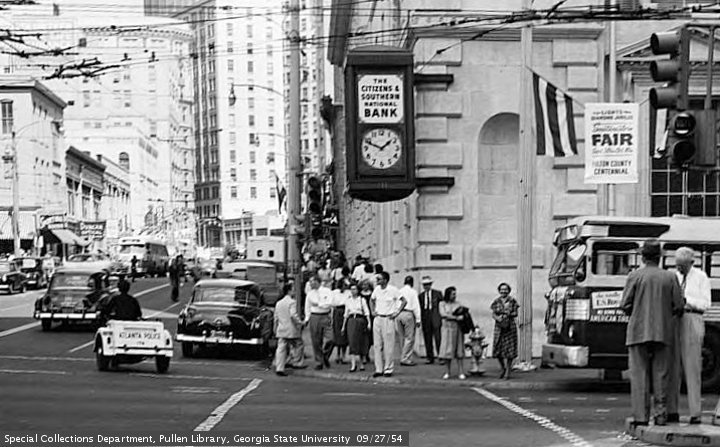
PG was having a delightfully slack afternoon, The one productive activity was editing pictures from “The Special Collections and Archives, Georgia State University Library”. In box seventy two of “corporate bodies”, in the Lane Brothers archive, there was a picture commissioned by King Road Marker Company. It displayed a brand new crosswalk, over Marietta Street at the intersection of Broad Street. The picture was taken at 1:51 p.m. September 27, 1954. This is a repost.
The time caught PG’s eye. 1:51 is one of the times used to display clocks and watches in advertising. Most ads use 10:09. This arrangement of the hour and minute hands makes a welcoming gesture. This allows the logo of the watch to be visible, and is thought to encourage the viewer to purchase the timepiece. The shadows on the buildings indicate that the picture was shot in early afternoon.
The clock with the magic time advertised the C&S national bank. The building behind the clock was the headquarters of that bank. In 1954, Citizens and Southern bank was a prime player in the Atlanta market. (PG’s dad said that C&S stood for choke’m and squeez’m.) At some point, C&S merged with NCNB to become Nationsbank, which was later absorbed by Bank Of America.
C&S kept it’s headquarters at 35 Broad Street for many years after competitors built trophy buildings. Their were constant rumors about where the C&S highrise was going to go. Finally, C&S Plaza was built at Peachtree and North Avenue, a mile north of five points. The building was to become the tallest building in America outside of New York and Chicago. During the construction of this building, C&S became part of Nationsbank, and later Bank of America.
The picture is featured in Atlanta Time Machine. The building is now owned by Georgia State University, with a BOA branch on the first floor. The banking hall is spectacular. It was designed by Philip Shutze, before the great depression. Here is more information.
Nations Bank Building (Citizens and Southern National Bank Building, Empire Building)
35 Broad Street, NW 1901: Bruce and Morgan, Architects, NR.
Remodeling of Lower Floors and Interiors 1929:
Hentz, Adler and Shutze, Architects; Philip Shutze, Designer
Fourteen stories high, the Nations Bank Building was the first steel-frame structure to be built in Atlanta. Its clear-cut silhouette, simple fenestration, and heavily decorated terra-cotta top bear the influence of the Chicago School. In 1929 the building became the headquarters of the Citizens and Southern National Bank, which asked Philip Shutze to redesign its three lower floors. Because the impression of load-bearing masonry was regarded as better suited for a banking establishment than large glass panes were, the original display windows were replaces by classical motifs apparently “carved out” of Indiana limestone.
Philip Shutze was inspired by Italian Mannerism, and especially by the city gates of Verona by Michele Sanmichelo (1484-1559) … Reached from Marietta and Walton streets through lofty arcaded entryways and a more intimate elevator lobby in the early Renaissance style on Broad Street, the banking hall is a long nave articulated by colossal Corinthian pilasters. While its walls and floors feature several kinds of Georgia, Tennessee, and European marbles in a warm gold-brown color scheme, the ceiling, from which hang gigantic chandeliers, is left bare. The Pantheon, which Shutze had measured during his internship at the American Academy in Rome, served as direct source for the pedimented niches, and for the floors with alternate square and circular patterns. Also, of Roman inspiration are the bronze desks and the eagle motif found throughout the design.


Two Hundred Yards Behind
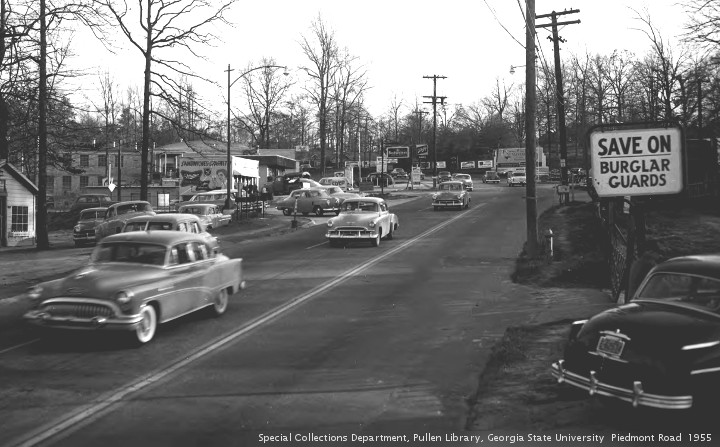


In 1985, PG went to work for Shaky Blueprints. The real name was a Japanese word that nobody knew how to spell. Two of the previous hires were an athletic young lady, and a fat man. Until better nicknames arrive, we will call them AYL and FM for this story.
AYL was trying to get FM to go jogging with her after work. This was an ongoing conversation, with FM always turning her down. One afternoon, PG wore an old pair of jogging shoes to work, and said that he would go running with AYL.
Shaky was just off highway 400, in what is now part of Sandy Springs. There was a road leading away from it. The road went over the highway, and went in a wooded semi circle for a couple of miles. The plan was to go on this loop, and take sidewalks on Roswell Road back to Shaky.
At one time, PG went running every day. He was out of the habit by this time, and always a slow runner. When the work day was over, PG tied his glasses on with a rubber band, did a few stretches, and was ready to take on the course.
AYL and PG left the parking lot, and started up the road. PG trudged along with his head down. When he got to the bridge over the highway, PG looked up. AYL had taken off like greased lightning, and was already two hundred yards ahead. PG hollered for her to slow down, and finished the course.
Pictures for this repost are from “The Special Collections and Archives, Georgia State University Library”. Have a happy July.



Midtown

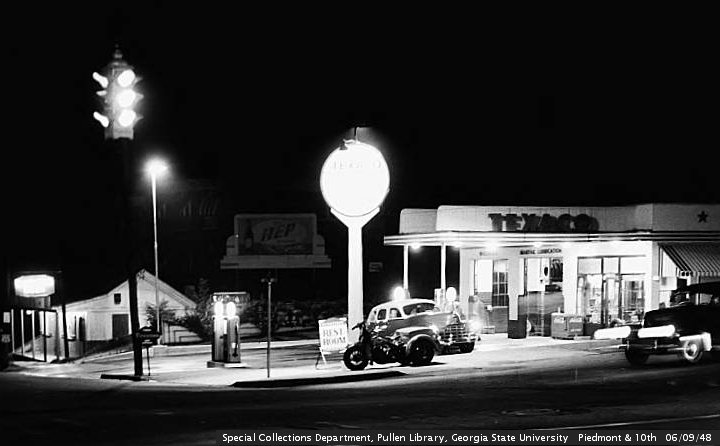


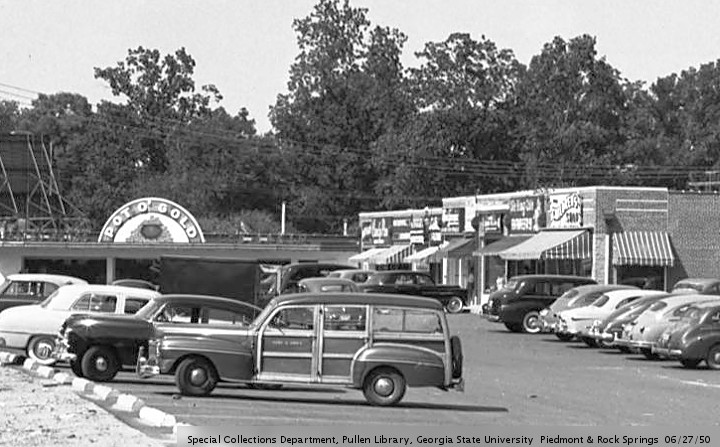
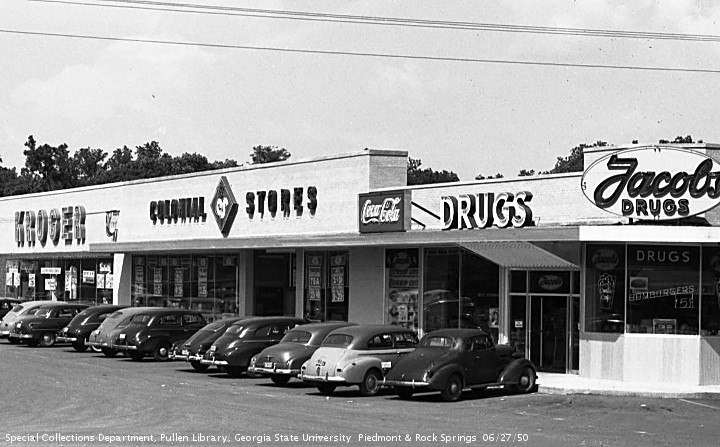
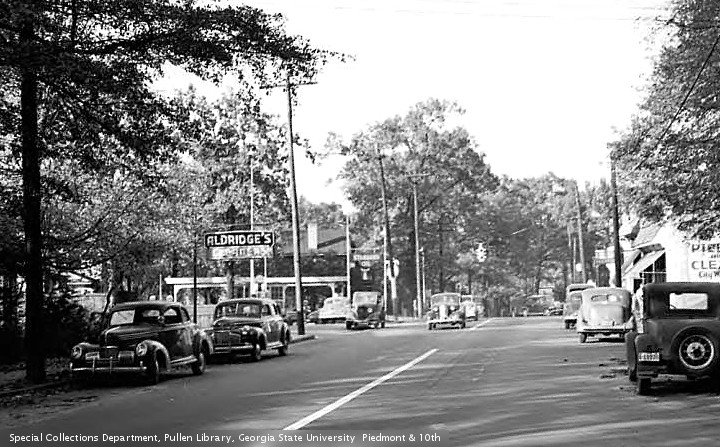
The neighborhood along Peachtree Road has always been a great place to be a freak. For a long time it didn’t have a name. It is north of downtown, between Piedmont Park and Georgia Tech. Sometime in the early eighties, people started to call it Midtown, and the name stuck.
In the time after the War Between the States, this area was a shantytown called “Tight Squeeze”. It evolved into a pleasant middle class area. In the sixties, hippies took over. The area was known as the strip, or tight squeeze. Many stories could be told.
After the flower children moved on, the area went into decline. Gays started to move in, with the battle cry “Give us our rights or we will remodel your house.” Developers, worshiping the triune G-d of location, location, location, began to smell money. The neighborhood became trendy, then expensive, then more expensive. The freaks with money remain. This is a repost. Pictures are from “The Special Collections and Archives, Georgia State University Library”.
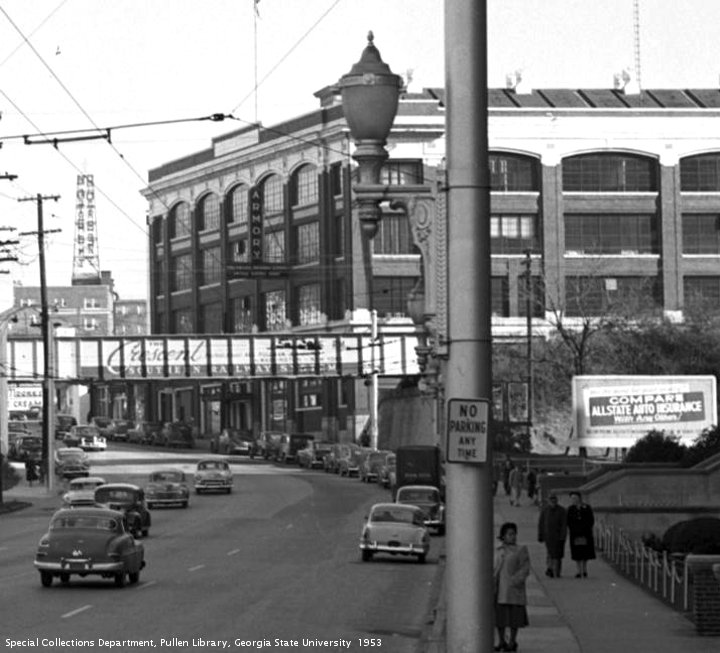

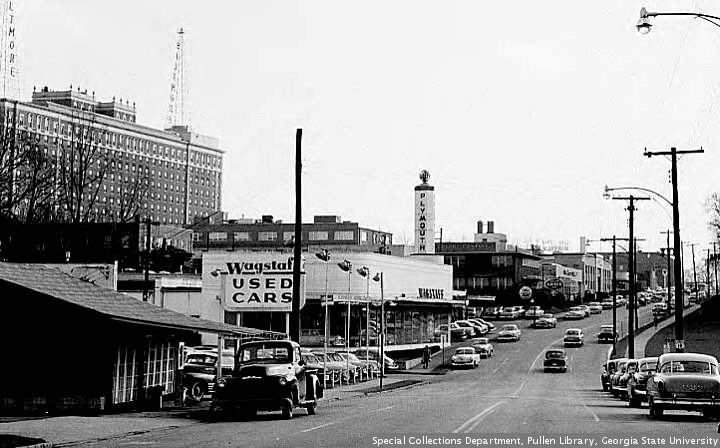

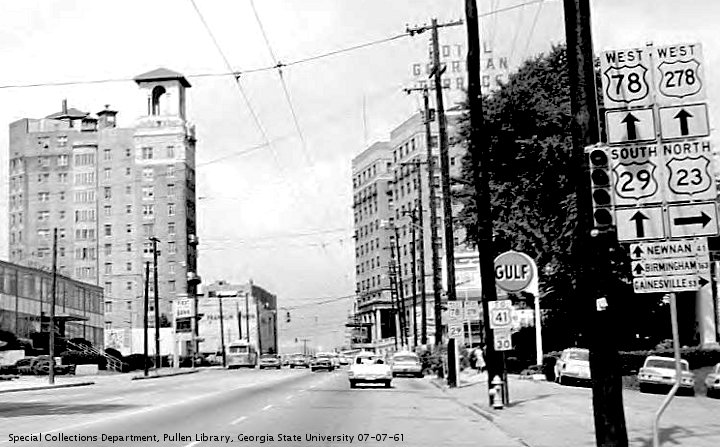


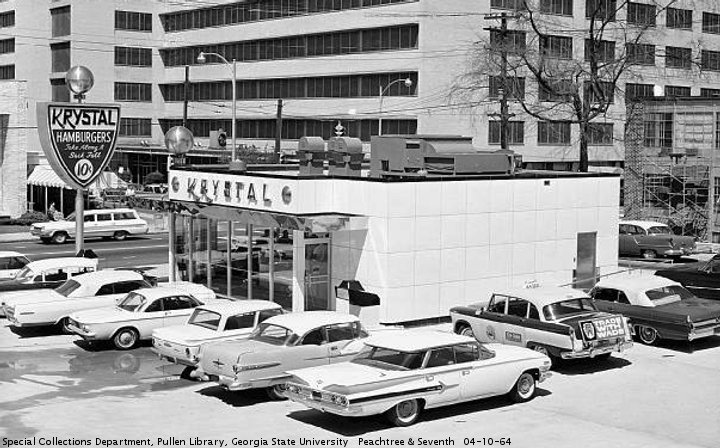
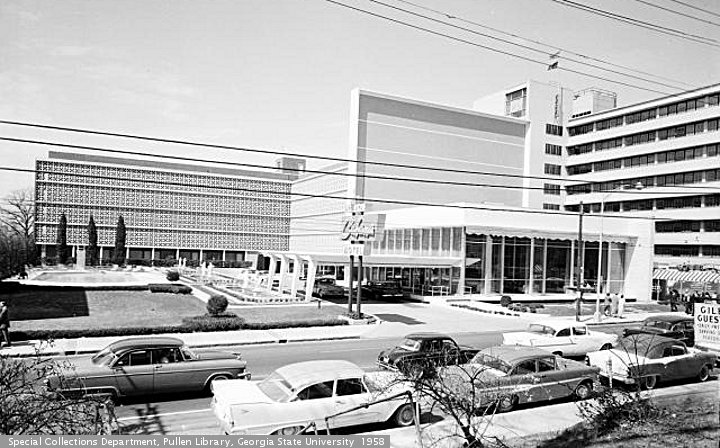

There was a nifty webcam up when this feature was written. It shows the progress of a high rise going up now at 12th and Peachtree in midtown. The location of the camera itself is not certain. The most likely location is 999 Peachtree, on Tenth Street, two blocks south of the project.
A glance at the image reveals a curve in the road, between the two glass boxes under construction. Atlanta does not have wide, straight boulevards extending to the horizon. It is said that Atlanta did not build roads, but paved the cow paths.
People of a certain age will remember this area as the strip. The tenth street district was a neighborhood shopping area, up until the mid sixties. At some point, the old businesses started to move out and the hippies moved in. For a while, it was a festive party. Soon enough reality returned, and the area went into a crime filled decline.
The 999 complex is the neighborhood story in a nutshell. Before 1985, it was a block of small businesses. There was a hardware store, with the peace symbol set in tiles in the sidewalk. On Juniper Street stood the Langdon Court Apartments. They were named for PG’s great uncle Langdon Quin. Ru Paul used to stay there. He would sit out on a balcony, and wave to the traffic going by.
Across the street was a chinese restaurant, the House of Eng. A staircase on the side led to the Suzy Wong Lounge. Behind the building was an apartment building. It was one of the residences of Margaret Mitchell, while she wrote “Gone With The Wind”. She called it “the dump”, which was fairly accurate. The museum on that site would have amazed her.
PG went to the House of Eng for lunch one day in 1985. He noticed that he was the only customer in the house, at 12:30 pm on a weekday. After finishing his lunch, PG knew why.
At some point, it was decided to build a high rise there. Heery was one of the equity partners, along with a law firm and an ad agency. The building was designed by Heery (duh).The ad agency folded before the building opened, followed within a couple of years by the law firm. Heery was sold to a British company. PG does not know who owns 999 Peachtree now.
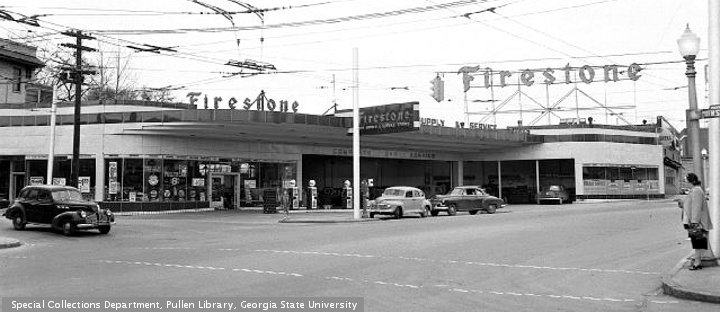
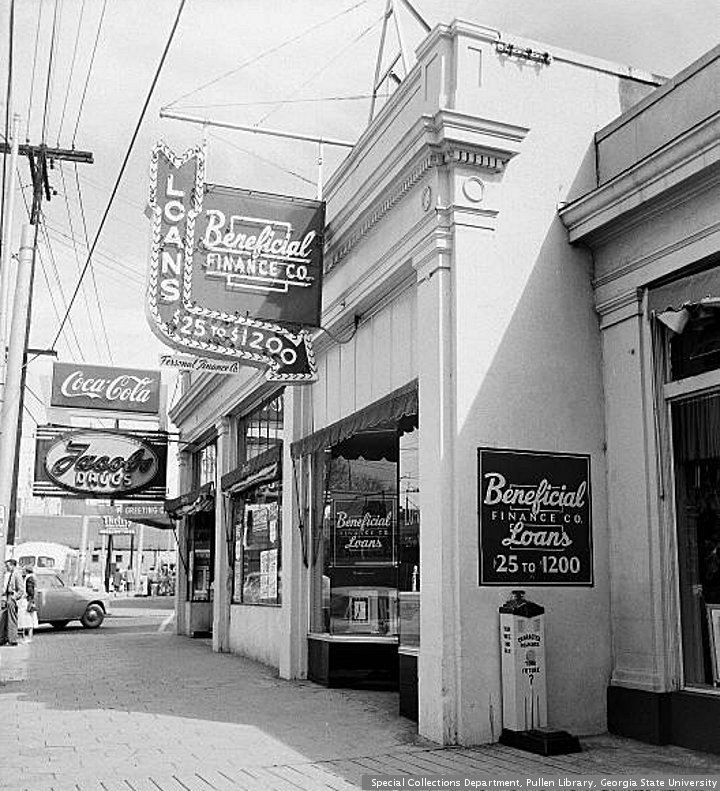
This is a repost, with pictures from “The Special Collections and Archives, Georgia State University Library”. The building, at 12th and Peachtree, is finished.



Steve Martin


There is a form letter floating through the intercourse now. It is a letter that Steve Martin used to send to his fans. (The letter was recently immortalized at Letters of Note.)
He …that is Stephen Glenn “Steve” Martin (born August 14, 1945) … has moved up in correspondence with his adoring fans. Mr. Martin now gives out business cards, with the message “This card certifies that the holder had met Steve Martin and found him genuinely friendly”. What a wild and crazy guy!
 This is becoming one of those really really modern days here. Listening to a djmix with a Lady Gaga song, drinking coffee out of a Mcdonalds plastic cup, and writing a tribute to Steve Martin. What a day! Oh, before we forget, there is the story about the drive in theater on I85 that was showing “Father of the Bride”. One day, the h fell off the marquee, and the title of the movie became “Fater of the Bride”. Good times.
The story of Steve Martin and PG began one night at the Great Southeast Music Hall. PG got tired of hearing how great the Nitty Gritty Dirt Band was, and decided to see a show. The show started when some guy in a white suit came out with a banjo. John McEuen stood next to him, and kept falling into the microphone stand and saying “this guy cracks me up”.
Steve Martin, the white suit guy, said that he paid somebody five thousand dollars for a joke. He then took this arrow, with a coat hanger wire attached to it, with a shape for his head to fit in, and put it on. That got a laugh, but not worth five thousand dollars. There was another gag…”do you mind if i smoke, no do you mind if i fart”. That got a slightly bigger laugh.
In those days, you could not sell alcohol in public on sunday night in Georgia. To compensate, the Music Hall sold children’s tickets for the sunday night shows. Mr. Martin was not used to having children in the audience. “Hey kid I gotta joke for you. There were these two lesbians…”
The show went over well with the Nitty Gritty crowd. However, it is doubtful that anyone thought, this is the beloved entertainer of our generation.
Mr. Martin was not through for the night. At one point, the NGDB moved to the back of the stage, and a smarmy lounge lizard, in a white suit, came on stage. While the band played “The girl from Ipanema”, Mr. Martin sang about the girl with diarrhea.
 This was one of the last shows that Steve Martin did as an opening act. (He did return to the Great Southeast Music Hall. Once, he did a week with Martin Mull, called the Steve Martin Mull Revue.) Within two years, he was a guest host on Saturday Night Live, and a certified wild and crazy guy. A couple of years later, he was famous again as “The Jerk”. Steve Martin had arrived.
This is a repost. The pictures today are from “The Special Collections and Archives, Georgia State University Library”. The animated dentures are from chattering teeth. The check is in the mail.




 Chamblee54
leave a comment