Author Insults Part Three

There was a comment at the source of Author Insults, a recently published offering from chamblee54: JC · “This article is plagarized wholesale from The 50 best author vs. author put-downs of all time. … This comment piqued my interest. However, it simply is not true. There were only ten duplicates in the two collections. The forty remaining quotes will be the basis of today’s post. The original numbering will be used today. Any skipped number indicates a quote that is available in Part One.
There is one more notice before we proceed: FULL DISCLOSURE – The quotes below have not been fact checked. There is a good possibility that some are the result of an overactive imagination. Caveat lector. … I chose a quote to promote AI Part Two: H.L. Mencken on Henry James: “He writes with all the daring of a grandmother smoking marijuana.” I soon had doubts about this item. Both google and duckduckgo said the quote was bogus. DDG did have a tasteful replacement: “Henry James would have been vastly improved as a novelist by a few whiffs of the Chicago stockyard.” H.L. Mencken “Mencken Chrestomathy”, p.500, Vintage. … This is one of the joys of being a Quote Truther. Often, the genuine quote is better than the fake.
05. John Updike, according to Gore Vidal – “I can’t stand him. Nobody will think to ask because I’m supposedly jealous; but I out-sell him. I’m more popular than he is, and I don’t take him very seriously…oh, he comes on like the worker’s son, like a modern-day D.H. Lawrence, but he’s just another boring little middle-class boy hustling his way to the top if he can do it.”
06. William Shakespeare’s A Midsummer Night’s Dream, according to Samuel Pepys
“We saw ‘Midsummer Night’s Dream,’ which I had never seen before, nor shall ever again, for it is the most insipid ridiculous play that ever I saw in my life.”
07. Edward Bulwer-Lytton, according to Nathaniel Hawthorne
“Bulwer nauseates me; he is the very pimple of the age’s humbug. There is no hope of the public, so long as he retains an admirer, a reader, or a publisher.”
08. Charles Dickens, according to Arnold Bennett
“About a year ago, from idle curiosity, I picked up ‘The Old Curiosity Shop’, and of all the rotten vulgar un-literary writing…! Worse than George Eliot’s. If a novelist can’t write where is the beggar.”
09. J.K. Rowling, according to Harold Bloom – “How to read ‘Harry Potter and the Sorceror’s Stone’? Why, very quickly, to begin with, and perhaps also to make an end. Why read it? Presumably, if you cannot be persuaded to read anything better, Rowling will have to do.”
10. Oscar Wilde, according to Noel Coward
“Am reading more of Oscar Wilde. What a tiresome, affected sod.”
11. Fyodor Dostoevsky, according to Vladimir Nabokov – “Dostoevky’s lack of taste, his monotonous dealings with persons suffering with pre-Freudian complexes, the way he has of wallowing in the tragic misadventures of human dignity — all this is difficult to admire.”
12. John Milton’s Paradise Lost, according to Samuel Johnson
“’Paradise Lost’ is one of the books which the reader admires and lays down, and forgets to take up again. None ever wished it longer than it is.”
13. Oliver Goldsmith’s The Vicar of Wakefield, according to Mark Twain
“Also, to be fair, there is another word of praise due to this ship’s library: it contains no copy of ‘The Vicar of Wakefield’, that strange menagerie of complacent hypocrites and idiots, of theatrical cheap-john heroes and heroines, who are always showing off, of bad people who are not interesting, and good people who are fatiguing.”
14. Ezra Pound, according to Conrad Aiken – “For in point of style, or manner, or whatever, it is difficult to imagine anything much worse than the prose of Mr. Pound. It is ugliness and awkwardness incarnate. Did he always write so badly?”
15. James Joyce’s Ulysses, according to George Bernard Shaw – “I have read several fragments of ‘Ulysses’ in its serial form. It is a revolting record of a disgusting phase of civilisation; but it is a truthful one; and I should like to put a cordon around Dublin; round up every male person in it between the ages of 15 and 30; force them to read it; and ask them whether on reflection they could see anything amusing in all that foul mouthed, foul minded derision and obscenity.”
16. George Bernard Shaw, according to Roger Scruton – “Concerning no subject would he be deterred by the minor accident of complete ignorance from penning a definitive opinion.”
17. Jane Austen, according to Charlotte Brontë – “Why do you like Miss Austen so very much? I am puzzled on that point. What induced you to say that you would rather have written ‘Pride and Prejudice’…than any of the Waverly novels? I should hardly like to live with her ladies and gentlemen, in their elegant but confined houses.”
18. Goethe, according to Samuel Butler
“I have been reading a translation of Goethe’s ‘Wilhelm Meister.’ Is it good? To me it seems perhaps the very worst book I ever read. No Englishman could have written such a book. I cannot remember a single good page or idea….Is it all a practical joke? If it really is Goethe’s ‘Wilhelm Meister’ that I have been reading, I am glad I have never taken the trouble to learn German.”
19. John Steinbeck, according to James Gould Cozzens – “I can’t read ten pages of Steinbeck without throwing up. I couldn’t read the proletariat crap that came out in the ’30s.”
21. Jonathan Swift, according to Samuel Johnson
“Swift has a higher reputation than he deserves…I doubt whether ‘The Tale of a Tub’ to be his; for he never owned it, and it is much above his usual manner.”
22. Gertrude Stein, according to Wyndham Lewis – “Gertrude Stein’s prose-song is a cold black suet-pudding. We can represent it as a cold suet-roll of fabulously reptilian length. Cut it at any point, it is the same thing; the same heavy, sticky, opaque mass all through and all along.”
23. Emile Zola, according to Anatole France – “His work is evil, and he is one of those unhappy beings of whom one can say that it would be better had he never been born.”
24. J.D.Salinger, according to Mary McCarthy – “I don’t like Salinger, not at all. That last thing isn’t a novel anyway, whatever it is. I don’t like it. Not at all. It suffers from this terrible sort of metropolitan sentimentality and it’s so narcissistic. And to me, also, it seemed so false, so calculated. Combining the plain man with an absolutely megalomaniac egotism. I simply can’t stand it.”
27. William Faulkner, according to Ernest Hemingway – “Have you ever heard of anyone who drank while he worked? You’re thinking of Faulkner. He does sometimes — and I can tell right in the middle of a page when he’s had his first one.”
28. E.M. Forster’s Howards End, according to Katherine Mansfield – “Putting my weakest books to the wall last night I came across a copy of ‘Howards End’ and had a look into it. Not good enough. E.M. Forster never gets any further than warming the teapot. He’s a rare fine hand at that. Feel this teapot. Is it not beautifully warm? Yes, but there ain’t going to be no tea. … And I can never be perfectly certain whether Helen was got with child by Leonard Bast or by his fatal forgotten umbrella. All things considered, I think it must have been the umbrella.”
30. Charles Dickens, according to George Meredith – “Not much of Dickens will live, because it has so little correspondence to life … If his novels are read at all in the future, people will wonder what we saw in them, save some possible element of fun meaningless to them.”
32. Gustave Flaubert, according to George Moore
“Flaubert bores me. What nonsense has been talked about him!”
33. Alexander Solzhenitsyn, according to Gore Vidal
“He is a bad novelist and a fool. The combination usually makes for great popularity in the US.”
34. Ernest Hemingway, according to Tom Wolfe
“Take Hemingway. People always think that the reason he’s easy to read is that he is concise. He isn’t. I hate conciseness — it’s too difficult. The reason Hemingway is easy to read is that he repeats himself all the time, using ‘and’ for padding.”
35. James Joyce’s Ulysses, according to Virginia Woolf – “I dislike ‘Ulysses’ more and more — that is I think it more and more unimportant; and don’t even trouble conscientiously to make out its meanings. Thank God, I need not write about it.”
36. William Shakespeare, according to George Bernard Shaw
“With the exception of Homer, there is no eminent writer, not even Sir Walter Scott, whom I can despise so entirely as I despise Shakespeare when I measure my mind against his. The intensity of my impatience with him occasionally reaches such a pitch, that it would positively be a relief to me to dig him up and throw stones at him, knowing as I do how incapable he and his worshippers are of understanding any less obvious form of indignity.”
37. Charles Lamb, according to Thomas Carlyle
“Charles Lamb I sincerely believe to be in some considerable degree insane. A more pitiful, rickety, gasping, staggering, stammering tomfool I do not know. He is witty by denying truisms and abjuring good manners. His speech wriggles hither and thither with an incessant painful fluctuation; not an opinion in it or a fact or even a phrase that you can thank him for.”
38. Edith Sitwell, according to Dylan Thomas – “Isn’t she a poisonous thing of a woman, lying, concealing, flipping, plagiarising, misquoting, and being as clever a crooked literary publicist as ever.”
39. James Jones, according to Ernest Hemingway
“To me he is an enormously skillful f#*&-up and his book will do great damage to our country. Probably I should re-read it again to give you a truer answer. But I do not have to eat an entire bowl of scabs to know they are scabs … I hope he kills himself ….”
40. Sir Walter Scott, according to Mark Twain – “Then comes Sir Walter Scott with his enchantments, and by his single might checks…progress, and even turns it back; sets the world in love with dreams and phantoms; with decayed and swinish forms of religion; with decayed and degraded systems of government; with the silliness and emptiness, sham grandeurs, sham gauds, and sham chivalries of a brainless and worthless long-vanished society. He did measureless harm; more real and lasting harm, perhaps, than any other individual that ever wrote.”
42. Robert Frost, according to James Dickey – “If it were thought that anything I wrote was influenced by Robert Frost, I would take that particular work of mine, shred it, and flush it down the toilet, hoping not to clog the pipes….a more sententious, holding-forth old bore, who expected every hero-worshipping adenoidal little twerp of a student-poet to hang on his every word I never saw.”
43. Tom Wolfe, according to John Irving – “He doesn’t know how to write fiction, he can’t create a character, he can’t create a situation…You see people reading him on airplanes, the same people who are reading John Grisham, for Christ’s sake….I’m using the argument against him that he can’t write, that his sentences are bad, that it makes you wince. It’s like reading a bad newspaper or a bad piece in a magazine….You know, if you were a good skater, could you watch someone just fall down all the time? Could you do that? I can’t do that.”
44. Bret Harte, according to Mark Twain – “Harte is a liar, a thief, a swindler, a snob, a sot, a sponge, a coward, a Jeremy Diddler, he is brim full of treachery, and he conceals his Jewish birth as carefully as if he considered it a disgrace. How do I know? By the best of all evidence, personal observation.”
45. Thomas Carlyle, according to Anthony Trollope
“I have read — nay, I have bought! — Carlyle’s ‘Latter Day Pamphlets,’ and look on my eight shillings as very much thrown away. To me it appears that the grain of sense is so smothered up in a sack of the sheerest trash, that the former is valueless….I look on him as a man who was always in danger of going mad in literature and who has now done so.”
46. Henry James, according to Arnold Bennett – “It took me years to ascertain that Henry James’s work was giving me little pleasure….In each case I asked myself: ‘What the dickens is this novel about, and where does it think it’s going to?’ Question unanswerable! I gave up. Today I have no recollection whatever of any characters or any events in either novel.”
47. James Fenimore Cooper, according to Mark Twain – “Cooper’s art has some defects. In one place in ‘Deerslayer,’ and in the restricted space of two-thirds of a page, Cooper has scored 114 offences against literary art out of a possible 115. It breaks the record.”
48. Gore Vidal, according to Martin Amis – “Vidal gives the impression of believing that the entire heterosexual edifice — registry offices, ‘Romeo and Juliet,’ the disposable diaper — is just a sorry story of self-hypnosis and mass hysteria: a hoax, a racket, or sheer propaganda.”
49. Elizabeth Barrett Browning, according to Edward Fitzgerald – “She and her sex had better mind the kitchen and her children; and perhaps the poor; except in such things as little novels, they only devote themselves to what men do much better, leaving that which men do worse or not at all.”
50. Tom Wolfe’s A Man in Full, according to Norman Mailer – “The book has gas and runs out of gas, fills up again, goes dry. It is a 742-page work that reads as if it is fifteen hundred pages long. … At certain points, reading the work can even be said to resemble the act of making love to a three-hundred pound woman. Once she gets on top, it’s over. Fall in love, or be asphyxiated. So you read and you grab and you even find delight in some of these mounds of material. Yet all the while you resist — how you resist! — letting three hundred pounds take you over.”
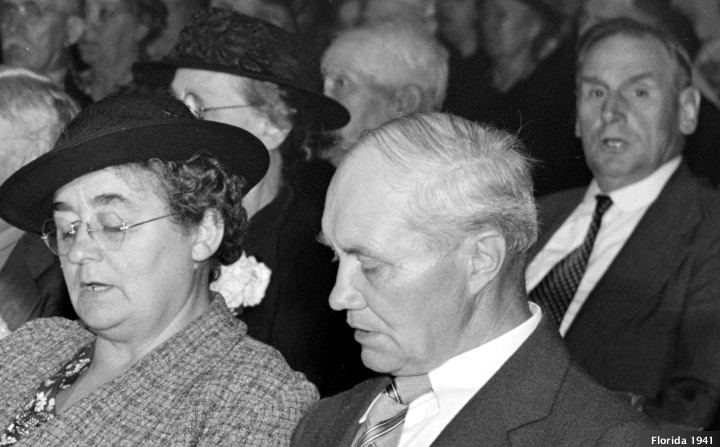
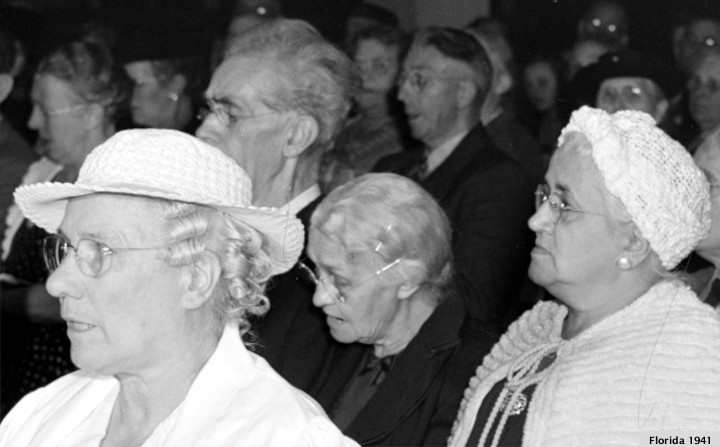
Parts One and Two of this series are available. Pictures today are from The Library of Congress. Marion Post Wolcott took the social media picture in January 1941. “Congregation attending Sunday church services. Sarasota trailer park, Sarasota, Florida” ©Luther Mckinnon 2026 · selah


 Chamblee54
[…] by the Wayback machine. While there, I started to look through the comments. Parts One and Three of this series are available. Jean-Paul • Louis-Ferdinand Céline on D.H.Lawrence’s “Lady […]
[…] media picture in April 1938. “Farm women, Halifax County, North Carolina.” Parts Two and Three of this series are available. ©Luther Mckinnon 2026 · […]
[…] · dr roy · fragoso · sam fragoso · ben lerner kitten’s corner · One · Two · Three · zander floyd ruthardt railroad map of ga 1911 · squeebs · charliebo313 · enduring beta · […]