William Lott Monroe, Sr.




“North Boulevard was renamed Monroe Drive in 1937 to honor noted Landscape Architect W.L. Monroe who built his house and a plant nursery on the road and was noted for his many landscape projects and public parks in Atlanta.” Faset (Bill) Seay, February 4, 2020, 3:48 pm This comment was made to Monroe Drive or Boulevard. MDOB looks at Atlanta roads that change names, and the reputed racial motivations for these changes. The Monroe story takes place in Piedmont Heights.
“In 1823 Benjamin Plaster was granted 3,000 acres of land along Peachtree Creek and Clear Creek in recognition of his military service during the War of 1812. This was two years before Archibald Holland acquired a similar tract several miles to the east where another village called Terminus was founded in 1837, later renamed Marthasville and eventually Atlanta. … Plaster built a bridge across Peachtree Creek and the trail to it became known as Plaster’s Bridge Road. The bridge’s stone abutments still remain on the creek banks and a short section of the old road, running along the northern boundary of today’s Piedmont Heights, is now called Plasters Avenue. As other settlers followed a township called Easton grew up around Walker’s Grist Mill on Clear Creek near the site of today’s Ansley Mall at Piedmont Road and Monroe Drive.”
“Around 1850 Captain Hezekiah Cheshire arrived from South Carolina. His sons, Napoleon and Jerome, settled on opposite sides of the south fork of Peachtree Creek. They built a bridge across the creek near to connect their farms and the road to it became Cheshire Bridge Road. … In 1864 General Sherman’s Union soldiers swept through Atlanta. General T. J. Wood’s troops built entrenchments along the eastern edge of Easton on the property of Benjamin Plaster’s son Edwin, putting the little community in the battle of Atlanta. These entrenchments remained until the 1950s when they were destroyed by the construction of a Holiday Inn. Today a few crumbling stone steps and historic marker on the site honor the Edwin Cheshire family’s handyman “Gold Tooth John” whose ghost is rumored to still wander the halls of the old hotel at night.
“In 1871 the Atlanta and Richmond Air Line Railway opened a line between Atlanta and Toccoa, Georgia with a depot at Easton. Its “Air Line Belle” train, said to be the finest on the line, allowed Easton residents to commute to Atlanta without having to ford Clear Creek which still had no bridge. Train service spurred growth of the township to 100 residents by 1888 but the surrounding area remained rural and mostly devoted to farming and dairying. The rail line serving Easton was called the “Southern Railway Belt Line” and in 1883 the “Georgia Pacific Belt Line Railroad” connected with it just north of Easton at Belt Junction, an area which later became known as … Armour/Ottley. … In 1895 North Boulevard was built, running through Easton parallel to the railroad, as a main route into Atlanta. … In 1912 Fulton County annexed Easton and renamed it Piedmont Heights. Plaster’s Bridge Road was paved in 1917 and its name changed to Piedmont Road.” (According to this narrative, the Boulevard-Monroe thoroughfare was originally called North Boulevard. This is not the same road as North Avenue. Confusing road names is not limited to multiple Peachtrees.)
“In 1925 Landscape Architect W. L. Monroe bought 15 acres on North Boulevard at Wimbledon Road where he operated a popular nursery and landscaping business for many years, … Remnants of two small stone structures that Monroe built … remain on the grounds of today’s Ansley-Monroe Villas Condominiums. In 1927 a portion of North Boulevard was renamed Monroe Drive in honor of Monroe’s many landscape projects in the city.” … “In 1928 the City of Atlanta began annexing Piedmont Heights by taking in the lots along North Boulevard. In the 1930s a new home could be bought for $4,700 on North Boulevard or Wimbledon Road.”
There is a bit of confusion here. One source says the Monroe renaming was in 1927, while another source says 1937. Then there is the story told by maps, found in the original post.
An 1892 “Bird’s eye view” shows Boulevard sailing off into the horizon, past a racetrack in today’s Piedmont Park. A 1911 map shows Boulevard starting near “L.P. Grant Park,” and sailing past Ponce up to Piedmont Park. A 1940 map shows Boulevard going past Park Drive, only to turn into Monroe Drive at Montgomery Ferry Road. Finally, a 1969 map of “Negro Residential Areas” shows Monroe Drive changing into Boulevard at Ponce De Leon Avenue, like it is today.
Two things are worth noting. None of these maps have a “North Boulevard.” The street name is a stand-alone Boulevard. Second, the 1940 map shows the street as Boulevard at Eighth Street, and Elmwood Drive. The first mention of Monroe is at Montgomery Fairy, near the Monroe Nursery. This might contradict the racial narrative.
The information about Mr. Monroe neither proves, nor disproves, the story that black Boulevard was changed to white Monroe. City on the Verge: Atlanta and the Fight for America’s Urban Future states “In 1925 landscape architect W. L. Monroe bought fifteen acres on what was then called North Boulevard, establishing a plant nursery that thrived for many years. In 1937, the street north of Ponce de Leon was renamed Monroe Drive in his honor (and to distinguish it as a white area as opposed to Boulevard to the south of Ponce).” The book offers no evidence for this, and its “woke” tone is cause for skepticism. While there is circumstantial evidence to support the legend, verifiable facts are hard to come by. A similar story might be the 1956 change of the state flag.
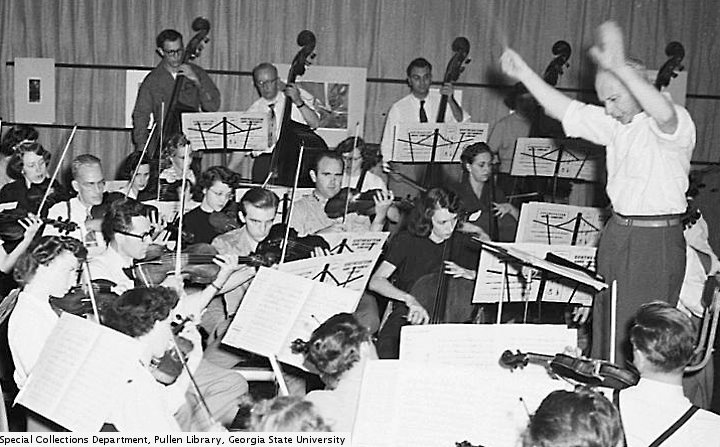
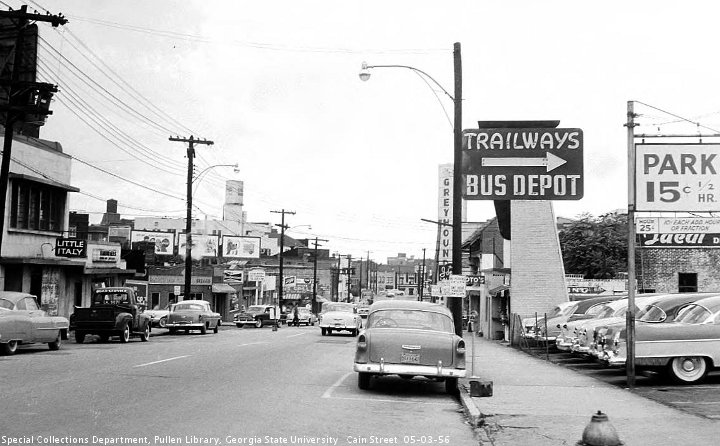
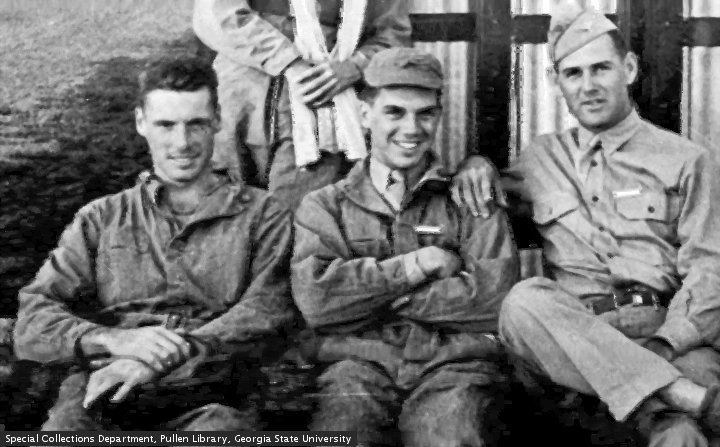
“William Lott Monroe, Sr. (1891-1965), landscape designer and nurseryman, is recognized in newspaper articles as the “landscape artist” during the development of North Fulton Park (later renamed Chastain Memorial Park) in the late 1930s and early 1940s. This work was financed partially through WPA (Works Progress Administration) funds and supported with local prison labor. … There are three main areas in Chastain Park with Monroe’s signature style as a landscape designer: (1) the master grill area; (2) the picnic grounds area; and (3) the amphitheater. … Monroe’s Landscape & Nursery Co. is removed from Fulton County’s payroll: “… Drawn more than $17,000 from the county in the last year and one-half… The company was drawing $500 a month for supervising landscaping of county parks, which was in addition to flowers, shrubs and blueprints sold by it to the county.” (“Nursery Company Is Cut Off Pay Roll.” Atlanta Constitution, Jan. 25, 1941)” … “1941 Amphitheater still under construction, originally planned as an outdoor venue for the Atlanta Symphony Orchestra.” … “It is unknown if Monroe oversaw the completion of construction at the amphitheater.” … “October 22, 1965 William Lott Monroe, Sr. dies in Atlanta.” Pictures are from “The Special Collections and Archives, Georgia State University Library”.




 Chamblee54
leave a comment