The Peanut Butter Dilemma


PG got an email from Uzi, with a list of home remedies, and alternate product uses. Peanut butter has three alternative uses, which is one more than preparation H. No one ever made a preparation H and jelly sandwich.
To remove labels off glassware, rub with peanut butter. To remove ink from the face of dolls, use peanut butter. To get the scratches out of CD’s, use peanut butter, and wipe off with a coffee filter.
Peanuts were used by the Incas in 950b.c. It probably didn’t take much imagination to grind the beans into a paste. To claim inventing peanut butter is like claiming to invent the knot.
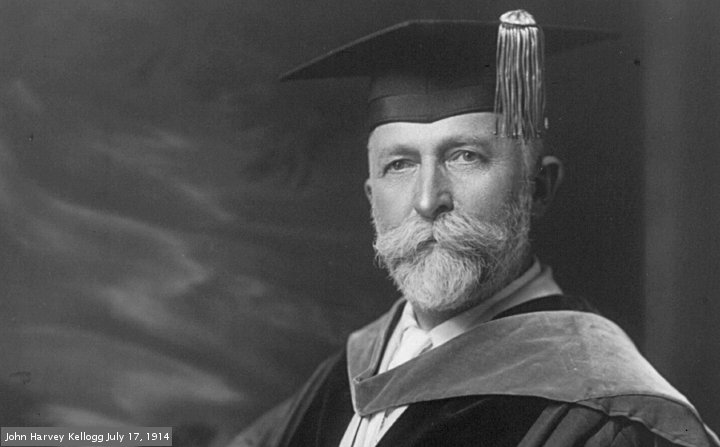
In recent times, Dr. Ambrose Straub of St. Louis patented a peanut butter-making machine in 1903. Dr. John Harvey Kellogg patented a “Process of Preparing Nut Meal” in 1895. Kellogg served the patients at his Battle Creek Sanitarium peanut butter.
Joseph L. Rosenfield invented a churning process that made smooth peanut butter smooth. In 1928, Rosenfield licensed his invention to the Pond Company, the makers of Peter Pan peanut butter. In 1932, Rosenfield began making his own brand of peanut butter called Skippy.
Did someone say George Washington Carver? Dr. Carver discovered hundreds of uses for the peanut. However, Dr. Carver did not patent peanut butter, as he believed food products were all gifts from God. The Incas beat all of these men by 2800 years.
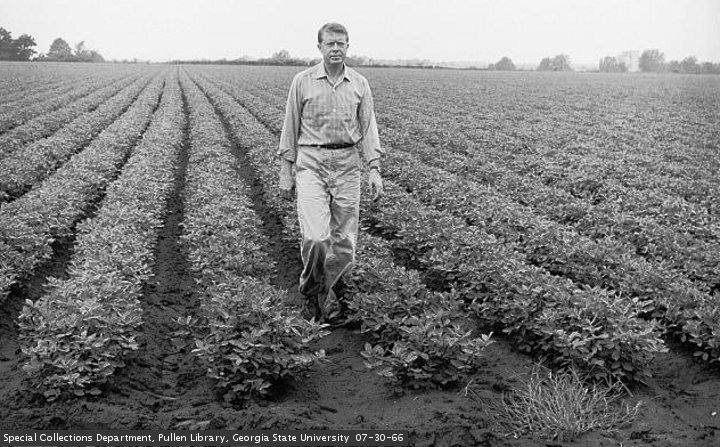
In 1976, a peanut farmer from Plains, Georgia was elected President. It is also known the his brother Billy ran the family business, while Jimmy got mixed up in politics. While President, Mr. Carter was revealed to be a major user of Preparation H.
Now that we are confused about who invented peanut butter, the next question is, why butter? In The Netherlands, the product is called Pinda Kaas, or peanut cheese. It could as easily be mud, goo, or cream, as butter.
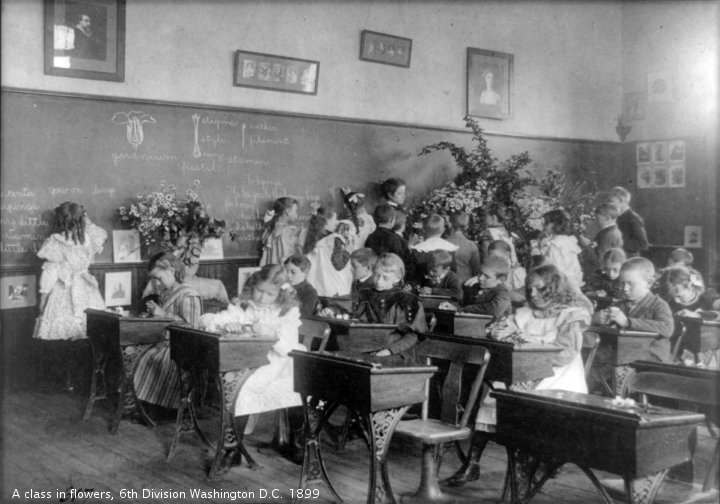
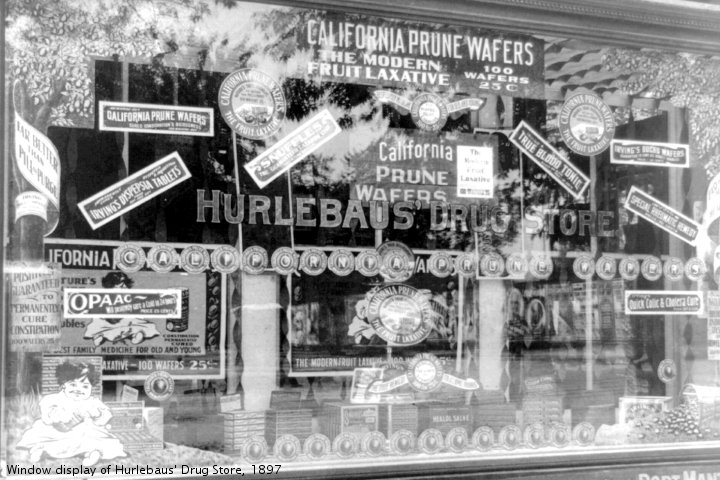
A google search on “why is peanut paste called peanut butter?” yielded an article about salmonella issues. Wikipedia sheds no light on the subject, but does mention that peanut butter is an effective bait for mouse traps. This is a repost. The picture of Jimmy Carter is from ” The Special Collections and Archives,Georgia State University Library” . Other pictures are from The Library of Congress. Inventors.about.com has a page about “The history of peanut butter”. Portions of the text were copied into this post. This is a repost.


Slavery And The Star Spangled Banner


There is a terrific Backstory episode about the War of 1812. This is a conflict that is not much thought about, even during its bicentennial. It was not a good war for people of color. Native tribes fought with the British in Michigan, and were soundly defeated. After this war, the attitude of the white man towards the natives got worse.
Perhaps the most famous product of the War of 1812 is The Star Spangled Banner, a.k.a. the national anthem. There are a few legends about writing this song that skeptical bloggers like to shoot down. At the 43 minute mark of the backstory episode, another aspect of TSSB is discussed.
It seems as though slaves were escaping their owners, and fighting with the British. Washington lawyer Francis Scott Key was a slave owner, and thought that the slaves would be better off with their owners. This is the sentiment behind the third verse of TSSB.
And where is that band who so vauntingly swore,
That the havoc of war and the battle’s confusion
A home and a country should leave us no more?
Their blood has wash’d out their foul footstep’s pollution.
No refuge could save the hireling and slave
From the terror of flight or the gloom of the grave,
And the Star-Spangled Banner in triumph doth wave
O’er the land of the free and the home of the brave.
The image of F.S. Key has been cleaned up over the years. This biography omits the third verse of TSSB, and does not mention his slaves. Wikipedia tells a different story.
“Key was appointed as a United States District Attorney from 1833-1841. Key used his position to suppress opponents of slavery. In 1833, he indicted Benjamin Lundy, editor of the anti-slavery publication, The Genius of Universal Emancipation, and his printer, WIlliam Greer, for libel after Lundy publishing an article that declared, “There is neither mercy nor justice for colored people in this district,” referring to the District of Columbia.” Lundy’s article, Key said, “was intended to injure, oppress, aggrieve, and vilify the good name, fame, credit & reputation of the Magistrates and constables” of Washington. Lundy left town rather than face trial; Greer was acquitted. …
In 1836, Key prosecuted New York doctor Reuben Crandall, brother of controversial Connecticut school teacher Prudence Crandall, for “seditious libel” for possessing a trunk full of anti-slavery publications in his Georgetown residence. In a trial that attracted nationwide attention, Key charged that Crandall’s actions had the effect of instigating enslaved people to rebel. Crandall’s attorneys acknowledged he opposed slavery but denied any intent or actions to encourage rebellion. In his final address to the jury, Key said “Are you willing gentleman to abandon your country, to permit it to be taken from you, and occupied by the abolitionist, according to whose taste it is to associate and amalgamate with the negro? Or gentleman, on the other hand, are there laws in this community to defend you from the immediate abolitionist, who would open upon you the floodgates of such extensive wickedness and mischief?” Crandall was acquitted.”
The Huffington Post has a story about F.S. Key, ‘Land of the Free?’ Francis Scott Key, Composer of National Anthem, Was Defender of Slavery.
Buying and selling humans remained a respectable business in Washington City. The slave holding elite of the south had a majority in the Congress and a partner in President Andrew Jackson.
As black aspirations collided and white supremacy, Francis Scott Key invoked the law to defend the slave system and Jackson’s political agenda. Personally, Key was a decent master of the people he owned. A prim many he was incapable of violence. He relied on black man, Clem Johnson, to supervise the enslaved people who worked on his plantation north of Frederick, Maryland. During his lifetime, Key freed seven slaves from his own household. In his work he sometimes assisted blacks in bringing cases to the circuit court, which was housed in City Hall in Judiciary Square. Key was sometimes critical of slavery’s cruelties in public. He was an active leader of the American Colonization Society, which sought to send African-Americans back to Africa. The colonization society was studiously neutral on the question of whether slavery should be abolished. So was Key. As long as slavery was legal, Key stoutly defended the white man’s right to own property in people….
To reassert the rule of law, Key set out to crack down on the anti-slavery men and their “incendiary publications.” Informants had reported to the grand jury about an abolitionist doctor from New York who was living in Georgetown. Key charged Rueben Crandall with bringing a trunk full of anti-slavery publications into the city.
In the spring of 1836, Key’s prosecution of Rueben Crandall was a national news story. In response, the American Antislavery Society circulated a broadsheet denouncing Washington as “The Slave Market of America.” The abolitionists needled Key for the hypocrisy of using his patriotic fame to defend tyranny in the capital: “Land of the Free… Home of the Oppressed.”
Key shrugged off his liberal critics. In front of courtroom crowded with Congressmen and correspondents Key waxed eloquent and indignant at the message of the abolitionists. “They declare that every law which sanctions slavery is null and void… ” Key told the jury. “That we have no more rights over our slaves than they have over us. Does not this bring the constitution and the laws under which we live into contempt? Is it not a plain invitation to resist them?”
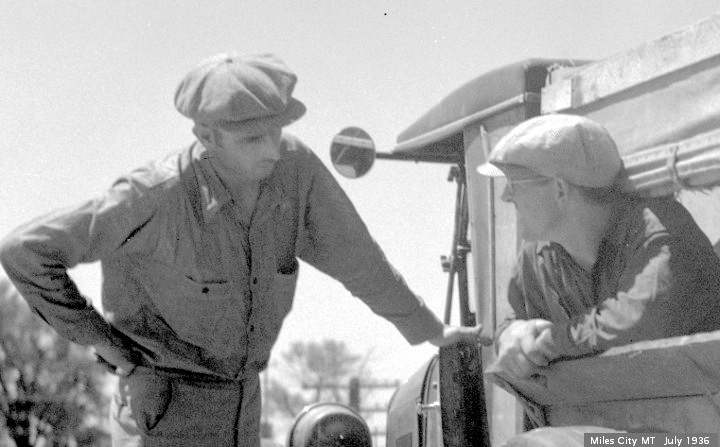
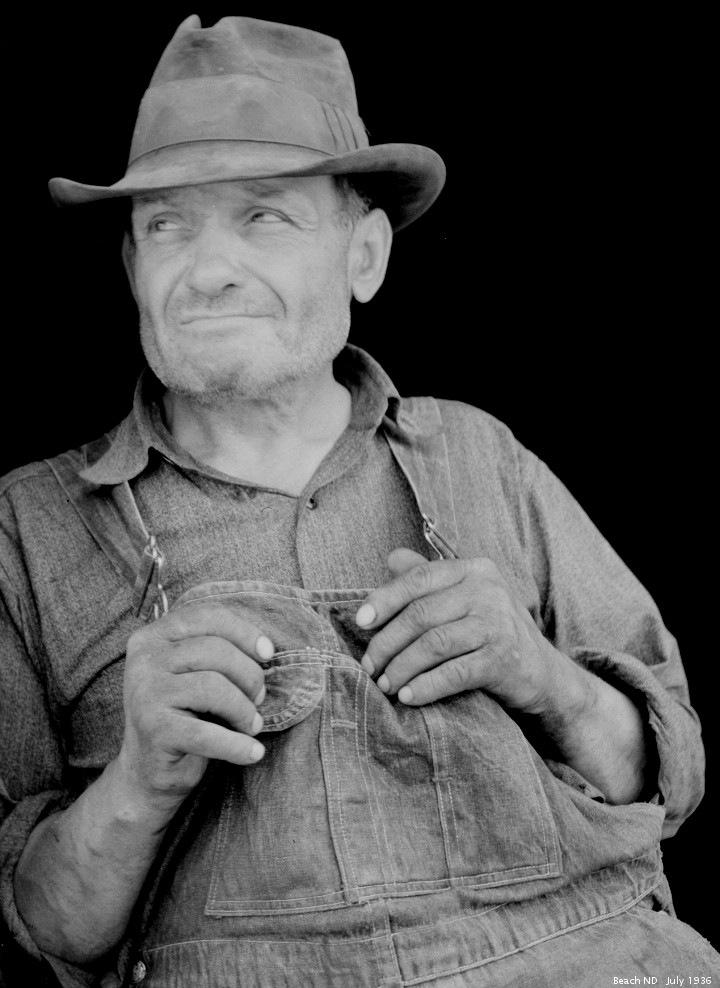
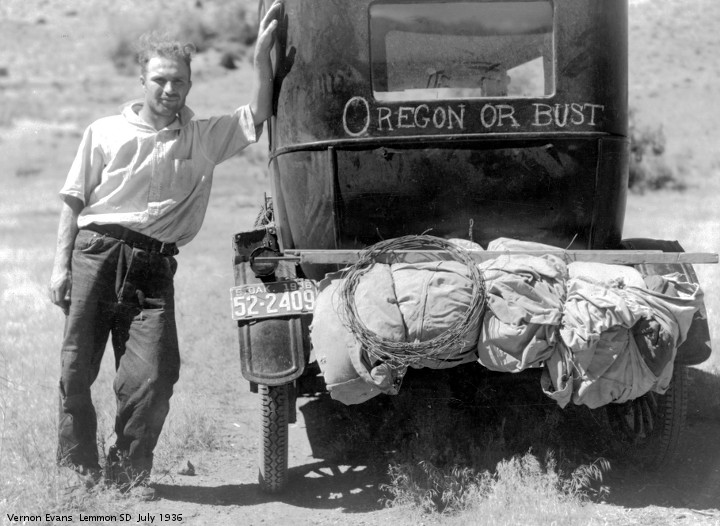
Pictures today are from The Library of Congress.



Being Spammy Or Unsafe



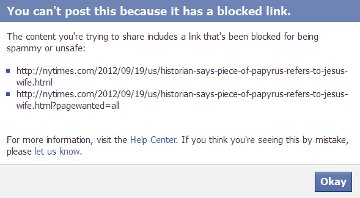
PG found an amusing post Wednesday morning. “Yesterday I posted a link to the New York Times article about what is being called “the Gospel of Jesus’ Wife,” and several friends commented on it. This morning my post has disappeared. I did not remove it, nor did I delete any of the comments, which I found interesting. When I tried to repost the article, I got this message from Facebook: “The content you’re trying to share includes a link that’s been blocked for being spammy or unsafe.” The New York Times is spammy or unsafe??? … As a theology geek, I find this new discovery fascinating. But as a Christian, my faith does not depend on Jesus’ celibacy. So if it were to be proven somehow that he was indeed married, it would not retroactively affect the relationship I’ve had with Jesus throughout my life. If anything, it would support the belief that Jesus was fully human as well as fully divine.”
Smithsonian magazine has a feature on this artifact. It is too long for a slack blogger. The NYT article is less than a page, and says enough to base this post on. The article has header ads, which rotate with the different page views. The two noted are for “Obama Victory Fund 2012” and Wells Fargo Bank. Which one is spammy, and which one is unsafe, is left for the reader to determine. Some times, you have to think for yourself.
 Here is a money quote from the NYT. “A historian of early Christianity at Harvard Divinity School has identified a scrap of papyrus that she says was written in Coptic in the fourth century and contains a phrase never seen in any piece of Scripture: “Jesus said to them, ‘My wife …’ ” The faded papyrus fragment is smaller than a business card, with eight lines on one side, in black ink legible under a magnifying glass. Just below the line about Jesus having a wife, the papyrus includes a second provocative clause that purportedly says, “she will be able to be my disciple.”
The specimen is written in Coptic. This is probably related to Coptic Christianity, which is still going on in Egypt. Reportedly, there is some connection between the Coptics and the recent controversy, about a movie offensive to Muslims.
The word prove is used several times in the article. Perhaps indicate would be a more accurate verb. It is tough to “prove” anything using a 1700 year old papyrus fragment. The last paragraph in the NYT says “The notion that Jesus had a wife was the central conceit of the best seller and movie “The Da Vinci Code.” But Dr. King said she wants nothing to do with the code or its author: “At least, don’t say this proves Dan Brown was right.”
Of course, none of this means anything to most contemporary Jesus worshipers. They think the Bible is the word of G-d. This text is is inerrant, sufficient, spam free, and safe. Recent discoveries about Revelations are ignored. Like the bumper sticker says, “G-d said it, I believe it, that settles it.”
A person’s religion is a one of a kind experience. How you are introduced to a spiritual discipline is much more important than the mechanics of the church. The facebook commenter says that it won’t matter to him if Jesus has a wife. To PG, any new information would not block the memory of humiliation at the hands of aggressive Jesus worshipers.
There was another commentary published recently about the separation of G-d and spam. It was in New Yorker magazine, written by Hendrik Hertzberg. There was a post about Mr. Hertzberg at Chamblee54 once. PG sent an email to Mr. Hertzberg about the post, and got a very nice reply.
The feature in question is about the way politicians think it will help them get elected to talk about G-d. PG, on the other hand, thinks this is a grotesque violation of the third commandment. The New Yorker feature doesn’t really cover much ground, but has a bangup last paragraph.
“It was not hard to guess what idol, and what institution, the Cardinal had in mind. On the other hand, his reference to “nature and nature’s G-d” was not so clear. The phrase was there to echo the Declaration of Independence. But Dolan must know that it is pure Deism—Jeffersonian code words for a non-supernatural G-d, a G-d who creates the universe and its laws and leaves the rest up to us. Could it be that we were witnessing an unheard-of political phenomenon, a dog whistle to voters who, whether or not they believe in a rights-endowing Creator, have their doubts about the sort of deity who begets sons, writes books, performs miracles, and determines the outcome of football games? Probably not. That G-d won’t hunt. “
Pictures are from The Library of Congress. This was written like Dan Brown.



Known Unknown Or Unknown Known



The last thing PG needs is another podcast website. Yesterday, Back Story Radio walked through the door. BSR is a history project, facilitated by academics in Virginia. They have three talkers, the 18th century guy, the 19th century guy, and the 20th century guy. The 21st century guy is in the second grade, and will join them in a few years.
In January of 2011, BSR had a three part series, The Civil War, 150 Years Later. We are currently in the 150th anniversary of the War Between the States. Yesterday it was the Battle of Antietam, aka the bloodiest day in American history.
There is going to be relatively little original writing today. Instead, there is going to be a quote from the transcript. PO, EA, and BB (Peter Onuf, Ed Ayers, Brian Balogh) are the three announcers, and Blake called in a question. We will try to think of a phrase for EA to stand for.
The subject is religion in the south. It is often said that the Bible was used to justify slavery. PG has not seen this, but will take peoples word. If you ask Mr. Google, he will tell you about it. According to this quote, the preachers in the south thought that the north was a secular place. When you fought for the south, you were fighting for righteousness.
There was also the idea that having a society where one race dominated the other was morally superior to equality. The Vice President of the Confederacy, Alexander H. Stephens, once gave a speech.
“Our new government is founded upon exactly the opposite idea; its foundations are laid, its corner- stone rests, upon the great truth that the negro is not equal to the white man; that slavery subordination to the superior race is his natural and normal condition. This, our new government, is the first, in the history of the world, based upon this great physical, philosophical, and moral truth.”
Another side of this discussion is the role of the Jesus Worship church in the African American society. This church is a powerful, and loud, part of America. It is highly ironic that this European religion has been so fervently embraced by African America. It is even stranger when you consider that this religion was forced on this population as a part of being enslaved. It is even stranger when you consider that some white people considered this shotgun marriage… of an enslaved people to the religion of a Jew … as a moral justification for horrific war.
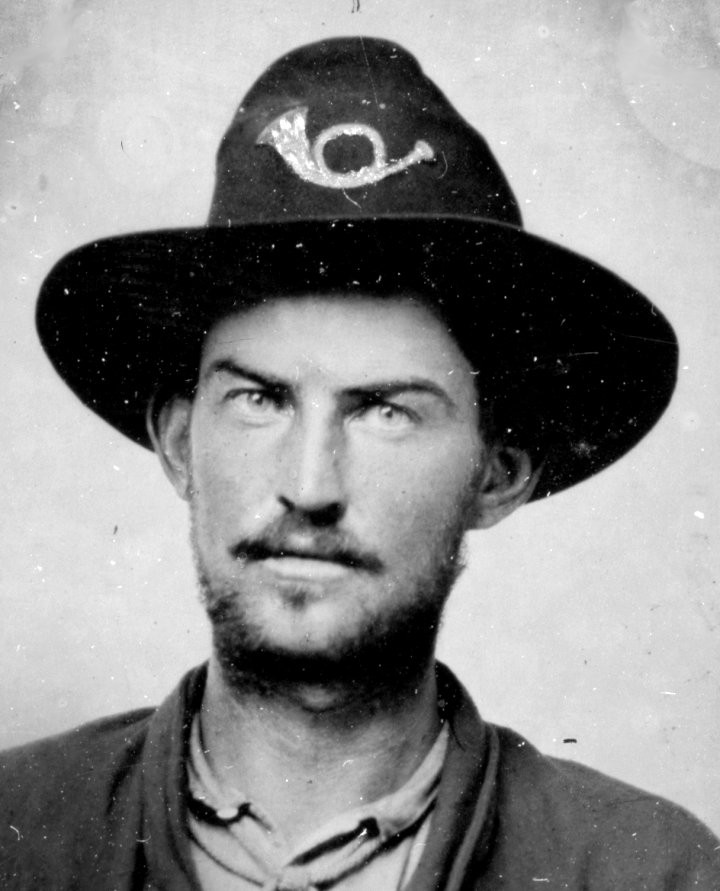
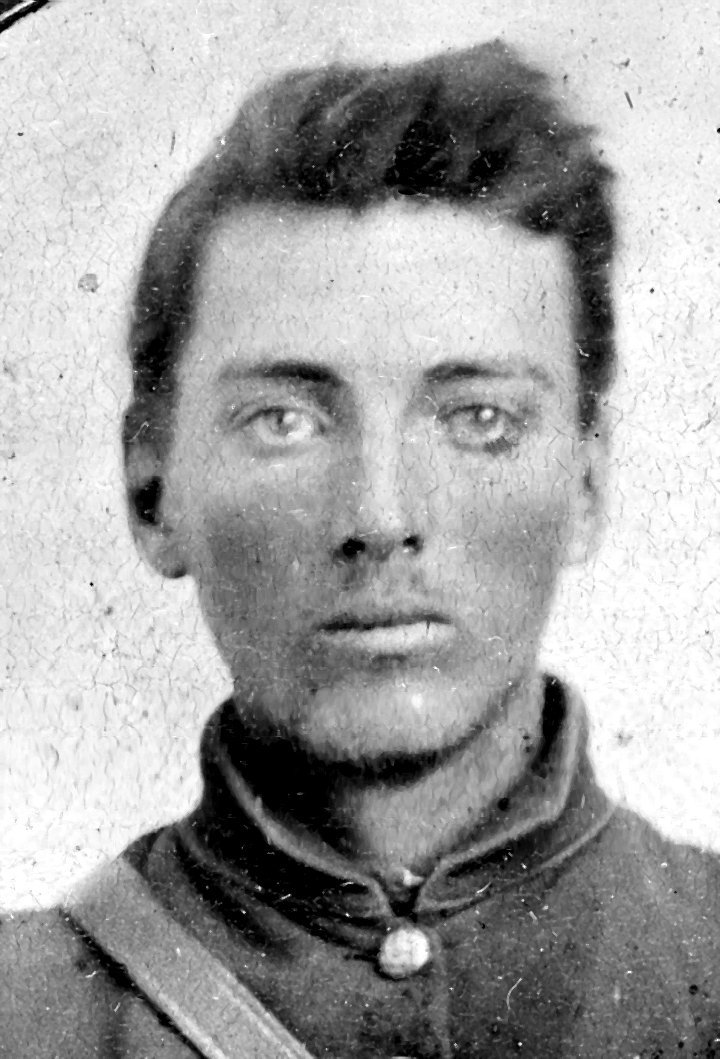
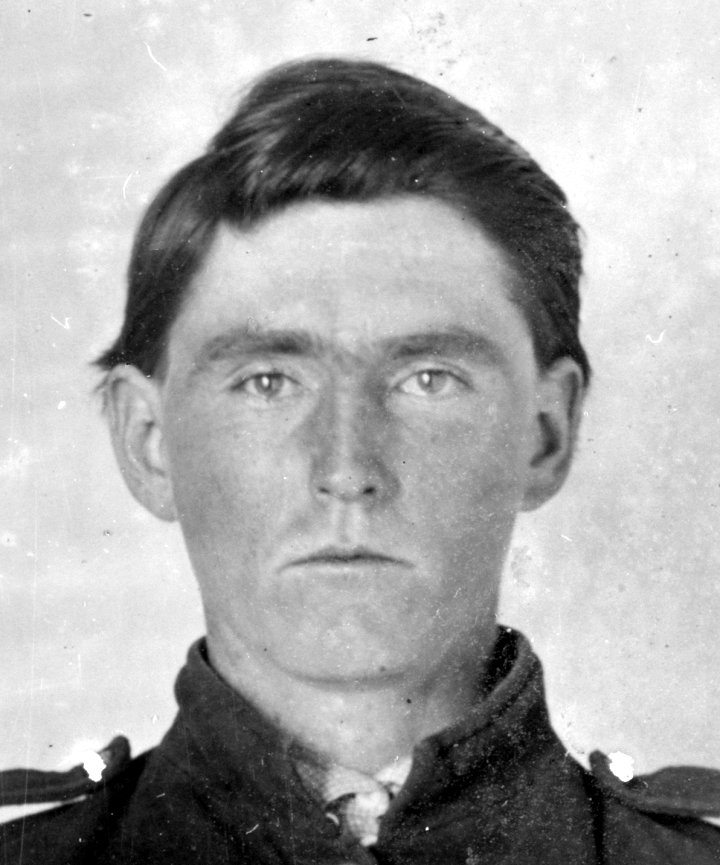
If you find yourself thinking too hard, just skip ahead to the pictures. They are from The Library of Congress. The men in these images are Union soldiers from the War Between The States. This was written like William Shakespeare.
PO: We’ve got another call and it’s a local call from right here in Charlottesville, Virginia. Blake— welcome to the show.
Caller (Blake): Hello.
PO: So, what’s on your mind?
Caller (Blake): Well, you know, I was brought up in Virginia and have lived I guess with the Civil War for my whole life and remember very vividly the Centennial in Richmond, but recently I have been trying to learn a little bit about the, for lack of a better word, the causes and have been reading particularly about the influence of the church, in this case, mostly Methodist and Presbyterian churches in the South and was wondering how you guys viewed that. Do you feel the preachers from their pulpits and their writings led the South to the Civil War and to secession?
PO: Well, Blake, that’s a great question. Blake wants to know whether the preachers are responsible for the Civil War. That’s the short version of it. Obviously, they didn’t do it all by themselves. I’d say this is a point of departure. Many Southerners believe there was a piety deficit between North and South, that the South was a more Christian place and the North was riven by heresy and socialism and secularism and so Southern preachers did a couple of important things, I think, and that is, on one hand, to tell Southerners that they had God on their side, that they were good Christians, and second, preachers played an absolutely crucial role in the emerging pro-slavery argument.
EA: That’s really well put, Peter. I think the preachers make a real point of saying, hey, hey, hey, the pulpit is no place to talk about politics.
PO: Right.
EA: All that we say is that slavery has God’s divine sanction. Other than that, we have no political position at all to make.
PO: That’s all.
EA: That’s right. So, Southern preachers do not lead the South into secession but as Peter says, as soon as providence seems to dictate that that’s the way to go, the ministers are some of the most vocal advocates of the Confederacy.
PO: But, Ed, it’s my impression from historians who’ve written on this subject that in fact Southerners had ample ground in scriptural reference for the support of slavery and they might even have had the edge over their Northerner counterparts, at least if you’re looking for literal readings of the Bible and what it tells us.
EA:Well, that’s the crucial point, Peter. The literal historic injunctions, especially in the Old Testament do accept slavery as a reality. Increasingly, what happens in the North is that people look at the spirit of the New Testament instead. It said how can you possibly love someone as your brother and hold them in perpetual bondage so there’s plenty of energy in the Bible—
PO: Yeah, yeah.
EA: For both pro- and anti-slavery.
PO: No question, but what is also going on and what’s important for white Southerners is that they believe that they have been successful in a great missionary campaign to Christianize the quarters and it’s one of the reasons why they’re comfortable with slavery is that they have taken an instrumental role in spreading Christianity in the slave population so the idea that the slaves were an internal enemy or dangerous subversives who would rise up and revolt, that had been mitigated if not altogether eliminated for many Southerners because they thought of Christianity as a profound bond of union between black and white, even if they worshipped separately.
Caller (Blake): But would that be a true belief, do you think, or more or less just an apology for the burdens that they’d put on African American through slavery.
PO: Hey, Blake, what is a true belief?
Caller (Blake): [laughter]
PO: It’s a known unknown or unknown known. Do they believe it? I think absolutely. One of the things that we learn as historians is to take our subject seriously. They may be by our standards deluded and self-serving, but that Southerners believe they were good Christians, I believe that’s absolutely true.
EA: As a matter of fact, the South says we are in the process of creating the most Christian nation on the face of the earth, but your question, I think, Blake is right. It doesn’t take long for the end of the war for white Southerners to begin to worry, hmmm, were we fooling ourselves?
PO: Yeah.
EA: Yeah, do they really love us? [laughter] The fact that they’re moving away at the very first moment of freedom really is a confrontation with a kind of truth that the white South is really not ready to embrace.
BB: Hey, Blake, may I add an addendum to your good question?
Caller (Blake): Yes, please.
BB: Guys, I’d like to know— I do know, actually, that the church played such a crucial role in the lives of African Americans after the Civil War. Can you tell me something about religion and slaves during the Civil War?
EA: Well, one of the first thing that happens is the churches which had been the really only inter-racial space in the slave South begins separating. At the very first moment, African Americans seize the opportunity to have their own churches. You know, they’ve always gone off on their private worship ceremonies out in the woods or whatever, but in the Civil War itself, as things begin to fall apart, you find that black ministers step forward and begin leading the African American church, so you find that there’s a kind of freedom that comes maybe first in the religious realm and African Americans are quick to seize it.
PO: Well, Blake, thank you for calling “BackStory.”
Caller (Blake): Thank you very much


Founding Babydaddies




People often try to justify their opinions by saying that the “founding fathers” agree with them. They often are guilty of selective use of history. A good place to start would be to define what we mean by the phrase founding fathers.
The FF word was not used before 1916. A senator from Ohio named Warren Harding used the phrase in the keynote address of the 1916 Republican convention. Mr. Harding was elected President in 1920, and is regarded as perhaps the most corrupt man to ever hold the office.
There are two groups of men who could be considered the founding fathers. (The fathers part is correct. Both groups are 100% white male.) The Continental Congress issued the Declaration of Independence, which cut the ties to England. Eleven years later, the Constitutional Convention wrote the Constitution that governs America today. While the Continental Congress was braver, the Constitution is the document that tells our government how to function. For the purposes of this feature, the men of the Constitutional Convention are the founding fathers.
Before moving on, we should remember eight men who signed the Declaration of Independence, and later attended the Constitutional Convention. Both documents were signed by George Clymer, Benjamin Franklin, Robert Morris, George Read, Roger Sherman, and James Wilson. George Wythe left the Convention without signing the new document. Elbridge Gerry (the namesake of gerrymandering) refused to sign the Constitution because it did not have a Bill of Rights.
The original topic of this discussion was about whether the founding fathers owned slaves. Many people wonder about this. If you go to google, and type in “did the founding fathers”, the first four answers are owned slaves, believed in G-d, have a death wish, and smoke weed.
The answer, to the obvious question, is an obvious answer. Yes, many of the founding fathers owned slaves. A name by name rundown of the 39 signatories of the Constitution was not done for this blogpost. There is this revealing comment at wiki answers about the prevalence of slave ownership. “John Adams, his second cousin Samuel Adams, Alexander Hamilton, and Thomas Paine were the only men who are traditionally known as founding fathers who did not own slaves.
Benjamin Franklin was indeed a founder of the Abolitionist Society, but he owned two slaves, named King and George. Franklin’s newspaper, the Pennsylvania Gazette routinely ran ads for sale or purchase of slaves.
Patrick Henry is another founding father who owned slaves, although his speeches would make one think otherwise. Despite his “Give Me Liberty or Give Me Death” speech, he had up to 70 slaves at a time. He did apologize from time to time. He knew it was wrong, he was accountable to his God, and bemoaned the “general inconvenience of living without them.”
Patrick Henry was a star of the Revolution, but not present at the Constitutional Convention. The author of the Declaration of Independence, Thomas Jefferson, was in Europe during the convention. Mr. Jefferson not only owned slaves, he took one to be his mistress, and kidsmama.
One of the more controversial features of the Constitution is the 3/5 rule. Here are the original words “Representatives and direct Taxes shall be apportioned among the several States which may be included within this Union, according to their respective Numbers, which shall be determined by adding to the whole Number of free Persons, including those bound to Service for a Term of Years, and excluding Indians not taxed, three fifths of all other Persons.” In other words, a slave was only considered to be 60% of a person.
That seems rather harsh. The truth is, it was a compromise. The agricultural southern states did not want to give up their slaves. The northern states did not want to give up Congressional representation. This was the first of many compromises made about slavery, ending with the War between the States. This webpage goes into more detail about the nature of slavery.
The research for this feature turned up a rather cynical document called The myth of the “Founding Fathers” . It is written by Adolph Nixon. He asks : “most rational persons realize that such political mythology is sheer nonsense, but it begs the question, who were the Founding Fathers and what makes them so great that they’re wiser than you are?”
Mr. Nixon reviews the 39 white men who signed the Constitution. He does not follow the rule, if you can’t say anything nice about someone, then don’t say anything at all. Of the 39, 12 were specified as slave owners, with many tagged as “slave breeders”.
The Constitution, and the Bill of Rights, have served America well. However it was intended, it was written so that it could be amended, and to grow with the young republic. It has on occasion been ignored (when was the last time Congress declared war?). However fine a document it is, it was created by men. These were men of their time, who could not have foreseen the changes that America has gone through. Those who talk the most about the founding fathers know the least about them.
A big thank you goes to wikipedia This is a repost.




 Chamblee54
2 comments