Halabja



This material was originally published June 21, 2008. … “On March 13, 1988, Iraq used poison gas to kill thousands of people in Halabja (ha lahb jah). A largely Kurdish town near the Iranian border, Halabja was the scene of much resistance to the War that Iraq and Iran were waging. The United States was “tilting” towards Iraq in this conflict. When Iraq invaded Iran (probably with the encouragement of the United States), Iran was holding Americans hostage in Tehran. This was a source of much anger towards Iran, and would be one reason for America to support Iraq.” …
This material was originally published June 21, 2008. … “The support for Iraq took the form of financial aid, shared intelligence, and a blind eye to Iraqi use of weapons of mass destruction. After the massacre in Halabja, The United States blamed Iran. There is also the question of where Iraq got the poison gas. Saddam was executed before he could go to trial on charges related to Halabja. There is also evidence that Iran was involved. According to Libcom.org, “On 13 March 1988 chemical bombs were dropped on Halabja. No Pasdaran nor Peshmargan were killed.” …
This material was originally published June 21, 2008. … “The New York Times has an excellent piece on the massacre. A key quote: “Some of those who engineered the tilt today are back in power in the Bush administration. They have yet to account for their judgment that it was Iran, not Iraq, that posed the primary threat to the Gulf; for building up Iraq so that it thought it could invade Kuwait and get away with it; for encouraging Iraq’s weapons of mass destruction programs by giving the regime a de facto green light on chemical weapons use” …
This material was originally published September 11, 2006. … “On March 13, 1988, the city of Halabja in Iraqi Kurdistan was almost completely destroyed by the Iraqi armed forces using chemical weapons, supplied by the West. Around 5,000 people were killed at the time and many more more died from their injuries over the next few weeks. Halabja was not chosen arbitrarily as the site for such a massacre. It had been a major site of proletarian struggle against the Iran-Iraq war There was at least one deserter in every house, and sometimes four or five.” …
This material was originally published September 11, 2006. … “During 1987 the Iraqi government destroyed 45 villages around Halabja, using explosives to completely demolish all the houses. The inhabitants poured into Halabja, swelling the population to around 110,000. Almost all the young men in these villages had been deserters from the army. They were not just dropping out of the war but were always discussing ways of doing something against it. The influx of people led to a severe housing shortage and there were no jobs for most people. All the time there was talk amongst the unemployed about what to do about the war.” …
This material was originally published September 11, 2006. … “In 1987, three types of army existed in Halabja, in addition to the Iraqi army: a) Clan Armies … b) The Home Guard – This was by far the largest army. It was not uniformed and had very few weapons. It was the army that deserters joined … c) The Bounty Hunters – This was a small force which acted with extreme viciousness on behalf of the state. Their main function was to force deserters to join the Home Guard. After the massacre most of these scum went to Iran to do the same job for the Iranian state.” …
This material was originally published September 11, 2006. … “All the talk about stopping the government from destroying Halabja turned to action on 13 May 1987, when militants occupied the mosques and used the loudspeakers to call for the organisation of an uprising. Mosques were used because they were the most suitable buildings in which to hold mass meetings. This was ironic because for weeks before the priests had been giving a special talk after each Friday prayer meeting on… the evils of communist subversion! Almost the whole working clan population of Halabja was awake that night discussing and organising.” …
This material was originally published January 17, 2003 … This was at a time when Iraq was launching what proved to be the final battles of the war against Iran. Its wholesale use of poison gas against Iranian troops and Iranian Kurdish towns, and its threat to place chemical warheads on the missiles it was lobbing at Tehran, brought Iran to its knees. Iraq had also just embarked on a counterinsurgency campaign, called the Anfal, against its rebellious Kurds. In this effort, too, the regime’s resort to chemical weapons gave it a decisive edge, enabling the systematic killing of an estimated 100,000 men, women, and children.” …
This material was originally published January 17, 2003 … “The deliberate American prevarication on Halabja was the logical outcome of a pronounced six-year tilt toward Iraq, seen as a bulwark against the perceived threat posed by Iran. The United States began the tilt after Iraq, the aggressor in the war, was expelled from Iranian territory by Iran, which then decided to pursue regime change in Baghdad. Sensing correctly that it had carte blanche, Saddam’s regime escalated its resort to gas warfare, graduating to ever more lethal agents. Because of the strong Western animus against Iran, few paid heed. Then came Halabja.” …
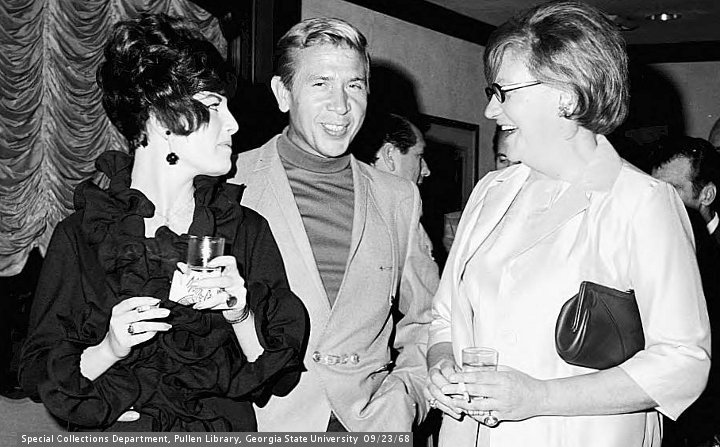
This material was originally published January 17, 2003 … “The United States launched the “Iran too” gambit. … A State Department document demonstrates that U.S. diplomats received instructions to press this line with U.S. allies, and to decline to discuss the details. It took seven weeks for the UN Security Council to censure the Halabja attack. Even then, its choice of neutral language diffused the effect of its belated move. Iraq proceeded to step up its use of gas until the end of the war and even afterward, during the final stage of the Anfal campaign, to devastating effect.” … Pictures today are from Special Collections and Archives, Georgia State University Library. The social media picture was taken September 23, 1968. “Buck Owens promotional visit, Riviera Motel”




 Chamblee54
[…] of WMD by “next Hitler” Saddam Hussein was one of the leading reasons for the invasion. Iraq was known to have used poison gas against the Kurds (while they were allies of the United States). […]