Is T-SPLOST Toast?




On July 31, voters will consider a proposal with the clumsy acronym T-SPLOST. . This stands for Transportation Special Purpose Local Option Sales Tax. It was a name given by a committee, just like the project list was created by a committee. Some say a camel is a horse designed by a committee. Perhaps the “regional roundtable” wants to have camel trails. Atlanta did not build roads, they paved the cow paths.
The Georgia Sierra Club is opposed to T-SPLOST. Their presentation will form the basis for this post. Not enough goodies are going to South Dekalb county, so the Dekalb NAACP is opposed. Chamblee54 has mixed feelings.
The project list was assembled by a “regional roundtable”. The ten counties of the region are Clayton, Cherokee, Cobb, DeKalb, Douglas, Fayette, Fulton, Gwinnett, Henry, and Rockdale. Sierra describes the sausage factory: “The Atlanta T-SPLOST project list was developed by a “regional roundtable,” a 21-member panel consisting of one mayor and one county commissioner from each of the region’s ten counties, plus the mayor of Atlanta. There was no attempt to apportion representation by population. As a result, the panel was dominated by smaller, more rural counties that do not prioritize transit. Twelve of the 21 panel members came from the six smallest counties, representing just 25% of the region’s population. Only nine of the panel members represented the region’s four biggest counties (Cobb, DeKalb, Fulton and Gwinnett) even though those counties account for 75% of the region’s population and 79% of the anticipated T-SPLOST tax revenue. The result of this disproportionate representation was an overemphasis on road projects that (unlike transit) have alternate sources of potential funding, and a series of political turf battles focusing on local demands rather than regional needs.”
It is like the old county unit system. Gwinnett county, with 805,321 people, had as much say so as Fayette county does with 106, 567. (Source of numbers.) Another problem is the way Local Assistance Road Program (LARP) money is distributed. 15% of T-SPLOST bucks will go to local governments. The problem is that several OTP counties will take in more money than they will generate. Fulton county is estimated to take in $88 mil less than it generates.
The Georgia Sierra Club has seven main objections to T-SPLOST. On their website, they go into luxurious detail. Here are the sloppy seven.
1 The Project List Does Not Present a Cohesive Transportation Vision, offering a hodgepodge of conflicting priorities when what is needed is a bold and consistent vision for a sustainable transportation future.
2 The Necessary Institutional Context is Not in Place, with the 2012 legislative session having failed to address serious questions about equitable regional transit governance and the ongoing second-class treatment of MARTA.
3 It Likely Kills Commuter Rail For Another Decade, taking off the table one of the most promising strategies for providing commute alternatives and promoting sustainable development.
4 It Does Too Little to Address the Current Road-Heavy Funding Imbalance, instead reinforcing a funding framework that already heavily favors highway expansion over commute alternatives.
5 The Road Funding Neglects Maintenance Needs to Focus on New Capacity, with five times as much funding going to expanded capacity than to maintenance and operations, further compounding an already serious backlog of asset management needs.
6 It Locks the Region into a Dysfunctional, Undemocratic Decision-Making Process, both through the highly politicized “roundtable” process and the blatantly anti-urban method for distributing local set-aside funds. (Fulton County alone would forfeit $88 million due to this inequity.)
7 The Transit Component Has Too Many Flaws, including vaguely defined project descriptions, underfunded capital expansions, and uncertainty about long-term operational support.
PG has a few things to add. The treatment of MARTA by the rest of the state is shameful. MARTA recieves no funding from the state. The same legislature passes laws telling MARTA how to spend it’s revenue. Fulton and Dekalb counties have had a one percent sales tax for forty years to support MARTA. While the system has it’s problems, it needs more support from the OTP crowd.
The Clifton Road Corridor is a big ticket item. This is a light rail system between the Lindbergh MARTA station and the Emory campus. GSC has concerns about whether this project can support itself after it is built. This is an ambitious project, and the demand for it is far from certain. It is currently planned to go in a railroad corridor, which will reduce disruption during construction.
There is a ton of information available about this referendum. Voters are encouraged to learn as much as possible before the vote. At this time, there is no Plan B.
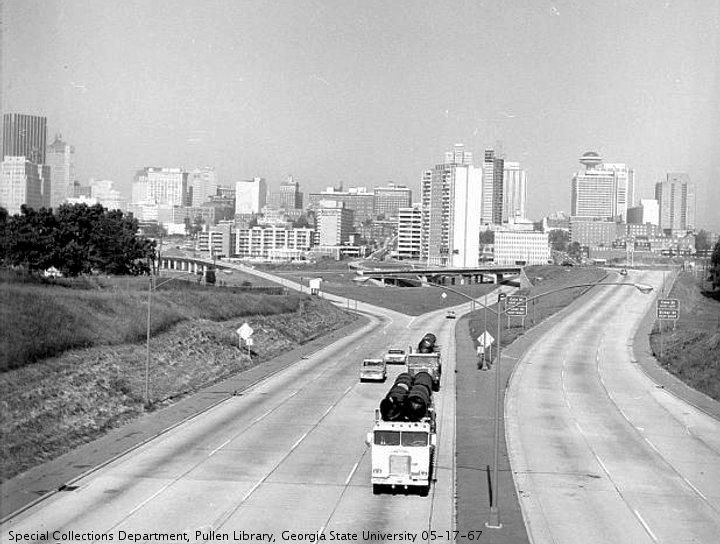
Pictures today are from ” Special Collections and Archives,Georgia State University Library”







Excellent post.
Thank you. This is basically a rehash of the Sierra Club position.
[…] And the OTP crowd yawns, and wonders what everyone is talking about. The truth is, the proposal is badly flawed It tries to make everyone happy, and fails. It is sausage making politics, at it’s most […]
[…] line to South DeKalb county. T-SPLOST was opposed by many people, with a wide variety of labels. T-SPLOST was a horribly flawed proposal. Two weeks before the referendum, the staff of Atlanta mayor Kasim […]