Brian Eno Rick Rubin



I had ran out of podcasts, and went into the archive. I found an interview Rick Rubin did with Brian Peter George Eno, released June 8, 2021. I had heard it before, but might enjoy a repeat listening. … I found a youtube copy, which had a transcript, the lazy bloggers friend. Later, while trying to find the release date, I stumbled onto an Extended Cut, with an extra half hour of content . I am going to listen to the longer version, take notes, write about it, and then absolutely never listen to this again. …
“Yes, and incidentally, I think that’s the power of religion as well. The power of religion is not the connection with God, but the connection with the rest of the congregation. I think the connection with all of the people who also believe in that particular story. I’m not really religious myself, but I really respond to that idea.”
A few years ago, Christopher Isherwood gave an interview with a magazine. (I have never found the source online.) Mr. Isherwood said that it was not the content of the religion that converted a person, but the person who introduces you to that religion. Mr. Isherwood said that if a Catholic had been the right person at the right time, then he might have become a Catholic.
In 1939, after living as an exuberant skeptic, Mr. Isherwood was converted. “Forty-five years ago, on a sultry July afternoon, 35-year old Christopher Isherwood met and embraced Ramakrishna Vedanta in downtown Hollywood, California. Aldous Huxley, writer extraordinaire and ardent explorer of Hindu interior consciousness, had just introduced Isherwood to his guru, Swami Prabhavananda, founder of the Hollywood Ramakrishna Mission Vedanta Society.” … The linked article is worth reading. …
There was a quote that I remembered. “I like being in unfamiliar surroundings. I always used to say that artists are either cowboys or farmers, and they’re both both ways of being an artist are fine. The farmer wants to find a piece of territory and fully explore it and exploit it.” … A talk like this can inspire you to further thinking. You can go paddling up the river, and spend all day exploring the tributary creeks. This is the cowboy side … to follow the thought wherever it goes. OTOH, you can stick to the quotes that capture your attention, let them speak for themselves, and FINISH WRITING YOUR PIECE. This is the farmer side, and is mostly what is going to happen here. …
BPGE was absolutely devastated by hearing It’s Gonna Rain, by Steve Reich. By amazing coincidence, I heard IGR twice on WREK, the Georgia Tech student station. This was many years ago. Both times I heard IGR, large amounts of rain fell the next day. …
I listened to the Extended Cut, and did not suffer any epiphanies. There was one quote. “During the war, when lots of GIs were coming over to England, somebody interviewed an old farmer from Devon and said, so, how do you feel about the Americans coming over here? And the farmer said, well, they’re all right, aren’t they, except for the white ones.” …
One day in the Köln airport, ambient music was born. It was a beautiful day and the airport was nearly empty, and I was sitting there bathing in light, and it was one of those cases like we were talking about earlier, where you think I wish there was another kind of music for this situation, and I started thinking, so what would that be? Like? You know, it’s an airport, so you can’t be too loud. Obviously, people have to hear announcements. It has to be interruptible for the same reason it shouldn’t dominate the vocal register, because people need to communicate. So I just was sort of thinking this out, and quite soon I thought, right, I think I know what I could make that music. I know how I could do that. And that’s how that first ambient record came about. I mean, it wasn’t unprecedented. I had been working on music a little bit like that before, but I suddenly realized what its role in life could be. If you like, what the place of this music could be. I knew it wasn’t dance music. I knew it wasn’t radio music. It was functional, but I hadn’t yet discovered the function. It was then that I thought, I know what this music could be for.” …
BPGE worked with Harold Budd, and created some of the prettiest music ever recorded. This fits in with the ambient music concept. … “I didn’t want drama. I just wanted something like nature, subtle variations. Subtle variations, yes, and variations that stay within a kind of range of possibilities and explore that range rather randomly. I just wanted the thing to be what Harold Budd used to call eternally pretty. That was his way of putting it. Dear Harold. He died about two months ago from COVID, very sad. So I dedicate this thought to Harold. So. Yes, So when Harold and I met, we were both pretty much on this groove of thinking, what about making music that isn’t designed to upset anybody? Now, of course that sounds pretty uncontroversial now, but in the mid to late seventies that was considered to be the biggest sell out of all time. You know, music was supposed to shake the world and create revolutions and upset your parents and all sorts of things like that. And we thought, what about making music that is just really comfortable? Comfortable was probably the most controversial word you could use.” …
I have one last question to ask, just because I’m really curious, what’s your relationship to spirituality? … Well, as you can tell from the way I talk too much, I think about this kind of thing quite a lot. What I always want to do is to cut away as much of the shit as possible and see what’s left. So I don’t want to be a believer. I want to be somebody who, as far as possible, understands and knows things. Believing things leaves me a little bit unsatisfied. If I find myself believing something, I want to test the belief. I want to say, how do I find out how valid this is? How true this is? How? In real belief, in proper faith, you’re not supposed to do that. Faith is supposed to be, by definition, the acceptance of something that you cannot find evidence for. If you can find evidence for, it’s not faith anymore. It’s called knowledge. Then. So this is a long way round of saying that I’m not anti spiritual, I’m not anti religion. Actually, in fact, I can see how religion really cements some communities together and really helps people in their lives. But I’m not by nature a believer, So it’s difficult for me to use that kind of cement. My cement has to come from trying to understand things and to see how they work, and to share those ideas with other people. Yeah so, I think one one of the other things that surrendering prepares you for is the experience of uncertainty, the experience of not knowing the answer but still having to do something. You know, the fact that you don’t know the answer can’t cripple you. And of course a lot of people are crippled by not knowing the answer, and so they just choose an inappropriate answer just for the want of an answer.”
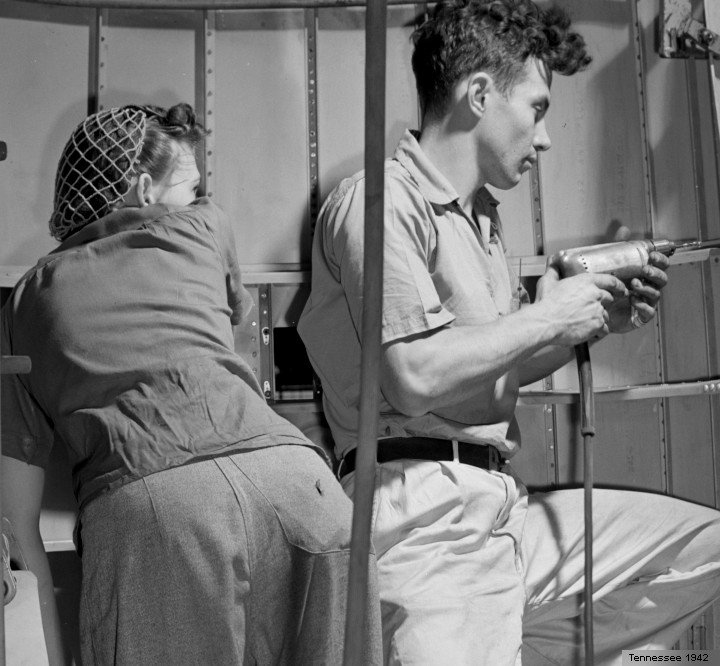
Pictures today are from The Library of Congress. Jack Delano took the social media picture in August 1942. “Nashville, Tennessee. Welding parts for fuel pumps. Vultee Aircraft Corporation plant” ©Luther Mckinnon 2025 · selah


 Chamblee54
[…] over here? And the farmer said, well, they’re all right, aren’t they, except for the white ones.” · Pictures today are from Special Collections and Archives, Georgia State University […]