Golden Rectangle


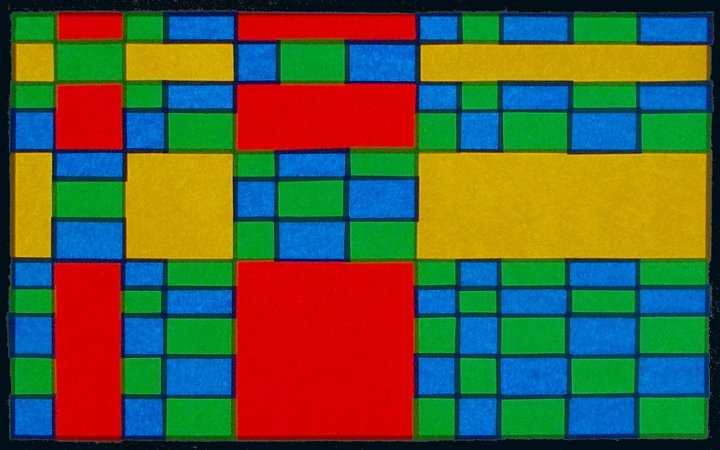
PG is not a math freak. However, he does appreciate the Fibonacci sequence, and the golden rectangle. Recently a picture project utilized these numbers. (2, 3, 5, 8, 13, 21)
The medium is faux stained glass. To get the colors, sticker paper is applied to a film base. There is an one eighth inch overlap between the sections. This overlap serves the same purpose as solder in stained glass. The images are designed on a grid. Each block is half an inch square, with one eight inch overlap on all sides. In the design phase, a half size model is used.
The design is a grid of rectangles and squares. The Fibonacci sequence of numbers is used. Horizontally, the 5 rows are 3 tiles wide, 5 tiles wide, 8 tiles wide, 13 tiles wide, and 21 tiles wide. Vertically, the rows are 2 tiles wide, 3 tiles wide, 5 tiles wide, 8 tiles wide, and 13 tiles wide. The totals are 50 tiles wide, and 31 tiles tall. This is close to the 1.61:1 ratio of the golden rectangle.
The final product is 18.875″ x 11.75″. It is centered on a format sheet 22″ x 17″, the standard size for these projects. The picture was designed, and the models built, at half size. The models were 9.4375″ x 5 .875″. (These dimensions are typically described using fractions. PG has a scale with the dimensions on it. The decimal numbers are easier to use in this text.)
The models are built using scrap from previous projects. The colors are assembled in the required shapes, and changed until the best arrangement is found. Normally, the biggest size building block is 3×4, or .625″ x .8125″. Since some large spaces were going to be filled in, PG decided to put tick marks on the design, to show where the individual tiles would go. This made for a model with a very neat appearance, which PG found appealing. A decision was made to break the shapes down into the smaller units. This would create a rhythm within the picture.
At first, the smaller tiles were arranged portrait style, that is they had the four tile side standing vertical. One night, PG realized that the picture was flowing horizontally, and that the smaller tiles needed to be portrait style, with the three tile side as the vertical side. The next move was to change the 3×4 tile to a 3×5 tile, which is a Fibonacci sequence of numbers.
There were now 3 dimensions in this model: 2 tiles (.4375″), 3 tiles (.625″) and 5 tiles (1.0″). There are four sizes of tiles: 2 x 3, 2 x 5, 3 x 3, and 3 x 5. There is a pattern. They start in the top left corner with small numbers, and work down into the large numbers at the bottom right. The bottom right has 5 rows of tiles by 5 rows of tiles, just like the overall picture.
As the model began to progress, a decision was made to do some sections as a green-blue checkerboard. This alternates with red and yellow sections. A decision was made to do the red and yellow sections as one solid tile in the final product, and keep the grid pattern in the green-blue sections.
Grayscale pictures are from “The Special Collections and Archives,Georgia State University Library”. The other two are a photograph of the final product, 345 fibnuchi, and a sample of the design grid.



 Chamblee54
leave a comment