Neil Sheehan


In 1988, C-SPAN presented a five part interview with Neil Sheehan. He was promoting a book, A Bright Shining Lie: John Paul Vann and America in Vietnam. Mr. Sheehan was a reporter in Vietnam during the early years of the war. Here are some highlights.
LAMB:(Brian Lamb, host of Booknotes) Neil Sheehan, author of “A Bright Shining Lie: John Paul Vann and America in Vietnam.” What role did the press play in the war? Mr. SHEEHAN: At the beginning, I suspect the press helped us to go to war in Vietnam. The the press was in gen the the the the news media of this country, in my opinion, tend to be quite conventional. They reflect conventional ideas. They are not the cabal of liberal plotters that the right wing would have us believe, at least, that thus that thesis doesn’t stand up to reality in my experience.
Mr. SHEEHAN: Let me back up for one moment. There’s a considerable misimpression about the role of the press in Vietnam all along and particularly in this early period. The reporters who went to Vietnam early on, like myself, were not anti war dissenters. We were very much in favor of American intervention in Vietnam. We had the same set of illusions everyone else did. What we wanted to what we felt was our well, was our duty excuse me we felt our duty was to report the truth, so that the president would know what was happening in Vietnam the president and the rest of the leadership and win the war. And the advisers in the field, like John Vann, told us, `Look, this isn’t working. The policy isn’t working. We’re losing. And here’s why.’ And we were writing these stories and and they were being denounced.
Mr. SHEEHAN:… the South Vietnamese army wouldn’t fight, that the Diem regime (Ngo Dinh Diem, President of South Vietnam before November 2, 1963) was deliberately holding deliberately holding it back from fighting, that they wouldn’t take on the Communist guerrillas. Because Diem wanted to preserve his army as a force in being to to preserve his regime. The Americans thought of the army, the South Vietnamese army, as a force with which to fight the Communists. Diem saw it as a force to keep him in power. And so he had a he had a secret order out to his commanders not to take casualties. And the advisers couldn’t get them to tangle with the with the guerrillas, and they would tell us this.
Mr. SHEEHAN: .. it was stupid to be shelling and bombing civilian hamlets, that we were just killing women and kids and we were turning the population against us. He (John Paul Vann) showed us the extent to which the ARVN, the Regular South Vietnamese Army, was avoiding contact with the enemy and would not fight the Viet Cong, would not take them on. He showed us the extent to which we were arming the guerillas through these outposts. Again, John would gather the data, precisely how many American arms were going to precisely how many outposts and we ended up – as I said in the book, we ended up arming the Viet Cong in South Vietnam with American weapons because the American generals were pouring weapons into the South Vietnamese Militia and the Viet Cong were collecting them from these outposts. And so, you were giving a communist guerilla who had a bolt action French rifle a fast firing semiautomatic M1 Garand, which was a World War II weapon, but which was a very good weapon in the mid – in the early 60s. This was prior to the fully automatic weapons, the M16, et cetera. The Garand was a fine weapon and we were arming our enemy. … the United States of America, are arming our enemy and giving them far better weapons than with than they already have and we’re going to change the whole the whole kind of wa we’re going to change the war we’re fighting. We’re we’re creating a a monster here.’
LAMB: Given your experience, and this book and other books, could a Vietnam ever happen again to the United States? Mr. SHEEHAN: No. Well, not in the foreseeable future. I think Vietnam has changed this country, for the foreseeable future, at least. I an event like Vietnam is unique in the history of a country. Vietnam was our first bad war …. And it was the first it was the first war in which Americans could get could and did get killed for nothing. Now the Europeans had learned that you could go to war and get killed for nothing, that you could go to war and and your in which you could get involved in a war in which your le leadership was was was driven by illusions rather than reality. We had never learned that as a nation. … And so I think the impact of that on us has been so profound, because the war was so divisive that it remains with us today and you ca the president of the United States cannot so blithely send Americans off to war as he does not have the power to do it that Kennedy and Johnson had, because the public doesn’t give him the credibility that it gave them those presidents.
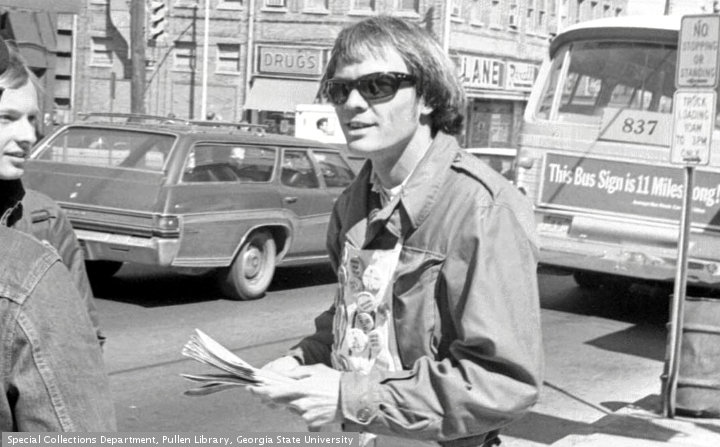
Pictures are from “The Special Collections and Archives,Georgia State University Library”.



 Chamblee54
leave a comment