The Eleven Rules






You have probably heard about “The speech Bill Gates gave at a High School”. PG saw an image on facebook, and the BS detector went off. When did he make the speech? What high school, in what location? Was this the same speech we heard about a few years ago, when Microsoft was being sued for antitrust violations? Are these questions fair? Rule 1: Life is not fair – get used to it!
These days, the answer is easy to find. Snopes is a friend of Mr. Google. The authoritative word is “misappropriated”. Bill Gates did not make a speech to a high school. Nor did Kurt Vonnegut. The eleven rules came from a newspaper column written by Charles J. Sykes. The column was published in the San Diego Union Tribune on September 19, 1996. The fourteen rules in that column were taken from a book Mr, Sykes wrote, 50 Rules Kids Won’t Learn in School: Real-World Antidotes to Feel-Good Education.
“Charles J. Sykes is senior fellow at the Wisconsin Policy Research Institute and a talk show host at WTMJ radio in Milwaukee, Wisconsin.” “The Institute is guided by a belief that competitive free markets, limited government, private initiative, and personal responsibility are essential to our democratic way of life.” Mr. Sykes is probably not a liberal.
The eleven rules have been floating from one email address to another since the Clinton administration. Ann Landers has printed them several times. They have been the rest of the story for Paul Harvey. “The prize for misattribution, however, has to go to the Atlanta Journal and Constitution, which published the list twice in the space of three weeks in mid-2000, the first time crediting it to “Duluth state Rep. Brooks Coleman of Duluth,” and the second time to Bill Gates.” The footnotes say “Brack, Elliott. “Legislator Offers Teens No-Nonsense Advice.” The Atlanta Journal and Constitution. 14 June 2000 (p. J3).” and ” “Advice from the Experts.” The Atlanta Journal and Constitution. 2 July 2000 (p. R1).”
The book has fifty rules. The column has fourteen. These are the three rules left out of the emails.
Rule No. 12: Smoking does not make you look cool. It makes you look moronic. Next time you’re out cruising, watch an 11-year-old with a butt in his mouth. That’s what you look like to anyone over 20. Ditto for “expressing yourself” with purple hair and/or pierced body parts.
Rule No. 13: You are not immortal. (See Rule No. 12.) If you are under the impression that living fast, dying young and leaving a beautiful corpse is romantic, you obviously haven’t seen one of your peers at room temperature lately.
Rule No. 14: Enjoy this while you can. Sure parents are a pain, school’s a bother, and life is depressing. But someday you’ll realize how wonderful it was to be a kid. Maybe you should start now. You’re welcome.
Maybe someone should take a critical look at these rules. If you get tired, and think this is negative, then you are free to skip ahead and look at the pictures, from The Library of Congress. The LOC is part of the big government in Washington. It is an very valuable resource. 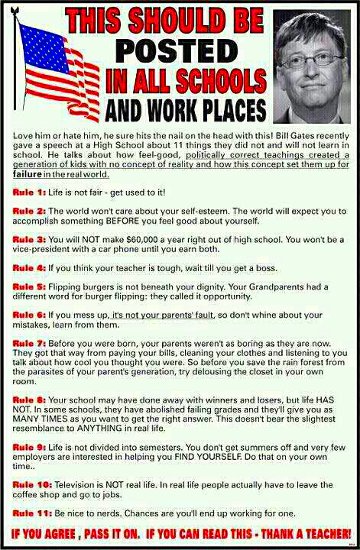
Rule No. 1: Life is not fair. Get used to it. The average teen-ager uses the phrase “It’s not fair” 8.6 times a day. You got it from your parents, who said it so often you decided they must be the most idealistic generation ever. When they started hearing it from their own kids, they realized Rule No. 1.
No argument here. This is a catch 22 whenever you find a contradiction in the rest of the rules.
Rule No. 2: The real world won’t care as much about your self-esteem as much as your school does. It’ll expect you to accomplish something before you feel good about yourself. This may come as a shock. Usually, when inflated self-esteem meets reality, kids complain that it’s not fair. (See Rule No. 1)
If you start to feel good about yourself, don’t worry. Between the church, radio talk shows, and back stabbing co workers, someone is sure to bring you down.
Rule No. 3: Sorry, you won’t make $40,000 a year right out of high school. And you won’t be a vice president or have a car phone either. You may even have to wear a uniform that doesn’t have a Gap label.
Conservative rules for living do not age well. Today, everybody eating solid food has a cell phone.
Rule No. 4: If you think your teacher is tough, wait ’til you get a boss. He doesn’t have tenure, so he tends to be a bit edgier. When you screw up, he’s not going to ask you how you feel about it.
This is the rule that set off the BS detector. In the “real world”, it is not what you produce that counts. It is how well you kiss ass. If the boss is impressed by you, you can screw up from now until bankruptcy. Ditto if you are a minority, and the company is recovering from a lawsuit. LINF
Rule No. 5: Flipping burgers is not beneath your dignity. Your grandparents had a different word for burger flipping. They called it opportunity. They weren’t embarrassed making minimum wage either. They would have been embarrassed to sit around talking about Kurt Cobain all weekend.
Your grandparents had a different word for your dark skinned co worker. Not all political correctness is bad.
Rule No. 6: It’s not your parents’ fault. If you screw up, you are responsible. This is the flip side of “It’s my life,” and “You’re not the boss of me,” and other eloquent proclamations of your generation. When you turn 18, it’s on your dime. Don’t whine about it, or you’ll sound like a baby boomer.
Fifty years ago, the parents of baby boomers said things like this. The younger generation is always going to hell, and somehow they manage to get it together. The baby boomers are the generation who was ordered to go to Vietnam and kill Asians. They said “hell no we won’t go”.
Rule No. 7: Before you were born your parents weren’t as boring as they are now. They got that way paying your bills, cleaning up your room and listening to you tell them how idealistic you are. And by the way, before you save the rain forest from the blood-sucking parasites of your parents’ generation, try delousing the closet in your bedroom.
Your parents got to be boring by listening to motivational speeches.
Rule No. 8: Your school may have done away with winners and losers. Life hasn’t. In some schools, they’ll give you as many times as you want to get the right answer. Failing grades have been abolished and class valedictorians scrapped, lest anyone’s feelings be hurt. Effort is as important as results. This, of course, bears not the slightest resemblance to anything in real life. (See Rule No. 1, Rule No. 2 and Rule No. 4.)
Teachers have a tough job. They are an easy target for criticism. Some of this whining is fair, even if life isn’t. Mr. Sykes has written several books lambasting the education system. There is a saying, those who can, do. Those who can’t, teach. Maybe this could be amended to say: those who can’t teach, whine about education.
Rule No. 9: Life is not divided into semesters, and you don’t get summers off. Not even Easter break. They expect you to show up every day. For eight hours. And you don’t get a new life every 10 weeks. It just goes on and on. While we’re at it, very few jobs are interested in fostering your self-expression or helping you find yourself. Fewer still lead to self-realization. (See Rule No. 1 and Rule No. 2.)
If you are the buddy of management, you sometimes take the afternoon off to play golf with a client. You go to conventions, while someone else works to produce. LINF
Rule No. 10: Television is not real life. Your life is not a sitcom. Your problems will not all be solved in 30 minutes, minus time for commercials. In real life, people actually have to leave the coffee shop to go to jobs. Your friends will not be as perky or pliable as Jennifer Aniston.
Life is not a motivational speech. Those after dinner platitudes are entertaining, and make you feel good about yourself. They have little to do with real life.
Rule No. 11: Be nice to nerds. You may end up working for them. We all could.
One more time, LINF. Regarding Rule No. 14:, this sounds like privilege speaking. If parents are human, they are possibly doing some very dirty things to their kids. This includes abusive religion, alcoholism, drug abuse, and conservative politics. The other kids can be pretty rough. Your preacher says you are going to hell. Since the real world does not care about your self esteem, you may be tempted to end your life. A smarmy list of rules is probably not going to help.
When writing a blog post, go ahead and publish before you read the one star reviews. There is a reply, from a teacher, about the list of eleven. The title is A teacher’s response to a mean man. This post is more thoughtful than the collection of one liners above. The post you are reading is already too long. Follow the link to read something better.
There is one review that needs to be shared. (This is from the amazon page for the book, 50 Rules Kids Won’t Learn in School: Real-World Antidotes to Feel-Good Education.)
And I thought liberals were condescending?!, Watujel (San Antonio, Texas) October 12, 2007
The reason you don’t get this stuff in school is because any savvy teacher knows that trying to motivate 30 restless kids with Sykes’ hoary platitudes and nagging tone will inevitably have the opposite effect. Everything’s here in cliched condescension except for maybe “back in MY DAY”
Rule number one of imparting advice to anyone of any age – gain their trust first. If you blunder in, wagging your finger as Sykes does, you’ll just get a backlash. It’s actually worse than keeping your trap shut.
Sykes should try his material on a classroom of average eighth-graders and see if he can get them to do anything close to what he intends.
Sykes expresses resentment toward teachers for getting tenure and suggests that this is not part of the “real world.” I envy teachers’ schedules (but not their jobs) as well, but just because you resent these perks doesn’t mean you can simply write them out of the “real world” unless you’re in serious denial. Without tenure, how many people would choose to become teachers what with so many other options available? That’s the real world.
It’s ironic that he claims to want to instill respect for authority but encourages his young readers to devalue what they’re learning from those who are acting in loco parentis. Teachers don’t create the curriculum. Changes in curricula are driven by administrators and education colleges. Blaming teachers for teaching too much self-esteem doesn’t make any more sense than blaming cops for giving illegal immigrants a pass. In both cases, the priorities are set elsewhere.
In one rule, he complains that kids are too materialistic. Then in another one, he complains about their idealism. Frankly, the Millennial Generation works hard, serves its country, and in general is the most bright-eyed and bushy-tailed I’ve seen in quite a while. They’ve really done their best to pick up the pieces in the aftermath of a generation of broken homes left by Sykes’ fellow Baby Boomers. But not many of them are going to respond to something this unfocused and mediocre.







 Chamblee54
Don’t agree with your comments about condescension – the author doesn’t GIVE a rip what an 8th grader thinks – NONE OF US SHOULD!!! Instead, the 8th grader needs to start giving a rip about what the ADULTS have to say.
This is the source of the problems in education today: it’s so centered on the kids and their self-esteem that it makes them (FALSELY) think they ARE important. They are, but they are so much LESS importan than they MIGHT be someday, IF they can learn to become useful, productive members of society.
After all, there’s a REASON that children are called “dependents” because that’s just what they are: dependent on the adults in their life to provide for them. Until they can learn to provide for themselves, a little gratitude and respect for their elders would go a LOOOONG way in their real-world educations.
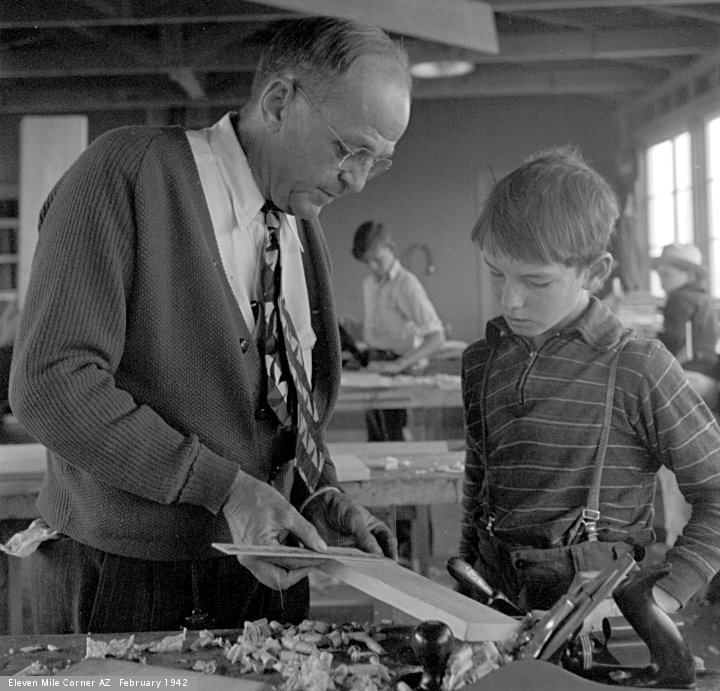
PS: These pictures remind me of ones I’ve seen from my grandparents, about life on the prairie in the 1920s. Do you know why families had so many kids then? It was because they needed all the hands they could get to work on the farm – and they kept having them so they’d have plenty to replace any they lost along the way (callous but true nonetheless).
Thank you for stopping by.
This is a repost. […]