Iraq Blog Count
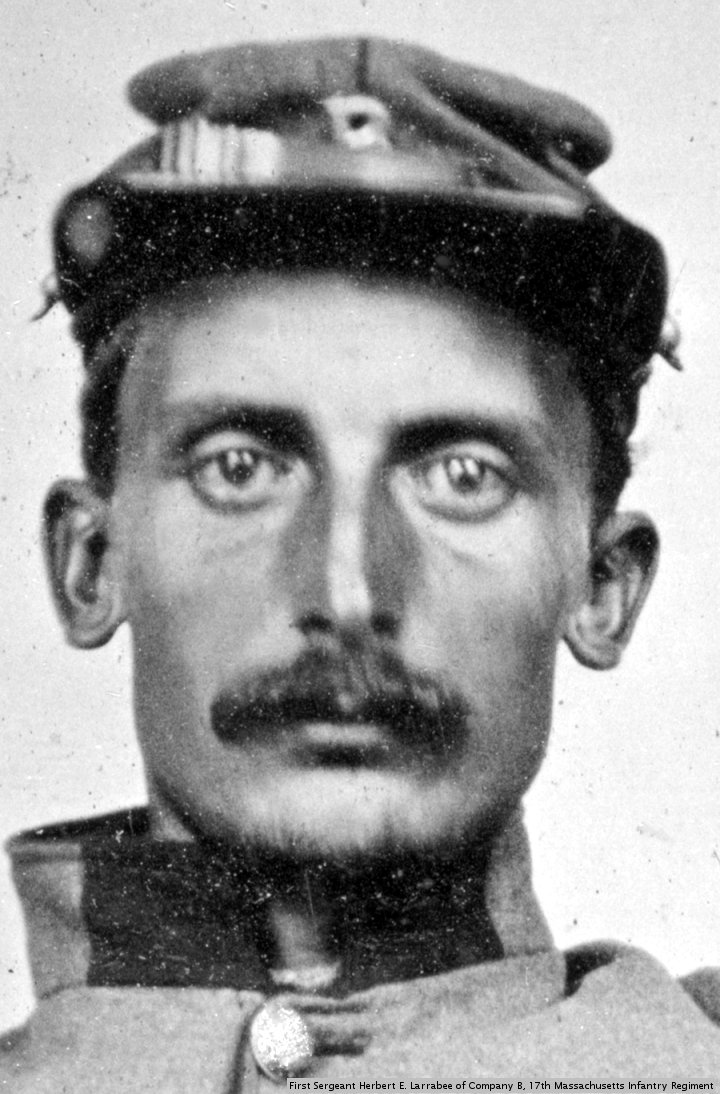
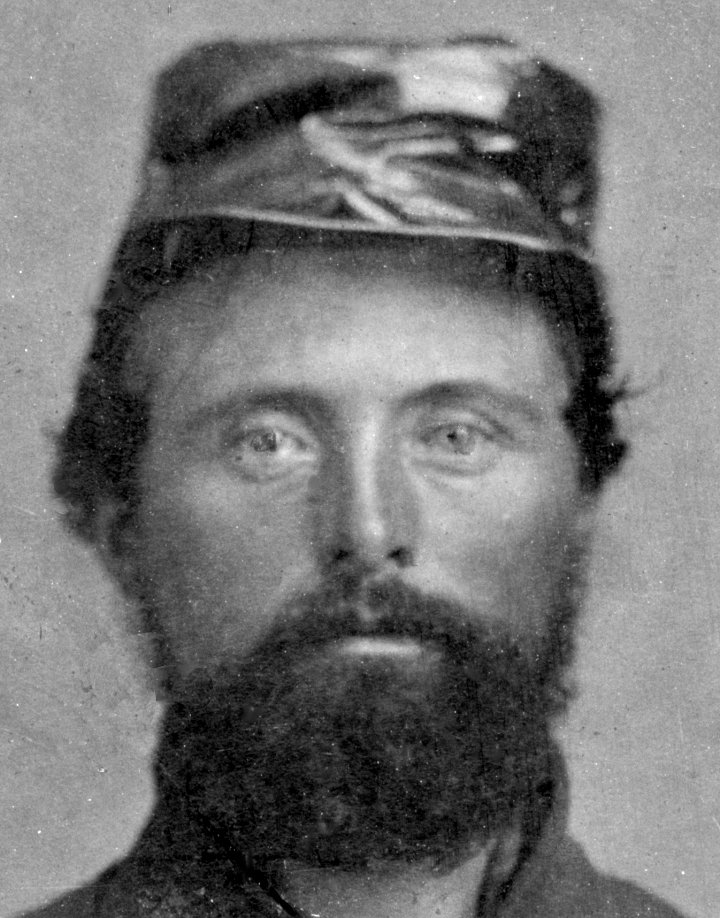
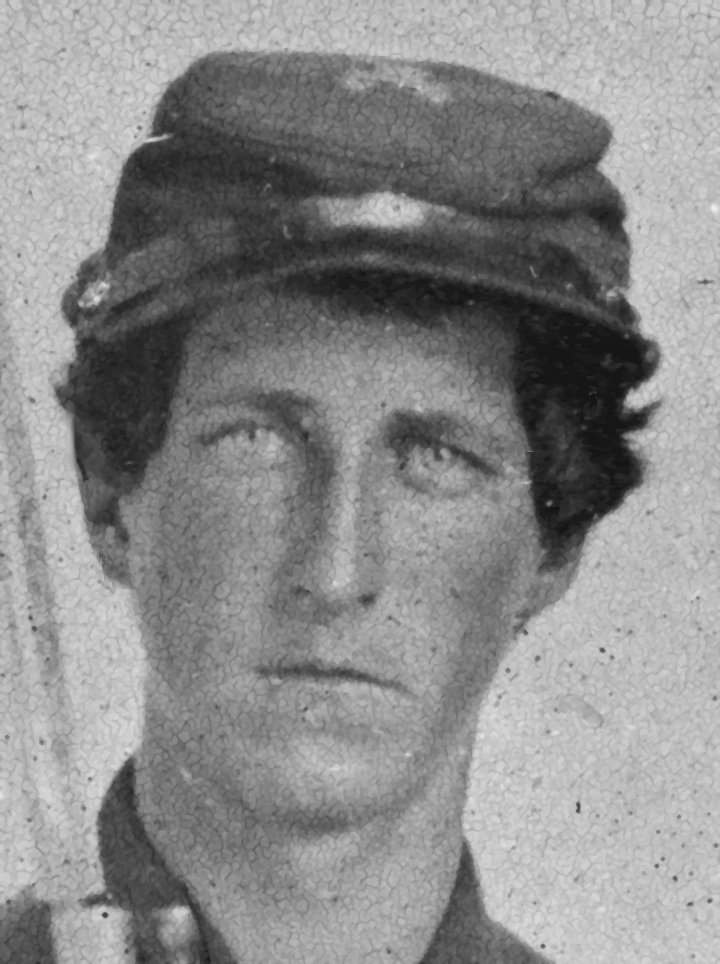

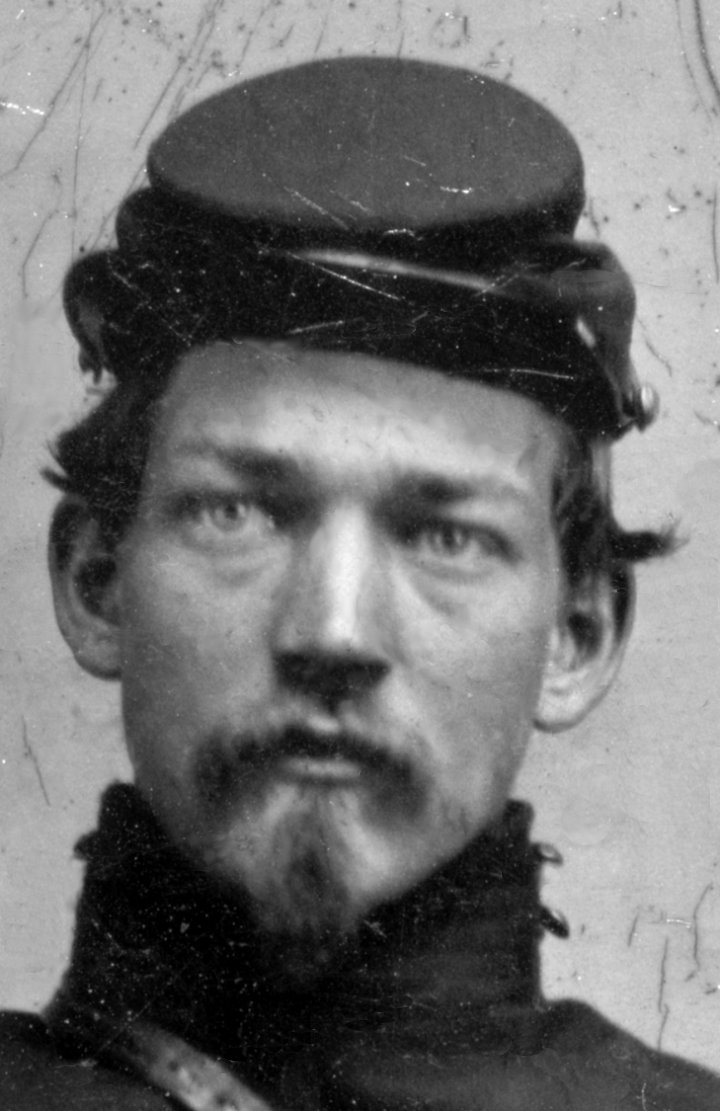
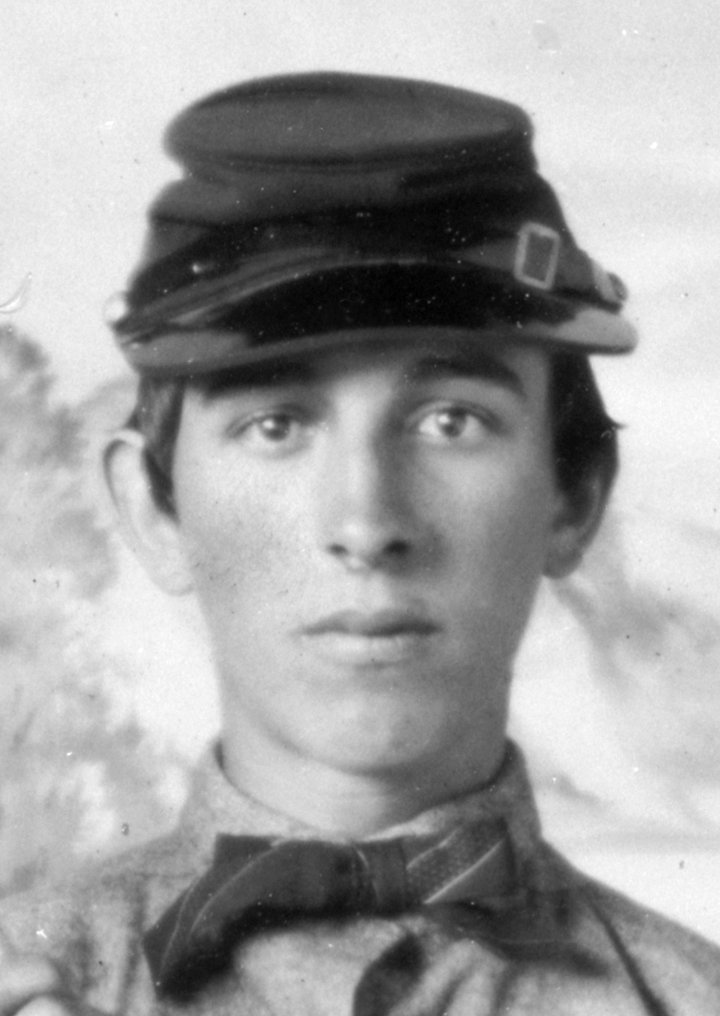
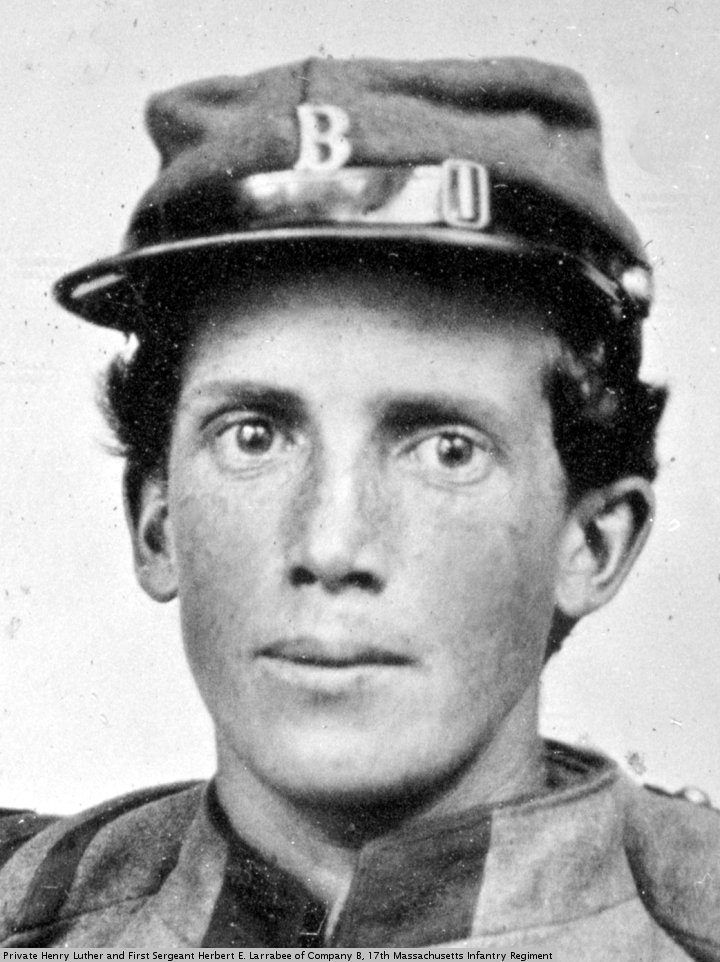
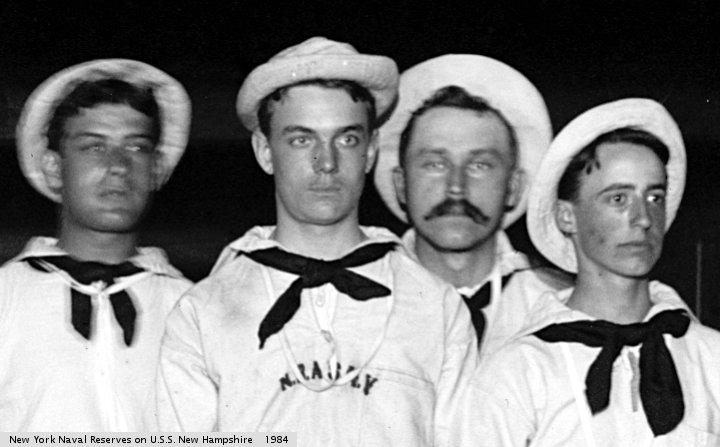
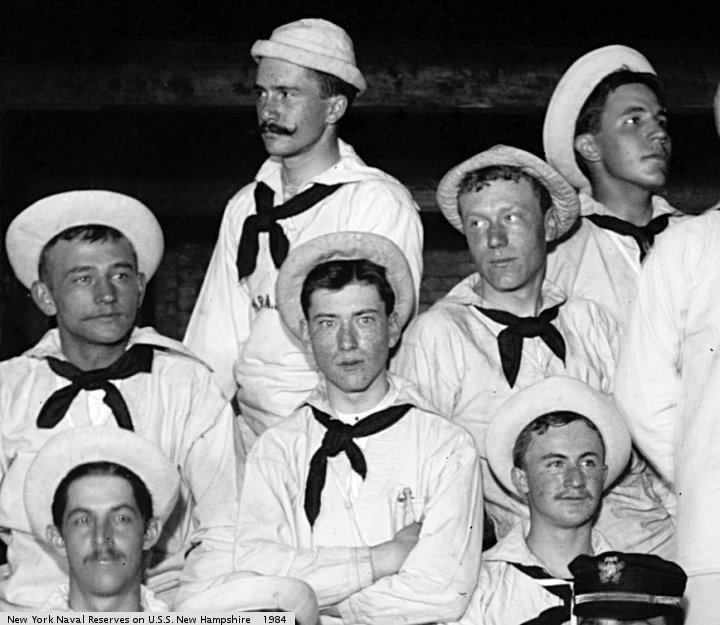
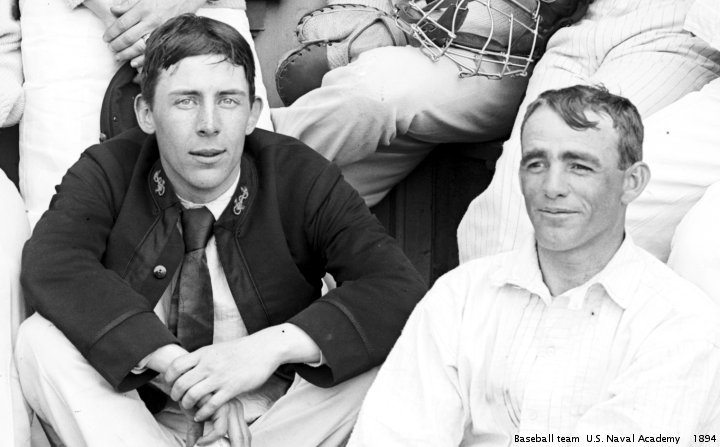
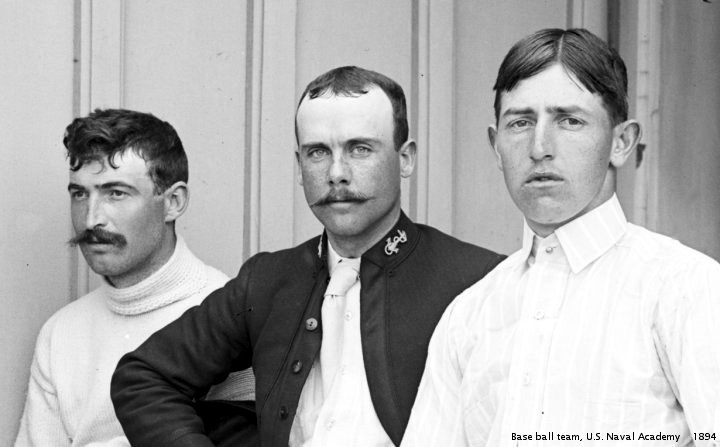
Iraq Blog Count is a collection of links to stories about the middle east. Many are in Arabic, and of little value to PG. Some are recycled quotes from other sources. Here are a few of these stories. The pictures are Union soldiers, from the War Between the States, borrowed from The Library of Congress
Free Iraq “…. In short , Iran has achieved a conventional deterrent to Israel. Therefor, statements by Iranian officials that Iran has no nuclear weapons program are in my view probably correct. Presently, Iran does not need nukes to deter Israel. It can do so with its GPS-guided medium range missiles. The Israelis are no doubt gnashing their teeth over this, because they now find themselves threatened by their own WMD stockpiles, and by their own nuclear reactors, especially Dimona, all of which have become targets.
A few direct hits by Iran could cause a toxic plume, killing thousands of Israelis. A worst case might signal the end of the Jewish state.
It is important to realize that Iran would never launch a pre-emptive strike on Israel because the Iranians know that the US/Israeli response would be devastating. However, if Iran comes under attack first, all bets are off. Iran will defend itself. A counter attack on Israel cannot be ruled out because Iranian leaders understand clearly (even if the American people do not) that the crisis has been manufactured, on Israel’s behalf.”
It was just a phase It was just a phase after all, though it had its benefits by letting me apply my frivolous and yet fervent thoughts into such scrambled sentences. I am figuring out that life is too short to spend on trivial matters, thus I Sincerely condemn the time that I spent here.
I am here to enunciate that this blog will be frozen(certainly deleted) and I am going to move on with my other projects, it was my pleasure to know people through this medium. The phase has ended and life continues even after our death, so I guess people will still be out there blogging about their daily flatulence and fecal whereabouts. (Comment) we all sincerely condemn the time we spend on the internet, yet its the perfect crime of spewing word vomit everywhere, without having to clean it up.
Logical Errors and Propaganda in Republican Debate on the Middle East Juan Cole is not listed on Iraq Blog Count. He does have “informed comment” about the Middle East daily. Today, he comments on the Repub debate, held last night. Newtie was calling fashion icon Ahmadinejad the “Dictator” of Iran, when he is a flunky to Supreme Leader Ali Khamenei.
Healing Iraq From yesterday, a Palestinian in Gaza holds up a sign that reads: “If the road to liberate al-Quds (Jerusalem) has to pass through the bloodshed of our brothers in Syria, then we have no need to liberate al-Quds.”
Bassam Sebti This time, the so-called “infidels” won the hearts and minds of many Iraqis who are relentlessly sharing a YouTube video of the Australian version of Britain’s Got Talent, The X Factor, in which Iraqi war survivor Emanuel Kelly performs. .
Emanuel, who doesn’t know his actual age because he was raised in an orphanage for disabled Iraqi children, was rescued and adopted by Children First Foundation director Moira Kelly along with his brother Ahmed after they both suffered from limb deficiencies as a result of chemical warfare in Iraq.
After I watched the clip in which Emanuel performs in the show’s auditions, all I was able to think of is how happy I am for him. He’s lucky he’s no longer in Iraq where orphans and the disabled are in most cases not treated as equal or in some cases as human beings. Our Iraqi society, or the Arab society as a whole to be specific, has no mercy on disabled people. It’s harsh, non-accepting and degrading. Most people like Emanuel would end up being beggars on the streets.
Skies As far as I know, no driving license has been issued since 2003 in Iraq. Today I was in a bus reading about “Nairn Transport Co.” when a passenger in our bus asked the bus driver to stop just at the start of a bridge in a highway. The bus driver hit the break with his feet as if pressing on a cockroach and we stop just few centimeters from a taxi driver who was out of his car for unclear reason at the mouth of the bridge. “You was about to hit me idiot” the taxi driver yelled. “Learn to choose your words,” murmured our bus driver with anger. The taxi driver went inside his taxi and yelled: “ZMAL (=jackass)” and hit the benzene pedal with his feet as if killing a roach.
CPAC Honeys Run Wild





It was yet another story about inappropriate cell phone use at a public event. There was a profound sentence. “When a phone chimes a cute little diddy, it arrogantly broadcasts some aspect of the user’s “personality” to those in earshot.”
Personalities need to be expressed. It is a free country. Political conservatives like to huff and puff about freedom. Then they go to CPAC, and run wild.
“Women will be future leaders, too, and I was dismayed to see how many of them either looked frumpish or like two-bit whores. First, are these young people being taught anything by their parents? I was at another service-oriented gathering of young women where the girls were in tight bandeau-skirts (you know, the kind of tube-top skirts that hookers wear on street corners?). They were sitting with their mothers. What is going on here? Second, have women so internalized feminist dogma that they see themselves in only two ways? Butch, men-lite wannabes or 3rd wave sluts who empower themselves by screwing every available horndog man?” (spell check suggestion:foghorn)
Pictures are by chamblee54.




Code Of Ethics
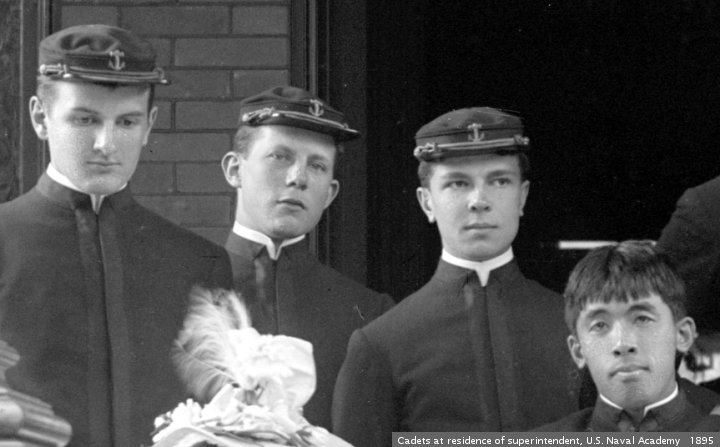


There is a bit of creativity floating around called “The native american code of ethics”. If you google that phrase, there are 329k ways to read this list, many suitable for framing. PG is not opposed to people sharing nuggets of wisdom, but is just a touch skeptical of this latest development.
The version of NACE cited above says the list was originally published in the October 1994 edition of Intertribal Times. A google search of the site shows no trace of the NACE. However, it does show a recent article, about an effort in the Montana legislature to adopt the cowboy “Code of the west” as an official state creed.
The legal effort is a bit of Republican showboating, and is likely to be vetoed if it gets passed. Contrary to initial reports, the code does not contain the phrase “The only good Indian is a dead Indian”. The code does say ““Ride for the brand,” “Talk less and say more” ,“Always finish what you start ”,“Live each day with courage,” “Take pride in your work,” “Do what has to be done,” “Be tough but fair,” “When you make a promise, keep it,” “Remember that some things aren’t for sale,” and “Know where to draw the line.”
Getting back to NACE, there are some good ideas there, but why are they specific to Native Americans? When the Europeans conquered the Americas, there were hundreds of individual tribes. Many of these had little in common with each other. While some may have agreed with some of these rules, it is doubtful that all agreed with all. That does not even consider the issue of whether they practiced these ideals, especially in times of war and hardship.
Item 5 of this list says “Do not take what is not yours whether from a person, a community, the wilderness or from a culture. If it was not earned or given, it is not yours.” Even if the NACE is the real deal, what right do non native Americans have to print pretty posters of it?
The different peoples of North America have long been “the other”. During the 19th century, the Northeast quadrant of the United States gained hegemony over the country, first in the War Between The States, and later during the “Indian Wars” of the west. The mostly European population did not respect people different from them. Today, this is seen with embarrassment, and the “Native American” is seen as a mythical Mr. Natural. This view is probably just as unreal as the Indians killing cowboys in the movies. ( Native American is a phrase coined by non native Americans.)
The “otherness” of the original americans continues today. Many of the poor people from Mexico that come to the United States are original americans. Maybe the name of this list should be “Illegal Alien Code Of Ethics”. Pictures for this entertainment are from The Library of Congress This is a repost.


1. Rise with the Sun to pray. Pray alone. Pray often. The Great Spirit will listen, if you only speak.
2. Be tolerant of those who are lost on their path.
Ignorance, conceit, anger, jealousy and greed stem from a lost soul. Pray that they will find guidance.
3. Search for yourself, by yourself. Do not allow others to make your path for you.
It is your road, and yours alone. Others may walk it with you, but no one can walk it for you.
4. Treat the guests in your home with much consideration.
Serve them the best food, give them the best bed and treat them with respect and honor.
5. Do not take what is not yours whether from a person, a community, the wilderness or from a culture. If it was not earned or given, it is not yours.
6. Respect all things that are placed upon this earth – whether it be people or plant.
7. Honor other people’s thoughts, wishes and words.
Never interrupt another or mock or rudely mimic them.
Allow each person the right to personal expression.
8. Never speak of others in a bad way.
The negative energy that you put out into the universe will multiply when it returns to you.
9. All persons make mistakes. And all mistakes can be forgiven.
10. Bad thoughts cause illness of the mind, body and spirit. Practice optimism.
11. Nature is not FOR us, it is a PART of us. They are part of your worldly family.
12. Children are the seeds of our future.
Plant love in their hearts and water them with wisdom and life’s lessons.
When they are grown, give them space to grow.
13. Avoid hurting the hearts of others. The poison of your pain will return to you.
14. Be truthful at all times. Honesty is the test of one’s will.
15. Keep yourself balanced.
Mental self, Spiritual self, Emotional self, and Physical self –
All need to be strong, pure and healthy. Work out the body to strengthen the mind.
Grow rich in spirit to cure emotional ails.
16. Make conscious decisions as to who you will be and how you will react.
Be responsible for your own actions.
17. Respect the privacy and personal space of others.
Do not touch the personal property of others – especially sacred and religious objects.
This is forbidden.
18. Be true to yourself first.
You cannot nurture and help others if you cannot nurture and help yourself first.
19. Respect others religious beliefs. Do not force your belief on others.
20. Share your good fortune with others. Participate in charity.


Theological Secularism
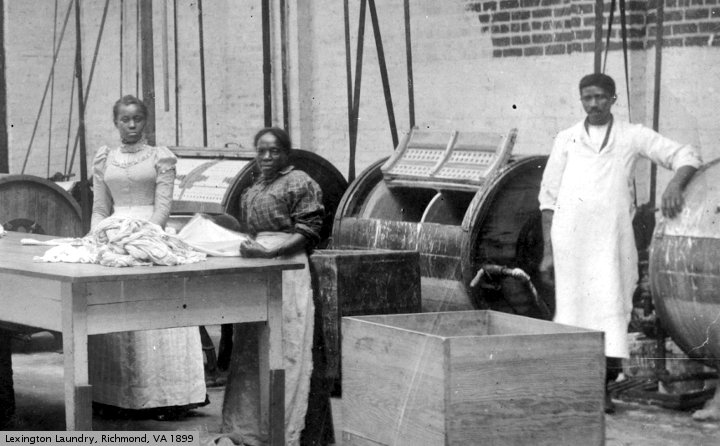

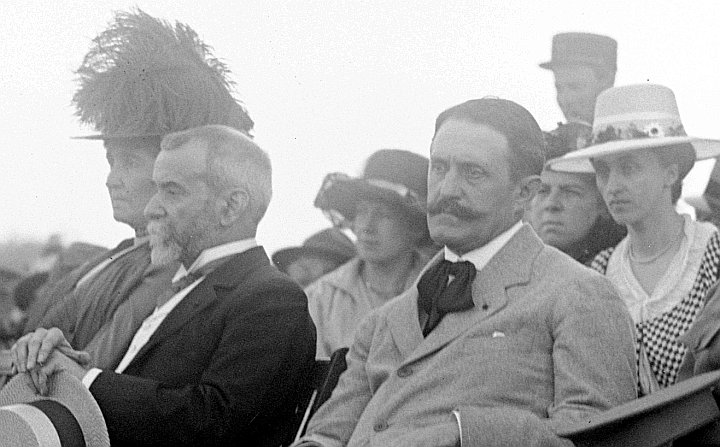
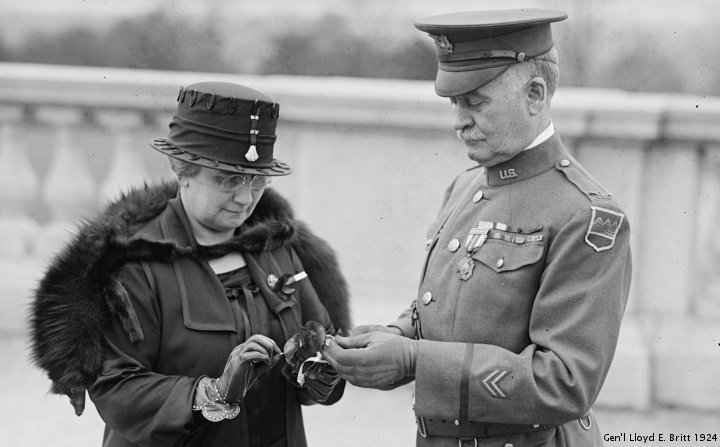
Rick Santorum wants to be President. He says the darnedest things. First he appeared to question the religion of BHO, then he said that it was really about the environment.
His speaker, Alice Stewart, tried to clarify matters. “He wasn’t questioning the President’s character. He wasn’t questioning the President’s religion. As he said, as he has clarified the statement, he was talking about radical environmentalists. He was talking about—there is a type of theological secularism when it comes to the global warmists in this country. That’s what he was referring to. He was referring to the President’s policies, in terms of the radical Islamic policies the President has, specifically in terms of the energy exploration.”
Oops, she said radical Islamist policies. What she meant was concern for the planet.
It is puzzling how so called Christians can have so little regard for our planet. In the embedded video, a man discusses the impact of developing the oil in Canadian tar sands. Maybe we will get a bit more oil, but we are going to tear up the planet to get it.
Pictures are from The Library of Congress.
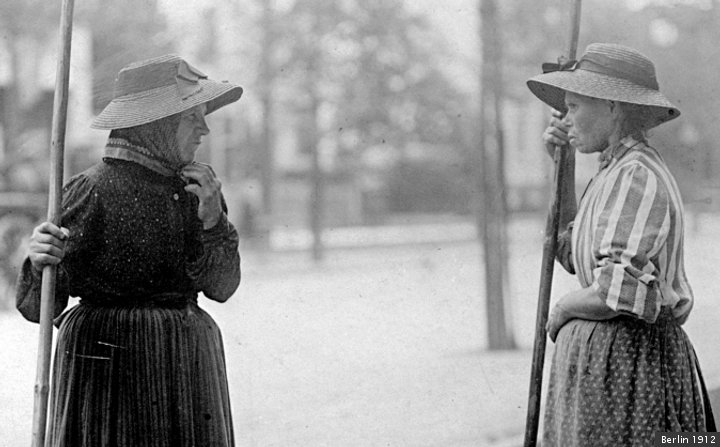
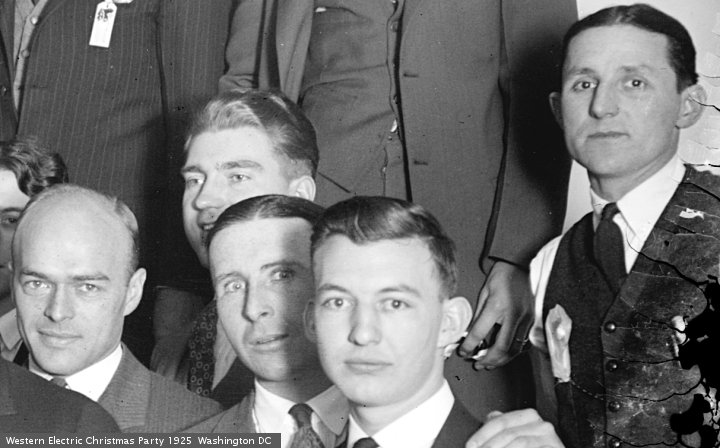
Happy Mardi Gras

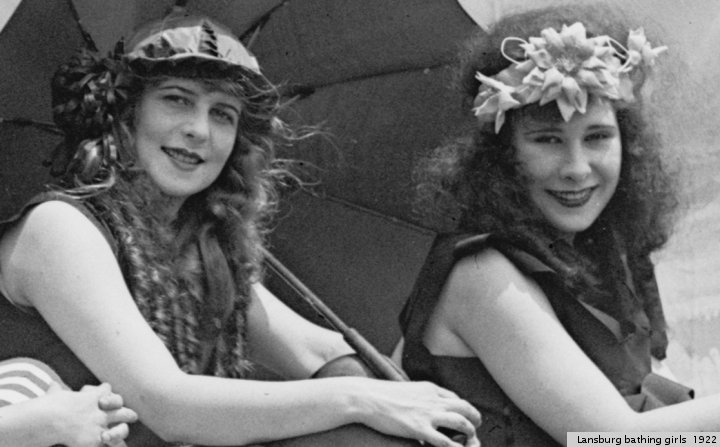
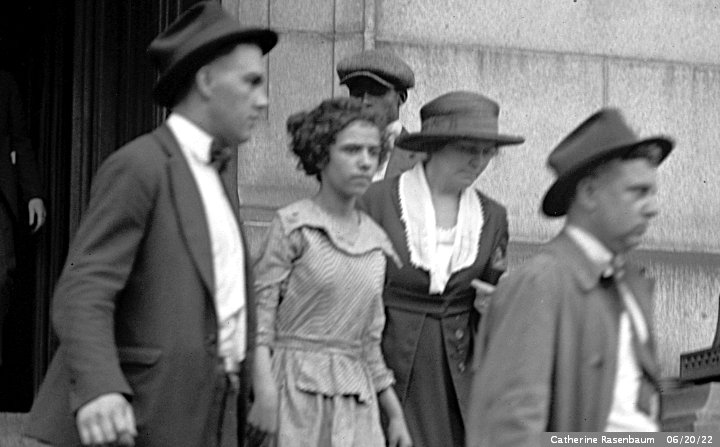

It is fat tuesday again. For someone who lived most of his life in Georgia, it is just another day.
In 1990, PG went to carnival. He rented sleeping bag space in a house on Marigny Street, just outside the quarter. It was like nothing he had ever seen.
This was 14 months after PG quit drinking. If he had life to do over, he would have gone to Mardi Gras first. He did feel good about going through that much drinking without being tempted to participate.
By the end of the Rex Parade, PG was getting tired of the whole shebang, Mob scenes of drunks, in costume, can get old. PG has not been back.
Two years later, the Grateful Dead was playing at the Omni, and the camp followers were in the parking lot. PG would go on his lunch hour and observe. A young lady walked by, and PG said Happy Mardi Gras. She gave him a string of beads.
Five years after that, PG had a boss from New Orleans. He looked like the Grinch who stole Christmas. He also hated Mardi Gras. PG did not know this, and greeted him Tuesday morning with a cheerful Happy Mardi Gras. If looks could kill, PG would have dropped dead.
This is a repost. Pictures from The Library of Congress.


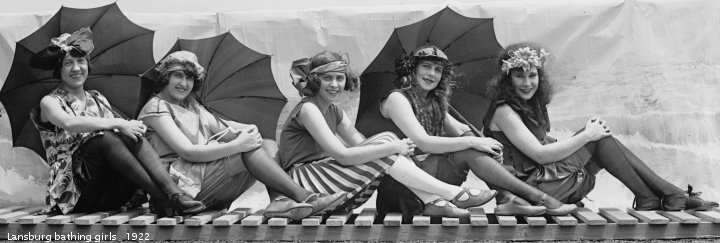
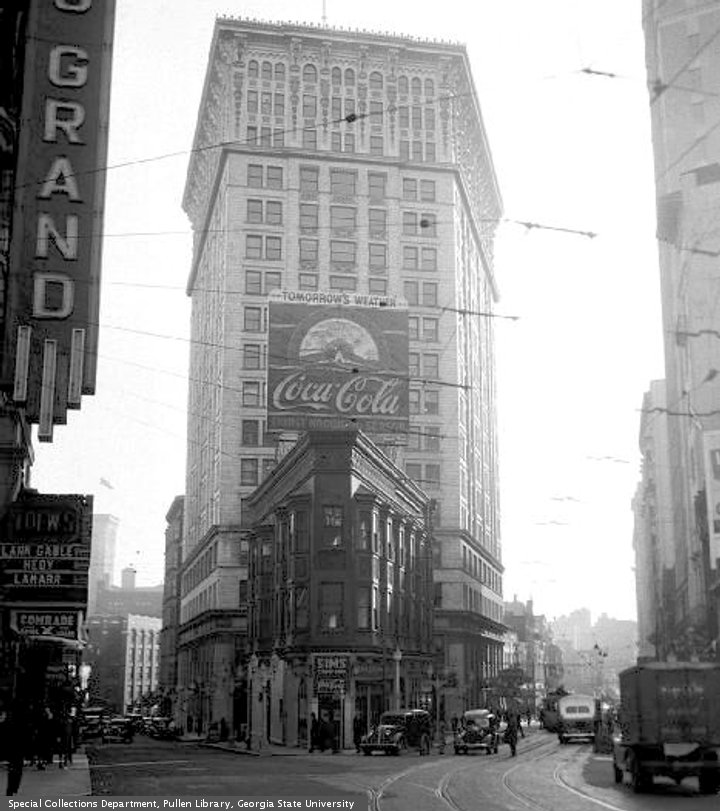
The Healey Building


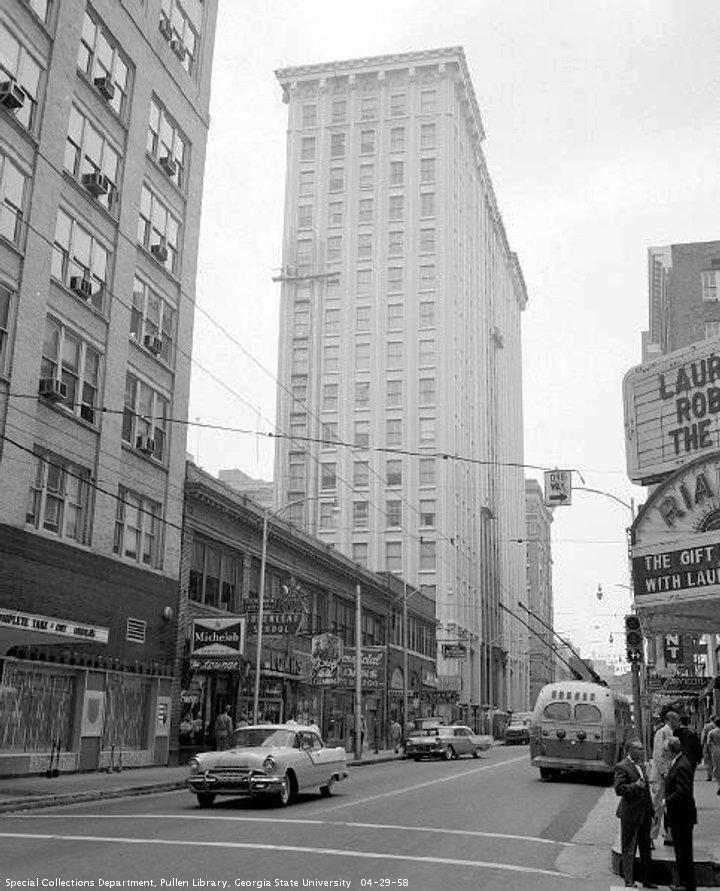


A local blog recently had a feature about the Healey Building. PG worked at 57 Forsyth Street for five years, between 1991 and 1995. This is a good excuse to write some text, and upload some pictures.
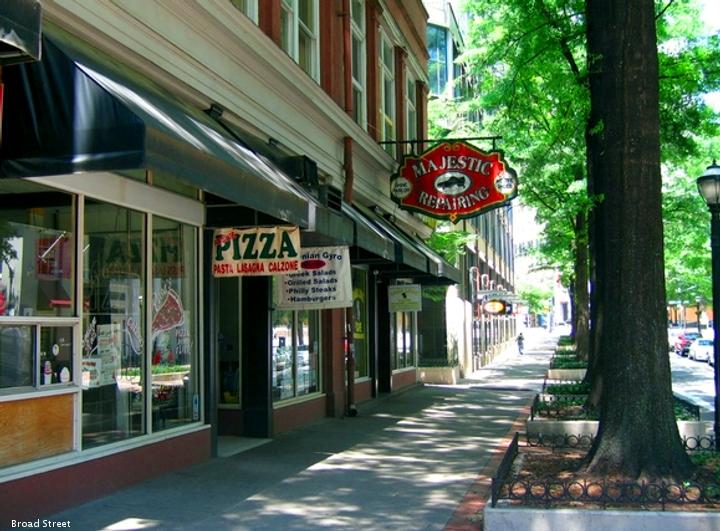
PG represented Redo Blue in an architect’s office on the fourteenth floor. His printroom was the third window from the north end, on the third floor from the top. There was a large window, on the west side overlooking Woodruff Park. A surprising amount of attention was captured by the gold dome of the State Capitol. At street level was Broad Street, home to a constantly changing array of merchants.
There were some sights coming in that window. On the coldest winter day in 1993, a music video was filmed on top of the Church’s Fried Chicken on Broad Street. On the week before the Super Bowl, The Dallas Cowboy cheerleaders kicked field goals in the park, along with Martin Mull. When PG left town that Friday, a large, inflated rendering of Izzy, the Olympic mascot, was resting in the park.
It was not completely happy times. In April of 1992, a jury in California delivered an unpopular verdict. The next day, the streets downtown erupted. People in Rosa’s Pizza got a broken window to go with their calzones. The next day, a notions shop on the Forsyth Street side had a sign in the window, “Black owned business”.
William T. Healey opened his office building in 1914. There were sixteen stories, taking the entire block between Broad, Walton, Forsyth and Poplar Streets. The firm of Morgan and Dillon designed the building. The original plan was to have twin towers, with the rotunda, and arcade, in the middle. World War One, and the death of Mr. Healey, put a stop to those plans.
The tower stood on the edge of the Fairlie-Poplar district. In photos of downtown, the Healey building, and the Candler building, serve as easily recognized landmarks. For many years, many bus lines ended on Walton Street, at the south end of the building. Hundreds of people waited there to change buses.
The Healey Building has many features that are no longer seen, The terra cotta details are too fancy for today’s buildings. The stairwells had a garbage chute. You could go to the garbage hole on any floor, and throw your trash to a receptacle down below. The building does not have a loading dock. A freight elevator pops up from behind a steel plate on the Forsyth Street sidewalk. This takes deliveries into the sub basement, where they are transferred onto the freight elevator.
Since 2001, the building has been a condo residence..
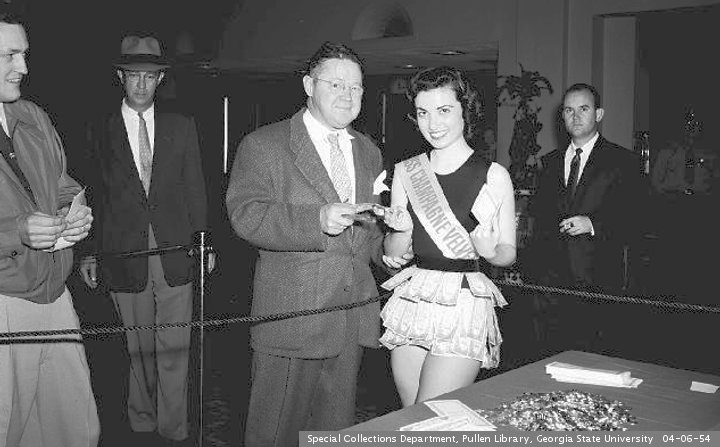
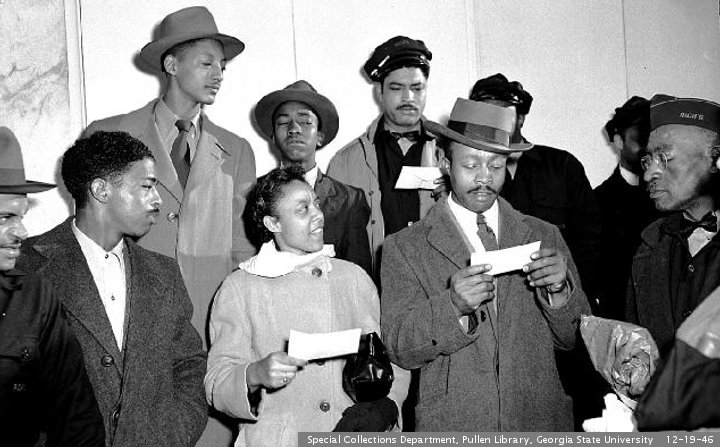
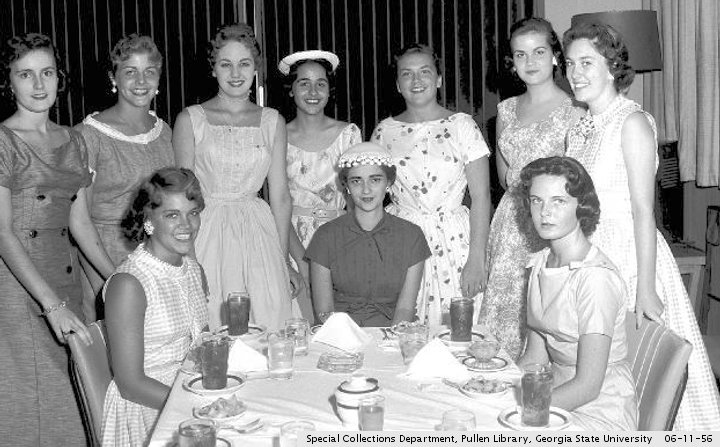
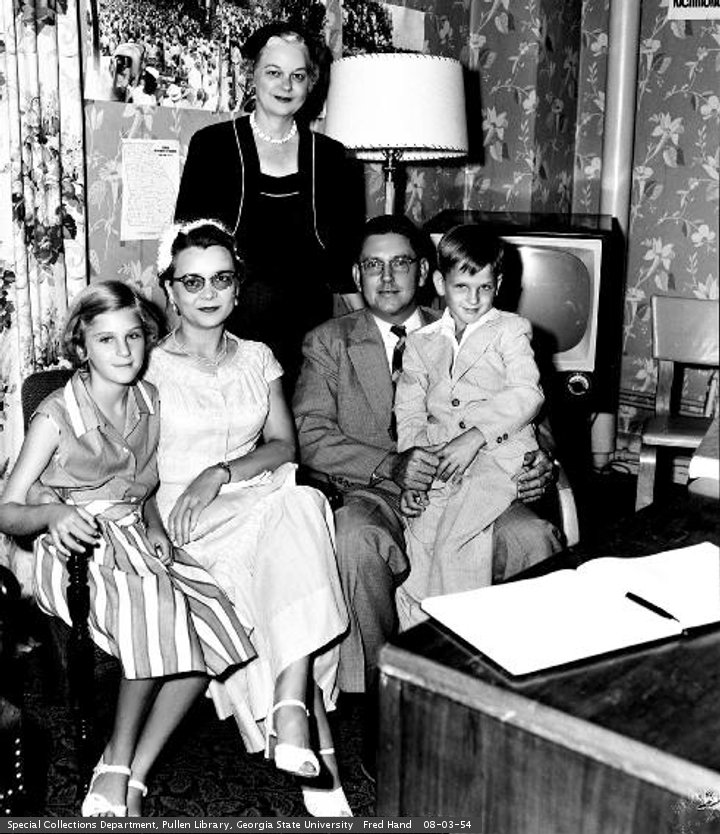
Pictures today are from Wendy Darling, The Healey Building, ” The Special Collections and Archives,Georgia State University Library”, and Chamblee54.




Presidential Popularity Poll
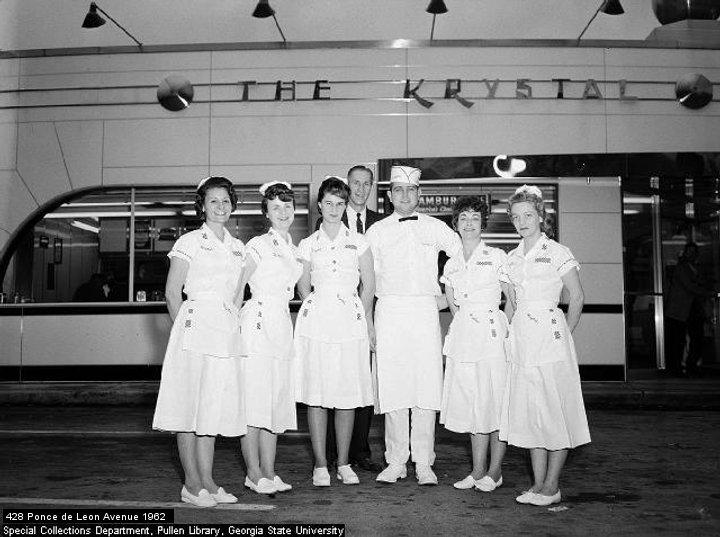

A North Carolina based polling company had some free time lately, and conducted a Presidential popularity poll. 89% of the respondents had a favorable opinion of George Washington, making him the most popular POTUS. It is not known if those people know why they admire Mr. Washington.
The study reveals a few details. PPP surveyed 1,200 American voters from February 9th to 12th. The margin of error for the survey is +/-2.8%. This poll was not paid for or authorized by any campaign or political organization. PPP surveys are conducted through automated telephone interviews. PPP is a Democratic polling company, but polling expert Nate Silver of the New York Times found that its surveys in 2010 actually exhibited a slight bias toward Republican candidates.
Questions 1-43 are the same. Do you have a favorable or unfavorable opinion of ________ ? Questions 43-49 are the demographics… who you voted for in 2008, ideology, gender, party affiliation, ethnicity, and age. Income and education were not considered.
In the fine print of the report, the 43 men have their popularity broken down by demographics. An example would be on William Henry Harrison. The overall score on Favorable/ Unfavorable/ Not Sure is 14%/8%/78%. This coincides with conventional wisdom, considering that Mr. Harrison died after being in office 32 days, and that it happened 170 years ago. The surprise is the young people. The 18-29 age group gives Mr. Harrison 32% favorable, with 19% negative, and 49% not sure. The 30-45 group gave Mr. Harrison 14%/9%/77%, the 45-65 group gave Mr. Harrison 10%/5%/85%, and the older than 65 population rated Mr. Harrison 9%/5%/86%. (This crosstab is on page 61 of the study).
Mr. Harrison was succeeded by John Tyler, who has been in the news lately. Two grandsons of Mr. Tyler are still alive. The overall score on John Tyler was 10%/10%/80%, with no significant differences noted in the crosstabs.
The overall scores are not surprising, Following Mr. Washington, as the most popular POTUS, are Abraham Lincoln, Thomas Jefferson, Teddy Roosevelt, and John Adams. The most popular of PG’s lifetime is Dwight Eisenhower, in a tie for sixth with Harry Truman. (Mr. Truman was not well thought of when he was in office.) Richard Nixon is the least popular POTUS, followed by Lyndon Johnson, Warren Harding, Millard Fillmore, and Herbert Hoover. Franklin Pierce scored 84% not sure, to win that category. It is not known how many respondents thought James Garfield was a cat.
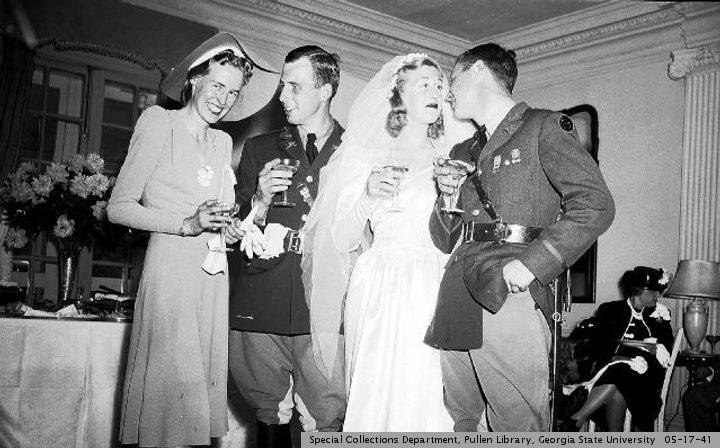
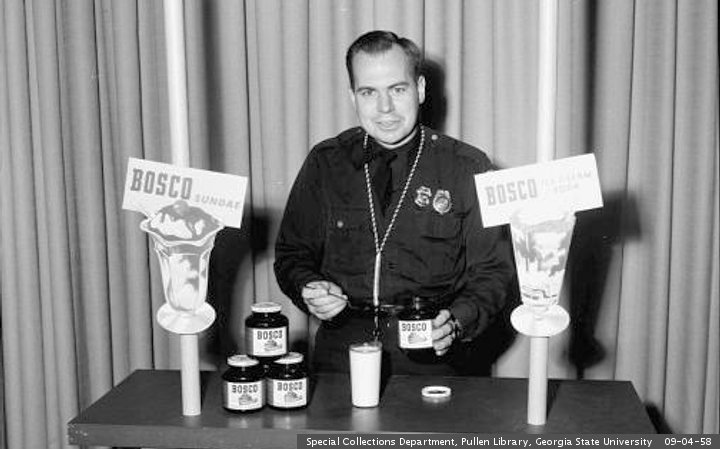
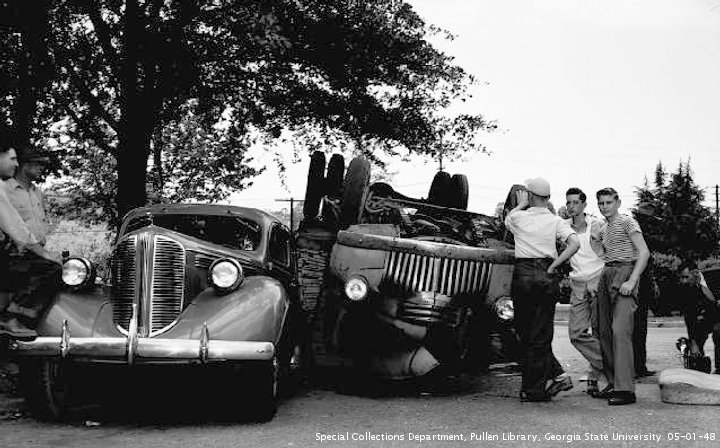
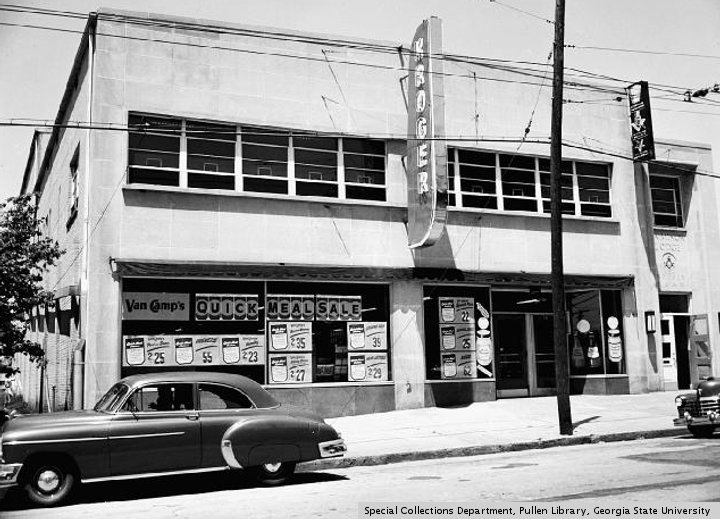
Commenter WT said “This poll is hopelessly flawed because it doesn’t separate out Grover Cleveland’s first and second terms.” Pictures today are from ” The Special Collections and Archives,Georgia State University Library” .

Frank Zappa




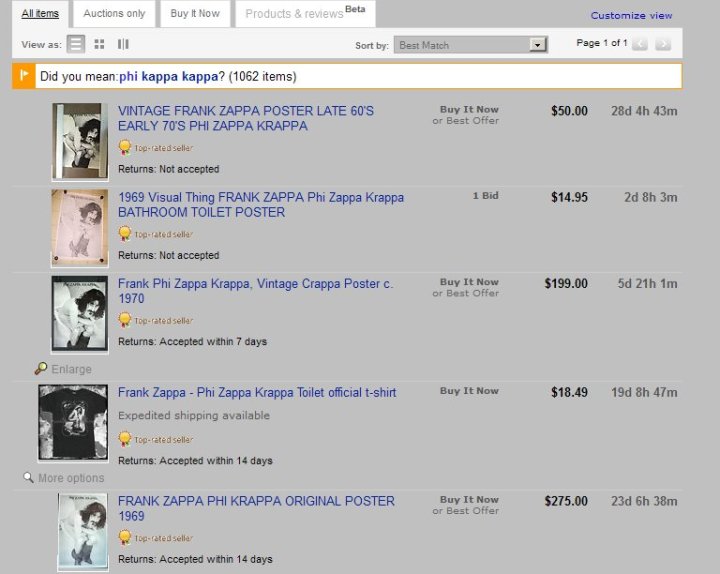
The first time PG saw the word Zappa, it was on an item at the Poster Hut. It showed a man sitting on a commode, with the words Phi Zappa Krappa rendered above. The poser, Frank Zappa, later said “I’m probably more famous for sitting on the toilet than for anything else that I do.”
It was 1969, give or take a bit. FZ was already well known in some hip circles. His band, the Mothers of Invention, played at something called the Cosmic Carnival at Atlanta Stadium, where the music lovers were actually allowed onto the field. PG paid $1.98 for a copy of We’re Only in It for the Money at the Woolco on Buford Hiway. Years later, he would pay $16.00 for a CD of this piece of work.
The records started to come out like clockwork, with or without the Mothers. FZ started to become a star, with an appeal to druggies who fancied themselves intellectual. It should be noted that FZ was notoriously anti drug. His music made fun of the establishment and counterculture with equal glee. FZ was also a capitalist, known to be tight fisted when it came to paying hired hands. He stayed with his second wife, Gail, until his death, and produced four children… Moon Unit, Dweezil, Ahmet Emuukha Rodan and Diva Thin Muffin Pigeen.
The concerts came to town every year or so, and people liked them. A show at the Fox Theater in 1974 may have caught FZ at his peak. PG heard the raves about this show until he bought a ticket for his next show. This was in 1975, at the Municipal Auditorium. PG brought a half pint in with him, and didn’t remember a lot later, except some song about the Illinois Eneman Bandit.
Life goes on. Nine years later, FZ was in legal hell with a former manager, and could only make money by touring. One night, a friend had an extra ticket to a show. PG arrived after the band had started, and FZ was playing a fine guitar solo. This was going to be good.
Only it wasn’t. The rest of the show was social commentary. The man had opinions on everything, and was generous with them. At one point, the band started to sing “He’s so gay”, while a double headed dildo was lowered from the ceiling. PG thinks he heard FZ sing “one day you might be gay too”, but by then it really didn’t matter.
Frank Zappa was many things to many people. He had lots of opinions, which were dutifully recorded by the press. Here are a few .
Rock journalism is people who can’t write, interviewing people who can’t talk, in order to provide articles for people who can’t read. // I think that if a person doesn’t feel cynical then they’re out of phase with the 20th century. Being cynical is the only way to deal with modern civilization, you can’t just swallow it whole. // When God created Republicans, he gave up on everything else. // Let’s not be too rough on our own ignorance; it’s what makes America great! // The U.S. is a mere pup tent of a civilization. We’ve got two hundred years of stupidity behind us and we think we’re right up there with everyone else who’s been doing it for thousands of years. // Beauty is a pair of shoes that makes you wanna die. // After all, he wrote this book here, and in the book it says he made us all to be just like him! So if we’re dumb, then God is dumb — and maybe even a little ugly on the side. // Remember there’s a big difference between kneeling down and bending over. // Do you think you are protecting somebody by taking away seven words? // For the record, folks; I never took a shit on stage and the closest I ever came to eating shit anywhere was at a Holiday Inn buffet in Fayetteville, North Carolina, in 1973. // If you wind up with a boring, miserable life because you listened to your mom, your dad, your teacher, your priest or some guy on TV telling you how to do your shit, then YOU DESERVE IT. // There is no hell. There is only France. // The United States is a nation of laws: badly written and randomly enforced. // Children are naïve — they trust everyone. School is bad enough, but, if you put a child anywhere in the vicinity of a church, you’re asking for trouble. // People make a lot of fuss about my kids having such supposedly ‘strange names’, but the fact is that no matter what first names I might have given them, it is the last name that is going to get them in trouble. //
The reviews at Amazon sometimes have insights into the truth about an artist. Here are a few one star reviews of We’re Only in It for the Money.
I just don’t get this October 11, 2010 By Neomorphus “Neomorphus” (Superior, Colorado)
This is unlistenable. I could only get half way through before giving up. Too clever for me.
Put the kettle on June 7, 2006 By Noddy Box (New York)
This high-pitched snit fit might rouse the odd smirk if all you’ve consumed is a cup of tea and a Digestive biscuit but on no account listen to it under the influence of anything stronger because then you’re liable to prang right into a hectoring bore who comes off like some renegade member of the school debating team rehearsing his–fnarr fnarr–naughty rhyming rebuttals. Farting around in Edgar Varese’s old corduroys is all well and good but this breathtakingly condescending harangue sounds depressingly like–dear oh dear–social commentary. Jacobs Cream Crackers but is there anything more tedious than windy social commentary set to popular music? And the exhortation to read Kafka in the liner notes? Please Frank, rock stars should never mix their drinks, or at least not so the stitches show. Zappa is much more bearable when he takes his own advice, shuts his cakehole and plays guitar. Like on Hot Rats, where the only vocal is the sublime Beefy on Willie the Pimp and Frank in the kitchen the whole time cooking up a kettle of wordless aural gumbo–a movie for the ears I think he called it, something like that anyway, it’s right there on the sleeve, good description at any rate of one of the authentically crunchy Zappa records. Well he did release over sixty of them after all, I mean he was bound to get it right once or twice, wasn’t he? So toss this turkey on the fire and get yourself out onna porch of the Lido Hotel.





The Doe Family



A doe is a female deer. There is also a human Doe family.
John Doe is rather slow. Not much is known about him.
How does a man without an face get in wikipedia?
Sha Dow is a mysterious figure. Why he changed his name, no one knows.
Jane Doe is the ex wife of Sha Dow. She is having an identity crisis.
Juan Doe is undocumented.
Bro Doe is on the down Low.
TaeKwonDoh is the asian of the family. She will kick your ass.
Do Si Doe likes to dance. She thinks being called square as a compliment.
According to science and legend, there was once a bird, the Dodo.
This is doe-doe, not doo doo.
Which will bring us back to Doe.

Peachtree Street 2012


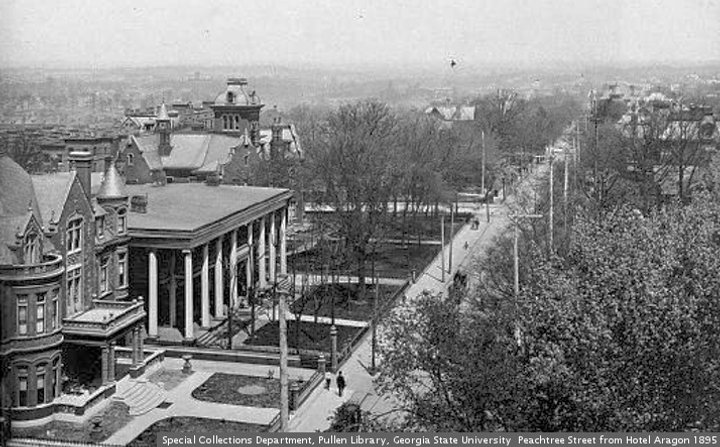

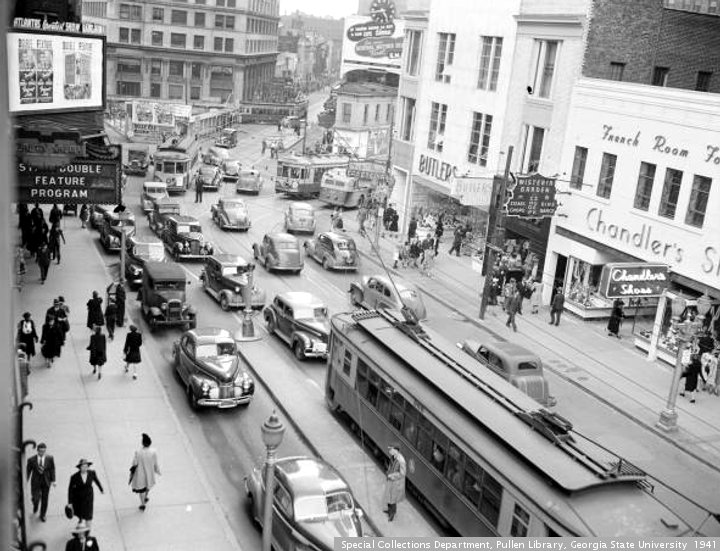
PG finished a book, Peachtree Street-Atlanta. The author is William Bailey Williford, and it was published by the University of Georgia Press in 1962. PG found this at the Chamblee library, and this is probably the best way to find this book today.
How this road got the name Peachtree is a good question. Most peaches grow south of the fall line. The story goes that there was a Creek Indian village called Standing Peachtree, located where Peachtree Creek runs into the Chattahoochee. During the war of 1812 Fort Peachtree was built on this site.
There was a trail that ran from Buckhead to an intersection with the Sandtown Trail, at what is now Five Points. A short distance south of this intersection was a settlement known as White Hall. For many years, Peachtree Street south of Five Points was known as Whitehall Road. At some point in the last thirty years, a decision was made to change Whitehall to Peachtree. It did not help the rundown condition of Whitehall Street.
In 1835 Governor Wilson Lumpkin decided that Georgia should build a Railroad that would be centered near the junction of Peachtree Trail and Sandtown Trail. The new town was named “Marthasville”, after the youngest daughter of the Governor. Martha Lumpkin is a resident of Oakland Cemetery today.
The village was soon renamed Atlanta, which was a feminine form of Atlantic. Houses, churches, and businesses were soon built on Peachtree Road. In 1856, Richard Peters built a flour mill. To insure a steady supply of firewood, he bought four hundred acres of land, for five dollars an acre. The land was between Eighth Street, North Avenue, Argonne Avenue, and Atlantic Drive.
Another pioneer citizen with a large landholding was George Washington (Wash) Collier. Mr. Collier bought 202 acres for $150 in 1847. The land was between West Peachtree, Fourteenth Street, Piedmont Road, Montgomery Ferry Road, and the Rhodes Center. Much of the land was used for the development of Ansley Park.
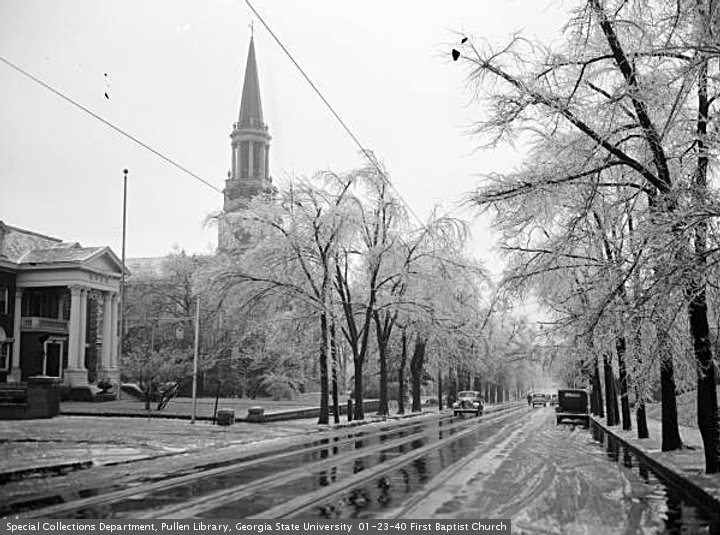

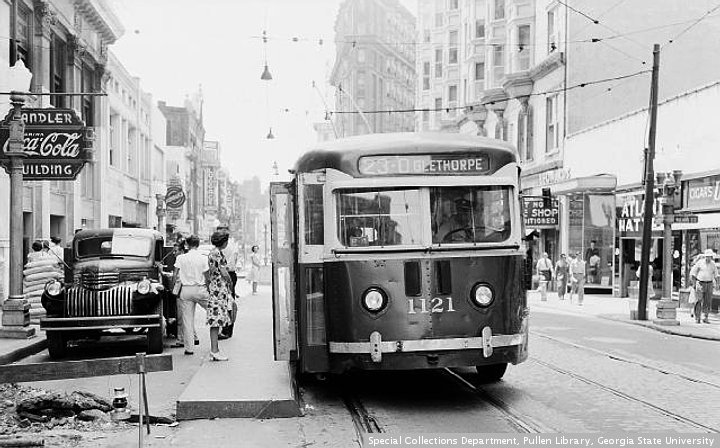
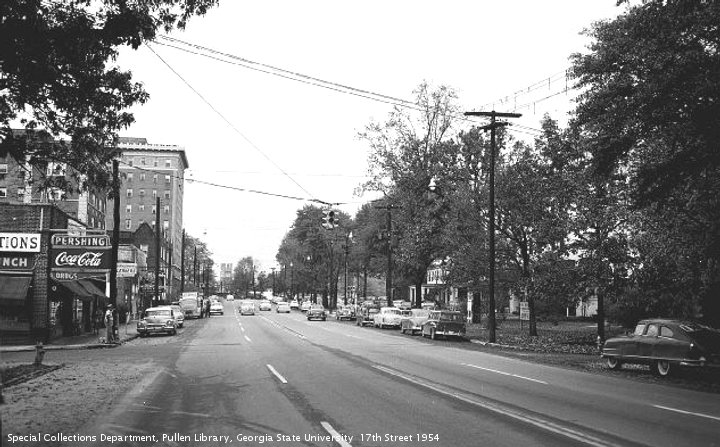
In 1854, Atlanta entertained, for the first time, a man who had been President. On May 2, Millard Fillmore arrived from Augusta on a private rail car.
There was some unpleasantness in 1864, which we will not concern ourselves with.
In 1866, there was a shocking murder. John Plaster was found dead, in an area known as “tight squeeze”. This was an area of shanties, at the present location of Crescent Avenue and Tenth Street. A hundred years later, this was near “the strip”, Atlanta’s hippie district, also called “Tight Squeeze”.
As the nineteenth century rolled along, many mansions were built on Peachtree Street. The road was paved, and streetcars ran up and down. Automobiles came, and came, and came. An expressway was built in the 1950’s, and quickly became obsolete. One by one, the mansions were torn down and replaced with businesses and churches.
The book was written in 1962, when the party was just getting started. The High Museum was known then as the Atlanta Art Association. In June of 1962, a plane full of prominent Atlanta residents crashed in Paris, killing all on board. As a memorial to those people, the Memorial Arts Center on Peachtree, at Fifteenth Street, was built.
Another phenomenon which is not explained by the book is the custom of naming everything here Peachtree. There are countless streets and institutions named for a fruit tree that likes warmer climates. Atlanta has a one street skyline, that stretches from Five Points to Peachtree Dunwoody Road, almost at the city limits. PG lives a quarter mile off Peachtree, in Dekalb County, and has no idea why Peachtree is a magic word.
Pictures are from ” The Special Collections and Archives,Georgia State University Library” and The Library of Congress. This is the annual repost. The book Peachtree Street-Atlanta has been reissued by the UGA Press.


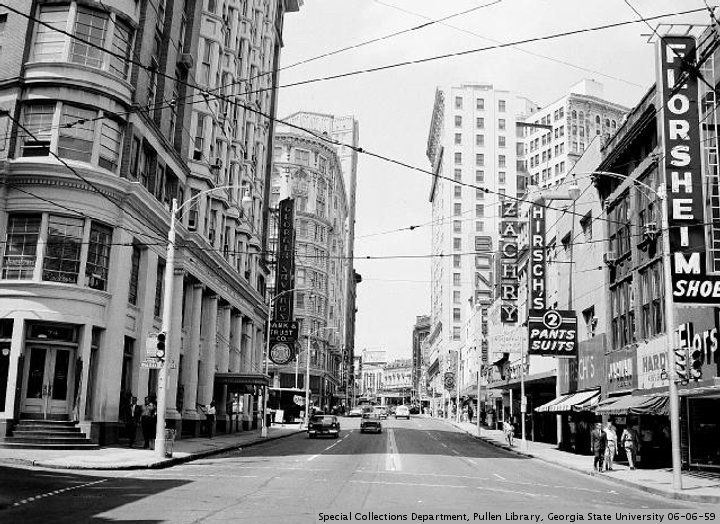

Gator A Go Go





PG just finished reading Gator A-Go-Go. It is a crime story set in Florida. There are drugs, sex, gangsters, corrupt, incompetent lawmen, and muscle cars. The central figure is Serge Storms, a trouble maker with clever ways to kill people. Someone named Coleman is his sidekick. They drive a ’73 Dodge Challenger, and have an uncertain, though dynamic, source of income.
The story goes around various spring break locations in the Sunshine State. Serge is making a movie about spring break, and does a lot of research. The story never stays in one location for more than a page or two, which is a bit annoying until you get used to it. Just like multi colored posts written in third person. Instead of pictures from chamblee54, GAGG has a cartoon gator peering over the bottom of the page. Alligators don’t play much of a role in this story. The humans have sharper teeth, and duller minds.
Gator A-Go-Go is not great literature. If you are recovering from a twisted knee, and easily amused, it will do. It is cheaper than pain medication. Three reviewers at Amazon gave it one star. Their comments are enlightening.
JUST SAY NO February 11, 2010 Douglas M. Zuccollo “dougiez” (Chicagoland USA)
NO CD…. what’s up with that ???? EASY good-bye Serge ..Good-bye Tim Good-bye Harper Collins and 20 bucks for an audio download …guess my days of donating old CDs to the Veterans Hospital are over … Thanks and Good Luck you greedy PIGS
impossible to read unless you read scripts?
December 26, 2009 willie “roadie” (pineapple park, FL, USA)
i cannot recommend this book as i found it impossible to read for a number of reasons – first, it reads like a TV script converted to a book with the prose infused with stream of consciousness dialect that jumps from thought to scene and back again (there is a lot of conversation, but little in the way of description) – second, only a few paragraphs in the book are longer than one or two sentences – third, disruptive use of onomatopoeia combined with italicizing and exclamation marks… also every chapter is broken up with sometimes bold and sometimes roman sans serif subheads, and use of all caps in the text is liberally used throughout – also, the ‘flip comic book’ animation effect of a gator eating the page numbers did not endear this reader to what is essentially an unreadable book – avoid this stinker
Gater a-go-go December 1, 2009 Isabelle Jolly (El Segundo, CA)
Cute title, huh? Blurb sounds good, too. Said it was a humorous murder mystery. The book opens with some seemingly irrelevant vignettes, and the prologue includes a gruesome murder which occurs after a good dinner. The hostess dons a raincoat, and with guests observing, proceeds to cut off a prisoner’s head with the electric carving knife. You don’t know why or who. Next, four men force their way into a room, gun down 5 students enjoying spring break in Florida, and throw a midget who had been in the bathroom off the balcony on the count of three. Still no explanation. Next, a man who had keyed a car, admittedly very bad behavior, is caught, tied up, and left under a garage door on which razor blades had been glued. The door has been rigged to fall when the sun hits it! The book may have something going for it later, but I couldn’t stomach anymore. I quit reading it at the end of chapter 4. It may get funny later, but much too gruesome for me. I’ve read a lot of murder mysteries, but nothing like this.





Universal Declaration of Human Rights
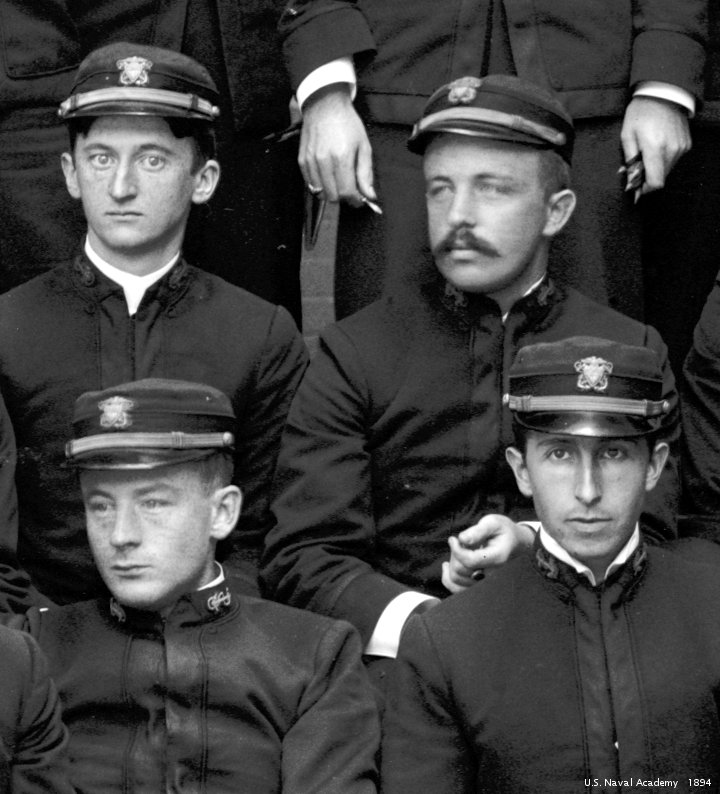
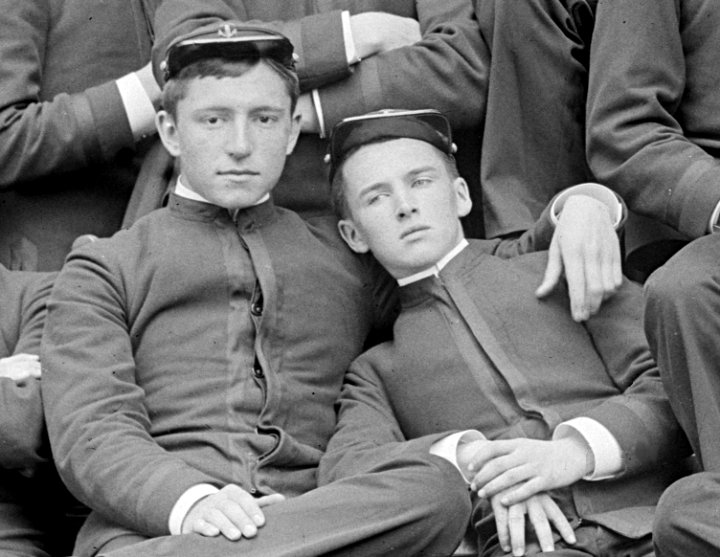
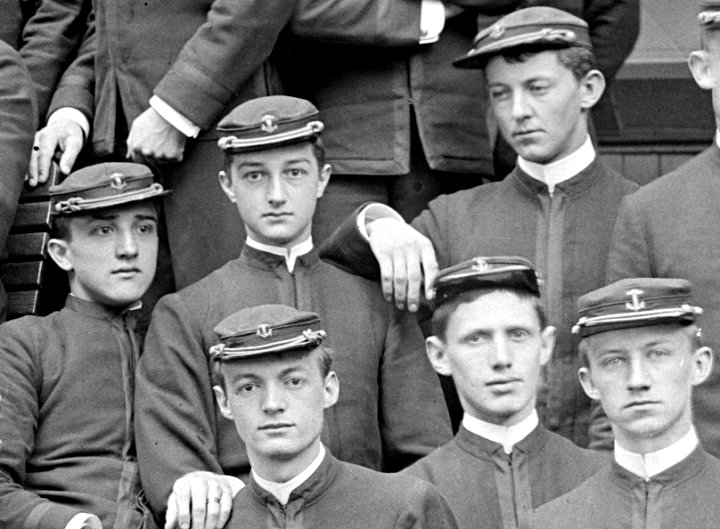
PREAMBLE Whereas recognition of the inherent dignity and of the equal and inalienable rights of all members of the human family is the foundation of freedom, justice and peace in the world, Whereas disregard and contempt for human rights have resulted in barbarous acts which have outraged the conscience of mankind, and the advent of a world in which human beings shall enjoy freedom of speech and belief and freedom from fear and want has been proclaimed as the highest aspiration of the common people, Whereas it is essential, if man is not to be compelled to have recourse, as a last resort, to rebellion against tyranny and oppression, that human rights should be protected by the rule of law, Whereas it is essential to promote the development of friendly relations between nations, Whereas the peoples of the United Nations have in the Charter reaffirmed their faith in fundamental human rights, in the dignity and worth of the human person and in the equal rights of men and women and have determined to promote social progress and better standards of life in larger freedom, Whereas Member States have pledged themselves to achieve, in co-operation with the United Nations, the promotion of universal respect for and observance of human rights and fundamental freedoms, Whereas a common understanding of these rights and freedoms is of the greatest importance for the full realization of this pledge, Now, Therefore THE GENERAL ASSEMBLY proclaims THIS UNIVERSAL DECLARATION OF HUMAN RIGHTS as a common standard of achievement for all peoples and all nations, to the end that every individual and every organ of society, keeping this Declaration constantly in mind, shall strive by teaching and education to promote respect for these rights and freedoms and by progressive measures, national and international, to secure their universal and effective recognition and observance, both among the peoples of Member States themselves and among the peoples of territories under their jurisdiction. Article 1. All human beings are born free and equal in dignity and rights.They are endowed with reason and conscience and should act towards one another in a spirit of brotherhood. Article 2. Everyone is entitled to all the rights and freedoms set forth in this Declaration, without distinction of any kind, such as race, colour, sex, language, religion, political or other opinion, national or social origin, property, birth or other status. Furthermore, no distinction shall be made on the basis of the political, jurisdictional or international status of the country or territory to which a person belongs, whether it be independent, trust, non-self-governing or under any other limitation of sovereignty. Article 3. Everyone has the right to life, liberty and security of person. Article 4. No one shall be held in slavery or servitude; slavery and the slave trade shall be prohibited in all their forms. Article 5. No one shall be subjected to torture or to cruel, inhuman or degrading treatment or punishment. Article 6. Everyone has the right to recognition everywhere as a person before the law. Article 7. All are equal before the law and are entitled without any discrimination to equal protection of the law. All are entitled to equal protection against any discrimination in violation of this Declaration and against any incitement to such discrimination. Article 8. Everyone has the right to an effective remedy by the competent national tribunals for acts violating the fundamental rights granted him by the constitution or by lawArticle 9. No one shall be subjected to arbitrary arrest, detention or exile. Article 10. Everyone is entitled in full equality to a fair and public hearing by an independent and impartial tribunal, in the determination of his rights and obligations and of any criminal charge against him. Article 11. (1) Everyone charged with a penal offence has the right to be presumed innocent until proved guilty according to law in a public trial at which he has had all the guarantees necessary for his defence. (2) No one shall be held guilty of any penal offence on account of any act or omission which did not constitute a penal offence, under national or international law, at the time when it was committed. Nor shall a heavier penalty be imposed than the one that was applicable at the time the penal offence was committed. Article 12. No one shall be subjected to arbitrary interference with his privacy, family, home or correspondence, nor to attacks upon his honour and reputation. Everyone has the right to the protection of the law against such interference or attacks. Article 13. (1) Everyone has the right to freedom of movement and residence within the borders of each state. (2) Everyone has the right to leave any country, including his own, and to return to his country. Article 14. (1) Everyone has the right to seek and to enjoy in other countries asylum from persecution. (2) This right may not be invoked in the case of prosecutions genuinely arising from non-political crimes or from acts contrary to the purposes and principles of the United Nations. Article 15. (1) Everyone has the right to a nationality. (2) No one shall be arbitrarily deprived of his nationality nor denied the right to change his nationality. Article 16. (1) Men and women of full age, without any limitation due to race, nationality or religion, have the right to marry and to found a family. They are entitled to equal rights as to marriage, during marriage and at its dissolution. (2) Marriage shall be entered into only with the free and full consent of the intending spouses. (3) The family is the natural and fundamental group unit of society and is entitled to protection by society and the State. Article 17. (1) Everyone has the right to own property alone as well as in association with others. (2) No one shall be arbitrarily deprived of his property. Article 18. Everyone has the right to freedom of thought, conscience and religion; this right includes freedom to change his religion or belief, and freedom, either alone or in community with others and in public or private, to manifest his religion or belief in teaching, practice, worship and observance. Article 19. Everyone has the right to freedom of opinion and expression; this right includes freedom to hold opinions without interference and to seek, receive and impart information and ideas through any media and regardless of frontiers. Article 20. (1) Everyone has the right to freedom of peaceful assembly and association. (2) No one may be compelled to belong to an association. Article 21. (1) Everyone has the right to take part in the government of his country, directly or through freely chosen representatives. (2) Everyone has the right of equal access to public service in his country. (3) The will of the people shall be the basis of the authority of government; this will shall be expressed in periodic and genuine elections which shall be by universal and equal suffrage and shall be held by secret vote or by equivalent free voting procedures. Article 22. Everyone, as a member of society, has the right to social security and is entitled to realization, through national effort and international co-operation and in accordance with the organization and resources of each State, of the economic, social and cultural rights indispensable for his dignity and the free development of his personality. Article 23. (1) Everyone has the right to work, to free choice of employment, to just and favourable conditions of work and to protection against unemployment. (2) Everyone, without any discrimination, has the right to equal pay for equal work. (3) Everyone who works has the right to just and favourable remuneration ensuring for himself and his family an existence worthy of human dignity, and supplemented, if necessary, by other means of social protection. (4) Everyone has the right to form and to join trade unions for the protection of his interests. Article 24. Everyone has the right to rest and leisure, including reasonable limitation of working hours and periodic holidays with pay. Article 25. (1) Everyone has the right to a standard of living adequate for the health and well-being of himself and of his family, including food, clothing, housing and medical care and necessary social services, and the right to security in the event of unemployment, sickness, disability, widowhood, old age or other lack of livelihood in circumstances beyond his control. (2) Motherhood and childhood are entitled to special care and assistance. All children, whether born in or out of wedlock, shall enjoy the same social protection. Article 26. (1) Everyone has the right to education. Education shall be free, at least in the elementary and fundamental stages. Elementary education shall be compulsory. Technical and professional education shall be made generally available and higher education shall be equally accessible to all on the basis of merit. (2) Education shall be directed to the full development of the human personality and to the strengthening of respect for human rights and fundamental freedoms. It shall promote understanding, tolerance and friendship among all nations, racial or religious groups, and shall further the activities of the United Nations for the maintenance of peace. (3) Parents have a prior right to choose the kind of education that shall be given to their children. Article 27. (1) Everyone has the right freely to participate in the cultural life of the community, to enjoy the arts and to share in scientific advancement and its benefits. (2) Everyone has the right to the protection of the moral and material interests resulting from any scientific, literary or artistic production of which he is the author. Article 28. Everyone is entitled to a social and international order in which the rights and freedoms set forth in this Declaration can be fully realized. Article 29. (1) Everyone has duties to the community in which alone the free and full development of his personality is possible. (2) In the exercise of his rights and freedoms, everyone shall be subject only to such limitations as are determined by law solely for the purpose of securing due recognition and respect for the rights and freedoms of others and of meeting the just requirements of morality, public order and the general welfare in a democratic society. (3) These rights and freedoms may in no case be exercised contrary to the purposes and principles of the United Nations. Article 30. Nothing in this Declaration may be interpreted as implying for any State, group or person any right to engage in any activity or to perform any act aimed at the destruction of any of the rights and freedoms set forth herein. The Universal Declaration of Human Rights was adopted by the UN General Assembly on 10 December 1948. Pictures are from The Library of Congress.
 Chamblee54
leave a comment