World Premieres In Atlanta

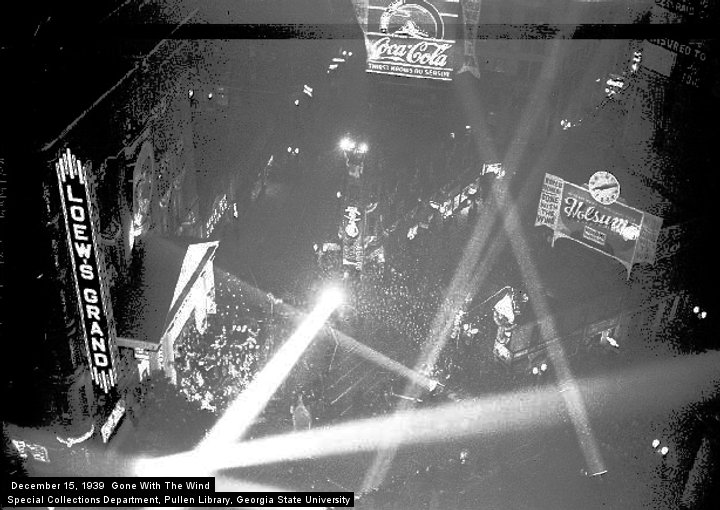


Several movies have had a world premiere in Atlanta. We will take a look today. Pictures are from the ” Special Collections and Archives,Georgia State University Library”. Information about the films is from the Internet Movie Database. This is an encore presentation.
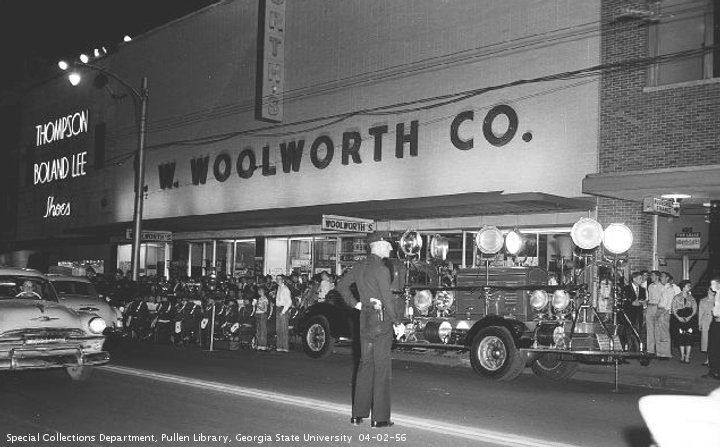
As some of you may know, “Gone With The Wind had it’s world premiere at the Lowes Grand Theater on December 15, 1939. The Lowes Grand site is the current location of the Georgia Pacific building. There is a vacant lot next door, on top of some MARTA paraphernalia. This lot was the site of the Paramount Theater, another movie palace that did not survive.
The GWTW premiere was a big deal. Ten year old Martin Luther King Jr. sang with his church choir. Clark Gable requested a private meeting with Margaret Mitchell, who became the envy of every woman in America. When Mr. Gable checked out of his hotel, a lady was going to be given his room. The clerk asked for a minute to change the sheets on the bed, and the lady said, no, I want to sleep on the same sheets as him.
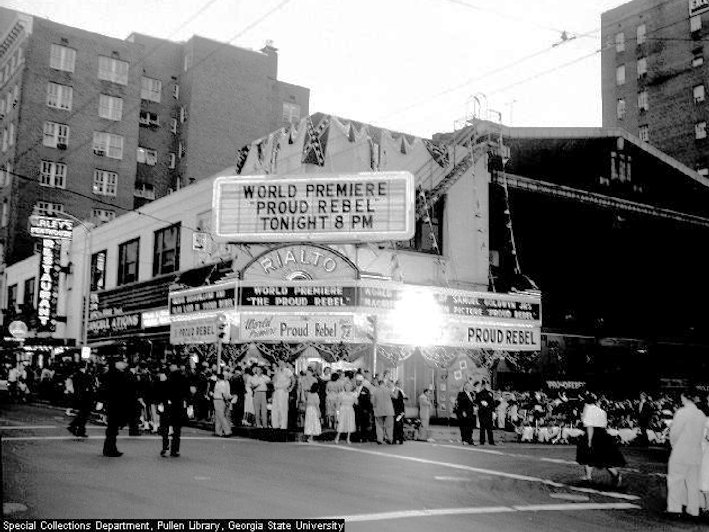
It was the golden age of movies, and the next year Atlanta hosted the first showing of “Who Killed Aunt Maggie”. The premiere was at the Rialto, on October 24, 1940. The review at IMDB said it was an enjoyable mystery, even if it was a cliche fest. It is not often seen today.
In 1946, “Song Of The South” had it’s premiere at the Fox Theater. SOTS is a controversial item these days. It was based on the Uncle Remus stories, which were written down by Joel Chandler Harris. For those who don’t know, these stories were told by the rural black people that Mr. Harris knew when he was growing up near Eatonton GA. As Wikipedia tells the tale “Controversy surrounding his southern plantation themes, narrative structure, collection of African-American folklore, use of dialect, and Uncle Remus character, however, has denigrated the significance of Harris’ work”. In other words, Brer Rabbit is not politically correct.
The reviews at IMDB tell a different tale. To them, SOTS is a happy children’s movie. The Disney company seems to wish it would go away and be forgotten. Copies are tough to come by these days. PG would say to see it for yourself and make up your own mind, but Disney won’t let you.
The female lead in SOTS was Ruth Warrick. Miss Warrick was a versatile talent. Her first movie role was in “Citizen Kane”, as Kane’s first wife. She was in many movies, before moving to television. She was perhaps best known as Phoebe Tyler, in the soap opera “All My Children”. Wikipedia tells a story about her, that is ironic for the female lead of “Song Of The South”
“In July 2000, she refused to accept a lifetime achievement award from the South Carolina Arts Commission because she was offended by legislators’ decision to move the Confederate flag from the state Capitol dome to another spot on the grounds in response to a boycott of the state by flag opponents. A lifelong supporter of African-American rights, she felt the flag should be removed completely, and commented, “In my view, this was no compromise. It was a deliberate affront to the African-Americans, who see it as a sign of oppression and hate.”
In 1949, the Paramount had the first screening of “The Gal Who Took The West”. The female lead was Yvonne De Carlo, who later achieved immortality as Lily Munster. In November 1951, the spotlights returned to Lowes Grand for “Quo Vadis”.
The last film in the GSU picture collection is “The Last Rebel”. This western had it’s premiere at the Rialto, May 27, 1958. The movie was a return to Atlanta glory for Olivia De Havilland. The film is the story of a man, whose wife dies in a fire during the war between the states. PG questions the use of the Stars and Bars on the marquee.
In 1974, Ringo Starr produced and acted in “Son of Dracula”. The movie had it’s world premiere at the Cherokee Plaza Theater. Cherokee Plaza is a shopping center on Peachtree Road, just east of the Atlanta city limits. The theater was torn down during a renovation, and the space is currently the produce department at Krogers.
A local radio station hired a band to play in the parking lot at the premiere. At some point, a long limousine pulled up to a stage, and Ringo Starr and Harry Nillson got out. Both were wearing sunglasses, even though it was after dark. Ringo got on the stage, waved a wand at the crowd, and said “I am turning you into frogs”. He went inside to see the movie, the crowd went home, and the movie was mercifully forgotten.
In 1981, PG went to a supper in an apartment building (now a vacant lot) across from First Baptist Church on Peachtree Street. There was a commotion down the street at the Fox, and PG went to see what it was. “Sharkey’s Machine” had it’s World Premiere that night.



Destroy In Twenty One Minutes




We are pumping too much carbon dioxide into the atmosphere. The primary source of this is use of fossil fuels. primarily coal and petroleum. Most of the attention has focused on the effect this imbalance has on the air. Informed Comment has a feature today about the effects of excess carbon dioxide on the planet’s water.
The oceans absorb excess carbon dioxide from the atmosphere. As The National Science Foundation tells the tale, “The oceans act like a sponge to draw down excess carbon dioxide from the air. The gas reacts with seawater to form carbonic acid, which over time is neutralized by fossil carbonate shells on the seafloor. If too much carbon dioxide enters the ocean too quickly, it can deplete the carbonate ions that corals, mollusks and some plankton need for reef and shell-building.”
The NSF feature deals with the history of the earth over the last 300 million years. (It is noted that ” because ocean sediments older than 180 million years have been recycled back into the deep Earth, scientists have fewer records to work with.”) At various times, the carbon portion of the atmosphere has risen dramatically. The reasons are open to speculation, but many feel it was due to volcanic activity, and an asteroid collision.
“In a review of hundreds of paleoceanographic studies, the researchers found evidence for only one period in the last 300 million years when the oceans changed as fast as today: the Paleocene-Eocene Thermal Maximum, or PETM. In ocean sediment cores, the PETM appears as a brown mud layer flanked by thick deposits of white plankton fossils. About 56 million years ago, a mysterious surge of carbon into the atmosphere warmed the planet and turned the oceans corrosive. In about 5,000 years, atmospheric carbon doubled to 1,800 parts per million (ppm), and average global temperatures rose by about 6 degrees Celsius. The carbonate plankton shells littering the seafloor dissolved, leaving the brown clay layer that scientists see in sediment cores today. As many as half of all species of benthic foraminifera, a group of one-celled organisms that live at the ocean bottom, went extinct, suggesting that deep-sea organisms higher on the food chain may have also disappeared, said paper co-author Ellen Thomas, a paleoceanographer at Yale University.”
It should be noted that the current atmospheric changes have occured over the last 200 years. Over a period of 50,000,000 years, the earth has recovered to the point of supporting a fabulous variety of life. In .00004% of that time, the promiscuous use of fossil fuels has almost ruined paradise. What G-d created in a year, man has destroyed in 21 minutes.
Alternet has a feature, Our Oceans Are in Dire Shape, But Without Them All Life on Land — Human, Plant and Animal — Is Totally Screwed. Here is a quote. “Already the increased levels of ocean acidification have led to a loss of phytoplankton and of coral reefs. And losses of phytoplankton and of coral reefs have a ripple effect.
First, much marine life relies on them for nourishment. Flounder, haddock, pollock, salmon and shrimp all eat phytoplankton. Humans eat many of these fish. Krill eat phytoplankton and whales eat krill. So a decrease in one threatens the liveilhood of the other.
Second, phytoplankton also absorbs carbon dioxide. Phytoplankton floats along the ocean’s surface absorbing CO2 as land plants do in photosynthesis. As the CO2 is absorbed, the plant dies and sinks to the ocean floor, releasing CO2 along the way. Cold water can hold higher levels of CO2 than warmer water, so most of the CO2 released, which turns water acidic, is to be found along the ocean floor. But this acidic water does not stay at the ocean’s floor. During an upswell, it rises to the surface. Its acidity is deadly for the shells of marine life, such as shrimps, clams and oysters.
If the smallest part of the food chain is affected by ocean acidification, it ripples all the way up the food chain, making the largest part of the food chain vulnerable.”
Global warming may be the least of our worries. Pictures are from ” The Special Collections and Archives,Georgia State University Library”.






Flak Jacket


Palestinian Pundit links to a fine story, Robert Fisk: The heroic myth and the uncomfortable truth of war reporting. There is an old saying … in wars, the first casualty is the truth. Stories for the home front are a key part of the war effort. The government often sees war reporters as being a part of the propaganda offensive, and many play along. Mr. Fisk has been playing the game for many years, and has a few stories to tell.
“The flak jacket has now become the symbol of almost every television reporter at war. I’ve nothing against flak jackets. I wore one in Bosnia. But I’ve been increasingly discomfited by all these reporters in their blue space-suits, standing among and interviewing the victims of war, who have no such protection. I know that insurers insist correspondents and crews wear this stuff. But on the streets, a different impression emerges: that the lives of Western reporters are somehow more precious, more deserving, more inherently valuable than those of the “foreign” civilians who suffer around them.”
Not only western reporters, but the western soldiers and mercenaries as well. There is something ugly about an advanced society going into a backwards country to kill people. In Vietnam, we had B52s raining napalm on peasants living in bamboo shacks. In Pakistan, we have unmanned aircraft slaughtering helpless women and children.
In the old days, soldiers marched into battle, protected only by their weapon. Now, they move in armored vehicles, which they exit leave wearing body armor. The hosts are left to struggle as best they can… with i.e.d.s and suicide bombers. The blood of the people is the weapon of mass destruction.
“A similar and equally uncomfortable phenomenon appeared 15 years ago. How did reporters “cope” with war? Should they receive “counselling” for their terrible experiences? Should they seek “closure”? The Press Gazette called me up for a comment. I declined the offer. The subsequent article went on and on about the traumas suffered by journalists – and then suggested that those who declined psychological “help” were alcoholics. It was either psycho-babble or the gin bottle. The terrible truth, of course, is that journos – and for God’s sake, we must stop demeaning our profession by calling ourselves “hacks” – can fly home if the going gets too tough, business class with a glass of bubbly in their hands. The poor, flak-jacketless people they leave behind – with pariah passports, no foreign visas, desperately trying to stop the blood splashing on to their vulnerable families – are the ones who need “help”.
“Yes, all honour to those who reported from Homs. But here’s a thought: when the Israelis unleashed their cruel bombardment of Gaza in 2008, they banned all reporters from the war, just as the Syrians tried to do in Homs. And the Israelis were much more successful in preventing us Westerners from seeing the subsequent bloodbath. Hamas forces and the “Free Syria Army” in Homs actually have a lot in common – both were increasingly Islamist, both faced infinitely superior firepower, both lost the battle – but it was left to Palestinian reporters to cover their own people’s suffering. They did a fine job. Funny, though, that the newsrooms of London and Washington didn’t have quite the same enthusiasm to get their folk into Gaza as they did to get them into Homs. Just a thought. A very unhappy one.”
Pictures are from The Library of Congress .
The Six G-ds of Christianity


There is a discussion brewing in the Jesus Worship blogosphere on the question of ” Is Christianity really monotheistic ”. This is in response to a post, on the subject of the unquestioning Christian .
There is a “motivational” poster, with the headline “Ten signs you are an unquestioning Christian”. One of these (either number one or ten) deals with monotheism. To wit: “You vigorously deny the existence of thousands of G-ds claimed by other religions, but feel outraged when someone denies the existence of your G-d.” Some writers are promising/threatening to write about all ten of these arguments, and the feature on monotheism is the first.
PG is a recovering Baptist, who is severely alienated from Jesus, and Jesus Worship. He does suspect that there is a G-d, and is in no way an “atheist”. The tracts linked to above tend to break down the discussion to atheists vs. christians, which is highly misleading.
In any event, PG has been knocking around for some time the idea of a post about the six G-ds of Jesus Worshipers. The appearance of this series…at blogs that ban PG from commenting…has spurred him into action. Whether or not there will be more comments (from PG) remains to be seen.
Christianity claims to be a monotheistic religion. This means, there is only one G-d. In contrast, the Romans and Greeks had G-ds and G-ddesses galore, and the Hindus have literally millions of deities. In what was claimed by some as an advancement, the Jews worshiped one G-d. (Zoraroastrians are said to be monotheistic, and did it before the Jews. There may be others.)
One of the sacred tracts of Judaism and Christianity is the ten commandments . The first three relate to the concept of monotheism, and the proper way to talk about G-d.
1-Thou shalt have no other G-ds before me.
2-Thou shalt not make unto thee any graven image, or any likeness of any thing that is in heaven above, or that is in the earth beneath, or that is in the water under the earth.
Thou shalt not bow down thyself to them, nor serve them: for I the LORD thy G-d am a jealous G-d, visiting the iniquity of the fathers upon the children unto the third and fourth generation of them that hate me; And shewing mercy unto thousands of them that love me, and keep my commandments.
3-Thou shalt not take the name of the LORD thy G-d in vain; for the LORD will not hold him guiltless that taketh his name in vain.
As a side note, PG has heard something about the use of Lord as a name for G-d. The riff is that “Lord” was an expression for an English nobleman. When the Bible was translated by James I, his workers used the L word as a synonym for G-d. The words for G-d in the Greek and Hebrew texts that comprised the Bible do not translate as Lord…that word was inserted by the anglocentric workers of James I. This is something that PG read in a book by Tom Robbins, and has no other source for. It may, or may not be true. If it is, then it just might be a violation of the third commandment.
Getting back to monotheism, does Christianity live up to the first commandment? This may seem to be a silly question when you consider the concept of the trinity. At some point in the early days of Jesus Worship, a decision was made top split G-d into three parts. We now had the father, the son, and the holy ghost. (Which makes for a neat blessing…the father the son the holy ghost, whoever eats fastest gets the most) The first commandment is still in effect, but, well, you just have to understand. The Jews continued to worship one G-d, and when Mohammed started his franchise, he changed the name to Allah. In that version, there is no G-d but Allah, and Mohammed is his messenger.
Meanwhile, the Jesus Worshipers were good at converting and reproducing, and soon had a very popular religion. But was it one G-d only? The faith had a book of ancient texts that they call “the word of G-d”. The fact that it was written, copied, edited and translated by man did not stop folks. The first commandment would seem to prohibit this custom, but, you just have to believe.
PG is willing to concede the point that he doesn’t understand the concept of the Trinity. He thinks it is a concoction of the Council of Nicea, and is a violation of the first commandment. This is something that seems to happen a lot with Christianity…to proclaim one thing as a rule, to apparently violate that rule, but have a clever explanation that few seem to understand.


This does not explain the other G-ds of Christianity. For this discussion, we will focus on three…the Bible, Satan, and Salvation.
The Catholic Church had a conference to establish a consistent canon for their church. This conference became known as the Council of Nicea. (This conference is where the concept of the Triune G-d was formulated.) The texts in use by the church at the time were collected in one book. Some texts were not used, and there is a good possibility that the texts that were used were edited. This committee effort became known as the Bible.
During the protestant reformation, the new churches needed a source for their authority over the people. It was during this time that the concept of the Bible as the “Word of G-d” became known. This in effect made a G-d out of a book. This is in direct defiance of the First Commandment, which teaches to have no other G-d before you.
The book has been interpreted into many languages, and the interpretations have been interpreted. The star of the New Testament, Jesus, spoke Aramaic. His words were recorded, in Greek, many years after he *died*.Any quote from Jesus has been translated at least twice. This is from texts that were written many years after he lived. And yet, people talk about what Jesus taught, and have confidence, that they know what they are talking about. (The only thing we know about Jesus is what the Council of Nicea chose to tell us.)
At some point, the idea began to float around that the Bible was not only the word of G-d, but that it was inerrant…that is, without errors. This would presume that no scribe copying a text, no Catholic editor assembling a canon, and no one translating ancient languages made a mistake.
This one is too blatant to let slide. When you declare a text to be the “word of G-d”, you are making a G-d out of a book. There is a semantic argument to be made, you can say that this isn’t worship. Lets say it out loud…calling the Bible the “word of G-d” makes a G-d out of a book, in violation of the First Commandment. This is not monotheism.
A quick look at the way Satan is treated by the church shows a curious similarity to worship. Yes, it is backhanded worship, and lots of negative things are said about Beelzebub. He with the horns and tail is given credit for all kinds of powers, and needs to be fought ( with human collateral damage). Yes, Jesus Worshipers give the Devil his due, and then some.
The last “G-d” that we will look at today is Salvation, or the Christian scheme for life after death. Anyone living in the USA has heard this plan a thousand times, and many agree with it. Some do not agree with it. It is up to your imagination (and none of your business) how PG feels.
What is undeniable is the importance placed on salvation in Christianity. It is discussed in every church meeting, often at top volume, and with dramatics that would shame a ham actor. Salvation is said to justify all the rudeness and verbal abuse that Jesus Worshiper inflict on their neighbors. If you do not agree with the concept of Salvation, you have no business belonging to a Christian Church.
Does this hysterical emphasis on Salvation make a G-d out of the concept? As with the Bible and Satan, it is a matter of perspective. A good argument could be made that Jesus Worshipers treat these three items with G-d like devotion, and make G-ds out of them.
Pictures are from The Library of Congress. This is a repost.



Andrew Breitbart

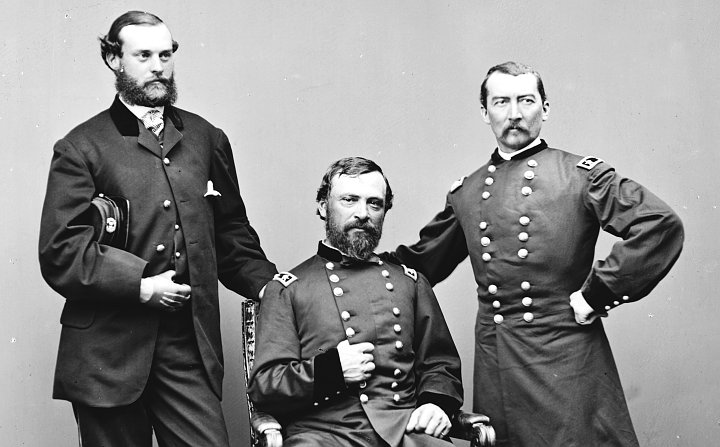
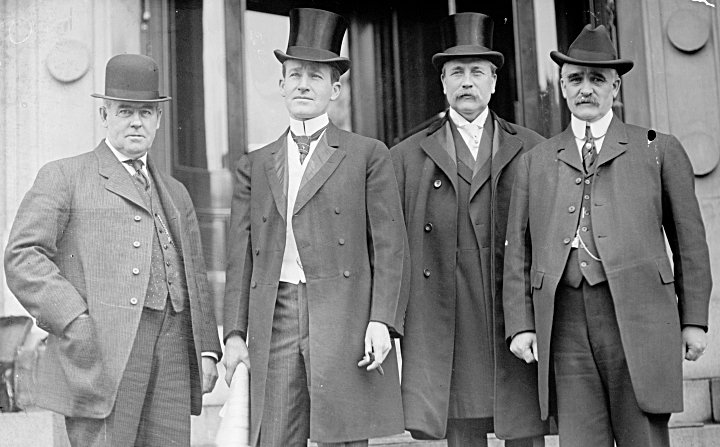

Internet personality Andrew Breitbart passed away this morning. It is considered classless to say unkind things about most of the recently deceased. Shirley Sherrod would be justified in dancing for joy. Instead, she issued a statement: “The news of Mr. Breitbart’s death came as a surprise to me when I was informed of it this morning. My prayers go out to Mr. Breitbart’s family as they cope through this very difficult time.”
Some find it odd that a 43 year old man would drop dead. A co worker of PG had a sudden heart attack at 41. Mr. Breitbart was a controversial man, and it is possible that someone thought he had gone too far. For the time being, it is a mystery.
While it is bad form to badmouth the recently departed, the current climate of attack politics is fair game. Nothing you say about your opponent is out of bounds. Two wrongs make a right, and you can always find something your enemies did that justify your sorry behavior. While bare knuckles politics is an old American tradition, one could wish for something better. (There is a law in Georgia. You must repeat a certain saying whenever the subject of wishing comes up. “You can wish in one hand, and poop in the other, and see which one gets full faster.” Whichever choice you make, you should wash your hands when you are through.)
PG heard a radio whiner this morning. A caller complained about all the terrible things BHO was doing. Why doesn’t anyone listen to us, when we warn them about this horrible President. PG thought that the right wing spent so much time screaming about BHO’s birth certificate, and other goofy attacks, that no one takes anything they say seriously. The boy who cried wolf is a powerful story.
A comment at Little Green Footballs speaks volumes. ” Unfortunately, lest we not forget…Breitbart had a few things to say when Ted Kennedy died … We do not have to repay him in kind. Sadly, however, this is a major part of his legacy… I’ve seen that brought up a few times already. And I don’t know what Andy’s response to the outrage was at the time, but I know that more than a few who indulged in glee at Kennedy’s passing said the same thing to me in each instance: “You did the same when Reagan died.”
Pictures today are from The Library of Congress .
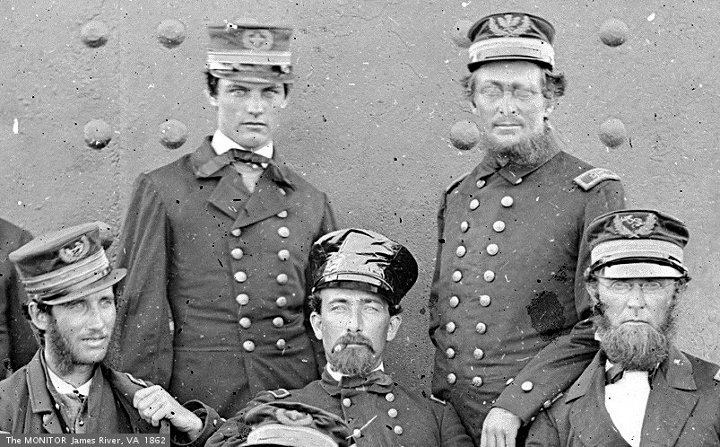
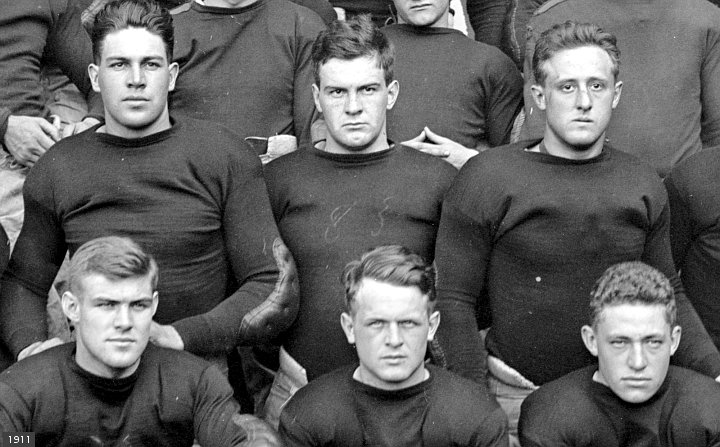

Brand-Awareness Perceptions And Preferences

PG saw a notice on Facebook. “I am attempting to help out someone who is very dear to me and they need 150 people to take this survey: http://nyustern.qualtrics.com/SE/?SID=SV_2nrHnDrbfj71IJm PG used to take surveys door to door, and likes to visit the world of market research from time to time. If nothing else, it will provide text to put between some pictures, from The Library of Congress .
When you click on the link, you see the Objective. “This survey is being conducted by NYU Stern MBA students to collect information about brand-awareness, perceptions and preferences around luxury vehicles. In addition, we will also ask your thoughts on one particular luxury brand. If you’re interested in cars, we’re interested in you. We’d like to understand more about your needs, what you want in a car, what excites you – what drives you.”
The next paragraph is Benefits. “This survey should take no more than fifteen minutes of your time and will help us create better vehicles and service experiences for you. There is no compensation to participants, however, the research team will donate $1 to the Wounded Warrior Project charity (www.woundedwarriorproject.org) for each completed response. ” PG had a dodgy experience with the Wounded Warrior Project charity a few years ago, and is skeptical about any benefits.
The rest of the first page is boilerplate about confidentiality. It is reassuring to PG that NYU is not selling information about his luxury car buying habits. It would be a very short report.
Page two is where the data starts to dribble. There are two multiple choice questions… “Which category of vehicle have you owned or leased? On average, how often do you purchase or lease a new vehicle?” The third question is where things get weird. “How soon are you looking to purchase or lease a new luxury vehicle?” PG is a pointA-to-pointB type of car owner. Luxury, by modern standards, is something that he cannot afford.
In many surveys, they have qualifying questions at the start. You don’t want to waste your time on people who are not in your target market. When PG answered the first question, and did not indicate that he ever owned, or wanted to own, a luxury vehicle, the survey should have terminated. The presence of PG in this project is going to corrupt the data.
Of course, the smart MBA students don’t have a qualifying question, and PG takes the rest of the study. When asked to type in “What features are most important to you in a luxury vehicle? Please enter as many items as you wish.”, PG answers brakes. On page two, where you agree of disagree with a series of statements about “Before purchasing a luxury vehicle it is important to know…”, the answers were marked “neither agree nor disagree”. (One of the statements was “Which vehicle athletes, musicians & entertainers drive”.)
At the bottom of page three, we find out who is sponsoring the study. “What do you associate with the Lincoln brand? What thoughts immediately come to mind?” (Please type your response in the box below.) John Kennedy was shot while riding in a Lincoln Ford. Abraham Lincoln was shot in Ford’s theater.
Before long we get to the demographics. When asked “What is your gender?”, PG checked “Prefer not to respond”. When you hit the >> button, you get to see a video for the Lincoln 2012 MKZ Hybrid. Nobody said thank you.


A Man In Full





PG read A Man In Full, by Tom Wolfe, all 742 pages of the dern thing. Normally, there is a 400 page limit, but when your knee is torn up, and your computer torn down, you need diversion. AMIF can keep your attention intact, even as the plot gets more, and more, ridiculous.
AMIF is about Atlanta, the home of PG. Some of the action takes place in Chamblee, the namesake of this blog. PG’s mother grew up in Atlanta, and was a constant reader. AMIF was the last book she read, before her death in 1998. PG found a hardback copy at a yard sale, and began to read it when his knee went out. (He heard that at his mother’s knee, or some other low joint.)
A lot of what you need to know about AMIF can be learned from the picture included here. (The other pictures are from ” The Special Collections and Archives,Georgia State University Library” ). It is a shot of downtown, taken from where Freedom Parkway crosses Boulevard. (The hospital that birthed PG is across the street.) Two landmark buildings… The Peachtree Plaza Hotel, and 191 Peachtree … stick up like a peace sign. To the left of 191, the Georgia Pacific tower rises, out of the ashes of Loews Grand Theater. Except GP doesn’t fit in with the statement of the book designer, and is shrunk down to half it’s size. A halfsize copy of the Bell South tower is next to the Peachtree Plaza. The BS tower is a mile north in real life, behind the Fox Theater.
The text of AMIF is the same way… it is based on Atlanta, but poetic license is “liberally” applied. An example is a road trip made by the mayor ( based on a slimmed down Maynard Jackson), and his Morehouse buddy, Roger Too White. They start at City Hall, and cross Ponce de Leon, noting the role of that seedy boulevard as a racial borderline. They go down Piedmont, towards the park, and the Mayor says that the Northside is all uphill, and the expensive car goes up and up. In real life, the stretch of Piedmont between Ponce, and the park, is flat.
In one of the opening chapters, Roger Too White is stuck in Freaknik, trying to get to an appointment in Buckhead. The standard line about Freaknik… the Piedmont Driving Club crowd is upset because black kids are doing what white kids do… is trotted out. The racial divisions in Atlanta get lots of attention. This is a subject that can be blathered on about for another 742 pages, and still not make sense. The temptation is to say we have a yankee writer, trying to write southern gothic. The only trouble is, Tom Wolfe is from Virginia. He did spend a lot of time in New York. This is the opposite of the typical OTPerson, who moved here from Ohio, and is occasionally civilized by the patient natives.
The main character of AMIF is Charles Croker. He is a filthy rich developer, in debt to his eyes, with a quail hunting plantation, a trophy wife, a bum knee, and a half empty skyscraper in Cherokee County. The bank is threatening to kick him out on the streets. A well dressed Morehouse man lawyer offers him a way out of his troubles, but it involves betraying his longtime friend. Take race, sex, money, conspicuous consumption, mix well, cook for 742 pages in a well greased pan.
PG was about to give up, and skim over a chapter. This was when a former employee of Mr. Croker gets out of prison because of an earthquake. The jailbird, Conrad Hensley, winds up in Chamblee, living in an antique shop, and working for a home health care provider. Conrad … now known as Connie … is assigned to work for Mr. Croker. This leads to the conclusion of the story.
AMIF got 128 one star reviews at Amazon. Here are a few.
Amazing what a good publicist can do March 24, 1999 By A Customer
We’ve been had. The publicity machine surrounding Tom Wolfe is probably the real story here. And probably a lot more interesting than A Man in Full.
Oh dear me January 6, 2000 By A Customer
Peppered with Wolfe’s bizarre and laughable descriptions of burly male physique, A MAN IN FULL is a slow moving story filled with stock characters. Thank God that the universally panned BONFIRE OF THE VANITIES, the movie, will prevent this from ever hitting the big screen.
Flat January 12, 1999 By h20pipe@swbell.net (usa)
What a bunch of liberal mish mash. A selfmade millionaire is made a laughing stock, while an escaped convict is held up the hero. Typical New Aged balogney. All form and no substance. I wish I could get my money back
Save your time, integrity and money/ March 11, 1999 By A Customer
All the depth of a baby pool . .
A Man in Full January 9, 2001 By Norwest (Port Lavaca, Texas United States)
I should have quit reading when he mentioned shooting quail with buckshot. The author apparently did no research to make this a credible story. The ending was deplorable. The characters are caricatures. The dialoque unreal. The verbose, stilted descriptions of clothing, architecture and furnishings added nothing unless you consider embellishment of the author’s ego worthwhile.. This will be my last Tom Wolfe book.





Ayatollah Rick


Foreign Policy dot com has a festive feature, Grand Ayatollah or Grand Old Party?. There are a series of quotes, which requires the viewer to open a different page each time. Page view statistics are so unkind to readers. The reader can choose between two “conservative” leaders for the source of the quote. The two “religious conservatives” are Iranian Supreme Leader Ali Khamenei, and Rick Santorum . (Spell check suggestions: Tutankhamen, Sanatorium)
The feature is in English, which is the language favored by Mr. Santorum. Mr. Khamenei speaks Farsi, which is a very different tongue. There have been controversial translations before. When the person doing the translating wants to make trouble, it can cause misunderstanding. This feature will probably not lead to war, unless it helps Mr. Santorum get elected. Here are the quotes. If you want to keep score, the answers will be in the last paragraph.
1. “We were put on this Earth as creatures of God to have dominion over the Earth.”
2. “We believe in democracy and we also believe in freedom,
but we do not believe in liberal democracy.”
3. “Although the literal meaning of socialism is equitable distribution of wealth, it is associated with other concepts which we hate. Over time, socialism has come to be associated with certain things in society that are unacceptable to us.”
4. “The radical feminists succeeded in undermining the traditional family and convincing women that professional accomplishments are the key to happiness.”
5. “This is not a political war at all. This is not a cultural war. This is a spiritual war.”
6. “This is a war between two willpowers:
the willpower of the people and the willpower of their enemies.”
7. “Go back and read what the sirens did once you arrived on that island.…
They devour you. They destroy you. They consume you.”
8. “The American people’s hatred for Iran is profound.” Oh wait, we got that one backward. Sorry. It should read: “The Iranian people’s hatred for America is profound.”
Not much is known about the Supreme Leader. (Diana Ross was the Supremes leader.) He has a charismatic underling, Mr. Ahmadinejad. It is unlikely that anyone calls the Supreme Leader “frothy mix”, although he is possibly familiar with the concept. Both speakers in this exercise would tell you they are conservative, and probably mean two different things by this phrase. They worship the same G-d, who is probably embarrassed by both.
HT to Sarah Posner . Pictures are from The Library of Congress.
The Answers: 1-Rick 2-Ali 3-Ali 4-Rick 5-Rick 6-Ali 7-Rick 8-Ali


February 29






Today is February 29. It is the extra day added for leap year. People wonder how this tradition got started. It is a feature of the Julian and Gregorian calenders. A vintage website, written by a 1968 leap baby, tells this tale:
“The Romans originally had a 355-day calendar. To keep up with the seasons, an extra 22 or 23-day month was inserted every second year. For reasons unknown, this extra month was only observed now and then. By Julius Caesar’s time, the seasons no longer occurred at the same calendar periods as history had shown. To correct this, Caesar eliminated the extra month and added one or two extra days to the end of various months (his month included, which was Quintilis, later renamed Julius we know it as July). This extended the calendar to 365 days. Also intended was an extra calendar day every fourth year (following the 28th day of Februarius). However, after Caesar’s death in 44 B.C., the calendars were written with an extra day every 3 years instead of every 4 until corrected in 8 A.D. So again, the calendar drifted away from the seasons. By 1582, Pope Gregory XIII recognized that Easter would eventually become closer and closer to Christmas. The calendar was reformed so that a leap day would occur in any year that is divisible by 4 but not divisible by 100 except when the year is divisible by 400.
Thus 1600 and 2000, although century marks, have a Leap Day. The calendar we use today, known as the Gregorian calendar, makes our year 365.2425 days only off from our solar year by .00031, which amounts to only one day’s error after 4,000 years”.
Starting in 8 a.d., an extra day was added to the year. However, this wasn’t working, and changes needed to be made. Pope Gregory XIII changed the calender to drop the leap year on years ending in 100, except for years divisible by 400. 1900 did not have a leap year, but 2000 did. (We needed it to make the changes for Y2K.) A British site from the National Maritime Museum has more details.
“The calendar year is 365 days long, unless the year is exactly divisible by four, in which case an extra day is added to February to make the year 366 days long. If the year is the last year of a century, eg. 1800, 1900, 2000, then it is only a leap year if it is exactly divisible by 400. Therefore, 1900 wasn’t a leap year but 2000 was. The reason for these rules is to bring the average length of the calendar year into line with the length of the Earth’s orbit around the Sun, so that the seasons always occur during the same months each year.
The year is defined as being the interval between two successive passages of the Sun through the vernal (spring) equinox. Of course, what is really occurring is that the Earth is going around the Sun but it is easier to understand what is happening by considering the apparent motion of the Sun in the sky. The vernal equinox is the instant when the Sun is above the Earth’s equator while going from the south to the north. It is the time which astronomers take as the definition of the beginning of spring. The year as defined above is called the vernal tropical year and it is the year length that defines the repetition of the seasons. The length of the vernal tropical year is 365.24237 days.
In 46 BC Julius Caesar established the Julian calendar which was used in the west until 1582. In the Julian calendar each year contained 12 months and there were an average of 365.25 days in a year. This was achieved by having three years containing 365 days and one year containing 366 days. (In fact the leap years were not correctly inserted until 8 AD).
The discrepancy between the actual length of the year, 365.24237 days, and the adopted length, 365.25 days, may not seem important but over hundreds of years the difference becomes obvious. The reason for this is that the seasons, which depend on the date in the tropical year, were getting progressively out of kilter with the calendar date. Pope Gregory XIII, in 1582, instituted the Gregorian calendar, which has been used since then.
The change from the Julian calendar to the Gregorian involved the change of the simple rule for leap-years to the more complex one in which century years should only be leap-years if they were divisible by 400. For example, 1700, 1800 and 1900 are not leap-years whereas 2000 was. The net effect is to make the adopted average length of the year 365.2425 days. The difference between this and the true length will not have a serious effect for many thousands of years. (The error amounts to about 3 days in 10,000 years.)
The adoption of the Gregorian calendar was made in Catholic countries in 1582 with the elimination of 10 days, 4 October being followed by 15 October. The Gregorian calendar also stipulated that the year should start on 1 January. In non-Catholic countries the change was made later; Britain and her colonies made the change in 1752 when 2 September was followed by 14 September and New Year’s Day was changed from 25 March to 1 January 1″.
There are some traditions for February 29. The most notable is the idea of women proposing marriage to men. “According to an old Irish legend, or possibly history, St Bridget struck a deal with St Patrick to allow women to propose to men – and not just the other way around – every 4 years. … In some places, Leap Day has been known as “Bachelors’ Day” for the same reason. A man was expected to pay a penalty, such as a gown or money, if he refused a marriage proposal from a woman on Leap Day. In many European countries, especially in the upper classes of society, tradition dictates that any man who refuses a woman’s proposal on February 29 has to buy her 12 pairs of gloves. The intention is that the woman can wear the gloves to hide the embarrassment of not having an engagement ring.” Gentlemen, you have been warned.
Since it happens every four years, there are not that many famous births and deaths on February 29 . Births include Gioachino Rossini(1792), Dinah Shore (1916), Bart Stupak (1952) and Pedro Zamora (1972). Earl Scheib went to the paintshop in the sky on February 29, 1992. In 1940, the academy awards were given out, with Gone With The Wind a big winner. Most of the time, February 29 is just another day.






Bathtubs In The US Capitol



Two days ago, 99invisible posted a show, The Bathtubs or the Boiler Room . It seems as though an NPR reporter likes to go places she is not supposed to be in. In the basement of the US Capitol, she found a bathtub, carved out of a chunk of Italian marble.
“The bathtubs were installed around 1860 during the expansion of the Capitol. DC is known for its swampy summers, and legend has it that senators could be banished from the chamber if they were too smelly. But lawmakers—like most Americans at the time—didn’t have indoor plumbing at home. They needed a place where they could wash up. So, the Architect of the Capitol ordered six marble bath tubs, each three by seven feet and carved by hand in Italy, to be installed in the Capitol basement—three on the House side, three on the senate.”
The tubs were imported from Italy, and sent to the port of Baltimore. They arrived just in time for the War Between The States. They were quite a luxurious item. Today, they are forgotten, surrounded by HVAC machines, with one covered with plywood and file cabinets.
Pictures are from The Library of Congress.


When All the World Was Young





PG read When All the World Was Young, by Dr. Ferrol Sams. This is the last part of the Sambo trilogy, allegedly based on the life of Dr. Sams when he was younger. The first two books, in the trilogy, are Run With The Horsemen and The Whisper of the River.
The story starts at Pearl Harbor. Sambo wants to join the war effort, but is convinced to go to Medical School. At Emory Med School, he meets the toughest character in this war story, Dr. Wingo. Sambo makes it through the first year at Emory, but feels bad about not being in battle. This feeling of not doing enough for the cause persists throughout the story.
Soon, he gets word that a friend of his is missing in action. Sambo buys a pint of Four Roses, gets drunk, decides to flunk out of Med school, and join the army. He gets his wish, and goes to basic training in frozen Illinois. One of his companions is fellow former Emoroid Carter Otten, who will be with Sambo until they go to France.
The next stop is Lawton General Hospital. This is adjacent to Camp Gordon, which is now Peachtree Dekalb Airport. PG used to work off W. Hospital Avenue, and heard stories of a hospital there. One of the doctors had an apartment on Peachtree Road, near Hospital 48. (This was the Brookhaven VA hospital.) Sambo had a few adventures here, and encountered the first of a few “small world” stories. These pop up throughout the book, and make PG wonder if there might be too many coincidences.
A paratrooper named Will Barton shows up in the hospital. He had been kicked out of Medical School for throwing a cadaver muscle at another student. Another character at the Med school did Sambo wrong, and got his Yellow Packard messed up as a result. When Sambo is at Lawton General, a teacher winds up buying the Packard.
Sambo and Otten go to a camp in Illinois to wait on a trip to Europe. DDay comes, and the two sit and wait. It turns out the Army has forgotten about them. Otten finds a Hospital unit for the two to join, and soon they are on the Queen Mary, riding to France. When they finally arrive, the company records are lost at sea. At this point, an imaginary soldier named Daniel Farbecker joins the unit.
The troops set up a field hospital, and survive an inspection. Will Barton shows up again, in a dramatic episode. Sambo shows how far he has gone from the wide eyed farmboy of the first book. After the emergency surgery to save Barton fails, Sambo says “fuck him if he can’t take a joke”.
Before he leaves the war, Barton tells Sambo to go to Paris, find a hooker, and tell her what has happened. The girl is called “La Petite”. She may, or may not, have gone to college with Sambo. It is a good story, but sometimes it is a bit tough to believe.
Before long, Germany surrenders, Sambo has an affair with a married woman, Hiroshima is nuked, and Sambo goes home. He learned well the concept of looking out for number one. The guilt for not seeing more action never quite goes away. In the last chapter, Sambo is in Fort Bragg, fighting with the Army about service in the reserves.
As with the other two Sambo books, this is a great waste of time. Some of the stories, like the last day of Will Barton, are as good as reading gets. If you are not too picky about believing everything you read, you will have a good time with When All the World Was Young. Pictures today are from The Library of Congress.






Miss Beatrice


Miss Beatrice ,the church organist,was in her eighties and had never been married. She was admired for her sweetness and kindness to all. One afternoon the pastor came to call on her and she showed him into her quaint sitting room. She invited him to have a seat while she prepared tea…As he sat facing her old Hammond organ, the young minister noticed a cut glass bowl sitting on top of it.The bowl was filled with water, and in the water floated, of all things, a condom!
When she returned with tea and scones, they began to chat. The pastor tried to stifle his curiosity about the bowl of water and its strange floater, but soon it got the better of him and he could no longer resist. ” Miss Beatrice “, he said, pointing to the bowl, “I wonder if you would tell me about this?”
“Oh, yes,” she replied, “Isn’t it wonderful? I was walking through the park a few months ago and I found this little package on the ground.The directions said to place it on the organ, keep it wet and that it would prevent the spread of disease.. Do you know, I haven’t had the flu all winter.”
Thank you Ed. Pictures are from ” The Special Collections and Archives,Georgia State University Library” This is a repost.


 Chamblee54
leave a comment